Questions · Page 1 of 8

M.C.Q (1 Marks)

🎯

Test yourself on this topic

50 questions · timed · auto-graded

MCQ 11 Mark
In an ecosystem if the Net Primary Productivity ($NPP$) of first trophic level is $100 \times\left(\mathrm{kcal} \mathrm{m}^{-2}\right) \mathrm{yr}^{-1}$, what would be the $GPP$ (Gross Primary Productivity) of the third trophic level of the same ecosystem?
  • A
    $x\left(\mathrm{kcal} \mathrm{m}^{-2}\right) \mathrm{yr}^{-1}$
  • $10 x\left(\mathrm{kcal} \mathrm{m}^{-2}\right) \mathrm{yr}^{-1}$
  • C
    $\frac{100 x}{3 x}\left(\mathrm{kcal} \mathrm{m}^{-2}\right) \mathrm{yr}^{-1}$
  • D
    $\frac{x}{10}\left(\mathrm{kcal} \mathrm{m}^{-2}\right) \mathrm{yr}^{-1}$
Answer
Correct option: B.
$10 x\left(\mathrm{kcal} \mathrm{m}^{-2}\right) \mathrm{yr}^{-1}$
b
$NPP$ at first trophic level would be the $GPP$ for second trophic level. $NPP$ at second trophic level would be $GPP$ for third trophic level. Therefore, $100 x\left(\mathrm{kcal} / \mathrm{m}^2 / \mathrm{yr}\right)$ would be $GPP$ at second trophic level and $100 x$ $\times 10 \%\left(\mathrm{kcal} / \mathrm{m}^2 / \mathrm{yr}\right)$ i.e., $10 \times\left(\mathrm{kcal} / \mathrm{m}^2 / \mathrm{yr}\right)$ energy would be $GPP$ at third trophic level.
View full question & answer
MCQ 21 Mark
Identify the correct statements:

$A.$ Detrivores perform fragmentation.

$B.$ The humus is further degraded by some microbes during mineralization.

$C$. Water soluble inorganic nutrients go down into the soil and get precipitated by a process called leaching.

$D$. The detritus food chain begins with living organisms.

$E$. Earthworms break down detritus into smaller particles by a process called catabolism.

Choose the correct answer from the options given below:

  • A
    $D, E, A$ only
  • $A, B, C$ only
  • C
    $B, C, D$ only
  • D
    $C, D, E$ only
Answer
Correct option: B.
$A, B, C$ only
b
The detritus food chain begins with detritus that is dead organic matter. The saprotrophic bacteria and fungi breakdown detritus into simpler inorganic substances by a process called catabolism.
View full question & answer
MCQ 31 Mark
In the equation GPP $- R = NPP$ (GPP is Gross Primary Productivity)(NPP is Net Primary Productivity)$R$ here is
  • A
    Reproductive allocation
  • B
    Photosynthetically active radiation
  • C
    Respiratory quotient
  • Respiratory loss
Answer
Correct option: D.
Respiratory loss
d
A considerable amount of $GPP$ is utilised by plants in respiration. Gross primary productivity minus respiration losses $(R)$, is the net primary productivity.

So $R =$ Respiratory loss

View full question & answer
MCQ 41 Mark
Detritivores breakdown detritus into smaller particles. This process is called :
  • Fragmentation
  • B
    Humification
  • C
    Decomposition
  • D
    Catabolism
Answer
Correct option: A.
Fragmentation
a
View full question & answer
MCQ 51 Mark
Given below are two statements:

Statement $I:$

Decomposition is a process in which the detritus is degraded into simpler substances by microbes.

Statement $II:$

Decomposition is faster if the detritus is rich in lignin and chitin

In the light of the above statements, choose the correct answer from the options given below:

  • A
    Both Statement $I$ and Statement $II$ are incorrect
  • Statement $I$ is correct but Statement $II$ is incorrect
  • C
    Statement $I$ is incorrect but Statement $II$ is correct
  • D
    Both Statement $I$ and Statement $II$ are correct
Answer
Correct option: B.
Statement $I$ is correct but Statement $II$ is incorrect
b
View full question & answer
MCQ 61 Mark
Which of the following statements is incorrect?
  • A
    Energy content gradually decreases from first to fourth trophic level
  • B
    Biomass decreases from first to fourth trophic level
  • Energy content gradually increases from first to fourth trophic level
  • D
    Number of individuals decreases from first trophic level to fourth trophic level
Answer
Correct option: C.
Energy content gradually increases from first to fourth trophic level
c
Energy content does not remain trapped permanently in any organism. It is passed on to various trophic levels in food chain.

Hence, energy content gradually decreases from first $\left(T_{1}\right)$ to fourth $\left(T_{4}\right)$ trophic level by following ten percent law proposed by Lindemann.

View full question & answer
MCQ 71 Mark
The rate of decomposition is faster in the ecosystem due to following factors $EXCEPT$
  • Detritus richer in lignin and chitin
  • B
    Detritus rich in sugars
  • C
    Warm and moist environment
  • D
    Presence of aerobic soil microbes
Answer
Correct option: A.
Detritus richer in lignin and chitin
a
The rate of decomposition is slow if it contains lignin, chitin, tannins (Phenolics) and cellulose.
View full question & answer
MCQ 81 Mark
Match the trophic levels with their correct species examples in grassland ecosystem.

$(a)$ Fourth trophic level $(i)$ Crow
$(b)$ Second trophic level $(ii)$ Vulture
$(c)$ First trophic level $(iii)$ Rabbit
$(d)$ Third trophic level $(iv)$ Grass

Select the correct option :

$(a)\quad(b) \quad(c) \quad(d)$

  • A
    $(i)\quad(ii) \quad(iii) \quad(iv)$
  • $(ii)\quad(iii) \quad(iv) \quad(i)$
  • C
    $(iii)\quad(ii) \quad(i) \quad(iv)$
  • D
    $(iv)\quad(iii) \quad(ii) \quad(i)$
Answer
Correct option: B.
$(ii)\quad(iii) \quad(iv) \quad(i)$
b
$(ii)\quad(iii) \quad(iv) \quad(i)$
View full question & answer
MCQ 91 Mark
Which of the following ecological pyramids is generally inverted ?
  • A
    Pyramid of numbers in grassland
  • B
    Pyramid of energy
  • C
    Pyramid of biomass in a forest
  • Pyramid of biomass in a sea
Answer
Correct option: D.
Pyramid of biomass in a sea
d
View full question & answer
MCQ 101 Mark
What type of ecological pyramid would be obtained with the following data?
Secondary consumer: $120\,g$
Primary consumer: $60\,g$
Primary producer: $10\,g$
  • A
    Upright pyramid of biomass
  • Inverted pyramid of biomass
  • C
    Upright pyramid of numbers
  • D
    Pyramid of energy
Answer
Correct option: B.
Inverted pyramid of biomass
b
View full question & answer
MCQ 111 Mark
The mass of living material at a trophic level at a particular time is called
  • A
    net primary productivity
  • standing crop
  • C
    gross primary productivity
  • D
    standing state
Answer
Correct option: B.
standing crop
b
(b) :Standing crop is the total amount of living material in a specified population at a particular time, expressed as biomass (standing biomass) or its equivalent in terms of energy. The standing crop may vary at different times of the year; for example, in a population of deciduous trees between summer and winter.
View full question & answer
MCQ 121 Mark
Most animals that live in deep oceanic waters are
  • A
    tertiary consumers
  • detritivores
  • C
    primary consumers
  • D
    secondary consumers.
Answer
Correct option: B.
detritivores
b
(b) :Benthos is the community of organisms which live on, in, or near the sea bed, also known as the benthic zone. As no light is available at this zone of sea, the energy source for deep benthic ecosystems is often organic matter from higher up in the water column which drifts down to the depths. This dead and decaying matter sustains the benthic organisms, and therefore, most organisms in benthic zone $i.e.$, in deep oceanic waters, are scavengers or detritivores.
View full question & answer
MCQ 131 Mark
When man eats fish which feeds onzooplanktons which have eaten small plants,the producer in this chain is
  • small plants
  • B
    fish
  • C
    man
  • D
    zooplankton
Answer
Correct option: A.
small plants
a
(a) :The transfer of food energy from producers to consumers through a series of organisms with repeated eating and being eaten is known as food chain. Green plants are always the first link of food chain because they alone are capable of synthesising organic food by using light energy by photosynthesis. The logical sequence of a food chain is : Producer Consumers Decomposer
View full question & answer
MCQ 141 Mark
Which of the following is a primary consumerin maize field ecosystem ?
  • Grasshopper
  • B
    Wolf
  • C
    Phytoplankton
  • D
    Lion
Answer
Correct option: A.
Grasshopper
a
(a) : Primary consumers are herbivorous organisms that feed on producers. Carnivores are termed secondary, tertiary etc., consumers depending upon their position in food chain. In food chain on land, grasshopper is a herbivore (primary consumer) while wolf and lion are carnivores. Phytoplanktons are producers in aquatic food chains.
View full question & answer
MCQ 151 Mark
Secondary productivity is rate of formation ofnew organic matter by
  • consumers
  • B
    decomposers
  • C
    producers
  • D
    parasites.
Answer
Correct option: A.
consumers
a
(a) :The rate of photosynthesis of organic matter by the consumers is known as secondary productivity. It depends upon the loss while transferring energy containing organic matter from the previous trophic level plus the consumption due to respiration and predation. Therefore, net productivity decreases with each trophic level.
View full question & answer
MCQ 161 Mark
Which one of the following processes during decomposition is correctly described ?
  • A
    Catabolism -Last step in thedecomposition under fully anaerobiccondition
  • B
    Leaching -Water soluble inorganicnutrients rise to the top layers of soil
  • Fragmentation -Carried out by organismssuch as earthworm
  • D
    Humification -Leads to the accumulationof a dark coloured substance humuswhich undergoes microbial action at a veryfast rate.
Answer
Correct option: C.
Fragmentation -Carried out by organismssuch as earthworm
c
(c) :Decomposition is the process in which decomposers break down complex organic matter into inorganic substances like carbon dioxide, water and nutrients. The important steps in the process of decomposition are fragmentation, leaching, catabolism, humification and mineralisation. Detritivores ($e.g.$, earthworm) break down detritus into smaller particles. This process is called fragmentation. By the process of leaching, water­ soluble inorganic nutrients go down into the soil horizon and get precipitated as unavailable salts. Bacterial and fungal enzymes degrade detritus into simpler inorganic substances. This process is called as catabolism. Humification and mineralisation occur during decomposition in the soil. Humification leads to accumulation of a dark coloured amorphous substance called humus that is highly resistant to microbial action and undergoes decomposition at an extremely slow rate. The humus is further degraded by some microbes and release of inorganic nutrients occur by the process known as mineralisation.
View full question & answer
MCQ 171 Mark
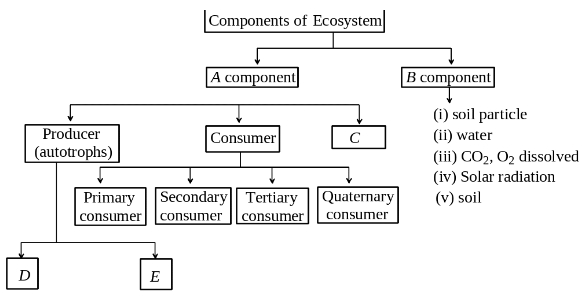
Study the diagram carefully and fill in the blanks

Choose the correct option for $A, B, C, D$ and $E$


  • $A-$Biotic, $B-$Abiotic, $C-$Decomposers, $D-$Photoautotrophs, $E-$Chemoautotrophs
  • B
    $A-$Physical, $B-$Chemical, $C-$Phytoplanktons, $D-$Plants, $E-$Parasites
  • C
    $A-$Biotic, $B-$Abiotic, $C-$Decomposers, $D-$Autotrophs, $E-$Mixotrophs
  • D
    $A-$Physical, $B-$Chemical, $C-$Bacteria and Fungi, $D-$Autotrophs, $E- $Heterotrophs
Answer
Correct option: A.
$A-$Biotic, $B-$Abiotic, $C-$Decomposers, $D-$Photoautotrophs, $E-$Chemoautotrophs
a
$A-$Biotic, $B-$Abiotic, $C-$Decomposers, $D-$Photoautotrophs, $E-$Chemoautotrophs
View full question & answer
MCQ 181 Mark
$A$ : Pyramid of biomass is always upright for tree ecosystem.

$R$ : Total biomass of a tree in a specific area is more than that of herbivores.

  • Assertion and Reason both are correct and also correct explanation.
  • B
    Assertion and Reason both are correct but not explanation of assertion.
  • C
    Assertion is correct, but Reason is incorrect.
  • D
    Both Assertion and Reason are incorrect.
Answer
Correct option: A.
Assertion and Reason both are correct and also correct explanation.
a
Pyramid of biomass is upright for terrestrial ecosystem.
View full question & answer
MCQ 191 Mark
$A $ : Ecological pyramid of biomass is generally inverted in sea.

$R$ : Biomass of fishes far exceeds that of phytoplanktons.

  • Assertion and Reason both are correct and also correct explanation.
  • B
    Assertion and Reason both are correct but not explanation of assertion.
  • C
    Assertion is correct, but Reason is incorrect.
  • D
    Both Assertion and Reason are incorrect.
Answer
Correct option: A.
Assertion and Reason both are correct and also correct explanation.
a
Biomass $\propto$ life span of an organism.
View full question & answer
MCQ 201 Mark
$A $ : Ecological pyramids cannot explain all the vital functions of any ecosystem.

$R$ : Pyramids actually does not explain the role of organisms working at more than one trophic levels.

  • Assertion and Reason both are correct and also correct explanation.
  • B
    Assertion and Reason both are correct but not explanation of assertion.
  • C
    Assertion is correct, but Reason is incorrect.
  • D
    Both Assertion and Reason are incorrect.
Answer
Correct option: A.
Assertion and Reason both are correct and also correct explanation.
a
Ecological pyramids assume food chain but actually food web exists.
View full question & answer
MCQ 211 Mark
Pyramid of number in a cropland ecosystem is
  • Upright
  • B
    Inverted
  • C
    Rhomboidal
  • D
    Spindle shaped
Answer
Correct option: A.
Upright
a
Pyramid of number in a cropland is upright.
View full question & answer
MCQ 221 Mark
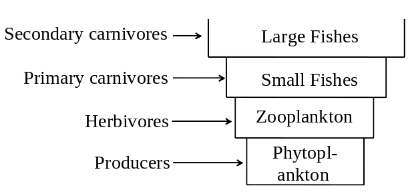
What does the given ecological pyramid represent?
  • A
    Inverted pyramid of number in pond
  • B
    Role of decomposers
  • Inverted pyramid of biomass in pond
  • D
    Pyramid of biomass in a forest ecosystem
Answer
Correct option: C.
Inverted pyramid of biomass in pond
c
Shows inverted pyramid of biomass in a pond.
View full question & answer
MCQ 231 Mark
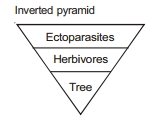
If producer is a large tree that supports a number of herbivorous animals which are further attacked by ectoparasites, the pyramid of number shall be
  • Inverted
  • B
    Upright
  • C
    Irregular
  • D
    Spindle shaped
Answer
Correct option: A.
Inverted
a

View full question & answer
MCQ 241 Mark
Which of the following ecological pyramids is most representative of functional characteristics of an ecosystem?
  • A
    Pyramid of number
  • B
    Pyramid of biomass
  • Pyramid of energy
  • D
    All are equally representative
Answer
Correct option: C.
Pyramid of energy
c
Pyramid of energy.
View full question & answer
MCQ 251 Mark
The respiratory loss of producers, herbivores and carnivores are respectively
  • A
    $10\;\%, 20\;\%, 30\;\%$
  • $20\;\%, 30\;\%, 60\;\%$
  • C
    $20\;\%, 40\;\%, 80\;\%$
  • D
    $Always\; 10\;\%$
Answer
Correct option: B.
$20\;\%, 30\;\%, 60\;\%$
b
Respiratory loss of producers, herbivores and carnivores are $20\;\%, 30\;\% $ and $60\;\%$ respectively.
View full question & answer
MCQ 261 Mark
Which of the following organisms were not given any place in ecological pyramids?
  • A
    Working at several trophic levels
  • B
    Decomposers
  • C
    Parasites
  • More than one option is correct
Answer
Correct option: D.
More than one option is correct
d
Both parasites and decomposers.
View full question & answer
MCQ 271 Mark
The most common shape of pyramid of number is
  • A
    Inverted
  • B
    Urned
  • C
    Spindle
  • Upright
Answer
Correct option: D.
Upright
d
Pyramid of number is mostly upright.
View full question & answer
MCQ 281 Mark
Consider the following statements about ecological pyramids

$I.$ Charles Elton developed the concept of ecological pyramid

$II.$ After the name these pyramids are also called as Eltonian pyramids

$III.$ It is a graphical representation or pyramid shaped diagram which depicts the number of organisms, biomass and energy at each trophic level

Which of the statements given above are correct?

  • A
    $I\;and\; II$
  • B
    $I\; and\; III$
  • C
    $II\; and \;III$
  • $I, II\; and \;III$
Answer
Correct option: D.
$I, II\; and \;III$
d
There is some sort of relationship between the number, biomass and energy contents of the producers and consumers of different orders in any ecosystem. These relationships, when represented in diagrammatic ways are called ecological pyramids. The concept of pyramid was proposed by Charles Elton $(1927)$ so, they are also called as Eltonian pyramids
View full question & answer
MCQ 291 Mark
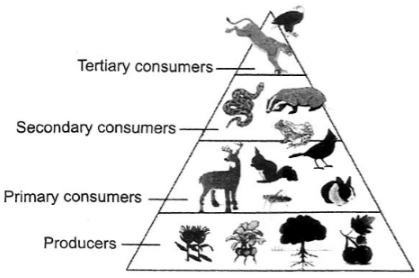
The given figure best represents
  • A
    Pyramid of number in parasitic food chain
  • Pyramid of biomass in forest ecosystem
  • C
    Pyramid of number in grassland ecosystem
  • D
    Pyramid of number in forest ecosystem
Answer
Correct option: B.
Pyramid of biomass in forest ecosystem
b
From the given option only b can be correct because pyramid of biomass is upright in that condition only
View full question & answer
MCQ 301 Mark
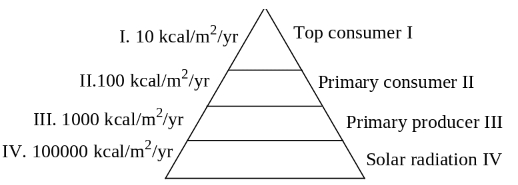
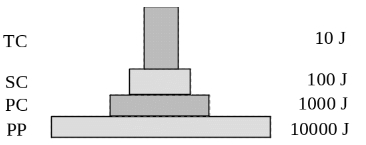
What is the rate of secondary production in the energy pyramid given below?
  • A
    Uncertain
  • $100 \;\mathrm{kcal} / \mathrm{m}^{2} / y r$
  • C
    $10\; \mathrm{kcal} / \mathrm{m}^{2} / \mathrm{yr}$
  • D
    $110\; \mathrm{kcal} / \mathrm{m}^{2} / y r$
Answer
Correct option: B.
$100 \;\mathrm{kcal} / \mathrm{m}^{2} / y r$
b
We know that plant only utilised $1-2\;\%$ of total energy incident on earth. In the given dustion $100000 \mathrm{Kcal} / \mathrm{m}^{2} / y r$ salar radiation is incident on earth. So plant producer utilize $1\; \%$ of $100000 \mathrm{kcalm}^{2} / \mathrm{yr}$ and that $1\; \%$ is$ \frac{100000 \times 1}{100}=1000\; \mathrm{kcal} / \mathrm{m}^{2} / y r$And from produces to the next level only $10 \%$ will goes, so$\frac{1000 \times 10}{100}=100\; \mathrm{kcal} / \mathrm{m}^{2} / \mathrm{yr}$ will be transferred to primary consumer which is called secondary production
View full question & answer
MCQ 311 Mark
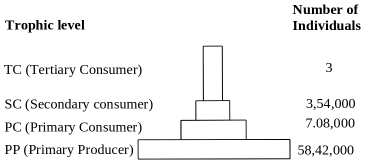
Given below is one of the types of ecological pyramids

This type represents

  • Pyramid of number in a grassland ecosystem
  • B
    Pyramid of energy in forest ecosystem
  • C
    Pyramid of biomass in sea ecosystem
  • D
    Pyramid of biomass in terrestrial ecosystem
Answer
Correct option: A.
Pyramid of number in a grassland ecosystem
a
Pyramids of number in grassland ecosystem. The pyramid of numbers deal with the number of primary producers and consumers. It is upright in a grassland and inverted in a tree ecosystem. In a grassland the number of producers is more than the number of top carnivores, whereas in case of a tree, the number of producers is less as compared to consumers
View full question & answer
MCQ 321 Mark
Which of the following pyramid of numbers in ecology is not upright?
  • A
    Pond ecosystem
  • B
    Desert ecosystem
  • Tree ecosystem
  • D
    Forest ecosystem
Answer
Correct option: C.
Tree ecosystem
c
In tree ecosystem, the pyramid of number is inverted because only one tree has many consumers like birds, insects, etc. While in pond, desert and forest ecosystem, the pyramids of numbers are upright because producers are large in number.
View full question & answer
MCQ 331 Mark
Given below is the diagram of the ecological pyramids

This type represents

  • A
    Pyramid of number in a grassland
  • B
    Pyramid of biomass in a lake
  • C
    Pyramid of biomass in a land
  • Pyramid of energy
Answer
Correct option: D.
Pyramid of energy
d
The pyramid of energy is always upright because energy is always loss as heat at each step. It represents the total amount of energy utilised by different trophic level organisms in unit area over a period of time
View full question & answer
MCQ 341 Mark
Which kind of pyramid is represented by the given diagram
  • A
    Pyramid of number in tree ecosystem
  • B
    Pyramid of biomass in tree ecosystem
  • Pyramid of biomass in aquatic ecosystem
  • D
    Pyramid of energy in tree ecosystem
Answer
Correct option: C.
Pyramid of biomass in aquatic ecosystem
c
In pond ecosystem producers are the smallest organisms while, carnivores are large in size. Consequently, there is a gradual increase in biomass of organisms at successive trophic levels from producers onward to top carmivores resulting in inverted pyramid. Thus, the biomass of phytoplanktons will be smaller than that of zooplanktons. The biomass of zooplanktons will be lesser than of primary carnivores ($e.g,$ small fishes). In such a inverted pyramid of biomass, small standing crop of phytoplankton support a large standing crop of zooplankton
View full question & answer
MCQ 351 Mark
A pyramid of number in grassland ecosystem shows
  • There are always a large number of producers at the bottom and fewer top consumers
  • B
    There are always a large number of top consumers and fewer producers
  • C
    There are an equal number of producers and consumers
  • D
    There are more top consumer than primary consumers
Answer
Correct option: A.
There are always a large number of producers at the bottom and fewer top consumers
a
In a grassland ecosystem, the number of producers is more than the number of top carnivores, whereas in case of a tree, the number of producers is less as compared to consumers
View full question & answer
MCQ 361 Mark
Which is an example of true pyramid in an ecosystem?
  • A
    Pyramid of a biomass
  • B
    Pyramid of number
  • Pyramid of energy
  • D
    None of the above
Answer
Correct option: C.
Pyramid of energy
c
Pyramid of energy is the graphic representation of the amount of energy trapped per unit time and area in different trophic levels of a food chain from producers to top carnivores. Pyramid of energy is a true pyramid as it is always upright.
View full question & answer
MCQ 371 Mark
The relation between producers and consumers in an ecosystem can be graphically represented in the form of a pyramid called
  • Ecological pyramid
  • B
    Trophic level
  • C
    Pi chart
  • D
    Pyramid of biomass
Answer
Correct option: A.
Ecological pyramid
a
There is some sort of relationship between the numbers, biomass and energy contents of the producers and consumers of different orders in any ecosystem. These relationships, when represented in diagrammatic ways, are called ecological pyramids.Ecological pyramids are of the types

$(i)$ Pyramid of number

$(ii)$ Pyramid of biomass

$(iii)$ Pyramid of energy

The concept of pyramid was proposed by Charles Elton $(1927)$ so, they are also called as Eltonian pyramids

View full question & answer
MCQ 381 Mark
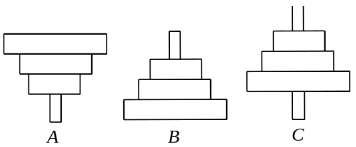
Which of the following representations show the pyramid of numbers in a grassland ecosystem?
  • A
    $A$
  • $B$
  • C
    $C$
  • D
    $None\; of\; these$
Answer
Correct option: B.
$B$
b
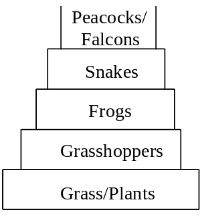
In a grassland ecosystem, a larger number of grass plants or herbs support a fewer number of grasshoppers that support a still smaller number of frogs, the latter still smaller number of snakes and the snakes very few peacocks or falcons
View full question & answer
MCQ 391 Mark
To show how many organisms are present at each level of a food chain, ecologists use a model called
  • A
    An energy flow pyramid
  • Pyramid of numbers
  • C
    Pyramid of energy
  • D
    Food chain/food web pyramid
Answer
Correct option: B.
Pyramid of numbers
b
Pyramid of number is used to know how many organisms are present at each level of a food chain
View full question & answer
MCQ 401 Mark
Which of the following pyramid is always upright and can never be inverted?
  • A
    Pyramid of biomass
  • B
    Pyramid of number
  • Pyramid of energy
  • D
    Both $(a)$ and $(c)$
Answer
Correct option: C.
Pyramid of energy
c
Pyramid of energy represents amount of energy trapped per unit area and time in different trophic levels of a food chain. It is always upright.
View full question & answer
MCQ 411 Mark
The pyramid of number of a parasitic food chain in tree ecosystem is
  • Always inverted
  • B
    Always upright
  • C
    Mixture of inverted and upright
  • D
    Sometimes inverted and sometimes upright
Answer
Correct option: A.
Always inverted
a
The pyramid of numbers deal with the number of primary producers and consumers. It is upright in a grassland and inverted in a tree ecosystem. In a grassland the number of producers is more than the number of top carnivores, whereas in case of a tree, the number of producers is less as compared to consumers
View full question & answer
MCQ 421 Mark
Following pyramid indicates
  • A
    More phytoplanktons and less zooplanktons
  • B
    Similar phytoplanktons and zooplanktons
  • C
    Less zooplanktons and more phytoplanktons
  • Less phytoplanktons and more $3$ zooplanktons
Answer
Correct option: D.
Less phytoplanktons and more $3$ zooplanktons
d
View full question & answer
MCQ 431 Mark
It does not include in limitations of ecological pyramid.
  • It does accommodate food web
  • B
    It does not take into account the same species belonging to two or more trophic level
  • C
    Saprophytes are not given any place in ecological pyramid
  • D
    It assumes a simple food chain, something that almost never exists in nature.
Answer
Correct option: A.
It does accommodate food web
a
View full question & answer
MCQ 441 Mark
The pyramid of biomass in sea is generally inverted because...
  • A
    Biomass of secondary consumers is less than primary producers
  • B
    Biomass of primary producers is more than secondary consumers
  • C
    Biomass of fourth trophic level is less than first and third trophic level
  • The biomass of Secondary consumer is more than that of primary producer
Answer
Correct option: D.
The biomass of Secondary consumer is more than that of primary producer
d
View full question & answer
MCQ 451 Mark
Inverted pyramid is found in
  • Biomass pyramid of aquatic system
  • B
    Energy pyramid of grassland
  • C
    Biomass pyramid of grassland
  • D
    Pyramid of number of aquatic system
Answer
Correct option: A.
Biomass pyramid of aquatic system
a
(a)In this case the biomass of producers (algae etc.) is minimum which increases at herbivore (rotifers, insects, etc) level and further at carnivore (small fishes etc) level. The biomass of top carnivores (large fishes) is maximum. Thus the pyramid of biomass in aquatic system is inverted.
View full question & answer
MCQ 461 Mark
In a food chain, the total amount of living material is depicted by
  • A
    Pyramid of energy
  • B
    Pyramid of numbers
  • Pyramid of biomass
  • D
    All of these
Answer
Correct option: C.
Pyramid of biomass
c
(c)Total dry weight of all living organisms in a certain unit area is called biomass.
View full question & answer
MCQ 471 Mark
Pyramid of energy is
  • Upright
  • B
    Inverted
  • C
    Oblique
  • D
    None of these
Answer
Correct option: A.
Upright
a
It’s obvious.
View full question & answer
MCQ 481 Mark
Ecological pyramids are of
  • A
    Two types
  • Three types
  • C
    Four types
  • D
    Five types
Answer
Correct option: B.
Three types
b
(b)Three types i.e., pyramid of number, pyramid of biomass and pyramid of energy.
View full question & answer
MCQ 491 Mark
The pyramid of energy in a forest ecosystem is
  • Always upright
  • B
    Always inverted
  • C
    Both upright and inverted
  • D
    None of the above
Answer
Correct option: A.
Always upright
a
(a)Pyramid of energy is always upright in all types of ecosystem as energy goes on decreasing with each and every trophic level.
View full question & answer
MCQ 501 Mark
In forest ecosystem, pyramid of number is
  • Upright
  • B
    Inverted
  • C
    Any of the two
  • D
    None of the above
Answer
Correct option: A.
Upright
a
(a)The pyramid of number in forest is erect or upright as producers are maximum in number and top consumers are least in number.
View full question & answer
M.C.Q (1 Marks) - Biology STD 12 Science Questions - Vidyadip