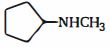
Questions · Page 1 of 21

M.C.Q (1 Marks)

🎯

Test yourself on this topic

50 questions · timed · auto-graded

MCQ 11 Mark
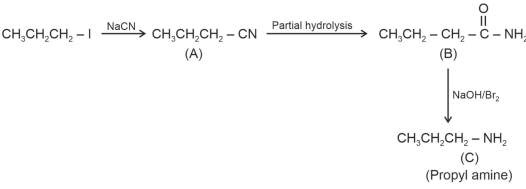
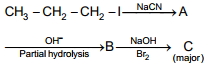
Identify the major product $\mathrm{C}$ formed in the following reaction sequence:

$Image$

  • A
     butylamine
  • B
    butanamide
  • C
    $\alpha$-bromobutanoic acid
  •  propylamine
Answer
Correct option: D.
 propylamine
d
$Image$

- Step$-l$ is $\mathrm{S}_{\mathrm{N}}$ reaction with $\stackrel{\ominus}{\mathrm{C}} \mathrm{N}$ nucleophile.

- Step$-Il$ will give amide.

- Step$-III$ is Hoffmann bromamide degradation reaction.

View full question & answer
MCQ 21 Mark
Given below are two statements:

Statement $I$ : Aniline does not undergo Friedel-Crafts alkylation reaction.

Statement $II$ : Aniline cannot be prepared through Gabriel synthesis.

In the light of the above statements, choose the correct answer from the options given below:

  • A
    Both Statement $I$ and Statement $II$ are false
  • B
     Statement $I$ is correct but Statement $II$ is false
  • C
    Statement $I$ is incorrect but Statement $II$ is true
  •  Both statement $I$ and Statement $II$ are true
Answer
Correct option: D.
 Both statement $I$ and Statement $II$ are true
d
- Aniline does not undergo Friedel-Crafts alkylation reaction due to salt formation with aluminium chloride, the Lewis acid, which is used as a catalyst.

- Aniline (aromatic primary amine) cannot be prepared by Gabriel phthalimide synthesis because aryl halides do not undergo nucleophilic substitution with anion formed by phthalimide.

View full question & answer
MCQ 31 Mark
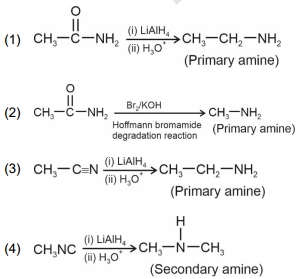
Which of the following reactions will NOT give primary amine as the product?
  • A
    $CH_3CN \xrightarrow[(ii) H _3 O ^{\oplus}]{(i) LiAlH_4}$ product
  • B
    $CH_3CONH_2 \overset{Br_2/KOH}{\rightarrow}$ product
  • C
    $CH_3CONH_2 \xrightarrow[(ii) H _3 O ^{\oplus}]{(i) LiAlH_4}$ product
  • $CH_3NC \xrightarrow[(ii) H _3 O ^{\oplus}]{(i) LiAlH_4}$ product
Answer
Correct option: D.
$CH_3NC \xrightarrow[(ii) H _3 O ^{\oplus}]{(i) LiAlH_4}$ product
d

View full question & answer
MCQ 41 Mark
Given below are two statements:

Statement $I:$ Primary aliphatic amines react with $HNO _{2}$ to give unstable diazonium salts.

Statement $II:$ Primary aromatic amines react with $HNO _{2}$ to form diazonium salts which are stable even above $300 \,K$.

In the light of the above statements, choose the most appropriate answer from the options given below:

  • A
    Both Statement $I$ and Statement $II$ are incorrect.
  • Statement $I$ is correct but Statement $II$ is incorrect.
  • C
    Statement $I$ is incorrect but Statement $II$ is correct.
  • D
    Both Statement $I$ and Statement $II$ are correct.
Answer
Correct option: B.
Statement $I$ is correct but Statement $II$ is incorrect.
b
View full question & answer
MCQ 61 Mark
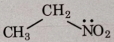
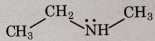
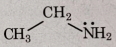
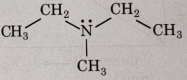
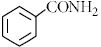
Identify the compound that will react with Hinsberg's reagent to give a solid which dissolves in alkali.
  • A

  • B


  • D

Answer
Correct option: C.

c
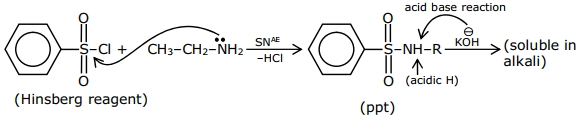
$1^{\circ}$ amine reacts with hinsberg reagent to give ppt. that is soluble in alkali.

$\mathrm{CH}_{3}-\mathrm{CH}_{2}-\mathrm{NH}_{2}$

View full question & answer
MCQ 71 Mark
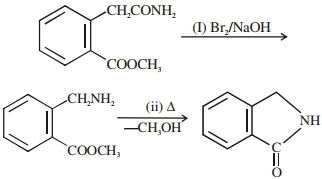
Reaction of propanamide with ethanolic sodium hydroxide and bromine will give
  • A
    Aniline
  • Ethylamine
  • C
    Methylamine
  • D
    Propylamine
Answer
Correct option: B.
Ethylamine
b

View full question & answer
MCQ 91 Mark
The correct order of the basic strength of methyl substituted amines in aqueous solution is
  • $\left(\mathrm{CH}_{3}\right)_{2} \mathrm{NH}>\mathrm{CH}_{3} \mathrm{NH}_{2}>\left(\mathrm{CH}_{3}\right)_{3} \mathrm{N} $
  • B
    $\left(\mathrm{CH}_{3}\right)_{3} \mathrm{N}>\mathrm{CH}_{3} \mathrm{NH}_{2}>\left(\mathrm{CH}_{3}\right)_{2} \mathrm{NH}$
  • C
    $\left(\mathrm{CH}_{3}\right)_{3} \mathrm{N}>\left(\mathrm{CH}_{3}\right)_{2} \mathrm{NH} > \mathrm{CH}_{3} \mathrm{NH}_{2}$
  • D
    $\mathrm{CH}_{3} \mathrm{NH}_{2}>\left(\mathrm{CH}_{3}\right)_{2} \mathrm{NH}>\left(\mathrm{CH}_{3}\right)_{3} \mathrm{N}$
Answer
Correct option: A.
$\left(\mathrm{CH}_{3}\right)_{2} \mathrm{NH}>\mathrm{CH}_{3} \mathrm{NH}_{2}>\left(\mathrm{CH}_{3}\right)_{3} \mathrm{N} $
a
The order of basic strength in case of methyl substituted amines and ethyl substituted amines in aqueous solution is as follows:

$\left(\mathrm{C}_{2} \mathrm{H}_{5}\right)_{2} \mathrm{NH}>\left(\mathrm{C}_{2} \mathrm{H}_{5}\right)_{3} \mathrm{N}>\mathrm{C}_{2} \mathrm{H}_{5} \mathrm{NH}_{2}>\mathrm{NH}_{3}$

$\left(\mathrm{CH}_{3}\right)_{2}\mathrm{NH}>\mathrm{CH}_{3} \mathrm{NH}_{2}>\left(\mathrm{CH}_{3}\right)_{3} \mathrm{N}>\mathrm{NH}_{3}$

View full question & answer
MCQ 101 Mark
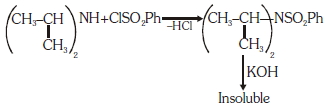
The amine that reacts will Hinsberg's reagent to give an alkali insoluble product is
  • $\begin{array}{*{20}{c}}
      {C{H_3} - CH - NH - CH - C{H_3}} \\ 
      {|\,\,\,\,\,\,\,\,\,\,\,\,\,\,\,\,\,\,\,\,\,\,\,\,\,\,\,\,\,\,\,\,\,|\,\,\,\,\,\,} \\ 
      {\,\,C{H_3}\,\,\,\,\,\,\,\,\,\,\,\,\,\,\,\,\,\,\,\,\,\,C{H_3}} 
    \end{array}$
  • B
    $\begin{array}{*{20}{c}}
      {\,\,\,\,\,\,\,\,\,\,\,\,\,\,\,\,\,\,\,\,\,\,\,\,C{H_2} - C{H_3}} \\ 
      | \\ 
      {C{H_3} - C{H_2} - N - C{H_2} - C{H_3}} 
    \end{array}$
  • C
    $\begin{array}{*{20}{c}}
      {N{H_2}\,\,\,\,\,\,\,\,\,\,\,\,\,\,\,\,\,\,\,\,\,\,\,\,\,\,\,} \\ 
      {|\,\,\,\,\,\,\,\,\,\,\,\,\,\,\,\,\,\,\,\,\,\,\,\,\,\,\,\,\,\,\,\,\,\,\,\,} \\ 
      {C{H_3} - C - C{H_2} - C{H_2} - C{H_3}} \\ 
      {|\,\,\,\,\,\,\,\,\,\,\,\,\,\,\,\,\,\,\,\,\,\,\,\,\,\,\,\,\,\,\,\,\,\,\,\,} \\ 
      {C{H_3}\,\,\,\,\,\,\,\,\,\,\,\,\,\,\,\,\,\,\,\,\,\,\,\,\,\,\,} 
    \end{array}$
  • D
    $\begin{array}{*{20}{c}}
      {C{H_3}\,\,\,\,\,\,\,\,\,\,} \\ 
      {|\,\,\,\,\,\,\,\,\,\,\,\,\,\,\,\,} \\ 
      {C{H_3} - C - CH - N{H_2}} \\ 
      {|\,\,\,\,\,\,\,\,\,|\,\,\,\,\,\,\,} \\ 
      {C{H_3}\,\,C{H_3}} 
    \end{array}$
Answer
Correct option: A.
$\begin{array}{*{20}{c}}
  {C{H_3} - CH - NH - CH - C{H_3}} \\ 
  {|\,\,\,\,\,\,\,\,\,\,\,\,\,\,\,\,\,\,\,\,\,\,\,\,\,\,\,\,\,\,\,\,\,|\,\,\,\,\,\,} \\ 
  {\,\,C{H_3}\,\,\,\,\,\,\,\,\,\,\,\,\,\,\,\,\,\,\,\,\,\,C{H_3}} 
\end{array}$
a

View full question & answer
MCQ 111 Mark
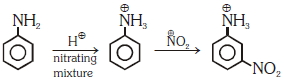
Nitration of aniline in strong acidic medium also gives m-nitroaniline because
  • A
    In spite of substituents nitro group always goes to only $m-$position
  • B
    In electrophilic substitution reactions amino group is meta directive.
  • C
    In absence of substituents nitro group always goes to m-position
  • In acidic (strong) medium aniline is present as anilinium ion
Answer
Correct option: D.
In acidic (strong) medium aniline is present as anilinium ion
d
In acidic medium aniline is protonated to form anilinium ion which is metadirecting.
View full question & answer
MCQ 121 Mark
Which of the following reactions is appropriate for converting acetamide to methanamine?
  • Hoffmann hypobromamide reaction
  • B
    Stephen's reaction
  • C
    Gabriel phthalimide synthesis
  • D
    Carbylamine reaction
Answer
Correct option: A.
Hoffmann hypobromamide reaction
a
$\begin{matrix}
   C{{H}_{3}}-C-N{{H}_{2}}  \\
   ||  \\
   O  \\
\end{matrix}$  $\xrightarrow{B{{r}_{2}}\,/\,4KOH}$  $C{{H}_{3}}-N{{H}_{2}}\,+\,2KBr\,+\,{{K}_{2}}C{{O}_{3}}$

This reactlon is known as hoffmann hypobromamide reaction.

View full question & answer
MCQ 131 Mark
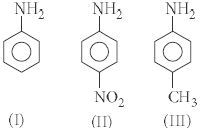
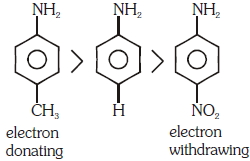
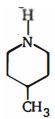
The correct increasing order of basic strength for the following compounds is
  • A
    $III < I < II$
  • B
    $III < II < I$
  • $II < I < III$
  • D
    $II < III < I$
Answer
Correct option: C.
$II < I < III$
c

View full question & answer
MCQ 141 Mark
The reaction:

$ArN _{2} Cl \overset{Cu / HCl}{\rightarrow} ArCl + N _{2}$ is known as

  • A
    Sandmeyers reaction
  • B
    Finkelstein reaction
  • Gattermann reaction
  • D
    Balz Schiemann reaction
Answer
Correct option: C.
Gattermann reaction
c
Getterman process
View full question & answer
MCQ 161 Mark
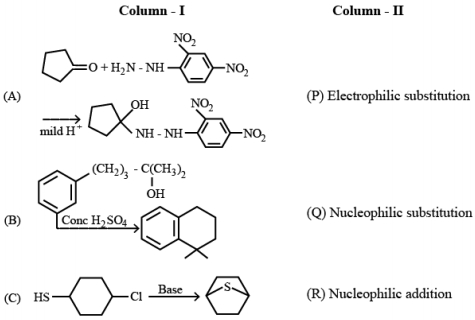
Match Column$-I$ with Column$-II:$
  • A
    $A-P; B-Q; C-R$
  • B
    $A - Q ; B - R ; C - P$
  • $A - R ; B - P ; C - Q$
  • D
    $A-R; B-Q; C-P$
Answer
Correct option: C.
$A - R ; B - P ; C - Q$
c
$A - R ; B - P ; C - Q$
View full question & answer
MCQ 171 Mark
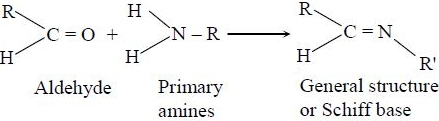
The product formed by the reaction of an aldehyde with a primary amine is
  • A
    carboxylic acid
  • B
    aromatic acid
  • Schiff's base
  • D
    ketone
Answer
Correct option: C.
Schiff's base
c
Aldehyde + Primary amines $\rightarrow$ Schiff base

Schiff bases can be synthesized from an aliphatic or aromatic amine and a carbonyl compounds by nucleophilic addition-elimination reaction

View full question & answer
MCQ 181 Mark
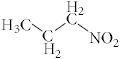
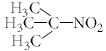
Which one of the following nitro-compounds does not react with nitrous acid ?
  • A

  • B


  • D

Answer
Correct option: C.

c
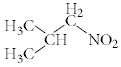
$1^{o}$ nitro compound,

$2^{o}$ nitro compound react with $\mathrm{HNO}_{2}$ acid

but $3^{o}$ nitro compound does not react with nitrous acid.

$(i)$  ${\mkern 1mu} \mathop {\begin{array}{*{20}{c}}
  {\,\,\,\,\,\,\begin{array}{*{20}{c}}
  {\,\,\,\,\,C{H_2}} \\ 
  {|\,\,} 
\end{array}} \\ 
  {C{H_3} - C - CH - N{O_2}} \\ 
  {||\,\,\,\,\,\,\,\,\,\,\,\,\,\,\,\,\,\,} \\ 
  {O\,\,\,\,\,\,\,\,\,\,\,\,\,\,\,\,\,\,} 
\end{array}}\limits_{{1^o}\,\,nitro} $ $\xrightarrow{{HN{O_2}}}$ $\begin{matrix}
   \,\,\,\,\,\,\,\,\,\begin{matrix}
   \,\,\,\,\,\,C{{H}_{3}}  \\
   |  \\
\end{matrix}  \\
   C{{H}_{3}}-C-C-N{{O}_{2}}  \\
   \,||\,\,\,\,\,\,\,\,\,|\,\,  \\
   \,\,\,\,\,\,\,\,\,\,\,\,O\,\,\,\,\,\,\,N=O  \\
\end{matrix}$

$(ii)$  $\mathop {C{H_3} - C{H_2} - C{H_2} - N{O_2}}\limits_{{1^o}\,nitro} $ $\xrightarrow{{HO - N = O}}$ $\begin{array}{*{20}{c}}
  {C{H_3} - C{H_2} - C - N{O_2}} \\ 
  {\,\,\,\,\,\,\,\,\,\,\,\,\,\,\,\,\,\,||} \\ 
  {\,\,\,\,\,\,\,\,\,\,\,\,\,\,\,\,\,\,\,\,\,\,\,\,\,\,\,\,\,\,\,\,N - OH} 
\end{array}$

$(iii)$  $\mathop {\begin{array}{*{20}{c}}
  {C{H_3} - CH - C{H_2} - N{O_2}} \\ 
  {|\,\,\,\,\,\,\,\,\,\,\,\,\,\,\,\,\,\,\,\,\,\,\,\,} \\ 
  {C{H_3}\,\,\,\,\,\,\,\,\,\,\,\,} 
\end{array}\,}\limits_{{1^o}\,\,nitro} $  $\xrightarrow{{HO - N = O}}$  $\begin{matrix}
   C{{H}_{3}}-CH-C-N{{O}_{2}}  \\
   |\,\,\,\,\,\,\,\,\,\,\,\,\,||  \\
   \,\,\,\,\,\,\,\,\,\,\,\,\,\,C{{H}_{3}}\,\,\,\,\,\,N-OH  \\
\end{matrix}$

$3^o$ nitro $\xrightarrow{HN{{O}_{2}}}$ No reaction.
View full question & answer
MCQ 191 Mark
The correct statement regarding the basicity of arylamines is
  • A
    arylamines are generally more basic than alkylamines because of aryl group
  • B
    arylamines are generally more basic than alkylamines, because the nitrogen atom in arylamines is $sp-$hybridised
  • arylamines are generally less basic than alkylamines because the nitrogen lone-pair electrons are delocalised by interaction with the aromatic ring $\pi -$electron system
  • D
    arylamines are generally more basic than alkylamines because the nitrogen lone-pair electrons are not delocalised by interaction with the aromatic ring $\pi -$electron system.
Answer
Correct option: C.
arylamines are generally less basic than alkylamines because the nitrogen lone-pair electrons are delocalised by interaction with the aromatic ring $\pi -$electron system
c
Delocalized lone pair of nitrogen less basic
View full question & answer
MCQ 201 Mark
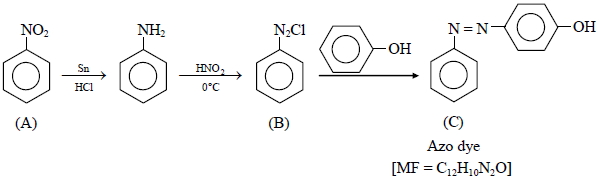
A given nitrogen-containing aromatic compound $'A'$ reacts with $Sn/HCl,$ followed by $HNO_2$ to give an unstable compound $'B'$. $ 'B',$ on treatment with phenol, forms a beautiful coloured compound $'C'$ with the molecular formula $C_{12}H_{10}N_2O.$ The structure of compound $'A'$ is
  • A


  • C

  • D

Answer
Correct option: B.

b

View full question & answer
MCQ 211 Mark
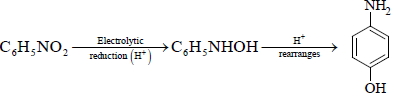
The electrolytic reduction of nitro benzene in strongly acidic medium produces
  • A
    azobenzene
  • B
    aniline
  • $p-$aminophenol
  • D
    azoxybenzene
Answer
Correct option: C.
$p-$aminophenol
c

View full question & answer
MCQ 221 Mark
Method by which aniline cannot be prepared is
  • A
    degradation of benzamide with bromine in alkaline solution
  • B
    reduction of nitrobenzene with $H_2/Pd$ in ethanol
  • potassium salt of phthalimide treated with chlorobenzene followed by hydrolysis with aqueous $NaOH$ solution
  • D
    hydrolysis of phenylisocyanide with acidic solution.
Answer
Correct option: C.
potassium salt of phthalimide treated with chlorobenzene followed by hydrolysis with aqueous $NaOH$ solution
c
due to resonance $C-Cl$ bond acquires double bond character.
View full question & answer
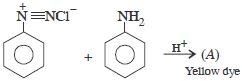
MCQ 231 Mark
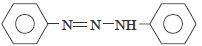
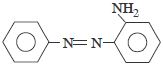
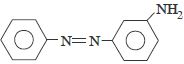
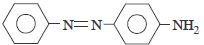
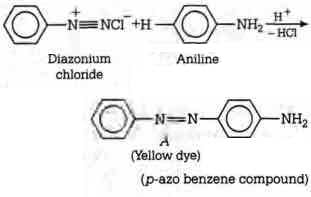
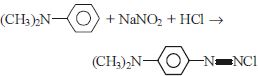
In the following reaction, the product $(A)$ is
  • A

  • B

  • C


Answer
Correct option: D.

d
The above reaction is a coupling reaction of aniline with diazonlum salt to give azo benzene compound. This coupling reaction takes place at the para-position to $- NH_2$ group of benzene. This reaction act as electrophilic substitution reaction of aniline.
View full question & answer
MCQ 241 Mark
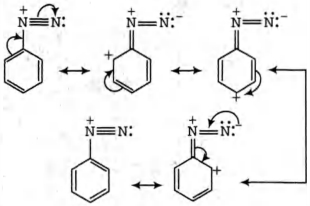
Which of the following will be most stable diazonium salt $RN_2^+X^-$ ?
  • A
    $CH_3N_2^+X^-$
  • $C_6H_5N_2^+X^-$
  • C
    $CH_3CH_2N_2^+X^-$
  • D
    $C_6H_5CH_2N_2^+X^-$
Answer
Correct option: B.
$C_6H_5N_2^+X^-$
b
Diazonium salt containing aryl group directly linked to the nitrogen atom is most stable due to resonance stabilisation between the benzene nucleus and $N-$atom. Diazonium ion act as a electrophile. [Resonance structure of benzene diazonium ion]
View full question & answer
MCQ 251 Mark
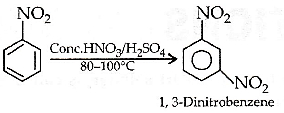
Nitrobenzene on reaction with conc. $HNO_3/H_2SO_4$ at $80-100\,^o C$ forms which one of the following products ?
  • A
    $1, 4-$Dinitrobenzene
  • B
    $1, 2, 4-$Trinitrobenzene
  • C
    $1, 2-$Dinitrobenzene
  • $1, {3-}$Dinitrobenzene
Answer
Correct option: D.
$1, {3-}$Dinitrobenzene
d

View full question & answer
MCQ 261 Mark
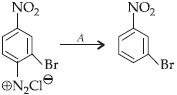
In the reaction $A$ is
  • $H_3PO_2$ and $H_2O$
  • B
    $H^+/H_2O$
  • C
    $HgSO_4/H_2SO_4$
  • D
    $Cu_2Cl_2$
Answer
Correct option: A.
$H_3PO_2$ and $H_2O$
a
View full question & answer
MCQ 271 Mark
On hydrolysis of a "compound", two compounds are obtained. One of which on treatment with sodium nitrite and hydrochloric acid gives a product which does not respond to iodoform test. The second one reduces Tollens reagent and Fehling's solution. The "compound" is
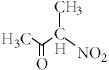
  • $CH_3CH_2CH_2NC$
  • B
    $CH_3CH_2CH_2CN$
  • C
    $CH_3CH_2CH_2ON=O$
  • D
    $CH_3CH_2CH_2CON(CH_3)_2$
Answer
Correct option: A.
$CH_3CH_2CH_2NC$
a
View full question & answer
MCQ 281 Mark
Some reactions of amines are given. Which one is not correct ?

  • B
    $CH_3CH_2NH_2 + HNO_2 \rightarrow CH_3CH_2OH + N_2$
  • C
    $CH_3NH_2 + C_6H_5SO_2Cl \rightarrow CH_3NHSO_2C_6H_5$
  • D
    $(CH_3)_2NH + NaNO_2 + HCl \rightarrow (CH_3)_2N-N=O$
Answer
Correct option: A.

a

View full question & answer
MCQ 291 Mark
${(RCO)_2}NH$ is
  • A
    Primary amine
  • B
    Secondary amine
  • Secondary amide
  • D
    Tertiary amide
Answer
Correct option: C.
Secondary amide
c
(c)$\mathop {R - CON{H_2}}\limits_{{\rm{Primary amide}}} $ $\mathop {{{(RCO)}_2}NH}\limits_{{\rm{Secondary amide}}} $
View full question & answer
MCQ 301 Mark
Which of the following is ${1^o}$ amine
  • Ethylene diamine
  • B
    Dimethyl amine
  • C
    Trimethyl amine
  • D
    $N-$methyl aniline
Answer
Correct option: A.
Ethylene diamine
a
in ethylene diamine here both amine are bond with different methyl group so this is $1^{\circ}$ amine
View full question & answer
MCQ 311 Mark
A secondary amine is
  • A
    An organic compound with two $ - N{H_2}$ groups
  • B
    A compound with two carbon atoms and an $ - N{H_2}$ group
  • C
    A compound with an $ - N{H_2}$ group on the carbon atom in number $2$ position
  • A compound in which two of the hydrogens of $N{H_3}$ have been replaced by organic groups
Answer
Correct option: D.
A compound in which two of the hydrogens of $N{H_3}$ have been replaced by organic groups
d
It’s obvious.
View full question & answer
MCQ 321 Mark
The structural formula of methyl aminomethane is
  • A
    ${(C{H_3})_2}CHN{H_2}$
  • B
    ${(C{H_3})_3}N$
  • ${(C{H_3})_2}NH$
  • D
    $C{H_3}N{H_2}$
Answer
Correct option: C.
${(C{H_3})_2}NH$
c
structure of amino methane $CH _3- CH _2- NHCH _3$
View full question & answer
MCQ 331 Mark
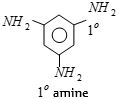
Triaminobenzene is a
  • A
    ${2^o}$ amine
  • B
    ${3^o}$ amine
  • ${1^o}$ amine
  • D
    Quarternary salt
Answer
Correct option: C.
${1^o}$ amine
c
(c)
View full question & answer
MCQ 341 Mark
Aniline is usually purified by
  • Steam distillation
  • B
    Simple distillation
  • C
    Vacuum distillation
  • D
    Extraction with a solvent
Answer
Correct option: A.
Steam distillation
a
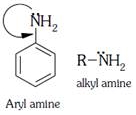
Aniline is purified by steam distillation. The temperature required for the simple distillation of aniline is too high. It decomposes at this temperature. Steam distillation occurs at lower temperature.
View full question & answer
MCQ 351 Mark
The Hinsberg's method is used for
  • A
    Preparation of primary amines
  • B
    Preparation of secondary amines
  • C
    Preparation of tertiary amines
  • Separation of amine mixtures
Answer
Correct option: D.
Separation of amine mixtures
d
It’s obvious.
View full question & answer
MCQ 361 Mark
The diazonium salts are the reaction products in presence of excess of mineral acid with nitrous acid and
  • A
    Primary aliphatic amine
  • B
    Secondary aromatic amine
  • Primary aromatic amine
  • D
    Tertiary aliphatic amine
Answer
Correct option: C.
Primary aromatic amine
c
The diazonium salts are the reaction product in presence of excess of mineral acid with nitrous acid and primary aromatic amine
View full question & answer
MCQ 371 Mark
The amine which can react with ${C_6}{H_5} - S{O_2} - Cl$ to form a product insoluble in alkali shall be
  • A
    Primary amine
  • Secondary amine
  • C
    Tertiary amine
  • D
    Both primary and secondary amines
Answer
Correct option: B.
Secondary amine
b
(b) ${C_6}{H_5}S{O_2}Cl$ is called Hinsberg’s reagent they react with sec amine to form a product in soluble in alkalies. This reaction used to separate ${1^o}$, ${2^o}$ and ${3^o}$ amine from their mixture.
View full question & answer
MCQ 381 Mark
A mixture of benzene and aniline can be separated by
  • A
    Hot water
  • dil. $HCl$
  • C
    dil. $NaOH$
  • D
    Alcohol
Answer
Correct option: B.
dil. $HCl$
b
(b) A mixture of benzene and aniline can be separated by dil. $HCl$.

 
View full question & answer
MCQ 391 Mark
Pure aniline is a
  • A
    Colourless solid
  • B
    Brown coloured solid
  • Colourless liquid
  • D
    Brown coloured liquid
Answer
Correct option: C.
Colourless liquid
c
Pure aniline is colurless liquid.But it gets easily oxidized by air.Hence, it develops color.
View full question & answer
MCQ 401 Mark
Which has a pyramidal structure
  • Trimethylamine
  • B
    Methanol
  • C
    Acetylene
  • D
    Water
Answer
Correct option: A.
Trimethylamine
a
Trimethylamine has a pyramidal shape. Center atom is $sp^3$ hybridized with three bond pairs and one lone pair.
View full question & answer
MCQ 411 Mark
Amines behave as
  • A
    Lewis acids
  • Lewis bases
  • C
    Aprotic acids
  • D
    Amphoteric compounds
Answer
Correct option: B.
Lewis bases
b
(b) In amines nitrogen has a lone pair of ${e^ - }$. It can donate a election pair. So amines behaves as a lewis base.
View full question & answer
MCQ 421 Mark
In amines, the hybridisation state of $N$ is
  • A
    $sp$
  • B
    $s{p^2}$
  • $s{p^3}$
  • D
    $s{p^2}d$
Answer
Correct option: C.
$s{p^3}$
c
(c) It is similar that of $N{H_3}$ except $H-$ is replaced by $-R$ group.

$\because \mathop {N{H_3}}\limits^{ \cdot \,\, \cdot \,\,\,\,\,\,} \to \frac{{5 + 3}}{2} \Rightarrow 4 \Rightarrow s{p^3}$.

View full question & answer
MCQ 431 Mark
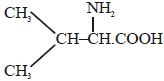
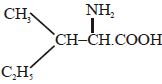
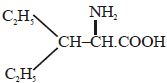
The structural formula of an amino acid, isoleucine is :-
  • A
    $\begin{array}{*{20}{c}}
      {N{H_2}} \\ 
      {|\,\,\,\,\,} \\ 
      {C{H_3} - CH \cdot COOH} 
    \end{array}$
  • B


  • D

Answer
Correct option: C.

c
View full question & answer
MCQ 441 Mark
Which of following statement is correct ?
  • Hinsberg reagent can be use to seperate $1^o,\, 2^o$ and $3^o$ amine
  • B
    Hinsberg reagent can not be use to distinguish $1^o,\, 2^o$ and $3^o$ amine
  • C
    Volatile nature of isomeric amine $1^o > 2^o > 3^o$
  • D
    Primary amine and secondary amine can not be distinguished by liebermann nitroso test
Answer
Correct option: A.
Hinsberg reagent can be use to seperate $1^o,\, 2^o$ and $3^o$ amine
a
View full question & answer
MCQ 451 Mark
Which of following can be use to distinguish primary, secondary and tertiary amine ?
  • A
    Hinsberg reagent
  • B
    $HNO_2$
  • C
    Carbyl amine test
  • $A$ and $B$ both
Answer
Correct option: D.
$A$ and $B$ both
d
View full question & answer
MCQ 461 Mark
Among the isomeric amines select the one with the lowest boiling point.
  • A

  • B


  • D

Answer
Correct option: C.

c
does not participate in $H$- bonding so has least $B.P.$
View full question & answer
MCQ 471 Mark
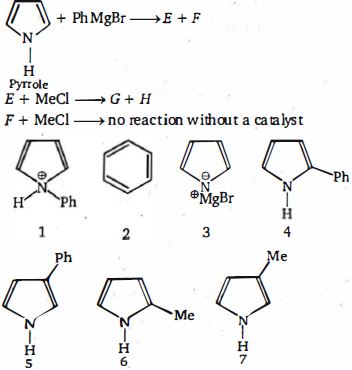
The structure of products $E -H,$ respectively are
  • $3, 2, 6, 7$
  • B
    $4, 5, 6, 1$
  • C
    $3, 4, 5, 2$
  • D
    $3, 2, 4, 5$
Answer
Correct option: A.
$3, 2, 6, 7$
a

View full question & answer
MCQ 481 Mark
Which is not primary amine ?
  • A
    Secondary butyl amine
  • B
    Tertiary butyl amine
  • $N-$ methyl ethanamine
  • D
    All of these
Answer
Correct option: C.
$N-$ methyl ethanamine
c
View full question & answer
MCQ 491 Mark
Which of following statement is correct ?
  • Hinsberg reagent can be use to seperate $1^o, 2^o$ and $3^o$ amine.
  • B
    Hinsberg reagent can not be use to distinguish $1^o, 2^o$ and $3^o$ amine
  • C
    Volatile nature of isomeric amine $1^o > 2^o > 3^o$
  • D
    Primary amine and secondary amine can not be distinguished by liebermann nitroso test
Answer
Correct option: A.
Hinsberg reagent can be use to seperate $1^o, 2^o$ and $3^o$ amine.
a
View full question & answer
MCQ 501 Mark
Primary and secondary amines can be distinguished by
  • A
    Hoffmann's mustard oil reaction
  • B
    carbylamine reaction
  • C
    Hinsberg reagent
  • All
Answer
Correct option: D.
All
d
View full question & answer
M.C.Q (1 Marks) - Chemistry STD 12 Science Questions - Vidyadip