Questions · Page 1 of 4

M.C.Q (1 Marks)

🎯

Test yourself on this topic

50 questions · timed · auto-graded

MCQ 11 Mark
Starch is a mixture of two components, a water soluble component amylose$(15-20\%)$ and a water insoluble component amylopectin $(80-85\%).$ The aqueous solution of amylose gives a blue colour with iodine solution due to the formation of:
  • A
    Amylose iodide
  • B
    Amylose iodate
  • Inclusion complex
  • D
    Amylose tetraiodide complex
Answer
Correct option: C.
Inclusion complex
Inclusion complex is a host$-$guest addition compound.
The space available within the crystal lattice of the host molecule, i.e., amylose is in the form of tunnels and the size of the tunnels is such that it can easily accommodate guest molecules, i.e., iodine molecules to form an addition compound called the inclusion complex.
The blue colour, however, disappears on heating and reappears on cooling.
View full question & answer
MCQ 21 Mark
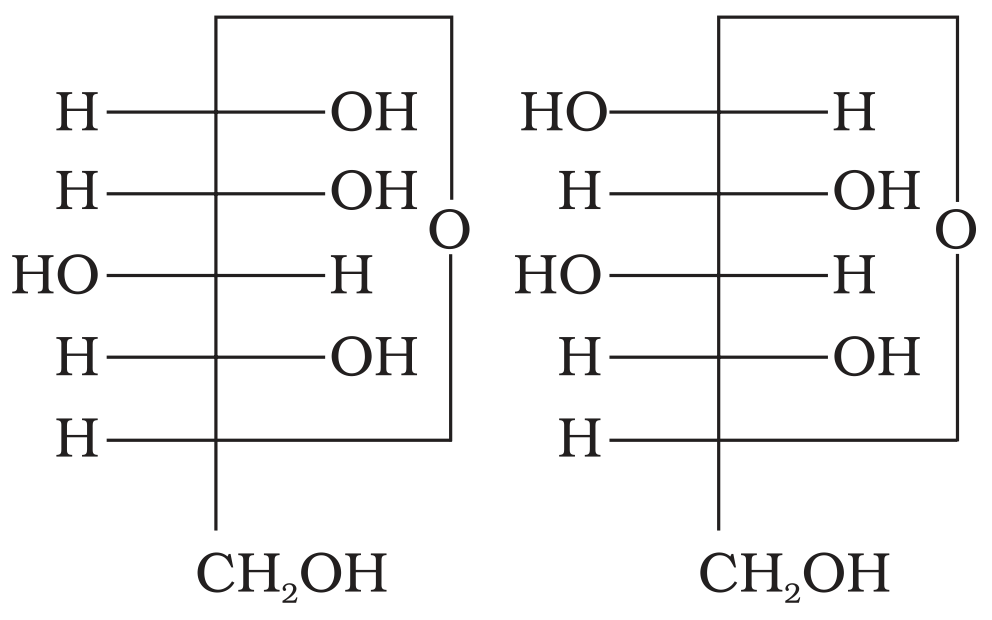
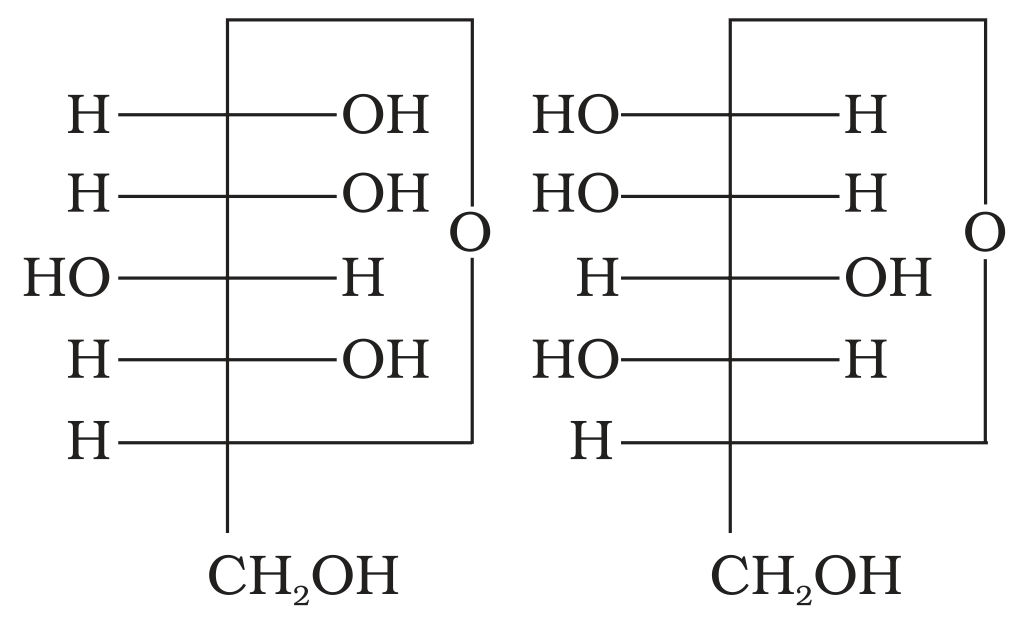
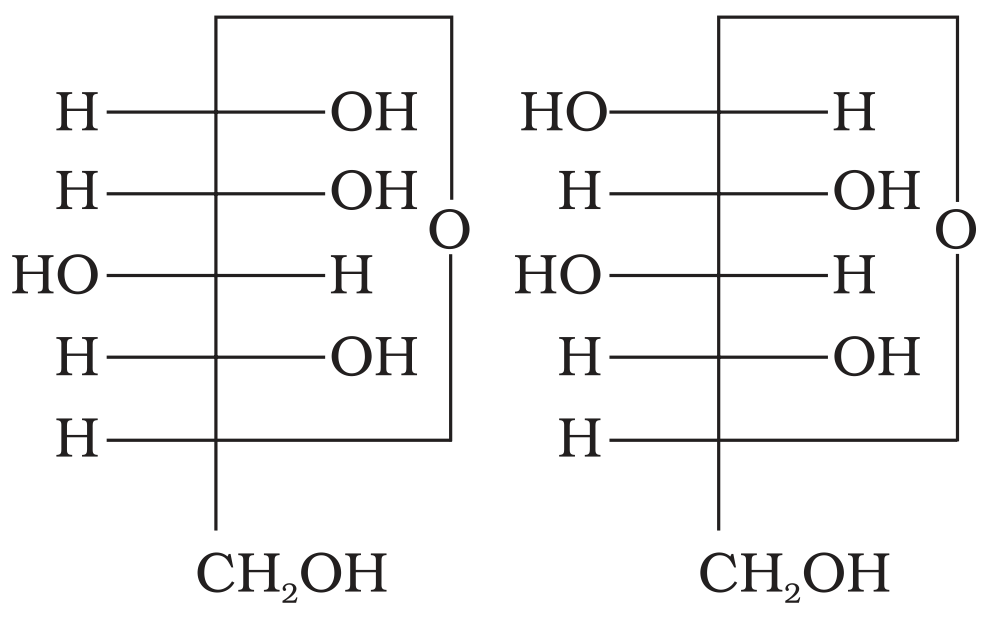
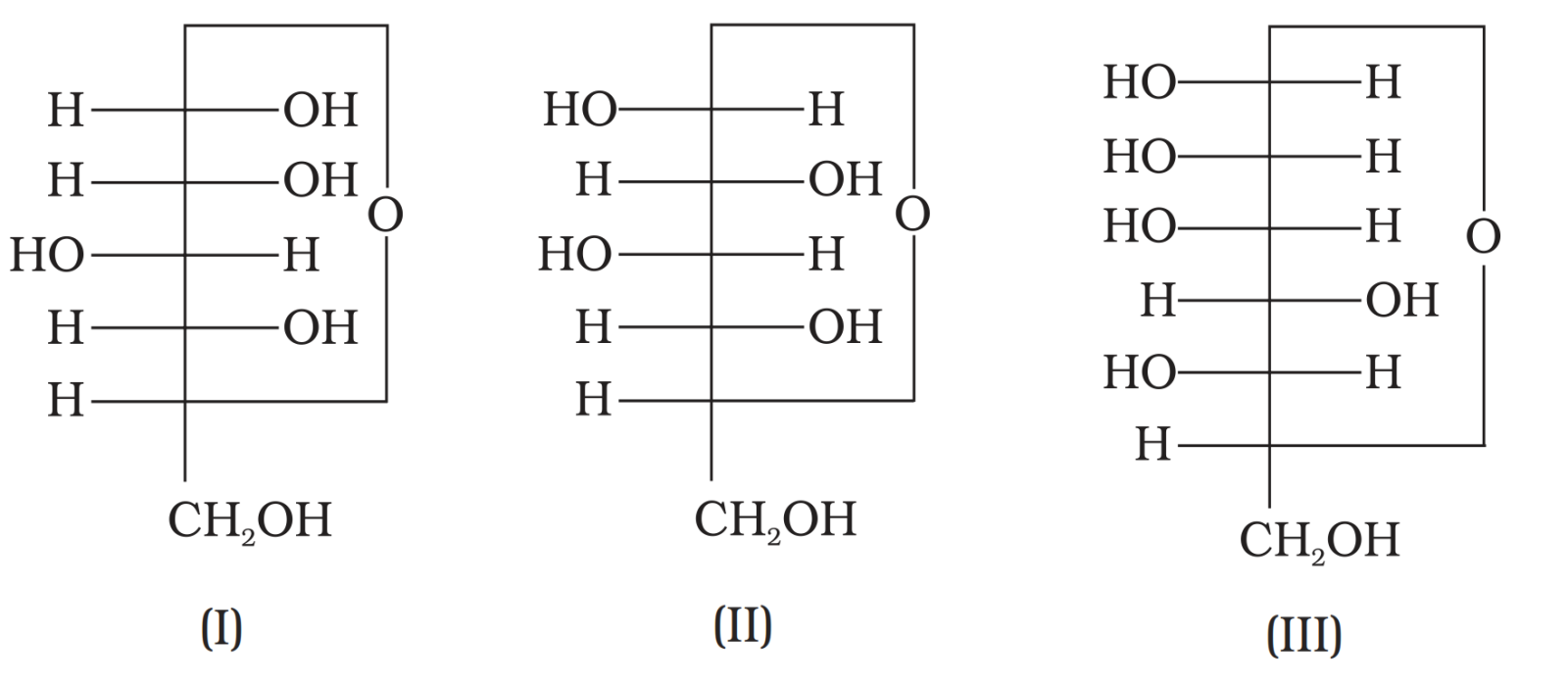
Three cyclic structures of monosaccharides are given below which of these are anomers.
  • $I$ and $II$
  • B
    $II$ and $\text{III}$
  • C
    $I$ and $\text{III}$
  • D
    $\text{III}$ is anomer of $I$ and $II$
Answer
Correct option: A.
$I$ and $II$
Cyclic structures of monosaccharides which differ in structure at carbon$-1$ are known as anomers. Here$, I$ and $II$ are anomer because they differ from each other at carbon$-1$ only.
View full question & answer
MCQ 31 Mark
Which of the following bases is not present in $\text{DNA}?$
  • A
    Adenine
  • B
    Thymine
  • C
    Cytosine
  • Uracil
Answer
Correct option: D.
Uracil
Uracil is present in $\text{RNA}$ but not in $\text{DNA}.$
View full question & answer
MCQ 41 Mark
Example of coenzyme is:
  • A
    $\mathrm{Zn}^{2+}$
  • B
    Lipase
  • Vitamin $B$
  • D
    Lysine
Answer
Correct option: C.
Vitamin $B$
For some biochemical reactions a substance other than enzymes and substrate is required. These substances are called coenzymes $($organic compounds$)$ or cofactors $($inorganic ions like zinc and copper etc$.).$ The coenzymes usually serve as an acceptor or donor of an atom or a group.
Many coenzymes are derived from vitamins$. B$ group of vitamins forma variety of coenzymes example Nicotinamide adenine dinucleotide $\text{(NAD)}$ which is derived from vitamin niacin, Flavin adenine dinucleotide $\text{(FAD)}$ which is derived from vitamin riboflavin, Coenzyme $A$ which is derived from pantothenate, pyridoxal phosphate which is derived from pyridoxin, Thiamine pyrophosphate which is derived from thiamine etc.
View full question & answer
MCQ 51 Mark
Which among the following are essential chemical components of many coenzymes?
  • A
    Nucleic acids
  • B
    Carbohydrates
  • Vitamins
  • D
    Proteins
Answer
Correct option: C.
Vitamins
Enzymes are simple if they are made up of only proteins example pepsin, amylase etc.
While conjugate enzymes have an additional non protein organic coenzyme or inorganic cofactor.
Loosely attached organic cofactors are called as coenzymes example $\text{NAD, FAD TPP}$ etc.
Coenzymes are generally derived from vitamins like Thiamine $\text{(TPP)},$ Riboflavin $\text{(FMN, FAD)},$ Niacin $\text{(NAD)},$ Pantothenate $\text{(CoA)}.$
View full question & answer
MCQ 61 Mark
Role of carbohydrates is to function as:
  • A
    Catalyst
  • Source of energy
  • C
    Enzyme
  • D
    Building material
Answer
Correct option: B.
Source of energy
Carbohydrates are more suitable for the production of energy in the body then proteins and fats.
Carbohydrate are also stored in the body cells as glycogen and are used for the production of energy whenever required.
View full question & answer
MCQ 71 Mark
The major role of minor elements inside living organisms is to play role of:
  • $Co-$factors of enzymes.
  • B
    Building blocks of important amino acids.
  • C
    Constituent of hormones.
  • D
    Binder of cell structure.
Answer
Correct option: A.
$Co-$factors of enzymes.
Micronutrients or microelements are those elements which are required in quantity of less than $10$ millimole/kg of dry matter.
Most of the micronutrients have a catalytic role. They are components of cofactors of enzymes, e.g., zinc $($required for activity of alcohol dehydrogenase$),$ copper $($required for activity of cytochrome oxidase$),$ nickel $($required for activity of urease4 etc.
View full question & answer
MCQ 81 Mark
The commonest disaccharide has the molecular formula $......$
  • A
    $\mathrm{C}_{10} \mathrm{H}_{18} \mathrm{O}_{19}$
  • B
    $\mathrm{C}_{10} \mathrm{H}_{20} \mathrm{O}_{10}$
  • C
    $\mathrm{C}_{11} \mathrm{H}_{22} \mathrm{O}_{11}$​
  • $\mathrm{C}_{12} \mathrm{H}_{22} \mathrm{O}_{11}$
Answer
Correct option: D.
$\mathrm{C}_{12} \mathrm{H}_{22} \mathrm{O}_{11}$
Disaccharides are the carbohydrates which on hydrolysis gives two same or different carbohydrates.
Sucrose is the most common disaccharide.
It can be found in many fruits and is naturally occuring.
It has molecular formula $\mathrm{C}_{12} \mathrm{H}_{22} \mathrm{O}_{11}$.
View full question & answer
MCQ 91 Mark
Which of the following is not a coenzyme?
  • A
    $\text{NAD}$
  • B
    $\text{NADP}$
  • C
    $\text{FAD}$
  • $\text{ATP}$
Answer
Correct option: D.
$\text{ATP}$
Many enzymes consists of a protein and non$-$protein component, they are called as holoenzymes. The protein component of a holoenzyme is called as apoenzyme and the non$-$protein component may be inorganic ions such as $\mathrm{Mg}^{2+}$ and $\mathrm{Mn}^{2+}$. They are tightly attached to apoenzyme, they are called as activators. The non-protein components may be organic substances such as $\mathrm{NAD}^{+}, \mathrm{NADP}^{+}$and $\mathrm{FAD}^{+}$. They are loosely attached to the apoenzyme. They are called coenzyme or cofactors.
View full question & answer
MCQ 101 Mark
Relation between amino acids and proteins is similar to the one present between:
  • Nucleotides and nucleic acids.
  • B
    $\text{RNA}$ and $\text{DNA}.$
  • C
    Glucose and fructose.
  • D
    All of the above.
Answer
Correct option: A.
Nucleotides and nucleic acids.
Amino acids and proteins are similar to the nucleotides and nucleic acids.
Just as proteins are made up of numbers of amino acids, similarly nucleic acids, which include $\text{DNA}\ ($deoxyribonucleic acid) and $\text{RNA}\ ($ribonucleic acid$),$ are made from monomers known as nucleotides.
View full question & answer
MCQ 111 Mark
For artificial ripening of fruit, which of the following is used?
  • A
    Auxin
  • B
    Cytokinin
  • Ethylene
  • D
    Gibberellin
Answer
Correct option: C.
Ethylene
All of the given options are phytohormones $($plant hormones$).$
Plant hormones control all the growth and development activities like cell division, enlargement, flowering, seed formation, dormancy and abscission.
The major function of the given hormones are as follows:
  1. Auxin$-$ Cell elongation of stems and roots
  2. Cytokinin$-$ Promotes lateral and adventitious shoot growth by inducing cell division.
  3. Ethylene$-$ Hastens the ripening of fruits
  4. Gibberellin$-$ Breaks seed dormancy promotes flowering. Hence, ethylene gas is used for the artificial ripening of fruits.
View full question & answer
MCQ 121 Mark
Carbohydrates are classified on the basis of their behaviour on hydrolysis and also as reducing or non-reducing sugar. Sucrose is a $......$
$A.$ Monosaccharide
$B.$ Disaccharide
$C.$ Reducing sugar
$D.$ Non$-$reducing sugar
  • A
    $A$ and $B$
  • B
    $A$ and $C$
  • C
    $B$ and $C$
  • $B$ and $D$
Answer
Correct option: D.
$B$ and $D$
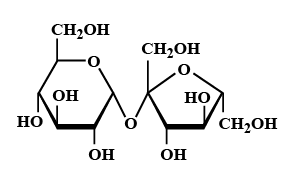
One of the common disaccharides is sucrose which on hydrolysis gives equimolar mixture of $D-(+)-$ glucose and $D-(-)$ fructose. These two monosaccharides are held together by a glycosidic linkage between $Cl$ of and $\mathrm{C}_2$. Since the reducing groups of glucose and fructose are involved in glycosidic bond formation, sucrose is a non$-$reducing sugar.
View full question & answer
MCQ 131 Mark
The number of tripeptides possible from three different amino acids is:
  • A
    $81$
  • $27$
  • C
    $9$
  • D
    $6$
Answer
Correct option: B.
$27$
The number of tripeptides possible from three different amino acids is $27.$
The protein can have $3^3=27$ different tripeptide sequences $($by permutations$).$
View full question & answer
MCQ 141 Mark
Enzymes are different from inorganic catalysts in:
  • A
    Not being used up in reactions.
  • Being proteinaceous in nature.
  • C
    Having high diffusion rate.
  • D
    Working at high temperature.
Answer
Correct option: B.
Being proteinaceous in nature.
Biochemically, enzymes are polymers of amino acids. They are not amino acids but are polymers of amino acids.
Most of the enzymes barring a few exceptions are proteins. Few non$-$proteinaceous enzymes are catalytic $\text{RNAs}.$
View full question & answer
MCQ 151 Mark
A distinct domain in an enzyme molecule may:
  • A
    Contribute to catalytic site
  • B
    Bind a coenzyme
  • C
    Bind an allosteric effector
  • All of the above
Answer
Correct option: D.
All of the above
A distinct domain in an enzyme molecule may be a catalytic site, allosteric site that binds to the cofactor to form holoenzyme.
View full question & answer
MCQ 161 Mark
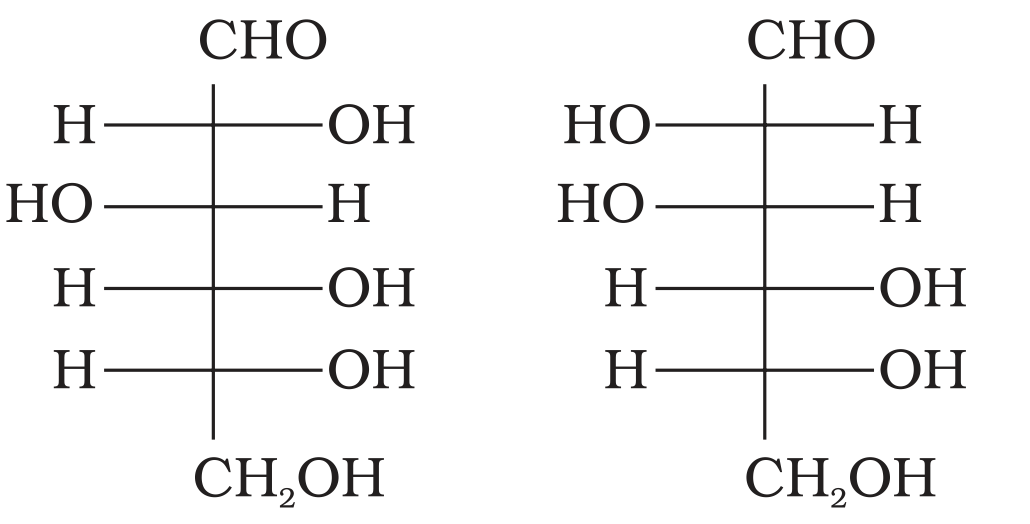
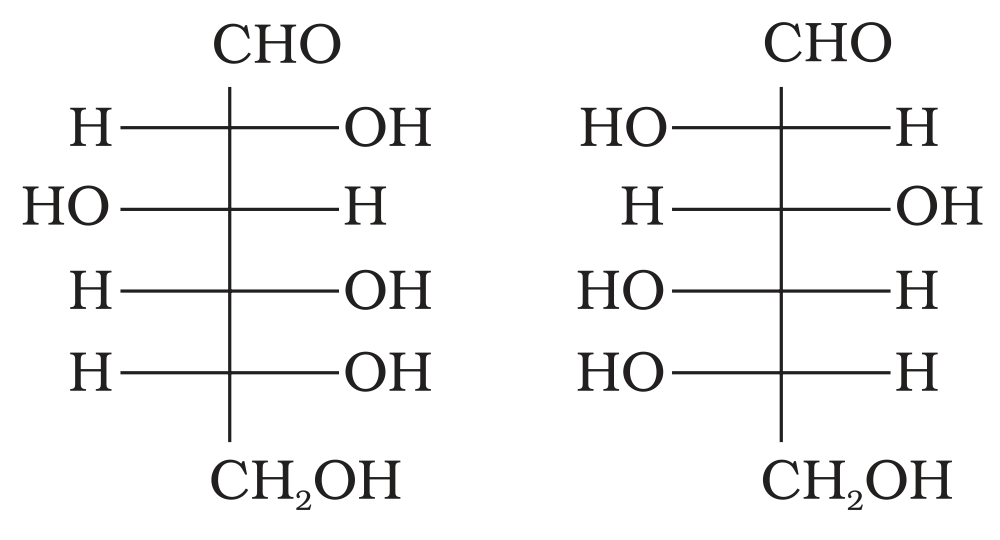
Which of the following pairs represents anomers?
  • A
  • B
  • D
Answer
Correct option: C.
​​​​Explanation:
The twocyclichemiacetalformsofglucosediffer only inthe configuration of the hydroxyl group at Cl, called anomeric carbon (the aldehyde carbon before cyclisation). Such isomers, i.e., alpha-form and beta-form, are called anomers.
View full question & answer
MCQ 171 Mark
Transition state structure of the substrate formed during an enzymatic reation is:
  • A
    Temporary but stable.
  • B
    Permanent but unstable.
  • Temporary and unstable.
  • D
    Permanent and stable.
Answer
Correct option: C.
Temporary and unstable.
During an enzymatic reaction, a substrate goes through a transition state before it becomes a product.
It is proposed that the transition state is bound more strongly than either the substrate or the product, however, the transition state is inherently unstable and are transient.
View full question & answer
MCQ 181 Mark
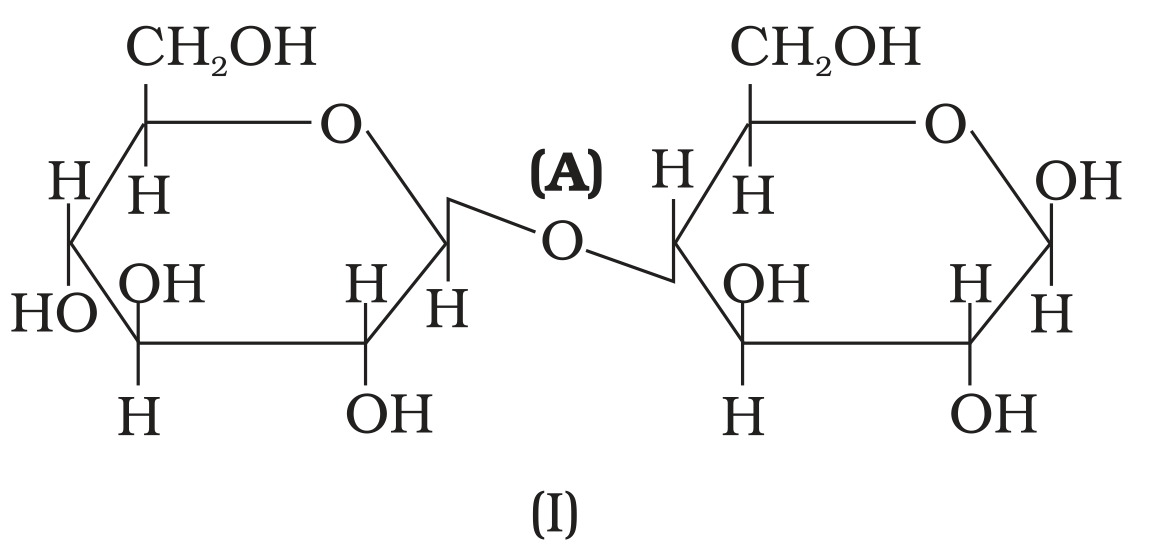
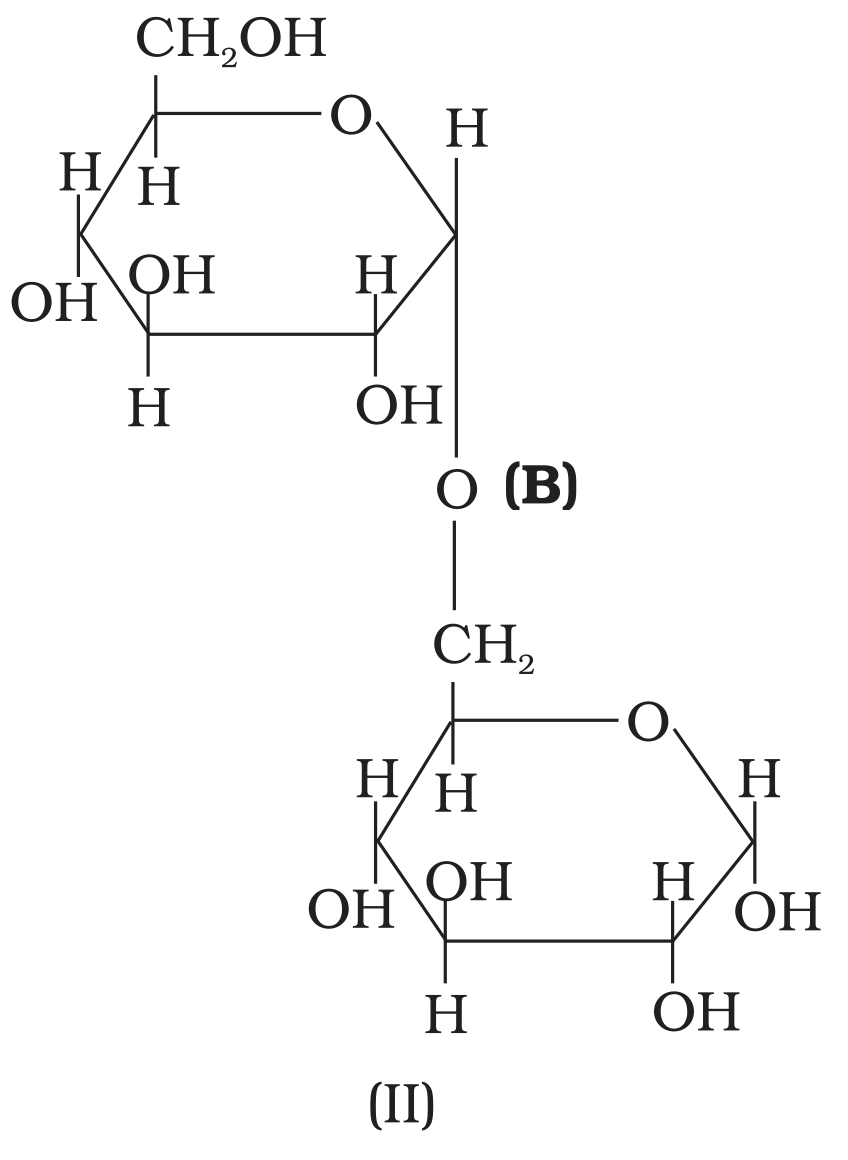
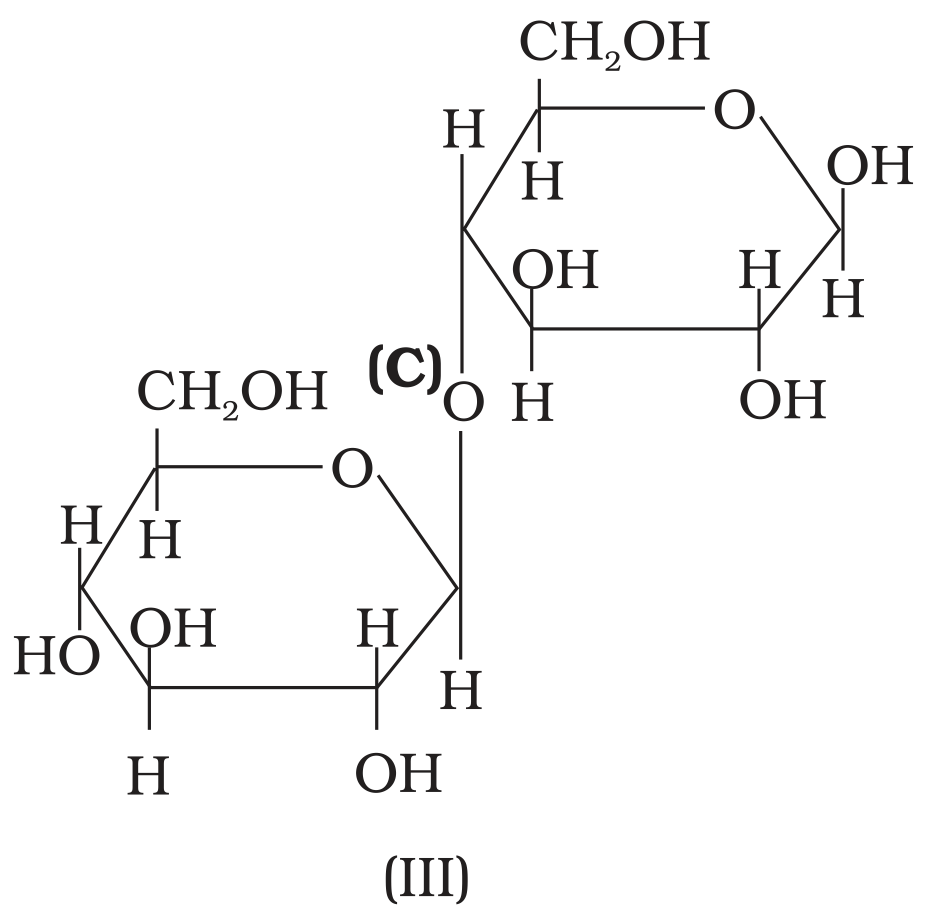
Three structures are given below in which two glucose units are linked. Which of these linkages between glucose units are between $\mathrm{C}_1$ and $\mathrm{C}_4$ and which linkages are between $\mathrm{C}_1$ and $\mathrm{C}_6$?


  • A
    (A) is between $\mathrm{C}_1$ and $\mathrm{C}_4$, (B) and (C) are between $\mathrm{C}_1$ and $\mathrm{C}_6$.
  • B
    (A) and (B) are between $\mathrm{C}_1$ and $\mathrm{C}_4$, (C) is between $\mathrm{C}_1$ and $\mathrm{C}_6$.
  • C
    (A) and (C) are between $\mathrm{C}_1$ and $\mathrm{C}_4$, (B) is between $\mathrm{C}_1$ and $\mathrm{C}_6$.
  • (A) and (C) are between $\mathrm{C}_1$ and $\mathrm{C}_6$, (B) is between $\mathrm{C}_1$ and $\mathrm{C}_4$.
Answer
Correct option: D.
(A) and (C) are between $\mathrm{C}_1$ and $\mathrm{C}_6$, (B) is between $\mathrm{C}_1$ and $\mathrm{C}_4$.
 d.  (A) and (C) are between $\mathrm{C}_1$ and $\mathrm{C}_6$, (B) is between $\mathrm{C}_1$ and $\mathrm{C}_4$.
View full question & answer
MCQ 191 Mark
$......$ are the chemical messengers that are used by multicellular organisms for control and coordination.
  • A
    Vitamins
  • B
    Minerals
  • C
    Antibiotics
  • Hormones
Answer
Correct option: D.
Hormones
Hormones are the chemical messengers that are produced by the endocrine system $($composed of glands$)$ but are transported to different parts of the body through the bloodstream.
Hormones play an important role in the control and coordination of the body.
For example, the growth of an individual is regulated by growth hormones secreted by the pituitary gland.
View full question & answer
MCQ 201 Mark
Which of the following is not produced by human body?
  • A
    Enzymes
  • Vitamins
  • C
    Proteins
  • D
    Nucleic acid
Answer
Correct option: B.
Vitamins
Vitamins are essential components of our diet and are not produced by our body.
View full question & answer
MCQ 211 Mark
Ergocalciferol is name of vitamin:
  • A
    $A$
  • B
    $B$
  • C
    $C$
  • $D_2$
Answer
Correct option: D.
$D_2$
Ergocalciferol is name of vitamin $D.$
This vitamin is essential for absorption of calcium and phosporus in the body.
It is used to treat and prevent bone disorders $($such as rickets, osteomalacia$).$
Vitamin $D$ is made by the body when skin is exposed to sunlight.
Ergocalciferol is name given to vitamin $D_2$​.
View full question & answer
MCQ 221 Mark
What is the chemical nature of the majority of prosthetic groups?
  • A
    Lipoidal
  • Organic
  • C
    Metallic
  • D
    Alkaloidal
Answer
Correct option: B.
Organic
A coenzyme or metal ion that is very tightly or even covalently bound to the enzyme protein is called a prosthetic group.
These may be organic or inorganic in nature. For example includes flavin nucleotides and heme.
This accentuates the enzymatic activity.
View full question & answer
MCQ 231 Mark
The most common reagent for qualitative and quantitative analysis of amino acids is:
  • A
    Ninhydrin reagent
  • Millon's reagent
  • C
    Sangars reagent
  • D
    Edmanns reagent
Answer
Correct option: B.
Millon's reagent
The most common reagent for qualitative and quantitative analysis of amino acids is Millon's reagent.
Million's reagent is a solution that is usually made by dissolving mercury in concentrated nitric acid and diluting with water and that when heated with phenolic compounds gives a red coloration, for proteins $($especially tyrosine amino acids$).$
View full question & answer
MCQ 241 Mark
The source of retinol $($vitamin $A)$ is:
  • A
    Liver
  • B
    Kidney
  • C
    Fish oils
  • All the above
Answer
Correct option: D.
All the above
The source of retinol $($vitamin $A)$ are liver kidney and fish oil. Retinol is that form of vitamin $A$ which is obtained from animal sources.
Vitamin $A$ comes from two sources. One group comes from animal sources and is called retinoids, which includes retinol.
The other group comes from plants and is called carotenoids, which includes beta$-$carotene. The body converts beta$-$carotene to vitamin $A.$
View full question & answer
MCQ 251 Mark
For the reduction of glucose to $n-$hexane, the reagent used is:
  • A
    $\text{HBr}$
  • B
    $\text{HCl}$
  • C
    $HF$
  • $HI$
Answer
Correct option: D.
$HI$
For the reduction of glucose to $n-$hexane, the reagent used is $HI.$
Glucose is heated with $HI$ and red phosphorus$, n-$hexane is obtained which suggests that all the six carbons are linked in a straight chain.
View full question & answer
MCQ 261 Mark
The enzymes are sensitive to:
  • A
    Cold
  • B
    Cell wall
  • Temperature
  • D
    Pressure
Answer
Correct option: C.
Temperature
Enzymes are proteinaceous in nature.
There are intra and intermolecular bonds that hold proteins in their secondary and tertiary structures.
The increase in the temperature over an optimum range leads to the disruption of bonds.
This makes the enzymes sensitive to heat.
View full question & answer
MCQ 271 Mark
Which of the following does not give silver mirror test with Tollen’s reagent?
  • Sucrose
  • B
    Glucose
  • C
    Fructose
  • D
    Lactose
Answer
Correct option: A.
Sucrose
Silver mirror test with Tollen's reagent is given by the molecule which contains aldehyde group. But, sucrose has no aldehyde group and rest of the molecule have aldehyde group.
Hence, glucose, fructose and lactose, each gives silver mirror test except sucrose.
View full question & answer
MCQ 281 Mark
Iodine stains:
  • A
    Pectin
  • B
    Lignified regions
  • C
    Cellulose
  • Starch.
Answer
Correct option: D.
Starch.
Iodine is used in chemistry as an indicator for starch. When starch is mixed with iodine in solution, an intensely dark blue colour develops, representing a starch/iodine complex.
Starch is a substance common to most plant cells and so a weak iodine solution will stain starch present in the cells. Iodine is one component in the staining technique known as Gram staining, used in microbiology.
View full question & answer
MCQ 291 Mark
Which of the following is correct about starch?
  • A
    It is a white cyrstalline powder.
  • B
    Coloured amorphous powder.
  • It is white-amorphous powder.
  • D
    Coloured crystalline compound.
Answer
Correct option: C.
It is white-amorphous powder.
Starchis white$-$amorphous powder. It a odourless, tasteless, solid carbohydrate, $\left(\mathrm{C}_6 \mathrm{H}_{10} \mathrm{O}_5\right) \mathrm{n}$​, occurring in the form of minute granules in the seeds tubers, and other parts of plants, and forming an important constituent of rice, corn, wheat, beans, potatoes and many other vegetable foods. It is used as a thickener or stabilizer.
View full question & answer
MCQ 301 Mark
Glycogen is a branched chain polymer of alpha$-D-$glucose units in which chain is formed by $C_1-C_4$ glycosidic linkage whereas branching occurs by the formation of $C_1-C_6$ glycosidic linkage. Structure of glycogen is similar to $.......$
  • A
    Amylose.
  • Amylopectin.
  • C
    Cellulose.
  • D
    Glucose.
Answer
Correct option: B.
Amylopectin.
Polysaccharides contain a large number of monosaccharide units joined together by glycosidic linkages. These are the most commonly encountered carbohydrates in nature. Amylopectin is insoluble in water and constitutes about $80-85\%$ of starch. It is a branched chain polymer of alpha$-D-$glucose units in which chain is formed by $C_1-C_4$ glycosidic linkage whereas branching occurs by $C_1-C_6$ glycosidic linkage.
View full question & answer
MCQ 311 Mark
Enzymes are found in all living cell. Their main functions is:
  • A
    To help in the digestion of food.
  • B
    To allow chemical to food reaction.
  • C
    To speed up the break down of substance.
  • To accelerate the rate of chemical reactions.
Answer
Correct option: D.
To accelerate the rate of chemical reactions.
Enzymes are biocatalysts that causes a change in the rate of a chemical reaction i.e they may enhance $($accelerate$)$ or reduce the rate of a chemical reaction.
View full question & answer
MCQ 321 Mark
The ratio of the enzyme to substrate molecule can be as high as $.........$
  • A
    $1 : 1000$
  • B
    $1 : 1,00,000$
  • $1 : 10,00,000$
  • D
    $1 : 50,000$
Answer
Correct option: C.
$1 : 10,00,000$
The enzyme attaches to the active site of the substrate. On attachment to the active site, the substrate is changed into the product. The active site has a residue that helps in the attachment of the substrate.
The substrate molecules form a temporary bond with the enzyme at the active site.
The ratio of enzyme to substrate molecules can be as high as $1 : 10,00,000.$ If the amount of substrate increases more than this, it will not get the vacant active site for attachment which terminates the reaction.
View full question & answer
MCQ 331 Mark
Nucleic acids are the polymers of $.......$
  • A
    Nucleosides
  • Nucleotides
  • C
    Bases
  • D
    Sugars
Answer
Correct option: B.
Nucleotides
Nucleic acids are long chain polymers of nucleotides, so they are also called polynucleotides.
View full question & answer
MCQ 341 Mark
Which of the following compound is not a vitamin?
  • A
    Niacin
  • B
    Riboflavin
  • C
    Thiamine
  • Guanine
Answer
Correct option: D.
Guanine
Guanine is is not a vitamin but it is a nitrogenous base. Niacin is called as vitamin $B_3​,$ riboflavin is vitamin $B_2$ and thiamine is vitamin $B_1​.$
View full question & answer
MCQ 351 Mark
Which of the following statements is not true about glucose?
  • A
    It is an aldohexose.
  • B
    On heating with $HI$ it forms $n-$hexane.
  • It is present in furanose form.
  • D
    It does not give $2,4-\text{DNP}$ test.
Answer
Correct option: C.
It is present in furanose form.
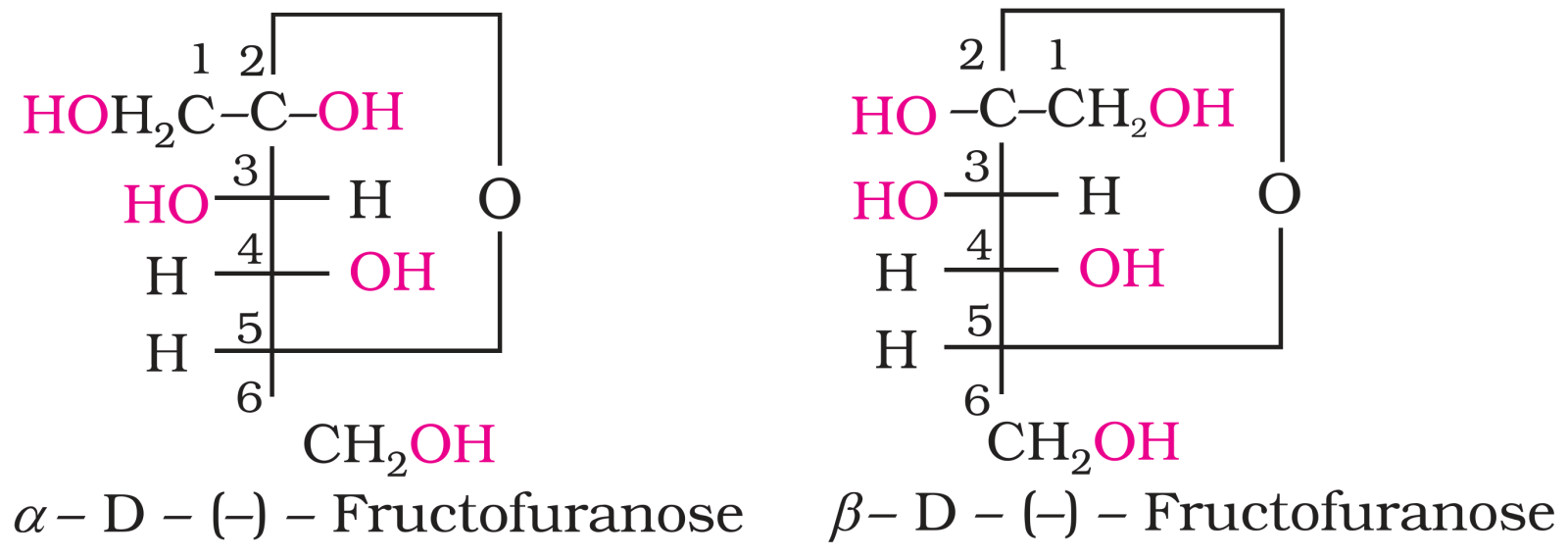
Fructose is present in furanose form.
View full question & answer
MCQ 361 Mark
Each polypeptide in a protein has aminoacids linked with each other in a specific sequence. This sequence of amino acids is said to be $.....$
  • Primary structure of proteins.
  • B
    Secondary structure of proteins.
  • C
    Tertiary structure of proteins.
  • D
    Quaternary structure of proteins.
Answer
Correct option: A.
Primary structure of proteins.
The sequence of amino acids in a polypeptide chain in called primary structure of proteins.
View full question & answer
MCQ 371 Mark
Which one of the following statements about starch is correct?
  • A
    It occurs in the cell walls of plants.
  • B
    It is a disaccharide.
  • It is present in roots and seeds of plants.
  • D
    It gives a red orange precipitate on boiling with Fehlings solution.
Answer
Correct option: C.
It is present in roots and seeds of plants.
Starch is the polysaccharide which is present in roots and seeds of plants.
It is present in all photosynthesis plants. It is present is seeds in form of granules.
View full question & answer
MCQ 381 Mark
The acidic amino acid is:
  • Aspartic acid
  • B
    Alycine
  • C
    Serine
  • D
    Tyrosine
Answer
Correct option: A.
Aspartic acid
An acidic amino acid contains more $-\text{COOH}$ groups than $-\mathrm{NH}_2$​ groups, which is the case of Aspartic acid among the given options.
View full question & answer
MCQ 391 Mark
Bile salts act as an activator of which enzyme?
  • A
    Pepsinogen
  • B
    Trypsinogen
  • Lipase
  • D
    Pancreatic amylase
Answer
Correct option: C.
Lipase
Bile salts act as activator of lipase as they emulsify fat globules into smaller droplet like structure called micelles thereby, increasing the surface area accessible to lipid hydrolyzing enzymes.
The bile acids also help to solubilize lipid breakdown products.
View full question & answer
MCQ 401 Mark
In fibrous proteins, polypeptide chains are held together by $.......$
$a.$ Van der Waals forces.
$b.$ Disulphide linkage.
$c.$ Electrostatic forces of attraction.
$d.$ Hydrogen bonds.
  • $a$ and $b$
  • B
    $a$ and $c$
  • C
    $b$ and $c$
  • D
    $b$ and $d$
Answer
Correct option: A.
$a$ and $b$
In fibrous proteins, main forces which stabilize structures of proteins are disulphide linkages and van der Waals.
View full question & answer
MCQ 411 Mark
Which of the following acids is a vitamin?
  • A
    Aspartic acid.
  • Ascorbic acid.
  • C
    Adipic acid.
  • D
    Saccharic acid.
Answer
Correct option: B.
Ascorbic acid.
Aspartic acid is vitamin $C.$ Aspartic acid is an amino acid. Adipic acid and saccharic acid are dicarboxylic acids.
View full question & answer
MCQ 421 Mark
Example of coenzyme is:
  • A
    $\text{COA}$
  • B
    $\text{NAD}$
  • C
    $\text{FAD}$
  • All of the above
Answer
Correct option: D.
All of the above
For some biochemical reactions, a substance other than enzymes and substrate is required.
These substances are called as coenzymes or cofactors.
The coenzymes usually serve as an acceptor or donor of an atom or a group, example $-$ nicotinamide adenine dinucleotide $(\text{NAD})$ which is derived from vitamin niacin, flavin adenine dinucleotide $\text{(FAD})$ which is derived from vitamin riboflavin, Coenzyme $A$ which is derived from pantothenate etc.
View full question & answer
MCQ 431 Mark
The prosthetic group present in nucleoproteins is:
  • Nucleic acids
  • B
    Lipids
  • C
    Carbohydrates
  • D
    Phosphoric acid
Answer
Correct option: A.
Nucleic acids
The prosthetic group present in nucleoproteins is nucleic acids.
Nucleoproteins are proteins of cell nuclei and are main component of chromatin.
They are present in every living cell a well as in virus and baceteria.
Example$-$ protamines, histones.
View full question & answer
MCQ 441 Mark
Guanine is an example of:
  • A nitrogenous base
  • B
    A nucleoside
  • C
    A nucleotide
  • D
    Phosphate
Answer
Correct option: A.
A nitrogenous base
The four nitrogenous bases present in $\text{DNA}$ are adenine $(A),$ guanine $(G)$, cytosine $(C)$ and thymine $(T).$
View full question & answer
MCQ 451 Mark
The term 'feed back' refers to the effect of:
  • A
    Substrate on the rate of enzymatic reaction.
  • End products on the rate of enzymatic reaction.
  • C
    Enzyme concentration on its rate of reaction.
  • D
    An external compound on the rate of enzymatic reactions.
Answer
Correct option: B.
End products on the rate of enzymatic reaction.
Feedback mechanism is a regulatory mechanism for the enzyme action where the end product inhibits the action of the enzyme when its concentration exceeds the need of the cell.
This helps to maintain the homeostasis.
The term 'feed back' refers to the effect of
View full question & answer
MCQ 461 Mark
Which one of the following bases is not present in $\text{DNA}\ ?$
  • A
    Thymine
  • Quinoline
  • C
    Adenine
  • D
    Cytosine
Answer
Correct option: B.
Quinoline
Quinoline is an alkaloid, it is not present in $\text{DNA}.$
$\text{DNA}$ has four nitrogen bases i.e. adenine $(A),$ guanine $(G),$ cytosine $(C)$ and thymine $(T).$
View full question & answer
MCQ 471 Mark
Which of the following statements about $\text{RNA}$ is not correct?
  • A
    It has a single strand.
  • B
    It does not undergo with the replication of bases.
  • It does not contain any pyrimidine base.
  • D
    It controls the synthesis of proteins.
Answer
Correct option: C.
It does not contain any pyrimidine base.
Cytosine is a pyrimidine base, and it is present in $\text{RNA}.$
View full question & answer
MCQ 481 Mark
In nucleic acids, the sequence is:
  • A
    Phosphate base sugar.
  • B
    Sugar phosphate base.
  • Phosphate $-$ sugar base.
  • D
    Base phosphate sugar.
Answer
Correct option: C.
Phosphate $-$ sugar base.
In nucleic acids, the sequence is phosphate$-$sugar base. Nucleic acids are polymeric macromolecules, or large biological molecules, essential for all known forms of life.
Nucleic acids, which include $\text{DNA}\ ($deoxyribonucleic acid$)$ and $\text{RNA} ($ribonucleic acid$),$ are made from monomers known as nucleotides.
Each nucleotide has three components$:$ a $5-$carbon sugar, a phosphate group and a nitrogenous base.
If the sugar is deoxyribose, the polymer is $\text{DNA}.$ If the sugar is ribose, the polymer is $\text{RNA}.$
In nucleic acids , the sequence is
View full question & answer
MCQ 491 Mark
A polysaccharide is a polymer of $......$
  • Monosaccharides
  • B
    Disaccharides
  • C
    Both $A$ and $B$
  • D
    None of these
Answer
Correct option: A.
Monosaccharides
A polysaccharide is a polymer of monosaccharides.
For example cellulose $($a polysaccharide$)$ is a polymer of $D-$glucose $($monosaccharide$).$
View full question & answer
MCQ 501 Mark
Lysine, $\text{H}_{2}\text{N}-(\text{CH}_{2})_{4}-\text{CH}-\text{COOH}\\ \ \ \ \ \ \ \ \ \ \ \ \ \ \ \ \ \ \ \ \ \ \ \ \ \ \ \ \ \ \ \ |\\ \ \ \ \ \ \ \ \ \ \ \ \ \ \ \ \ \ \ \ \ \ \ \ \ \ \ \ \ \ \ \text{NH}_{2}$ is $.......$
$a. \alpha-$Amino acid.
$b.$ Basic amino acid.
$c.$ Amino acid synthesised in body.
$d. \beta-$Amino acid.
  • $a$ and $b$
  • B
    $a$ and $c$
  • C
    $b$ and $c$
  • D
    $a$ and $d$
Answer
Correct option: A.
$a$ and $b$
View full question & answer
M.C.Q (1 Marks) - Chemistry STD 12 Science Questions - Vidyadip