Questions

5 Marks Questions

🎯

Test yourself on this topic

5 questions · timed · auto-graded

Question 15 Marks
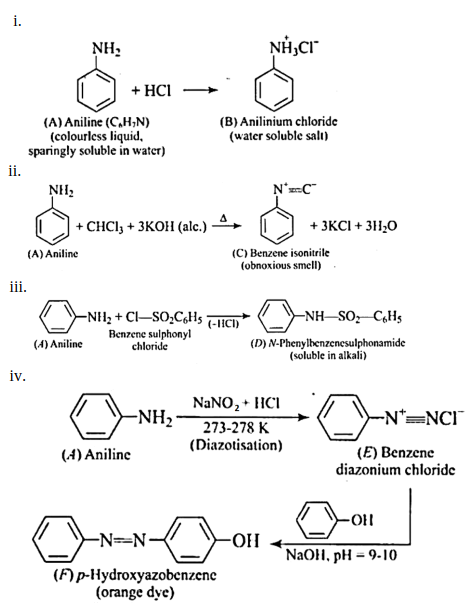
A colorless substance ' $A$ ' $\left( C _6 H _7 N\right)$ is sparingly soluble in water and gives a water-soluble compound ' B ' on treating with a mineral acid. On reacting with CHCl 3 and alcoholic potash ' A ' produces an obnoxious smell due to the formation of compound ' C '. The reaction of ' A ' with benzene sulphonyl chloride gives compound ' D ' which is soluble in alkali. With $NaNO _2$ and HCl , ' A ' forms compound ' E ' which reacts with phenol in alkaline medium to give an orange dye ' $F$ '. Identify compounds ' $A$ ' to ' $F$ '.
Answer
Substance 'A'-Aniline, 'B'-Anilinium chloride, 'C'-Benzene isonitrile, 'D'- N-phenylbenzene sulphonamide, 'E'-benzene diazonium chloride, 'F'-p- hydroxyazobenzene.
Image
View full question & answer
Question 25 Marks
Write IUPAC names of the following compounds and classify them into primary, secondary and tertiary amines.
1. $\left( CH _3\right)_2 CHNH _2$
2. $CH _3\left( CH _2\right)_2 NH _2$
3. $CH _3 NHCH \left( CH _3\right)_2$
4. $\left( CH _3\right)_3 CNH _2$
5. $C _6 H _5 NHCH _3$
Answer
i. Propan-2-amine (1º amine)
ii. Propan-1-amine (1º amine)
iii. N-Methyl-1-methylethanamine (2º amine)
iv. 2-Methylpropan-2-amine (1º amine)
v. N-Methylbenzamine or N-methylaniline (2ºamine)
View full question & answer
Question 35 Marks
What is crystal field splitting energy? How does the magnitude of $\Delta_0$ decide the actual configuration of d-orbitals in a coordination entity?
Answer
The degenerate d-orbitals (in a spherical field environment) split into two levels i.e., $e_g a n d, t_{2 g}$ in the presence of ligands. The splitting of the degenerate levels due to the presence of ligands is called the crystal-field splitting while the energy difference between the two levels ( $e_g$ and $t_{2 g}$ ) is called the crystal-field splitting energy. It is denoted by $\Delta_0$ After the orbitals have split, the filling of the electrons takes place. After 1 electron (each) has been filled in the three $t_{2 g}$ orbitals, the filling of the fourth electron takes place in two ways. It can enter the $e_g$ orbital (giving rise to $t_{2 g}^3 e_g^1$ like electronic configuration) or the pairing of the electrons can take place in the $t_{2 g}$ orbitals (giving rise to $t_{2 g}^4 e_g^0$ like electronic configuration). If the $\Delta_0$ value of a ligand is less than the pairing energy $( P )$, then the electrons enter the $e_g$ orbital. On the other hand, if the $\Delta_0$ value of a ligand is more than the pairing energy (P), then the electrons enter the $t_{2 g}$ orbital.
View full question & answer
Question 45 Marks
Specify the oxidation numbers of the metals in the following coordination entities:
i. $\left[ Co \left( H _2 O \right)( CN )( en )_2\right]^{2+}$
ii. $\left[ Pt ( Cl )_4\right]^{2-}$
iii. $K _3\left[ Fe ( CN )_6\right]$
iv. $\left[ Cr \left( NH _3\right)_3 Cl _3\right]$
View full question & answer
Question 55 Marks
(a) Differentiate between
a. Nucleotide and Nucleoside
b. Amylose and Amylopectin
(b) Write a reaction which shows that all the carbon atoms in glucose are linked in a straight chain.
(c) Write two differences between DNA and RNA.
(d) Amino acids can be classified as $\alpha-, \beta-, \gamma-, \delta-$ and so on depending upon the relative position of the amino group with respect to the carboxyl group. Which type of amino acids forms a polypeptide chain in proteins?
(e) What are any two good sources of vitamin A?
(f) What is anomeric carbon?
(g) What is the difference between a glycosidic linkage and a peptide linkage?
Answer
Attempt any five of the following:
(i)
a. Nitrogeneous base linked with pentose sugar called as nucleoside while Nucleoside linked with phosphate group is called as nucleotide.
b. Amylose is water soluble while amylopectin is water insoluble.
(ii) On prolonged heating with HI, glucose gives n-hexane which suggest that all the six carbon atoms in glucose are linked linearly.
HOH_2 $HOH _2 C \underset{\text { Glu cose }}{( CHOH )_4 CHO }+ HI \xrightarrow{\Delta} CH _3\left( CH _2\right)_4 CH _3$
(iii) 
DNARNA
Double strandedSingle stranded
Thymine base is presentUracil base is present

Image
(v) Milk, carrot
(vi)An anomeric carbon can be identified as the carbonyl carbon (of the aldehyde or ketone functional group) in the open- chain form of the sugar. It can also be identified as the carbon bonded to the ring oxygen and a hydroxyl group in the cyclic form.
(vii) Glycosidic linkage: It is the linkage which joins two monosaccharides through oxygen atom. It is present in carbohydrates.
Peptide Linkage: It is the linkage which joins two amino acids through - CO-NH- bond. It is present in proteins.
View full question & answer
5 Marks Questions - Chemistry STD 12 Science Questions - Vidyadip
