MCQ 1011 Mark
Choke coil works on the principle of
MCQ 1021 Mark
If a coil of $40$ turns and area $4.0 \mathrm{~cm}$ is suddenly removed from a magnetic field, it is observed that a charge of $2.0 \times 10^{-4} \mathrm{C}$ flows into the coil. If the resistance of the coil is $80 \Omega$, the magnetic flux density in $\mathrm{Wb} / \mathrm{m}^2$ is
Answer$\Delta Q=\frac{\Delta \phi}{R}=\frac{n \times B A}{R} $
$ \Rightarrow B=\frac{\Delta Q \cdot R}{n A}=\frac{2 \times 10^{-4} \times 80}{40 \times4 \times 10^{-4}}=1 \mathrm{~Wb} / \mathrm{m}^2$
View full question & answer→MCQ 1031 Mark
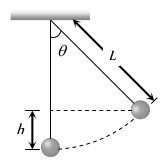
A simple pendulum with bob of mass $m$ and conducting wire of length $L$ swings under gravity through an angle $2 \theta$. The earth's magnetic field component in the direction perpendicular to swing is B. Maximum potential difference induced across the pendulum is
- ✓
$2 B L \sin \left(\frac{\theta}{2}\right)(g L)^{1 / 2}$
- B
$B L \sin \left(\frac{\theta}{2}\right)(g L)$
- C
$B L \sin \left(\frac{\theta}{2}\right)(g L)^{3 / 2}$
- D
$B L \sin \left(\frac{\theta}{2}\right)(g L)^2$
AnswerCorrect option: A. $2 B L \sin \left(\frac{\theta}{2}\right)(g L)^{1 / 2}$
View full question & answer→MCQ 1041 Mark
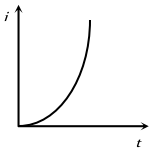
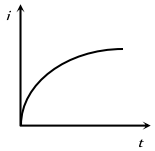
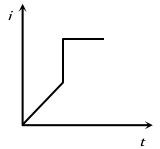
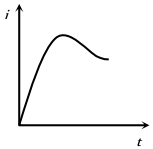
When attery is connected across a series combination of self inductance $L$ and resistance $R$, the variation in the current $i$ with time $t$ is best represented by
Answer$i=i_0\left(1-e^{-\frac{R}{L} t}\right)$
View full question & answer→MCQ 1051 Mark
An $L-R$ circuit has a cell of e.m.f. $E$, which is switched on at time $t=$ o. The current in the circuit after a long time will be
AnswerCorrect option: B. $\frac{E}{R}$
View full question & answer→MCQ 1061 Mark
A metal rod of length $2 \mathrm{~m}$ is rotating with an angular velocity of $100\ \mathrm{rad} / \mathrm{sec}$ in a plane perpendicular to a uniform magnetic field of $0.3$ $T$. The potential difference between the ends of the rod is
- A
$30 \mathrm{~V}$
- B
$40 \mathrm{~V}$
- ✓
$60 \mathrm{~V}$
- D
$600 \mathrm{~V}$
AnswerCorrect option: C. $60 \mathrm{~V}$
$e=\frac{1}{2} B l^2 \omega=\frac{1}{2} \times 0.3 \times(2)^2 \times 100=60 \mathrm{~V}$
View full question & answer→MCQ 1071 Mark
The magnetic flux linked with a circuit of resistance $100 \mathrm{ohm}$ increases from $10$ to $60$ webers. The amount of induced charge that flows in the circuit is (in coulomb)
AnswerInduced charge $Q=-\frac{N}{R}\left(\phi_2-\phi_1\right)=\frac{1}{100}(60-10)=0.5\ C$
View full question & answer→MCQ 1081 Mark
The magnetic flux linked with a vector area $\vec{A}$ in a uniform magnetic field $\vec{B}$ is
- A
$\vec{B} \times \vec{A}$
- B
$A B$
- ✓
$\vec{B} \cdot \vec{A}$
- D
$\frac{B}{A}$
AnswerCorrect option: C. $\vec{B} \cdot \vec{A}$
View full question & answer→MCQ 1091 Mark
Lenz's law is expressed by the following formula (here $e=$ induced e.m.f., $\phi=$ magnetic flux in one turn and $N=$ number of turns)
- A
$e=-\phi \frac{d N}{d t}$
- ✓
$e=-N \frac{d \dot{\phi}}{d t}$
- C
$e=-\frac{d}{d t}\left(\frac{\phi}{N}\right)$
- D
$e=N \frac{d \phi}{d t}$
AnswerCorrect option: B. $e=-N \frac{d \dot{\phi}}{d t}$
View full question & answer→MCQ 1101 Mark
The formula for induced e.m.f. in a coil due to change in magnetic flux through the coil is (here $A=$ area of the coil, $B=$ magnetic field)
- A
$e=-A \cdot \frac{d B}{d t}$
- B
$e=-B \cdot \frac{d A}{d t}$
- ✓
$e=-\frac{d}{d t}(A \cdot B)$
- D
$e=-\frac{d}{d t}(A \times B)$
AnswerCorrect option: C. $e=-\frac{d}{d t}(A \cdot B)$
View full question & answer→MCQ 1111 Mark
A transformer has $100$ turns in the primary coil and carries $8\ A$ current. If input power is one kilowatt, the number of turns required in the secondary coil to have $500 \mathrm{~V}$ output will be
Answer$ P_s=V_s i_s \Rightarrow 1000=V_s \times 8 \Rightarrow V_s=\frac{1000}{8} $
$ \frac{V_p}{V_s}=\frac{N_p}{N_s} \Rightarrow \frac{(1000 / 8)}{500}=\frac{100}{N_s} \Rightarrow N_s=400$
View full question & answer→MCQ 1121 Mark
In a circular conducting coil, when current increases from $2\ A$ to $18\ A$ in $0.05 \mathrm{sec}$, the induced e.m.f. is $20 \mathrm{~V}$. The self inductance of the coil is
- ✓
$62.5 \mathrm{mH}$
- B
$6.25 \mathrm{mH}$
- C
$50 \mathrm{mH}$
- D
AnswerCorrect option: A. $62.5 \mathrm{mH}$
$|e|=L \frac{d i}{d t} \Rightarrow 20=L \times \frac{(18-2)}{0.05} \Rightarrow L=62.5 \mathrm{mH}$
View full question & answer→MCQ 1131 Mark
A conducting rod of length $2 /$ is rotating with constant angular speed $\omega$ about its perpendicular bisector. A uniform magnetic field $\vec{B}$ exists parallel to the axis of rotation. The e.m.f. induced between two ends of the rod is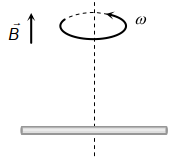
View full question & answer→MCQ 1141 Mark
Large transformers, when used for some time, become hot and are cooled by circulating oil. The heating of transformer is due to
- A
Heating effect of current alone
- B
- ✓
Both the hysteresis loss and heating effect of current
- D
AnswerCorrect option: C. Both the hysteresis loss and heating effect of current
View full question & answer→MCQ 1151 Mark
A solenoid has an inductance of 60 henrys and a resistance of $30$ ohms. If it is connected to a $100$ volt battery, how long will it take for the current to reach $\frac{e-1}{e} \approx 63.2 \%$ of its final value
- A
$1$ second
- B
$2$ seconds
- ✓
- D
$ 2$ e seconds
View full question & answer→MCQ 1161 Mark
A coil of inductance $40$ henry is connected in Oseries with a resistance of $8 \mathrm{ohm}$ and the combination is joined to the terminals of a $2$ volt battery. The time constant of the circuit is
- A
$40$ seconds
- B
$20$ seconds
- C
$8$ seconds
- ✓
$5$ seconds
AnswerCorrect option: D. $5$ seconds
$5$ seconds
View full question & answer→MCQ 1171 Mark
An e.m.f. of $12$ volt is produced in a coil when the current in it changes at the rate of $45\ \mathrm{amp} / \mathrm{minute}.$ The inductance of the coil is
- A
$0.25$ henry
- B
$1.5$ henry
- C
$9.6$ henry
- ✓
$16.0$ henry
AnswerCorrect option: D. $16.0$ henry
$e=L \frac{d i}{d t} \Rightarrow 12=L \times \frac{45}{60}$
$ \Rightarrow L=16 H$
View full question & answer→MCQ 1181 Mark
A $10$ metre wire kept in east-west falling with velocity $5\ \mathrm{m} / \mathrm{sec}$ perpendicular to the field $0.3 \times 10^{-4} \mathrm{~Wb} / \mathrm{m}^2$. The induced e.m.f. across the terminal will be
- A
$0.15 \mathrm{~V}$
- ✓
$1.5 \mathrm{mV}$
- C
$1.5 \mathrm{~V}$
- D
$15.0 \mathrm{~V}$
AnswerCorrect option: B. $1.5 \mathrm{mV}$
Induced e.m.f. $=$ Blv $=0.3 \times 10^{-4} \times 10 \times 5$
$=1.5 \times 10^{-3} \mathrm{~V}=1.5 \mathrm{mV}$
View full question & answer→MCQ 1191 Mark
In a step-up transformer the turn ratio is $1:10.$ A resistance of $200$ ohm connected across the secondary is drawing a current of $0.5 \mathrm{~A}$. What is the primary voltage and current
AnswerCorrect option: B. $10 V, 5 \mathrm{amp}$
$ N_p: N_s=1: 10 \text { and } V_s=0.5 \times 200=100 \mathrm{~V} $
$ \frac{V_s}{V_p}=\frac{N_s}{N_p} \Rightarrow \frac{100}{V_p}=\frac{10}{1} \Rightarrow V_p=10 \mathrm{~V}$
$ \frac{i_p}{i_s}=\frac{N_s}{N_p} \Rightarrow \frac{i_p}{0.5}=\frac{10}{1}, i_p=5 \mathrm{amp}$
View full question & answer→MCQ 1201 Mark
The energy stored in a $50\ \mathrm{mH}$ inductor carrying a current of $4\ A$ will be
- ✓
$0.4\ J$
- B
$4.0 \mathrm{~J}$
- C
$0.8 \mathrm{~J}$
- D
$0.04 \mathrm{~J}$
AnswerCorrect option: A. $0.4\ J$
$U=\frac{1}{2} L i^2=\frac{1}{2} \times\left(50 \times 10^{-3}\right) \times(4)^2=400 \times 10^{-3}=0.4\ J$
View full question & answer→MCQ 1211 Mark
- ✓
Change the alternating potential
- B
Change the alternating current
- C
To prevent the power loss in alternating current flow
- D
To increase the power of current source
AnswerCorrect option: A. Change the alternating potential
Change the alternating potential
View full question & answer→MCQ 1221 Mark
The self inductance of a solenoid of length $L$, area of cross-section $A$ and having $N$ turns is
- ✓
$\frac{\mu_0 N^2 A}{L}$
- B
$\frac{\mu_0 N A}{L}$
- C
$\mu_0 N^2 L A$
- D
$\mu_0 N A L$
AnswerCorrect option: A. $\frac{\mu_0 N^2 A}{L}$
View full question & answer→MCQ 1231 Mark
A circular coil of $500$ turns of wire has an enclosed area of $0.1 \mathrm{~m}^2$ per turn. lt is kept perpendicular to a magnetic field of induction $0.2 \ T$ and rotated by $180^{\circ}$ about a diameter perpendicular to the field in $0.1 \mathrm{sec}$. How much charge will pass when the coil is connected to a galvanometer with a combined resistance of $50 \mathrm{ohms}$
- A
$0.2 C$
- ✓
$0.4 C$
- C
$2 C$
- D
$4 C$
AnswerCorrect option: B. $0.4 C$
$ \Delta Q=\frac{N B A}{R}\left(\cos \theta_1-\cos \theta_2\right) $.
$ =\frac{500 \times 0.2 \times 0.1(\cos 0-\cos 180)}{50}=0.4 \mathrm{C}$
View full question & answer→MCQ 1241 Mark
A step up transformer connected to a $220 V A C$ line is to supply $22 k V$ for a neon sign in secondary circuit. In primary circuit a fuse wire is connected which is to blow when the current in the secondary circuit exceeds $10 \mathrm{~mA}$. The turn ratio of the transformer is
View full question & answer→MCQ 1251 Mark
A power transformer is used to step up an alternating e.m.f. of $220 V$ to $11 \mathrm{kV}$ to transmit $4.4 \mathrm{~kW}$ of power. If the primary coil has $1000$ turns, what is the current rating of the secondary ? Assume $100 \%$ efficiency for the transformer
- A
$4 A$
- ✓
$0.4 \mathrm{~A}$
- C
$0.04 \mathrm{~A}$
- D
$0.2 \mathrm{~A}$
AnswerCorrect option: B. $0.4 \mathrm{~A}$
$0.4 \mathrm{~A}$
View full question & answer→MCQ 1261 Mark
A circular coil of radius $5 \mathrm{~cm}$ has $500$ turns of a wire. The approximate value of the coefficient of self induction of the coil will be
- A
$25$ millihenry
- ✓
$25 \times 10^{-3}$ millihenry
- C
$50 \times 10^{-3}$ millihenry
- D
$50 \times 10^{-3}$ henry
AnswerCorrect option: B. $25 \times 10^{-3}$ millihenry
$\phi=L i \Rightarrow N B A=L i$
Since magnetic field at the centre of circular coil carrying current is given by
$B=\frac{\mu_0}{4 \pi} \cdot \frac{2 \pi N i}{r}$
$\therefore N \cdot \frac{\mu_0}{4 \pi} \cdot \frac{2 \pi N i}{r} \cdot \pi r^2=L i \Rightarrow L=\frac{\mu_0 N^2 \pi r}{2}$
Hence self inductance of a coil$=\frac{4 \pi \times 10^{-7} \times 500 \times 500 \times \pi \times 0.05}{2}=25 \mathrm{mH}$
View full question & answer→MCQ 1271 Mark
An e.m.f. of $100$ millivolts is induced in a coil when the current in another nearby coil becomes $10$ ampere from zero in $0.1$ second. The coefficient of mutual induction between the two coils will be
- ✓
$1$ millihenry
- B
$10$ millihenry
- C
$100$ millihenry
- D
$1000$ millihenry
AnswerCorrect option: A. $1$ millihenry
$ \text { Induced e.m.f. } e=M \frac{d i}{d t} $
$\Rightarrow 100 \times 10^{-3}=M\left(\frac{10}{0.1}\right) $
$ \therefore M=10^{-3} H=1 \mathrm{mH}$
View full question & answer→MCQ 1281 Mark
The north pole of a bar magnet is moved swiftly downward towards a closed coil and then second time it is raised upwards slowly. The magnitude and direction of the induced currents in the two cases will be of
- A
Low value clockwise / Higher value anticlockwise
- B
Low value clockwise/ Equal value anticlockwise
- C
Higher value clockwise / Low value clockwise
- ✓
Higher value anticlockwise / Low value clockwise
AnswerCorrect option: D. Higher value anticlockwise / Low value clockwise
View full question & answer→MCQ 1291 Mark
The coils of a step down transformer have $500$ and $5000$ turns. In the primary coil an ac of $4$ ampere at $2200$ volts is sent. The value of the current and potential difference in the secondary coil will be
- A
$20 \mathrm{~A}, 220 \mathrm{~V}$
- ✓
$0.4 A, 22000 \mathrm{~V}$
- C
$40 \mathrm{~A}, 220 \mathrm{~V}$
- D
$40 \mathrm{~A}, 22000 \mathrm{~V}$
AnswerCorrect option: B. $0.4 A, 22000 \mathrm{~V}$
$0.4 A, 22000 \mathrm{~V}$
View full question & answer→MCQ 1301 Mark
The number of turns of primary and secondary coils of a transformer are $5$ and $10$ respectively and the mutual inductance of the transformer is $25$ henry. Now the number of turns in the primary and secondary of the transformer are made $10$ and $5$ respectively. The mutual inductance of the transformer in henry will be
View full question & answer→MCQ 1311 Mark
An ideal coil of $10$ henry is joined in series with a resistance of $5$ ohm and a battery of $5$ volt. $2$ second after joining, the current flowing in ampere in the circuit will be
- A
$e^{-1}$
- ✓
$\left(1-e^{-1}\right)$
- C
$(1-e)$
- D
$e$
AnswerCorrect option: B. $\left(1-e^{-1}\right)$
From $i=i_0\left[1-e^{-R t / L}\right]$, where $i_0=\frac{5}{5}=1 \mathrm{amp}$
$\therefore i=1\left(1-e^{\frac{-5 \times 2}{10}}\right)=\left(1-e^{-1}\right) a m p$
View full question & answer→MCQ 1321 Mark
When current in a coil changes to $2$ ampere from $8$ ampere in $3 \times 10^{-3} \mathrm{sec}$ ond , the e.m.f. induced in the coil is $2$ volt. The self inductance of the coil in millihenry is
Answer$e=L \frac{d i}{d t} \Rightarrow 2=L \times \frac{6}{3 \times 10^{-3}}$
$ \Rightarrow L=1 \mathrm{mH}$
View full question & answer→MCQ 1331 Mark
$5 \mathrm{~cm}$ long solenoid having $10 \mathrm{ohm}$ resistance and $5 \mathrm{mH}$ inductance is joined to a 10 volt battery. At steady state the current through the solenoid in ampere will be
AnswerIn steady state current passing through solenoid
$i=\frac{E}{R}=\frac{10}{10}=1 \mathrm{~A}$
View full question & answer→MCQ 1341 Mark
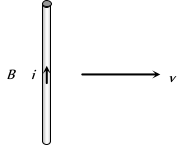
A conducting wire is moving towards right in a magnetic field $B$. The direction of induced current in the wire is shown in the figure. The direction of magnetic field will be
- A
In the plane of paper pointing towards right
- B
In the plane of paper pointing towards left
- ✓
Perpendicular to the plane of paper and down-wards
- D
Perpendicular to the plane of paper and upwards
AnswerCorrect option: C. Perpendicular to the plane of paper and down-wards
According to Fleming right hand rule, the direction of $B$ will be perpendicular to the plane of paper and act downward.
View full question & answer→MCQ 1351 Mark
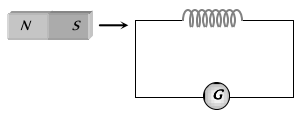
As shown in the figure, a magnet is moved with a fast speed towards a coil at rest. Due to this induced electromotive force, induced current and induced charge in the coil is $E, I$ and $Q$ respectively. If the speed of the magnet is doubled, the incorrect statement is
- A
$E$ increases
- B
$I$ increases
- C
$Q$ remains same
- ✓
$Q$ increases
AnswerCorrect option: D. $Q$ increases
Induced charge doesn't depend upon the speed of magnet.
View full question & answer→MCQ 1361 Mark
Dynamo core is laminated because
- A
- B
Magnetic saturation level in core increases
- C
Residual magnetism in core decreases
- ✓
Loss of energy in core due to eddy currents decreases
AnswerCorrect option: D. Loss of energy in core due to eddy currents decreases
View full question & answer→MCQ 1371 Mark
The self inductance of a coil is $5$ henry, a current of $1$ amp change to $2$ amp within $5$ second through the coil. The value of induced e.m.f. will be
- A
$10$ volt
- B
$0.10$ volt
- ✓
$1.0$ volt
- D
$100$ volt
AnswerCorrect option: C. $1.0$ volt
$e=-L \frac{d i}{d t} \Rightarrow e=5 \times \frac{1}{5}=1$ volt
View full question & answer→MCQ 1381 Mark
The direction of induced e.m.f. during electromagnetic induction is given by
MCQ 1391 Mark
In $L-R$ circuit, for the case of increasing current, the magnitude of current can be calculated by using the formula
AnswerCorrect option: C. $ I=I_0\left(1-e^{R t / L}\right)$
When battery disconnected current through the circuit start decreasing exponentially according to
$i=i_0 e^{-R t / L}$
$\Rightarrow 0.37 i_0=i_0 e^{-R t / L} $
$\Rightarrow 0.37=\frac{1}{e}=e^{-R t / L} $
$\Rightarrow t=\frac{L}{R}$
View full question & answer→MCQ 1401 Mark
Mutual inductance of two coils can be increased by
- A
Decreasing the number of turns in the coils
- ✓
Increasing the number of turns in the coils
- C
Winding the coils on wooden core
- D
AnswerCorrect option: B. Increasing the number of turns in the coils
View full question & answer→MCQ 1411 Mark
According to Faraday's law of electromagnetic induction
- A
The direction of induced current is such that it opposes the cause producing it
- ✓
The magnitude of induced e.m.f. produced in a coil is directly proportional to the rate of change of magnetic flux
- C
The direction of induced e.m.f. is such that it opposes the cause producing it
- D
AnswerCorrect option: B. The magnitude of induced e.m.f. produced in a coil is directly proportional to the rate of change of magnetic flux
View full question & answer→MCQ 1421 Mark
A $50$ turns circular coil has a radius of $3 \mathrm{~cm}$, it is kept in a magnetic field acting normal to the area of the coil. The magnetic field $B$ increased from $0.10$ tesla to $0.35$ tesla in $2$ milliseconds. The average induced e.m.f. in the coil is
- A
$1.77$ volts
- ✓
$17.7$ volts
- C
$177$ volts
- D
$0.177$ volts
AnswerCorrect option: B. $17.7$ volts
$ e=-\frac{N\left(B_2-B_1\right) A \cos \theta}{\Delta t}$
$ =-\frac{50(0.35-0.10) \times \pi\left(3 \times 10^{-2}\right)^2 \times \cos 0^{\circ}}{2 \times 10^{-3}}=17.7 \mathrm{~V} .$
View full question & answer→MCQ 1431 Mark
A $50$ volt potential difference is suddenly applied to a coil with $L=5 \times 10^{-3}$ henry and $R=180 \mathrm{ohm}$. The rate of increase of current after $0.001$ second is
- A
$27.3 \mathrm{amp} / \mathrm{sec}$
- B
$27.8 \mathrm{amp} / \mathrm{sec}$
- C
$2.73 \mathrm{amp} / \mathrm{sec}$
- ✓
View full question & answer→MCQ 1441 Mark
The efficiency of transformer is very high because
- ✓
There is no moving part in a transformer
- B
lt produces very high voltage
- C
It produces very low voltage
- D
AnswerCorrect option: A. There is no moving part in a transformer
There is no moving part in a transformer
View full question & answer→MCQ 1451 Mark
A coil has $2000$ turns and area of $70 \mathrm{~cm}^2$. The magnetic field perpendicular to the plane of the coil is $0.3 \mathrm{~Wb} / \mathrm{m}^2$ and takes $0.1 \mathrm{sec}$ to rotate through $180^{\circ}$. The value of the induced e.m.f. will be
- A
$8.4 \mathrm{~V}$
- ✓
$84 \mathrm{~V}$
- C
$42 \mathrm{~V}$
- D
$4.2 \mathrm{~V}$
AnswerCorrect option: B. $84 \mathrm{~V}$
$ e=-\frac{N B A\left(\cos \theta_2-\cos \theta_1\right)}{\Delta t}$
$ =-2000 \times 0.3 \times 70 \times 10^{-4} \frac{(\cos 180-\cos 0)}{0.1} $
$ \Rightarrow e=84 \mathrm{~V}$
View full question & answer→MCQ 1461 Mark
Two different loops are concentric and lie in the same plane. The current in the outer loop is clockwise and increasing with time. The induced current in the inner loop then, is
- A
- B
- ✓
- D
In a direction that depends on the ratio of the loop radii
AnswerThe induced current will be in such a direction so that it opposes the change due to which it is produced.
View full question & answer→MCQ 1471 Mark
We can reduce eddy currents in the core of transformer
MCQ 1481 Mark
The coil of dynamo is rotating in a magnetic field. The developed induced e.m.f. changes and the number of magnetic lines of force also changes. Which of the following condition is correct
- A
Lines of force minimum but induced e.m.f. is zero
- B
Lines of force maximum but induced e.m.f. is zero
- ✓
Lines of force maximum but induced e.m.f. is not zero
- D
Lines of force maximum but induced e.m.f. is also maximum
AnswerCorrect option: C. Lines of force maximum but induced e.m.f. is not zero
Lines of force maximum but induced e.m.f. is not zero
View full question & answer→MCQ 1491 Mark
The alternating voltage induced in the secondary coil of a transformer is mainly due to
- ✓
- B
- C
The vibrations of the primary coil
- D
The iron core of the transformer
View full question & answer→MCQ 1501 Mark
In a step-up transformer, the turn ratio is $1:2.$ A Leclanche cell (e.m.f. $1.5 \mathrm{~V}$ ) is connected across the primary. The voltage developed in the secondary would be
- A
$3.0 \mathrm{~V}$
- ✓
$0.75 \mathrm{~V}$
- C
$1.5 \mathrm{~V}$
- D
AnswerCorrect option: B. $0.75 \mathrm{~V}$
View full question & answer→