MCQ 11 Mark
A hemispherical bowl just floats without sinking in a liquid of density $1.2 \times 10 kg / m$. If outer diameter and the density of the bowl are $1 m$ and $2 \times 10 kg / m$ respectively, then the inner diameter of the bowl will be
- A
$0.94 m$
- B
$0.97 m$
- ✓
$0.98 m$
- D
$0.99 m$
AnswerCorrect option: C. $0.98 m$
View full question & answer→MCQ 21 Mark
Water is flowing through a tube of non-uniform cross-section ratio of the radius at entry and exit end of the pipe is $3: 2$. Then the ratio of velocities at entry and exit of liquid is
- ✓
$4: 9$
- B
$9: 4$
- C
$8: 27$
- D
$1: 1$
AnswerCorrect option: A. $4: 9$
If velocities of water at entry and exit points are $v_1$ and $v_2$, then according to equation of continuity
$A_1v_1=A_2v_2\Rightarrow \frac{v_1}{v_2}=\frac{A_2}{A_1}=\left(\frac{r_2}{r_1}\right)^2=\left(\frac{2}{3}\right)^2=\frac{4}{9}$
View full question & answer→MCQ 31 Mark
If pressure at half the depth of a lake is equal to $2 / 3$ pressure at the bottom of the lake then what is the depth of the lake
- A
$10 m$
- ✓
$20 m$
- C
$60 m$
- D
$30 m$
AnswerCorrect option: B. $20 m$
(b) Pressure at bottom of the lake $=P_0+h \rho g$
Pressure at half the depth of a lake $=P_0+\frac{h}{2} \rho g$
According to given condition
$P_0+\frac{1}{2} h \rho g=\frac{2}{3}\left(P_0+h \rho g\right) $
$\Rightarrow \frac{1}{3} P_0=\frac{1}{6} h \rho g$
$\Rightarrow h=\frac{2 P_0}{\rho g}=\frac{2 \times 10^5}{10^3\times10}=20\mathrm{~m}$
View full question & answer→MCQ 41 Mark
In which one of the following cases will the liquid flow in a pipe be most streamlined
- A
Liquid of high viscosity and high density flowing through a pipe of small radius
- ✓
Liquid of high viscosity and low density flowing through a pipe of small radius
- C
Liquid of low viscosity and low density flowing through a pipe of large radius
- D
Liquid of low viscosity and high density flowing through a pipe of large radius
AnswerCorrect option: B. Liquid of high viscosity and low density flowing through a pipe of small radius
(b) For streamline flow, Reynold's number $N_R \propto \frac{r \rho}{\eta}$ should be less. For less value of $N_R$, radius and density should be small and viscosity should be high.
View full question & answer→MCQ 51 Mark
Water falls from a tap, down the streamline
MCQ 61 Mark
Water is flowing through a horizontal pipe of non-uniform crosssection. At the extreme narrow portion of the pipe, the water will have
- ✓
Maximum speed and least pressure
- B
Maximum pressure and least speed
- C
Both pressure and speed maximum
- D
Both pressure and speed least
AnswerCorrect option: A. Maximum speed and least pressure
View full question & answer→MCQ 71 Mark
Two drops of the same radius are falling through air with a steady velocity of $5\ cm$ per sec. If the two drops coalesce, the terminal velocity would be
AnswerCorrect option: C. $5 \times(4)^{1 / 3} cm$ per $sec$
If two drops of same radius $r$ coalesce then radius of new drop is given by $R$$\frac{4}{3} \pi R^3=\frac{4}{3} \pi r^3+\frac{4}{3} \pi r^3 \Rightarrow R^3=2 r^3\Rightarrow R=2^{1 / 3} r$
If drop of radius $r$ is falling in viscous medium then it acquire acritical velocity $(v)$ and $(v) \propto r^2$
$\frac{v_2}{v_1}=\left(\frac{R}{r}\right)^2=\left(\frac{2^{1 / 3} r}{r}\right)^2$
$\Rightarrow v_2=2^{2 / 3} \times v_1=2^{2/3}\times(5)=5\times(4)^{1/ 3} \mathrm{~m} / \mathrm{s}$
View full question & answer→MCQ 81 Mark
A small sphere of mass $m$ is dropped from a great height. After it has fallen $100 m$, it has attained its terminal velocity and continues to fall at that speed. The work done by air friction against the sphere during the first $100 m$ of fall is
AnswerCorrect option: B. Less than the work done by air friction in the second $100 m$
(b) In the first $100 \mathrm{~m}$ body starts from rest and its velocity goes onincreasing and after $100 \mathrm{~m}$ it acquire maximum velocity (terminal velocity). Further, air friction i.e. viscous force which is proportional to velocity is low in the beginning and maximum at $v=v_T$.Hence work done against air friction in the first 100 $m$ is less than the work done in next $100 \mathrm{~m}$.
View full question & answer→MCQ 91 Mark
A tank is filled with water up to a height $H$. Water is allowed to come out of a hole $P$ in one of the walls at a depth $D$ below the surface of water. Express the horizontal distance $x$ in terms of $H$ and $D$
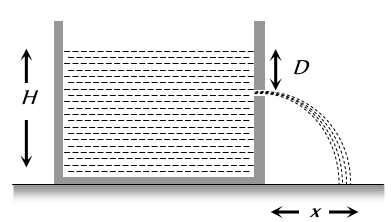
AnswerCorrect option: C. $x=2 \sqrt{D(H-D)}$
(c) Time taken by water to reach the bottom$=t=\sqrt{\frac{2(H-D)}{g}}$and velocity of water coming out of hole, $v=\sqrt{2 g D}$$\therefore$ Horizontal distance covered $x=v \times t$$=\sqrt{2 g D} \times \sqrt{\frac{2(H-D)}{g}}=2 \sqrt{D(H-D)}$
View full question & answer→MCQ 101 Mark
Two water pipes of diameters $2 cm$ and $4 cm$ are connected with the main supply line. The velocity of flow of water in the pipe of 2 $cm$ diameter is
AnswerCorrect option: A. 4 times that in the other pipe
$d_A=2 \mathrm{~cm}$ and $d_B=4 \mathrm{~cm} \quad \therefore r_A=1 \mathrm{~cm}$ and $r_B=2 \mathrm{~cm}$
From equation of continuity, $a v=$ constant
$\therefore \frac{v_A}{v_B}=\frac{a_B}{a_A}=\frac{\pi\left(r_B\right)^2}{\pi\left(r_A\right)^2}=\left(\frac{2}{1}\right)^2 \Rightarrow v_A=4 v_B$
View full question & answer→MCQ 111 Mark
A manometer connected to a closed tap reads $4.5 \times 10^5$ pascal. When the tap is opened the reading of the manometer falls to $4 \times 10^5$ pascal. Then the velocity of flow of water is
- A
$7 ms ^{-1}$
- B
$8 ms ^{-1}$
- C
$9 ms ^{-1}$
- ✓
$10 ms ^{-1}$
AnswerCorrect option: D. $10 ms ^{-1}$
(d) $\frac{P_1-P_2}{\rho g}=\frac{v^2}{2 g} \Rightarrow \frac{4.5 \times 10^5-4 \times 10^5}{10^3 \times g}=\frac{v^2}{2 g} \therefore v=10 \mathrm{~m} / \mathrm{s}$
View full question & answer→MCQ 121 Mark
Construction of submarines is based on
MCQ 131 Mark
An incompressible fluid flows steadily through a cylindrical pipe which has radius $2 r$ at point $A$ and radius $r$ at $B$ further along the flow direction. If the velocity at point $A$ is $v$, its velocity at point $B$ is
- A
$2 v$
- B
$v$
- C
$v / 2$
- ✓
$4 v$
View full question & answer→MCQ 141 Mark
What is the velocity $v$ of a metallic ball of radius $r$ falling in a tank of liquid at the instant when its acceleration is one-half that of a freely falling body ? (The densities of metal and of liquid are $\rho$ and $\sigma$ respectively, and the viscosity of the liquid is $\eta$ ).
- A
$\frac{r^2 g}{9 \eta}(\rho-2 \sigma)$
- B
$\frac{r^2 g}{9 \eta}(2 \rho-\sigma)$
- ✓
$\frac{r^2 g}{9 \eta}(\rho-\sigma)$
- D
$\frac{2 r^2 g}{9 \eta}(\rho-\sigma)$
AnswerCorrect option: C. $\frac{r^2 g}{9 \eta}(\rho-\sigma)$
View full question & answer→MCQ 151 Mark
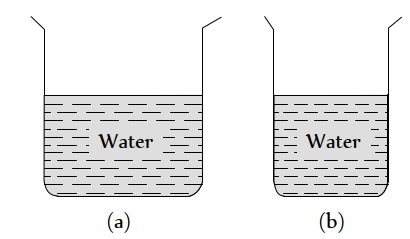
From the adjacent figure, the correct observation is
- A
The pressure on the bottom of tank is greater than at the bottom of .
- B
The pressure on the bottom of the tank is smaller than at the bottom of
- C
The pressure depend on the shape of the container
- ✓
The pressure on the bottom of and is the same
AnswerCorrect option: D. The pressure on the bottom of and is the same
(d) Pressure $=h \rho g$ i.e. pressure at the bottom is independent of the area ofthebottom of the tank. It depends on the height of water upto which the tank is filled with water. As in both the tanks, the levels of water are the same, pressure at the bottom is also the same.
View full question & answer→MCQ 161 Mark
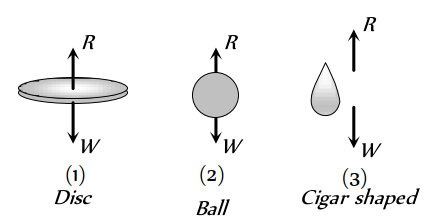
When a body falls in air, the resistance of air depends to a great extent on the shape of the body, 3 different shapes are given. ldentify the combination of air resistances which truly represents the physical situation. (The cross sectional areas are the same).
- A
$1<2<3$
- B
$2<3<1$
- ✓
$3<2<1$
- D
$3<1<2$
AnswerCorrect option: C. $3<2<1$
(c) A stream lined body has less resistance due to air.
View full question & answer→MCQ 171 Mark
A boat carrying steel balls is floating on the surface of water in a tank. If the balls are thrown into the tank one by one, how will it affect the level of water
- A
- B
- ✓
- D
First it will first rise and then fall
View full question & answer→MCQ 181 Mark
A large open tank has two holes in the wall. One is a square hole of side $L$ at a depth $y$ from the top and the other is a circular hole of radius $R$ at a depth $4\ y$ from the top. When the tank is completely filled with water the quantities of water flowing out per second from both the holes are the same. Then $R$ is equal to
- A
$2 \pi L$
- ✓
$\frac{L}{\sqrt{2 \pi}}$
- C
$L$
- D
$\frac{L}{2 \pi}$
AnswerCorrect option: B. $\frac{L}{\sqrt{2 \pi}}$
Velocity of efflux when the hole is at depth $h$ $v=\sqrt{2 g h}$
Rate of flow of water from square hole$Q_1=a_1 v_1=L^2 \sqrt{2 g y}$
Rate of flow of water from circular hole$Q_2=a_2 v_2=\pi R^2 \sqrt{2 g(4 y)}$
According to problem $Q_1=Q_2$
$\Rightarrow L^2 \sqrt{2 g y}=\pi R^2 \sqrt{2 g(4 y)}$
$ \Rightarrow R=\frac{L}{\sqrt{2 \pi}}$
View full question & answer→MCQ 191 Mark
A block of ice floats on a liquid of density $1.2$in a beaker then level of liquid when ice completely melt
AnswerThe volume of liquid displaced by floating ice$V_D=\frac{M}{\sigma_L}$Volume of water formed by melting ice, $V_F=\frac{M}{\sigma_W}$ If $\sigma_1>\sigma_W$, then, $\frac{M}{\sigma_L}<\frac{M}{\sigma_W}$ i.e. $V_D
View full question & answer→MCQ 201 Mark
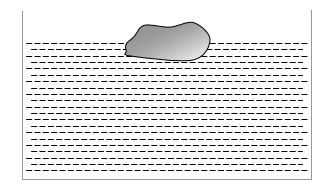
A body floats in a liquid contained in a beaker. The whole system as shown falls freely under gravity. The upthrust on the body due to the liquid is
- ✓
- B
Equal to the weight of the liquid displaced
- C
Equal to the weight of the body in air
- D
Equal to the weight of the immersed position of the body
AnswerUpthrust $=V \rho_{\text {liquid }}(g-a)$ where, $a=$ downward acceleration, $V=$ volume of liquid displaced But for free fall
$a=g \therefore$ Upthrust $=0$
View full question & answer→MCQ 211 Mark
A square plate of $0.1 m$ side moves parallel to a second plate with a velocity of $0.1 m / s$, both plates being immersed in water. If the viscous force is $0.002 N$ and the coefficient of viscosity is 0.01 poise, distance between the plates in $m$ is
- A
$0.1$
- B
$0.05$
- C
$0.005$
- ✓
$0.0005$
AnswerCorrect option: D. $0.0005$
(d)
$A=(0.1)^2=0.01 \mathrm{~m}^2, $
$\eta=0.01 \text { Poise }=0.001 \text { decapoise (M.K.S. unit), } $
$d v=0.1 \mathrm{~m} / \mathrm{s} \text { and } F=0.002 \mathrm{~N} $
$F=\eta A \frac{d v}{d x} $
$\therefore d x=\frac{\eta A d v}{F}=\frac{0.001 \times 0.01 \times 0.1}{0.002}=0.0005 \mathrm{~m} .$
View full question & answer→MCQ 221 Mark
The rate of steady volume flow of water through a capillary tube of length ' $I$ and radius ' $r$ ' under a pressure difference of $P$ is $V$. This tube is connected with another tube of the same length but half the radius in series. Then the rate of steady volume flow through them is (The pressure difference across the combination is $P$ )
- A
$\frac{V}{16}$
- ✓
$\frac{V}{17}$
- C
$\frac{16 V }{17}$
- D
$\frac{17 V }{16}$
AnswerCorrect option: B. $\frac{V}{17}$
(b) Rate of flow of liquid $V=\frac{P}{R}$ where liquid resistance $R=\frac{8 \eta l}{\pi r^4}$For another tube liquid resistance$R^{\prime}=\frac{8 \eta l}{\pi\left(\frac{r}{2}\right)^4}=\frac{8 \eta l}{\pi r^4} \cdot 16=16 R$
For the series combination$V_{\text {New }}=\frac{P}{R+R^{\prime}}=\frac{P}{R+16 R}=\frac{P}{17 R}=\frac{V}{17} .$
View full question & answer→MCQ 231 Mark
A liquid is flowing in a horizontal uniform capillary tube under a constant pressure difference $P$. The value of pressure for which the rate of flow of the liquid is doubled when the radius and length both are doubled is
- A
$P$
- B
$\frac{3 P}{4}$
- C
$\frac{P}{2}$
- ✓
$\frac{P}{4}$
AnswerCorrect option: D. $\frac{P}{4}$
(d)From $ V=\frac{P \pi r^4}{8 \eta l} $
$\Rightarrow P=\frac{V 8 \eta l}{\pi r^4}$
$\Rightarrow \frac{P_2}{P_1}=\frac{V_2}{V_1}\times\frac{l_2}{l_1}\times\left(\frac{r_1}{r_2}\right)^4=2 \times 2 \times\left(\frac{1}{2}\right)^4=\frac{1}{4} $
$\Rightarrow P_2=\frac{P_1}{4}=\frac{P}{4} .$
View full question & answer→MCQ 241 Mark
Two capillary of length $L$ and $2 L$ and of radius $R$ and $2 R$ are connected in series. The net rate of flow of fluid through them will be (given rate of the flow through single capillary, $\left.X=\pi P R^4 / 8 \eta L\right)$
- ✓
$\frac{8}{9} X$
- B
$\frac{9}{8} X$
- C
$\frac{5}{7} X$
- D
$\frac{7}{5} X$
AnswerCorrect option: A. $\frac{8}{9} X$
Fluid resistance is given by $R=\frac{8 \eta l}{\pi r^4}$.When two capillary tubes of same size are joined in parallel, then equivalent fluidresistance is $R_e=R_1+R_2=\frac{8 \eta L}{\pi r^4}+\frac{8 \eta \times 2 L}{\pi(2 R)^4}=\left(\frac{8 \eta L}{\pi r^4}\right) \times \frac{9}{8}$Equivalent resistance becomes $\frac{9}{8}$times so rate of flow will be $\frac{8}{9} X$
View full question & answer→MCQ 251 Mark
The rate of flow of liquid in a tube of radius $r$, length $l$, whose ends are maintained at a pressure difference $P$ is $V=\frac{\pi Q P r^4}{\eta l}$ where $\eta$ is coefficient of the viscosity and $Q$ is
- A
- ✓
$\frac{1}{8}$
- C
- D
$\frac{1}{16}$
AnswerCorrect option: B. $\frac{1}{8}$
View full question & answer→MCQ 261 Mark
A $\log$ of wood of mass $120 Kg$ floats in water. The weight that can be put on the raft to make it just sink, should be (density of wood = $600 Kg / m )$
- ✓
$80 Kg$
- B
$50 Kg$
- C
$60 Kg$
- D
$30 Kg$
AnswerCorrect option: A. $80 Kg$
(a) Volume of log of wood $V=\frac{\text { mass }}{\text { density }}=\frac{120}{600}=0.2 \mathrm{~m}^3$
Let $x$ weight that can be put on the $\log$ of wood.So weight of the body $=(120+x) \times 10 \mathrm{~N}$
Weight of displaced liquid $=\operatorname{Vog}=0.2 \times 10^3 \times 10 \mathrm{~N}$
The body will just sink in liquid if the weight of the body will be equal to the weight of displaced liquid.$\therefore(120+x) \times 10=0.2 \times 10^3 \times 10 $
$\Rightarrow 120+x=200 $
$ \therefore x=80 \mathrm{~kg}$
View full question & answer→MCQ 271 Mark
An ice berg of density $900\ Kg / m$ is floating in water of density $1000\ Kg / m$. The percentage of volume of ice-cube outside the water is
- A
$20 \%$
- B
$35 \%$
- ✓
$10 \%$
- D
$25 \%$
AnswerCorrect option: C. $10 \%$
Let the total volume of ice-berg is $\mathrm{V}$ and its density is $\rho$. If this ice-berg floats in water with volume $V_{\text {in }}$ inside it then $V_{i n} \sigma g=V \rho g \Rightarrow V_{i n}=\left(\frac{\rho}{\sigma}\right) V$
$\text { or } V_{\text {out }}=V-V_{\text {in }}=\left(\frac{\sigma-\rho}{\sigma}\right) V \\\Rightarrow \frac{V_{\text {out }}}{V}=\left(\frac{\sigma-\rho}{\sigma}\right)=\frac{1000-900}{1000}=\frac{1}{10} $
$\therefore V_{\text {out }}=10 \% \text { of } V$
View full question & answer→MCQ 281 Mark
There is a hole in the bottom of tank having water. If total pressure at bottom is $3 atm (1 atm =10 N / m )$ then the velocity of water flowing from hole is
- ✓
$\sqrt{400} m / s$
- B
$\sqrt{600} m / s$
- C
$\sqrt{60} m / s$
- D
AnswerCorrect option: A. $\sqrt{400} m / s$
(a) Pressure at the bottom of tank $P=h \rho g=3 \times 10^5 \frac{\mathrm{N}}{\mathrm{m}^2}$ Pressure due to liquid column$P_l=3 \times 10^5-1 \times 10^5=2 \times 10^5$and velocity of water $v=\sqrt{2 g h}$$\therefore v=\sqrt{\frac{2 P_l}{\rho}}=\sqrt{\frac{2 \times 2 \times 10^5}{10^3}}=\sqrt{400} \mathrm{~m} / \mathrm{s}$
View full question & answer→MCQ 291 Mark
In making an alloy, a substance of specific gravity $s_1$ and mass $m_1$ is mixed with another substance of specific gravity $S_2$ and mass $m_2$; then the specific gravity of the alloy is
- A
$\left(\frac{m_1+m_2}{s_1+s_2}\right)$
- B
$\left(\frac{s_1 s_2}{m_1+m_2}\right)$
- ✓
$\frac{m_1+m_2}{\left(\frac{m_1}{s_1}+\frac{m_2}{s_2}\right)}$
- D
$\frac{\left(\frac{m_1}{s_1}+\frac{m_2}{s_2}\right)}{m_1+m_2}$
AnswerCorrect option: C. $\frac{m_1+m_2}{\left(\frac{m_1}{s_1}+\frac{m_2}{s_2}\right)}$
(c) Specific gravity of alloy $=\frac{\text { Densityot alloy }}{\text { Densityof water }} $
$=\frac{\text { Mass of alloy }}{\text { Volume of alloy }\times \text { densityof water }} $
$=\frac{m_1+m_2}{\left(\frac{m_1}{\rho_1}+\frac{m_2}{\rho_2}\right) \times \rho_w}$
$=\frac{m_1+m_2}{\frac{m_1}{\rho_1} \rho_w + \frac{m_2}{\rho_2} \rho_w}$
$=\frac{m_1+m_2}{\frac{m_1}{s_1}+\frac{m_2}{s_2}} $
Asspecific gravityof substance $=\frac{\text { density of substance }}{\text { density of water }}$
View full question & answer→MCQ 301 Mark
An inverted bell lying at the bottom of a lake $47.6 m$ deep has 50 $cm$ of air trapped in it. The bell is brought to the surface of the lake. The volume of the trapped air will be (atmospheric pressure = $70 cm$ of $Hg$ and density of $Hg =13.6 g / cm )$
- A
$350 cm$
- ✓
$300 cm$
- C
$250 cm$
- D
$22 cm$
AnswerCorrect option: B. $300 cm$
View full question & answer→MCQ 311 Mark
A cylindrical vessel of $90 cm$ height is kept filled upto the brim. It has four holes $1,2,3,4$ which are respectively at heights of $20 cm$, $30 cm , 45 cm$ and $50 cm$ from the horizontal floor $P Q$. The water falling at the maximum horizontal distance from the vessel comes from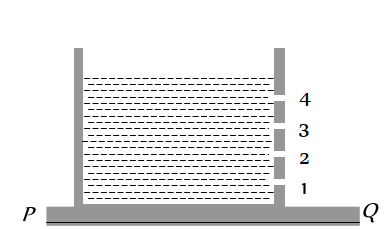
Answer(b) Horizontal range will be maximum when $h=\frac{H}{2}=\frac{90}{2}$ $=45 \mathrm{~cm}$ i.e. hole 3 .
View full question & answer→MCQ 321 Mark
A small spherical solid ball is dropped from a great height in a viscous liquid. Its journey in the liquid is best described in the diagram given below by the
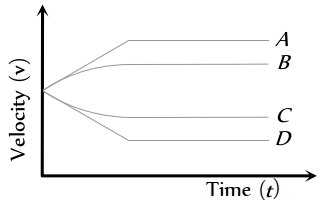
- A
Curve $A$
- ✓
Curve $B$
- C
Curve $C$
- D
Curve $D$
AnswerCorrect option: B. Curve $B$
View full question & answer→MCQ 331 Mark
Two bodies are in equilibrium when suspended in water from the arms of a balance. The mass of one body is $36\ g$ and its density is $9\ g / cm$. If the mass of the other is $48\ g$, its density in $g / cm$ is
- A
$\frac{4}{3}$
- B
$\frac{3}{2}$
- ✓
$3$
- D
$5$
Answer$\text { Apparent weight }=V(\rho-\sigma) g=\frac{m}{\rho}(\rho-\sigma) g$
where $m=$ mass of the body,$\rho=$ density of the body$\sigma=$ density of waterIf two bodies are in equilibrium then their apparent weight must be equal.
$\therefore\frac{m_1}{\rho_1}\left(\rho_1-\sigma\right)=\frac{m_2}{\rho_2}\left(\rho_2-\sigma\right) $
$\Rightarrow \quad \frac{36}{9}(9-1)=\frac{48}{\rho_2}\left(\rho_2-1\right)$By solving we get $\rho_2=3$.
View full question & answer→MCQ 341 Mark
Velocity of water in a river is
- A
- ✓
More in the middle and less near its banks
- C
Less in the middle and more near its banks
- D
Increase from one bank to other bank
AnswerCorrect option: B. More in the middle and less near its banks
View full question & answer→MCQ 351 Mark
Water is flowing in a pipe of diameter $4 cm$ with a velocity $3 m / s$. The water then enters into a tube of diameter $2 cm$. The velocity of water in the other pipe is
- A
$3 m / s$
- B
$6 m / s$
- ✓
$12 m / s$
- D
$8 m / s$
AnswerCorrect option: C. $12 m / s$
(c)$a_1 v_1=a_2 v_2 $
$\Rightarrow \frac{v_2}{v_1}=\frac{a_1}{a_2}=\left(\frac{r_1}{r_2}\right)^2 $
$\Rightarrow v_2=3 \times(2)^2=12 \mathrm{~m} / \mathrm{s}$
View full question & answer→MCQ 361 Mark
When a large bubble rises from the bottom of a lake to the surface. Its radius doubles. If atmospheric pressure is equal to that of column of water height $H$, then the depth of lake is
Answer(c) $P_1 V_1=P_2 V_2 \Rightarrow\left(P_0+h \rho g\right) \times \frac{4}{3}\pi r^3=P_0\times \frac{4}{3} \pi(2 r)^3$Where, $h=$ depth of lake$\Rightarrow h \rho g=7 P_0 \Rightarrow h=7 \times \frac{H \rho g}{\rho g}=7 \mathrm{H} \text {. }$
View full question & answer→MCQ 371 Mark
A concrete sphere of radius $R$ has a cavity of radius $r$ which is packed with sawdust. The specific gravities of concrete and sawdust are respectively 2.4 and 0.3 for this sphere to float with its entire volume submerged under water. Ratio of mass of concrete to mass of sawdust will be
Answer(b) Let specific gravities of concrete and saw dust are $\rho_1$ and $\rho_2$ respectively.
According to principle of floatation weight of whole sphere $=$ upthrust on the sphere
$\frac{4}{3} \pi\left(R^3-r^3\right) \rho_1 g+\frac{4}{3} \pi r^3 \rho_2 g=\frac{4}{3} \pi R^3 \times 1 \times g $
$\Rightarrow R^3 \rho_1-r^3 \rho_1+r^3 \rho_2=R^3 $
$\Rightarrow R^3\left(\rho_1-1\right)=r^3\left(\rho_1-\rho_2\right) $
$\Rightarrow \frac{R^3}{r^3}=\frac{\rho_1-\rho_2}{\rho_1-1} $
$\Rightarrow \frac{R^3-r^3}{r^3}=\frac{\rho_1-\rho_2-\rho_1+1}{\rho_1-1} $
$\Rightarrow \frac{(R^3-r^3)\rho_1}{r^3\rho_2}$$=\left(\frac{1-\rho_2}{\rho_1-1}\right) \frac{\rho_1}{\rho_2} $
$\Rightarrow \frac{\text { Mass of concrete }}{\text { Mass of saw dust }}=\left(\frac{1-0.3}{2.4-1}\right)\times\frac{2.4}{0.3}=4$
View full question & answer→MCQ 381 Mark
A body is just floating on the surface of a liquid. The density of the body is same as that of the liquid. The body is slightly pushed down. What will happen to the body
- A
It will slowly come back to its earlier position
- ✓
It will remain submerged, where it is left
- C
- D
It will come out violently
AnswerCorrect option: B. It will remain submerged, where it is left
View full question & answer→MCQ 391 Mark
Spherical balls of radius ' $r$ ' are falling in a viscous fluid of viscosity ' $\eta$ ' with a velocity ' $v$ '. The retarding viscous force acting on the spherical ball is
- A
Inversely proportional to $r$ but directly proportional to velocity '
- ✓
Directly proportional to both radius ' $r$ ' and velocity ' $v$ '
- C
Inversely proportional to both radius ' $r$ ' and velocity ' $v$ '
- D
Directly proportional to ' $r$ ' but inversely proportional to ' $v$ '
AnswerCorrect option: B. Directly proportional to both radius ' $r$ ' and velocity ' $v$ '
Directly proportional to both radius ' r ' and velocity ' v '
View full question & answer→MCQ 401 Mark
A cylinder of height $20 m$ is completely filled with water. The velocity of efflux of water (in $m / s$ ) through a small hole on the side wall of the cylinder near its bottom is
Answer(b) $v=\sqrt{2 g h}=\sqrt{2 \times 10 \times 20}=20 \mathrm{~m} / \mathrm{s}$
View full question & answer→MCQ 411 Mark
Air is blown through a hole on a closed pipe containing liquid. Then the pressure will
- A
- B
- ✓
Increase in all directions
- D
AnswerCorrect option: C. Increase in all directions
View full question & answer→MCQ 421 Mark
Why the dam of water reservoir is thick at the bottom
- A
Quantity of water increases with depth
- B
Density of water increases with depth
- ✓
Pressure of water increases with depth
- D
Temperature of water increases with depth
AnswerCorrect option: C. Pressure of water increases with depth
(c) A torque is acting on the wall of the dam trying to make it topple. The bottom is made very broad so that the dam will be stable.
View full question & answer→MCQ 431 Mark
A large ship can float but a steel needle sinks because of
MCQ 441 Mark
water containing vessel, the level of water An ice block contains a glass ball when the ice melts within the
- A
- ✓
- C
- D
First rises and then falls
View full question & answer→MCQ 451 Mark
Consider the following equation of Bernouillis theorem.$P+\frac{1}{2} \rho V^2+\rho g h=K \text { (constant) }$The dimensions of $K / P$ are same as that of which of the following
View full question & answer→MCQ 461 Mark
Radius of an air bubble at the bottom of the lake is $r$ and it becomes $2 r$ when the air bubbles rises to the top surface of the lake. If $P cm$ of water be the atmospheric pressure, then the depth of the lake is
- A
$2 p$
- B
$8 p$
- C
$4 p$
- ✓
$7 p$
View full question & answer→MCQ 471 Mark
A given shaped glass tube having uniform cross section is filled with water and is mounted on a rotatable shaft as shown in figure. If the tube is rotated with a constant angular velocity $\omega$ then
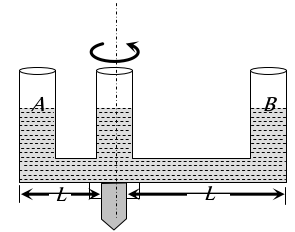
- ✓
Water levels in both sections $A$ zand $B$ go up
- B
Water level in Section $A$ goes up and that in $B$ comes down
- C
Water level in Section $A$ comes down and that in $B$ it goes up
- D
Water levels remains same in both sections
AnswerCorrect option: A. Water levels in both sections $A$ zand $B$ go up
View full question & answer→MCQ 481 Mark
Three liquids of densities $d, 2 d$ and $3 d$ are mixed in equal proportions of weights. The relative density of the mixture is
- A
$\frac{11 d}{7}$
- ✓
$\frac{18 d}{11}$
- C
$\frac{13 d}{9}$
- D
$\frac{23 d}{18}$
AnswerCorrect option: B. $\frac{18 d}{11}$
(b)$\rho_{\text {mix }}=\frac{3 m}{V_1+V_2+V_3}=\frac{3 m}{\frac{m}{d}+\frac{m}{2 d}\frac{m}{3 d}}=\frac{3 \times 6}{11} d=\frac{18}{11} d$
View full question & answer→MCQ 491 Mark
Three liquids of densities $d, 2 d$ and $3 d$ are mixed in equal volumes. Then the density of the mixture is
- A
$d$
- ✓
$2 d$
- C
$3 d$
- D
$5 d$
Answer(b)$\rho_{\text {mix }}=\frac{m_1+m_2+m_3}{3 V}=\frac{V(d+2 d+3 d)}{3 V}=2 d .$
View full question & answer→MCQ 501 Mark
With rise in temperature, density of a given body changes according to one of the following relations
- A
$\rho=\rho_0[1+\gamma d \theta]$
- ✓
$\rho=\rho_0[1-\gamma d \theta]$
- C
$\rho=\rho_0 \gamma d \theta$
- D
$\rho=\rho_0 / \gamma d \theta$
AnswerCorrect option: B. $\rho=\rho_0[1-\gamma d \theta]$
(b) Since, with increase in temperature, volume of given body increases, while mass remains constant so that density will decrease.
$\text { i.e. } \frac{\rho}{\rho_0}=\frac{m / V}{m / V_0}=\frac{V_0}{V}=\frac{V_0}{V_0(1+r \Delta \theta)}$
$\therefore \rho=\rho_0(1-\gamma \Delta \theta)$
View full question & answer→