MCQ 11 Mark
A combination of two thin convex lenses of focal length $0.3 \mathrm{~m}$ and $0.1 \mathrm{~m}$ will have minimum spherical and chromatic aberrations if the distance between them is
- A
$0.1 \mathrm{~m}$
- ✓
$0.2 \mathrm{~m}$
- C
$0.3 \mathrm{~m}$
- D
$0.4 \mathrm{~m}$
AnswerCorrect option: B. $0.2 \mathrm{~m}$
For minimum spherical and chromatic aberration distance between lenses.
$d=f_1-f_2=0.3-0.1=0.2 \mathrm{~m} .$
View full question & answer→MCQ 21 Mark
A compound microscope has an eye piece of focal length $10 \mathrm{~cm}$ and an objective of focal length $4 \mathrm{~cm}$. Calculate the magnification, if an object is kept at a distance of $5 \mathrm{~cm}$ from the objective so that final image is formed at the least distance vision $(20 \mathrm{~cm})$
Answer$\text { For objective lens } \frac{1}{f_o}=\frac{1}{v_o}-\frac{1}{u_o}$
$\Rightarrow \frac{1}{v_o}=\frac{1}{f_o}+\frac{1}{u_0}=\frac{1}{4}+\frac{1}{-5}=\frac{1}{20} \Rightarrow v_0=20 \mathrm{~cm} $
$ \text { Now } M=\frac{v_o}{u_o}\left(1+\frac{D}{f_e}\right)=\frac{20}{5}\left(1+\frac{20}{10}\right)=12 .$
View full question & answer→MCQ 31 Mark
Material $A$ has critical angle $i_A$, and material $B$ has critical angle $i_B\left(i_B>i_A\right)$. Then which of the following is true
(i) Light can be totally internally reflected when it passes from $B$ to $A$
(ii) Light can be totally internally reflected when it passes from $A$ to $B$
(iii) Critical angle for total internal reflection is $i_B-i_A$
(iv) Critical angle between $A$ and $B$ is $\sin ^{-1}\left(\frac{\sin i_A}{\sin i_B}\right)$
Answer(d) We know $C=\sin ^{-1}\left(\frac{1}{\mu}\right)$Given critical angle $i_B>i_A$So $\mu_B<\mu_A$ i.e. $B$ is rarer and $A$ is denser.Hence light can be totally internally reflected when it passes from $A$ to $B$Now critical angle for $A$ to $B$$\begin{aligned}& C_{A B}=\sin ^{-1}\left(\frac{1}{{ }_B \mu_A}\right)=\sin ^{-1}\left[_A \mu_B\right] \\& =\sin ^{-1}\left[\frac{\mu_B}{\mu_A}\right]=\sin ^{-1}\left[\frac{\sin i_A}{\sin i_B}\right]\end{aligned}$
View full question & answer→MCQ 41 Mark
Spherical aberration in a lens
- A
Is minimum when most of the deviation is at the first surface
- B
Is minimum when most of the deviation is at the second surface
- ✓
Is minimum when the total deviation is equally distributed over the two surface
- D
Does not depend on the above consideration
AnswerCorrect option: C. Is minimum when the total deviation is equally distributed over the two surface
View full question & answer→MCQ 51 Mark
A bi$-$convex lens made of glass $($refractive index $1.5)$ is put in a liquid of refractive index $1.7$. Its focal length will
- ✓
- B
- C
Decrease and remain of the same sign
- D
Increase and remain of the same sign
View full question & answer→MCQ 61 Mark
A light beam is being reflected by using two mirrors, as in a periscope used in submarines. If one of the mirrors rotates by an angle $\theta$, the reflected light will deviate from its original path by the angle
- ✓
$2 \theta$
- B
$0^{\circ}$
- C
$\theta$
- D
$4 \theta$
AnswerCorrect option: A. $2 \theta$
When a mirror is rotated by an angle $\theta$, the reflected ray deviate from its original path by angle $2 \theta$.
View full question & answer→MCQ 71 Mark
The optical path of a monochromatic light is same if it goes through $4.0 \mathrm{~cm}$ of glass or $4.5 \mathrm{~cm}$ of water. If the refractive index of glass is $1.53,$ the refractive index of the water is
- A
$1.30$
- ✓
$1.36$
- C
$1.42$
- D
$1.46$
AnswerCorrect option: B. $1.36$
Optical path $\mu x=$ constant i.e. $\mu_1 x_1=\mu_2 x_2$
$\Rightarrow 1.53 \times 4=\mu_2 \times 4.5 \Rightarrow \mu_2=1.36$
View full question & answer→MCQ 81 Mark
If two $+5 D$ lenses are mounted at some distance apart, the equivalent power will always be negative if the distance is
- ✓
Greater than $40 \mathrm{~cm}$
- B
Equal to $40 \mathrm{~cm}$
- C
Equal to $10 \mathrm{~cm}$
- D
Less than $10 \mathrm{~cm}$
AnswerCorrect option: A. Greater than $40 \mathrm{~cm}$
$P=P_1+P_2-d P_1 P_2|\leftrightarrows P=v \sigma-25 d|$
$\Rightarrow$ For $P$ to be negative $25 d>10$
$\Rightarrow d>0.4 \mathrm{~m}$ or $d>40 \mathrm{~cm}$
View full question & answer→MCQ 91 Mark
A thin lens made of glass of refractive index $\mu=1.5$ has a focal length equal to $12 \mathrm{~cm}$ in air. It is now immersed in water $\left(\mu=\frac{4}{3}\right)$. Its new focal length is
- ✓
$48 \mathrm{~cm}$
- B
$36 \mathrm{~cm}$
- C
$24 \mathrm{~cm}$
- D
$12 \mathrm{~cm}$
AnswerCorrect option: A. $48 \mathrm{~cm}$
$f_w=4 \times f_a=4 \times 12=48 \mathrm{~cm}$.
View full question & answer→MCQ 101 Mark
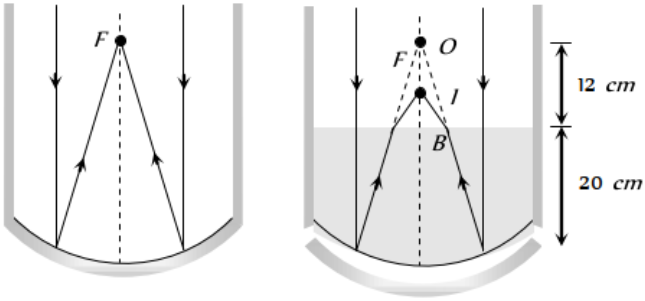
A concave mirror is placed at the bottom of an empty tank with face upwards and axis vertical. When sunlight falls normally on the mirror, it is focussed at distance of $32 \mathrm{~cm}$ from the mirror. If the tank filled with water $\left(\mu=\frac{4}{3}\right)$ upto a height of $20 \mathrm{~cm}$, then the sunlight will now get focussed at
- A
$16 \mathrm{~cm}$ above water level
- ✓
$9 \mathrm{~cm}$ above water level
- C
$24 \mathrm{~cm}$ below water level
- D
$9 \mathrm{~cm}$ below water level
AnswerCorrect option: B. $9 \mathrm{~cm}$ above water level
Sun is at infinity i.e. $u=\infty$ so from mirror formula we have
$\frac{1}{f}=\frac{1}{-32}+\frac{1}{(-\infty)} \Rightarrow f=-32 cm$
When water is filled in the tank upto a height of 20 cm , the image formed by the mirror will act as virtual object for water surface. Which will form it's image at $I$ such that
$\frac{\text { Actualheight }}{\text { Apperant height }}=\frac{\mu_w}{\mu_a}$ i.e. $\frac{B O}{B I}=\frac{4 / 3}{1}$
$\Rightarrow B I=B O \times \frac{3}{4}=12 \times \frac{3}{4}=9 cm$
View full question & answer→MCQ 111 Mark
If the wavelength of light in vacuum be $\lambda$, the wavelength in a medium of refractive index $n$ will be
- A
$n \lambda$
- ✓
$\frac{\lambda}{n}$
- C
$\frac{\lambda}{n^2}$
- D
$n \lambda$
AnswerCorrect option: B. $\frac{\lambda}{n}$
$\lambda_{\text {medium }}=\frac{\lambda_{\text {vacuum }}}{\mu}$
View full question & answer→MCQ 121 Mark
A double convex thin lens made of glass of refractive index $1.6$ has radii of curvature $15 \mathrm{~cm}$ each. The focal length of this lens when immersed in a liquid of refractive index $1.63$ is
- ✓
$-407 \mathrm{~cm}$
- B
$250 \mathrm{~cm}$
- C
$125 \mathrm{~cm}$
- D
$25 \mathrm{~cm}$
AnswerCorrect option: A. $-407 \mathrm{~cm}$
$\frac{f_l}{f_a}=\frac{\left({ }_a \mu_g-1\right)}{\left({ }_1 \mu_g-1\right)} ; f_a=\frac{R}{2\left(\mu_g-1\right)}=\frac{15}{2(1.6-1)}=12.5$
$\Rightarrow \frac{f_l}{12.5}=\frac{(1.6-1)}{\left(\frac{1.6}{1.63}-1\right)} \Rightarrow f_l=-407.5 \mathrm{~cm}$
View full question & answer→MCQ 131 Mark
A lens of power $+2$ diopters is placed in contact with a lens of power $-1$ diopoter. The combination will behave like
- A
A divergent lens of focal length $50 \mathrm{~cm}$
- B
A convergent lens of focal length $50 \mathrm{~cm}$
- ✓
A convergent lens of focal length $100 \mathrm{~cm}$
- D
A divergent lens of focal length $100 \mathrm{~cm}$
AnswerCorrect option: C. A convergent lens of focal length $100 \mathrm{~cm}$
$ P=P_1+P_2$
$ \Rightarrow P=+2+(-1)=+1 D, $
$ f=\frac{+100}{P}=\frac{+100}{1}=100 \mathrm{~cm}$
View full question & answer→MCQ 141 Mark
The ratio of thickness of plates of two transparent mediums $A$ and $B$ is $6: 4$. If light takes equal time in passing through them, then refractive index of $B$ with respect to $A$ will be
Answer(b) Time taken by light to travel distance $x$ through a medium of refractive index $\mu$ is$t=\frac{\mu x}{c} \Rightarrow \frac{\mu_B}{\mu_A}=\frac{x_A}{x_B}=\frac{6}{4} \Rightarrow{ }_A \mu_B=\frac{3}{2}=1.5$
View full question & answer→MCQ 151 Mark
Absolute refractive indices of glass and water are $\frac{3}{2}$ and $\frac{4}{3}$. The ratio of velocity of light in glass and water will be
- A
$4: 3$
- B
$8: 7$
- ✓
$8: 9$
- D
$3: 4$
AnswerCorrect option: C. $8: 9$
$v \propto \frac{1}{\mu} \Rightarrow \frac{v_1}{v_2}=\frac{\mu_2}{\mu_1} $
$\Rightarrow \frac{v_g}{v_w}=\frac{\mu_w}{\mu_g}=\frac{4 / 3}{3 / 2}=\frac{8}{9}$
View full question & answer→MCQ 161 Mark
The refractive indices for the light of violet and red colours of any material are $1.66$ and $1.64$ respectively. If the angle of prism made of this material is $10,$ then angular dispersion will be
- ✓
$0.20$
- B
$0.10$
- C
$ 0.40$
- D
$1$
AnswerCorrect option: A. $0.20$
$\theta=\left(\mu_v-\mu_r\right) A=(1.66-1.64) \times 10^{\circ}=0.2^{\circ}$
View full question & answer→MCQ 171 Mark
If a thin prism of glass is dipped into water then minimum deviation (with respect to air) of light produced by prism will be left $\left({ }_a \mu_g=\frac{3}{2}\right.$ and $\left.{ }_a \mu_w=\frac{4}{3}\right)$
- A
$\frac{1}{2}$
- ✓
$\frac{1}{4}$
- C
$2$
- D
$\frac{1}{5}$
AnswerCorrect option: B. $\frac{1}{4}$
$\frac{\delta_a}{\delta_w}=\frac{\left({ }_a \mu_g-1\right)}{\left({ }_w \mu_g-1\right)}=\frac{\left(\frac{3}{2}-1\right)}{\left(\frac{3 / 2}{4 / 3}-1\right)}=4 \Rightarrow \delta_w=\frac{\delta_a}{4}$
View full question & answer→MCQ 181 Mark
A concave mirror gives an image three times as large as the object placed at a distance of $20 \mathrm{~cm}$ from it. For the image to be real, the focal length should be
- A
$10 \mathrm{~cm}$
- ✓
$15 \mathrm{~cm}$
- C
$20 \mathrm{~cm}$
- D
$30 \mathrm{~cm}$
AnswerCorrect option: B. $15 \mathrm{~cm}$
$m=\frac{f}{f-u} \Rightarrow-3=\frac{f}{f-(-20)} \Rightarrow f=-15 \mathrm{~cm}$
View full question & answer→MCQ 191 Mark
Match List 1 with List 11 and select the correct answer using the codes given below the lists :
List I List II
(Position of the object) (Magnification)
(I) An object is placed at focus before a convex mirror (A) Magnification is $-\infty$
(II) An object is placed at centre of curvature before a concave mirror (B) Magnification is 0.5
(III) An object is placed at focus before a concave mirror (C) Magnification is +1
(IV) An object is placed at centre of curvature before a convex mirror (D) Magnification is -1
(E) Magnification is 0.33
Codes:
AnswerCorrect option: A. (a) I-B, II-D, III-A, IV-E
View full question & answer→MCQ 201 Mark
A concave lens of focal length $20 \mathrm{~cm}$ placed in contact with a plane mirror acts as a
- ✓
Convex mirror of focal length $10 \mathrm{~cm}$
- B
Concave mirror of focal length $40 \mathrm{~cm}$
- C
Concave mirror of focal length $60 \mathrm{~cm}$
- D
Concave mirror of focal length $10 \mathrm{~cm}$
AnswerCorrect option: A. Convex mirror of focal length $10 \mathrm{~cm}$
$\frac{1}{F}=\frac{2}{f}+\frac{1}{f_m}$.
Here $f_m=\infty$, hence $F=\frac{f}{2}=10 \mathrm{~cm}$
View full question & answer→MCQ 211 Mark
The objective of a compound microscope is essentially
- A
A concave lens of small focal length and small aperture
- B
Convex lens of small focal length and large aperture
- C
Convex lens of large focal length and large aperture
- ✓
Convex lens of small focal length and small aperture
AnswerCorrect option: D. Convex lens of small focal length and small aperture
View full question & answer→MCQ 221 Mark
The image distance of an object placed $10 \mathrm{~cm}$ in front of a thin lens of focal length $+5 \mathrm{~cm}$ is
- A
$6.5 \mathrm{~cm}$
- B
$8.0 \mathrm{~cm}$
- C
$9.5 \mathrm{~cm}$
- ✓
$10.0 \mathrm{~cm}$
AnswerCorrect option: D. $10.0 \mathrm{~cm}$
$\frac{1}{f}=\frac{1}{v}-\frac{1}{u} \Rightarrow \frac{1}{+5}=\frac{1}{v}-\frac{1}{(-10)} \Rightarrow v=10 \mathrm{~cm}$
View full question & answer→MCQ 231 Mark
The distance between an object and the screen is $100 \mathrm{~cm}$. A lens produces an image on the screen when placed at either of the positions $40 \mathrm{~cm}$ apart. The power of the lens is
- A
$\approx 3$ dioptres
- ✓
$\approx 5$ dioptres
- C
$\approx 7$ diopters
- D
$\approx 9$ diopters
AnswerCorrect option: B. $\approx 5$ dioptres
$ f=\frac{D^2-x^2}{4 D} \text { (Focal length by displacement method) } $
$ \Rightarrow f=\frac{(100)^2-(40)^2}{4 \times 40}=21 \mathrm{~cm}$
$ \therefore P=\frac{100}{f}=\frac{100}{21} \approx 5 D$
View full question & answer→MCQ 241 Mark
The path of a refracted ray of light in a prism is parallel to the base of the prism only when the
- A
light is of a particular wavelength
- B
Ray is incident normally at one face
- ✓
Ray undergoes minimum deviation
- D
Prism is made of a particular type of glass
AnswerCorrect option: C. Ray undergoes minimum deviation
View full question & answer→MCQ 251 Mark
The wavelength of light in air and some other medium are respectively $\lambda_a$ and $\lambda_m$. The refractive index of medium is
AnswerCorrect option: A. $\lambda_a / \lambda_m$
$\mu_m=\frac{c}{v}=\frac{n \lambda_a}{n \lambda_m}=\frac{\lambda_a}{\lambda_m}$
View full question & answer→MCQ 261 Mark
The phenomena of total internal reflection is seen when angle of incidence is
- A
$90^{\circ}$
- ✓
Greater than critical angle
- C
- D
$0^{\circ}$
AnswerCorrect option: B. Greater than critical angle
View full question & answer→MCQ 271 Mark
For a compound microscope, the focal lengths of object lens and eye lens are $f_o$ and $f_e$ respectively, then magnification will be done by microscope when
- A
(a) $f_o=f_e$
- B
(b) $f_o>f_e$
- ✓
(c) $f_o
- D
AnswerCorrect option: C. (c) $f_o
(c) Magnification will be done by compound microscope only when $f_o
View full question & answer→MCQ 281 Mark
lmage formed on retina of eye is proportional to
AnswerFor large objects, large image is formed on retina.
View full question & answer→MCQ 291 Mark
Image formed by a concave mirror of focal length $6 \mathrm{~cm}$, is $3$ times of the object, then the distance of object from mirror is
- ✓
$-4 \mathrm{~cm}$
- B
$8 \mathrm{~cm}$
- C
$6 \mathrm{~cm}$
- D
$12 \mathrm{~cm}$
AnswerCorrect option: A. $-4 \mathrm{~cm}$
$m= \pm 3$ and $f=-6 \mathrm{~cm}$Now $m=\frac{f}{f-u} \Rightarrow \pm 3=\frac{-6}{-6-u}$
For real image $-3=\frac{-6}{-6-u} \Rightarrow u=-8 \mathrm{~cm}$
For virtual image $3=\frac{-6}{-6-u} \Rightarrow u=-4 \mathrm{~cm}$
View full question & answer→MCQ 301 Mark
Which of the prism is used to see infrared spectrum of light
AnswerRock salt prism is used to see infrared radiations.
View full question & answer→MCQ 311 Mark
Focal length of a plane mirror is
Answer$f=\frac{R}{2}$, and $R=\infty$ for plane mirror.
View full question & answer→MCQ 321 Mark
Total internal reflection is possible when light rays travel
AnswerTotal internal reflection occurs when light ray travels from denser medium to rarer medium.
View full question & answer→MCQ 331 Mark
The minimum distance between the object and its real image for concave mirror is
AnswerWhen object is kept at centre of curvature. It's real image is also formed at centre of curvature.
View full question & answer→MCQ 341 Mark
A convex lens has $9 \mathrm{~cm}$ focal length and a concave lens has $-18 \mathrm{~cm}$ focal length. The focal length of the combination in contact will be
- A
$9 \mathrm{~cm}$
- B
$-18 \mathrm{~cm}$
- C
$-9 \mathrm{~cm}$
- ✓
$18 \mathrm{~cm}$
AnswerCorrect option: D. $18 \mathrm{~cm}$
$\frac{1}{F}=\frac{1}{f_1}+\frac{1}{f_2} $
$\Rightarrow \frac{1}{F}=\frac{1}{(+18)} \Rightarrow F=18 \mathrm{~cm}$
View full question & answer→MCQ 351 Mark
A lens which has focal length of $4 \mathrm{~cm}$ and refractive index of $1.4$ is immersed in a liquid of refractive index $1.6,$ then the focal length will be
- ✓
$-12.8 \mathrm{~cm}$
- B
$32 \mathrm{~cm}$
- C
$12.8 \mathrm{~cm}$
- D
$-32 \mathrm{~cm}$
AnswerCorrect option: A. $-12.8 \mathrm{~cm}$
$\frac{f_l}{f_a}=\left(\frac{{ }_a \mu_g-1}{{ }_l \mu_g-1}\right)$
$ \Rightarrow \frac{f_l}{4}=\frac{(1.4-1)}{\frac{1.4}{1.6}-1} \Rightarrow f_l=-12.8 \mathrm{~cm}$
View full question & answer→MCQ 361 Mark
If an observer is walking away from the plane mirror with $6 \mathrm{~m} / \mathrm{sec}$. Then the velocity of the image with respect to observer will be
- A
$6 \mathrm{~m} / \mathrm{sec}$
- B
$-6 m / \mathrm{sec}$
- ✓
$12 \mathrm{~m} / \mathrm{sec}$
- D
$3 \mathrm{~m} / \mathrm{sec}$
AnswerCorrect option: C. $12 \mathrm{~m} / \mathrm{sec}$
View full question & answer→MCQ 371 Mark
A watch shows time as $3: 25$ when seen through a mirror, time appeared will be
- ✓
$8: 35$
- B
$9: 35$
- C
$7: 35$
- D
$8: 25$
AnswerCorrect option: A. $8: 35$
$8: 35$
View full question & answer→MCQ 381 Mark
Focal length of a converging lens in air is $R$. If it is dipped in water of refractive index $1.33$ , then its focal length will be around (Refractive index of lens material is $1.5$ )
Answer$\frac{f_l}{f_a}=\frac{{ }_a \mu_g-1}{{ }_l \mu_g-1} \Rightarrow f_l=4 R$
View full question & answer→MCQ 391 Mark
The bottom of a container filled with liquid appear slightly raised because of
MCQ 401 Mark
The focal length of a combination of lenses formed with lenses having powers of $+2.50 D$ and $-3.75 D$ will be
- A
$-20 \mathrm{~cm}$
- B
$-40 \mathrm{~cm}$
- C
$-60 \mathrm{~cm}$
- ✓
$-80 \mathrm{~cm}$
AnswerCorrect option: D. $-80 \mathrm{~cm}$
$P=P_1+P_2=2.50-3.75=-1.25 \mathrm{D}$So $f=\frac{100}{1.25}=-80 \mathrm{~cm}$
View full question & answer→MCQ 411 Mark
- ✓
- B
- C
- D
Always forms virtual images
View full question & answer→MCQ 421 Mark
Dispersive power depends upon
Answer$\omega$ depend only on nature of material.
View full question & answer→MCQ 431 Mark
A normally incident ray reflected at an angle of $90^{\circ}$. The value of critical angle is
- A
$45^{\circ}$
- ✓
$90^{\circ}$
- C
$65^{\circ}$
- D
$43.2^{\circ}$
AnswerCorrect option: B. $90^{\circ}$
Critical angle $C$ is equal to incident angle if ray reflected normally $\therefore C=90^{\circ}$
View full question & answer→MCQ 441 Mark
The refractive index of water is $4 / 3$ and that of glass is $5 / 3$. What will be the critical angle for the ray of light entering water from the glass
- ✓
$\sin ^{-1} \frac{4}{5}$
- B
$\sin ^{-1} \frac{5}{4}$
- C
$\sin ^{-1} \frac{1}{2}$
- D
$\sin ^{-1} \frac{2}{1}$
AnswerCorrect option: A. $\sin ^{-1} \frac{4}{5}$
$ { }_w \mu_g=\frac{1}{\sin C} \Rightarrow \frac{\mu_g}{\mu_w}=\frac{5 / 3}{4 / 3}=\frac{1}{\sin C}$
$ \Rightarrow \sin C=\frac{4}{5} \Rightarrow C=\sin ^{-1}\left(\frac{4}{5}\right)$
View full question & answer→MCQ 451 Mark
Refractive index of air is $1.0003.$ The correct thickness of air column which will have one more wavelength of yellow light $(6000 \mathring A)$ than in the same thickness in vacuum is
- ✓
$2 \mathrm{~mm}$
- B
$2 \mathrm{~cm}$
- C
$2 \mathrm{~m}$
- D
$2 \mathrm{~km}$
AnswerCorrect option: A. $2 \mathrm{~mm}$
(a) For vacuum $t=n \lambda_o$For air $t=(n+1) \lambda_a$From equation (i) and (ii)
$t=\frac{\lambda}{\mu-1}=\frac{6 \times 10^{-7}}{1.0003-1}\left(\mu=\frac{\lambda_o}{\lambda_a}\right)$
$ =2 \times 10^{-3} \mathrm{~m}=2 \mathrm{~mm} .$
View full question & answer→MCQ 461 Mark
A plano convex lens is made of glass of refractive index $1.5.$ The radius of curvature of its convex surface is $R$. lts focal length is
- A
$R / 2$
- B
$R$
- ✓
$2 R$
- D
$1.5 R$
Answer$f=\frac{R}{(\mu-1)}=\frac{R}{(1.5-1)}=2 R$
View full question & answer→MCQ 471 Mark
Two parallel pillars are $11 \mathrm{~km}$ away from an observer. The minimum distance between the pillars so that they can be seen separately will be
- ✓
$3.2 \mathrm{~m}$
- B
$20.8 \mathrm{~m}$
- C
$91.5 \mathrm{~m}$
- D
$183 \mathrm{~m}$
AnswerCorrect option: A. $3.2 \mathrm{~m}$
View full question & answer→MCQ 481 Mark
A achromatic combination is made with a lens of focal length $f$ and dispersive power $\omega$ with a lens having dispersive power of $2 \omega$. The focal length of second will be
- A
$2\ f$
- B
$f / 2$
- C
$-f / 2$
- ✓
$-2 f$
AnswerCorrect option: D. $-2 f$
$\omega / f=-2 \omega / f^{\prime} \Rightarrow f^{\prime}=-2 f$
View full question & answer→MCQ 491 Mark
For a medium, refractive indices for violet, red and yellow are $1.62, 1.52$ and $1.55$ respectively, then dispersive power of medium will be
- A
$0.65$
- B
$0.22$
- ✓
$0.18$
- D
$0.02$
AnswerCorrect option: C. $0.18$
$\omega=\frac{\mu_v-\mu_R}{\mu_y-1}=\frac{1.62-1.52}{1.55-1}=0.18$
View full question & answer→MCQ 501 Mark
A plane mirror makes an angle of $30^{\circ}$ with horizontal. If a vertical ray strikes the mirror, find the angle between mirror and reflected ray
- A
$30^{\circ}$
- B
$45^{\circ}$
- ✓
$60^{\circ}$
- D
$90^{\circ}$
AnswerCorrect option: C. $60^{\circ}$
View full question & answer→