MCQ 11 Mark
The displacement $x$ (in metre) of a particle in, simple harmonic motion is related to time $t$ (in seconds) as$x=0.01 \cos \left(\pi t+\frac{\pi}{4}\right)$ The frequency of the motion will be
- ✓
$0.5 Hz$
- B
$1.0 Hz$
- C
$\frac{\pi}{2} Hz$
- D
$\pi H z$
AnswerCorrect option: A. $0.5 Hz$
(a) Comparing given equation with standard equation, $x=a \cos (\omega t+\phi)$ we get, $a=0.01$ and $\omega=\pi$ $\Rightarrow 2 \pi n=\pi \Rightarrow n=0.5 \mathrm{~Hz}$
View full question & answer→MCQ 21 Mark
A particle executes a simple harmonic motion of time period $T$. Find the time taken by the particle to go directly from its mean position to half the amplitude
- A
$T / 2$
- B
$T / 4$
- C
$T / 8$
- ✓
$T / 12$
AnswerCorrect option: D. $T / 12$
(d) $y=A \sin \omega t=\frac{A \sin 2 \pi}{T} t \Rightarrow \frac{A}{2}=A \sin \frac{2 \pi t}{T} \Rightarrow t=\frac{T}{12}$.
View full question & answer→MCQ 31 Mark
In simple harmonic motion, the ratio of acceleration of the particle to its displacement at any time is a measure of
Answer(c) $\quad a=-\omega^2 x \Rightarrow\left|\frac{a}{x}\right|=\omega^2$
View full question & answer→MCQ 41 Mark
What is constant in S.H.M.
MCQ 51 Mark
A simple pendulum is hanging from a peg inserted in a vertical wall. lts bob is stretched in horizontal position from the wall and is left free to move. The bob hits on the wall the coefficient of restitution is $\frac{2}{\sqrt{5}}$. After how many collisions the amplitude of vibration will become less than $60^{\circ}$
Answer(b) From the relation of restitution $\frac{h_n}{h_0}=e^{2 n}$ and
$ h_n=h_0\left(1-\cos 60^{\circ}\right) \Rightarrow \frac{h_n}{h_0}=1-\cos 60^{\circ}=\left(\frac{2}{\sqrt{5}}\right)^{2 n}$
$ \Rightarrow 1-\frac{1}{2}=\left(\frac{4}{5}\right)^n \Rightarrow \frac{1}{2}=\left(\frac{4}{5}\right)^n$
Taking $\log$ of both sides we get $ \log 1-\log 2=n(\log 4-\log 5) $
$ 0-0.3010=n(0.6020-0.6990) $
$ -0.3010=-n \times 0.097 \Rightarrow n=\frac{0.3010}{0.097}=3.1 \approx 3$
View full question & answer→MCQ 61 Mark
A particle executes simple harmonic motion with an amplitude of 4 $cm$. At the mean position the velocity of the particle is $10 cm / s$. The distance of the particle from the mean position when its speed becomes $5 cm / s$ is
- A
$\sqrt{3} cm$
- B
$\sqrt{5} cm$
- ✓
$2(\sqrt{3}) cm$
- D
$2(\sqrt{5}) cm$
AnswerCorrect option: C. $2(\sqrt{3}) cm$
(c)$v_{\max }=a \omega \Rightarrow \omega=\frac{v_{\max }}{a}=\frac{10}{4}$Now, $v=\omega \sqrt{a^2-y^2} \Rightarrow v^2=\omega^2\left(a^2-y^2\right) \Rightarrow y^2=a^2-\frac{v^2}{\omega^2}$$\Rightarrow y=\sqrt{a^2-\frac{v^2}{\omega^2}}=\sqrt{4^2-\frac{5^2}{(10 / 4)^2}}=2 \sqrt{3} \mathrm{~cm}$
View full question & answer→MCQ 71 Mark
A large horizontal surface moves up and down in SHM with an amplitude of $1 cm$. If a mass of $10 kg$ (which is placed on the surface) is to remain continually in contact with it, the maximum frequency of S.H.M. will be
- A
$0.5 Hz$
- B
$1.5 Hz$
- ✓
$5 Hz$
- D
$10 Hz$
AnswerCorrect option: C. $5 Hz$
(c) For body to remain in contact $a_{\max }=g$
$ \therefore \omega^2 A=g \Rightarrow 4 \pi^2 n^2 A=g $
$ \Rightarrow n^2=\frac{g}{4 \pi^2 A}=\frac{10}{4(3.14)^2 0.01}=25 \Rightarrow n=5 \mathrm{~Hz}$
View full question & answer→MCQ 81 Mark
The velocity of simple pendulum is maximum at
MCQ 91 Mark
A simple pendulum, suspended from the ceiling of a stationary van, has time period $T$. If the van starts moving with a uniform velocity the period of the pendulum will be
- A
Less than $T$
- B
Equal to $2 T$
- C
Greater than $T$
- ✓
Answer(d) Effective value of ' $g$ ' remains unchanged.
View full question & answer→MCQ 101 Mark
The kinetic energy of a particle executing $\text{S.H.M.}$ is $16 J$ when it is at its mean position. If the mass of the particle is $0.32 kg$, then what is the maximum velocity of the particle
- ✓
$5 m / s$
- B
$15 m / s$
- C
$10 m / s$
- D
$20 m / s$
AnswerCorrect option: A. $5 m / s$
$5 m / s$
View full question & answer→MCQ 111 Mark
The period of a simple pendulum measured inside a stationary lift is found to be $T$. If the lift starts accelerating upwards with acceleration of $g / 3$, then the time period of the pendulum is
- A
$\frac{T}{\sqrt{3}}$
- B
$\frac{T}{3}$
- ✓
$\frac{\sqrt{3}}{2} T$
- D
$\sqrt{3} T$
AnswerCorrect option: C. $\frac{\sqrt{3}}{2} T$
(c) For stationary lift $T_1=2 \pi \sqrt{\frac{l}{g}}$For ascending lift with acceleration $a, T_2=2 \pi \sqrt{\frac{l}{g+a}}$$\Rightarrow \frac{T_1}{T_2}=\sqrt{\frac{g+a}{g}} \Rightarrow \frac{T}{T_2}=\sqrt{\frac{g+\frac{g}{3}}{g}}=\sqrt{\frac{4}{3}} \Rightarrow T_2=\frac{\sqrt{3}}{2} T$
View full question & answer→MCQ 121 Mark
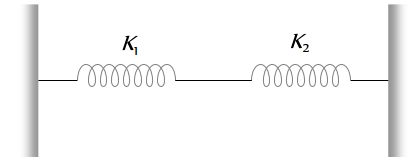
The effective spring constant of two spring system as shown in figure will be
- ✓
$K_1+K_2$
- B
$K_1 K_2 / K_1+K_2$
- C
$K_1-K_2$
- D
$K_1 K_2 / K_1-K_2$
AnswerCorrect option: A. $K_1+K_2$
(a) When external force is applied, one spring gets extended and another one gets contracted by the same distance hence force due to two springs act in same direction.i.e. $F=F_1+F_2 \Rightarrow-k x=-k_1 x-k_2 x \Rightarrow k=k_1+k_2$
View full question & answer→MCQ 131 Mark
If the length of simple pendulum is increased by $300 \%$, then the time period will be increased by
- ✓
$100 \%$
- B
$200 \%$
- C
$300 \%$
- D
$400 \%$
AnswerCorrect option: A. $100 \%$
$ \left.\frac{T_1}{T_2}=\sqrt{\frac{l_1}{l_2}} \Rightarrow \frac{T_1}{T_2}=\sqrt{\frac{100}{400}} \text { (if } l_1=100 \text { then } l_2=400\right) $
$ \Rightarrow T_2=2 T_1$
Hence $\%$ increase $=\frac{T_2-T_1}{T_1} \times 100=100 \%$
View full question & answer→MCQ 141 Mark
Two springs of constant $k_1$ and $k_2$ are joined in series. The effective spring constant of the combination is given by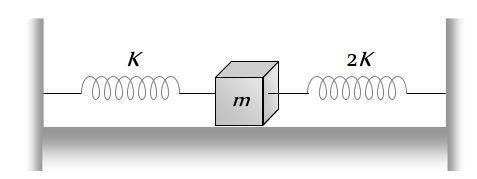
- A
$(1 / 2 \pi) \sqrt{(K / m)}$
- B
$(1 / 2 \pi) \sqrt{(2 K / m)}$
- ✓
$(1 / 2 \pi) \sqrt{(3 K / m)}$
- D
$(1 / 2 \pi) \sqrt{(m / K)}$
AnswerCorrect option: C. $(1 / 2 \pi) \sqrt{(3 K / m)}$
(c) $n=\frac{1}{2 \pi} \sqrt{\frac{K_{\text {effective }}}{m}}=\frac{1}{2 \pi} \sqrt{\frac{(K+2 K)}{m}}=\frac{1}{2 \pi} \sqrt{\frac{3 K}{m}}$
View full question & answer→MCQ 151 Mark
Length of a simple pendulum is $I$ and its maximum angular displacement is $\theta$, then its maximum K.E. is
- A
$m g l \sin \theta$
- B
$m g l(1+\sin \theta)$
- C
$ m g l(1+\cos \theta)$
- ✓
$m g l(1-\cos \theta)$
AnswerCorrect option: D. $m g l(1-\cos \theta)$
View full question & answer→MCQ 161 Mark
The total energy of the body executing S.H.M. is $E$. Then the kinetic energy when the displacement is half of the amplitude, is
- A
$\frac{E}{2}$
- B
$\frac{E}{4}$
- ✓
$\frac{3 E}{4}$
- D
$\frac{\sqrt{3}}{4} E$
AnswerCorrect option: C. $\frac{3 E}{4}$
Total energy in SHM $E=\frac{1}{2} m \omega^2 a^2$; (where $a=$ amplitude)Potential energy $U=\frac{1}{2} m \omega^2\left(a^2-y^2\right)=E-\frac{1}{2} m \omega^2 y^2$
When $y=\frac{a}{2} \Rightarrow U=E-\frac{1}{2} m \omega^2\left(\frac{a^2}{4}\right)=E-\frac{E}{4}=\frac{3 E}{4}$
View full question & answer→MCQ 171 Mark
In $\text{S.H.M}$. maximum acceleration is at
View full question & answer→MCQ 181 Mark
Two springs with spring constants $K_1=1500 N / m$ and $K_2=3000 N / m$ are stretched by the same force. The ratio of potential energy stored in spring will be
- ✓
$2: 1$
- B
$1: 2$
- C
$4: 1$
- D
$1: 4$
AnswerCorrect option: A. $2: 1$
(a) $U=\frac{F^2}{2 K} \Rightarrow U \propto \frac{1}{K} \Rightarrow \frac{U_1}{U_2}=\frac{K_2}{K_1}=2$
View full question & answer→MCQ 191 Mark
The length of a seconds pendulum is
- A
$99.8\ cm$
- ✓
$99 \ cm$
- C
$100\ cm$
- D
AnswerCorrect option: B. $99 \ cm$
(b) $T=2 \pi \sqrt{l / g} \Rightarrow l=\frac{g T^2}{4 \pi^2}=\frac{9.8 \times 4}{4 \times \pi^2}=99 \mathrm{~cm}$
View full question & answer→MCQ 201 Mark
For any S.H.M., amplitude is $6 cm$. If instantaneous potential energy is half the total energy then distance of particle from its mean position is
- A
$3 cm$
- ✓
$4.2 cm$
- C
$5.8 cm$
- D
$6 cm$
AnswerCorrect option: B. $4.2 cm$
(b) If at any instant displacement is $y$ then it is given that
$ U=\frac{1}{2} \times E \Rightarrow \frac{1}{2} m \omega^2 y^2=\frac{1}{2} \times\left(\frac{1}{2} m \omega^2 a^2\right) $
$ \Rightarrow y=\frac{a}{\sqrt{2}}=\frac{6}{\sqrt{2}}=4.2 \mathrm{~cm}$
View full question & answer→MCQ 211 Mark
Due to some force $F$ a body oscillates with period $4 / 5 sec$ and due to other force $F$ oscillates with period $3 / 5 sec$. If both forces act simultaneously, the new period will be
- A
$0.72 sec$
- B
$0.64 sec$
- ✓
$0.48 sec$
- D
$0.36 sec$
AnswerCorrect option: C. $0.48 sec$
Under the influence of one force $F_1=m \omega_1^2 y$ and under the action of another force, $F_2=m \omega_2^2 y$.
Under the action of both the forces $F=F_1+F_2$
$\Rightarrow m \omega^2 y=m \omega_1^2 y+m \omega^2 y $
$ \Rightarrow \omega^2=\omega_1^2+\omega_2^2 \Rightarrow\left(\frac{2 \pi}{T}\right)^2=\left(\frac{2 \pi}{T_1}\right)^2+\left(\frac{2 \pi}{T_2}\right)^2 $
$ \Rightarrow T=\sqrt{\frac{T_1^2 T_2^2}{T_1^2+T_2^2}}=\sqrt{\frac{\left(\frac{4}{5}\right)^2\left(\frac{3}{5}\right)^2}{\left(\frac{4}{5}\right)^2+\left(\frac{3}{5}\right)^2}}=0.48 \mathrm{sec} $
View full question & answer→MCQ 221 Mark
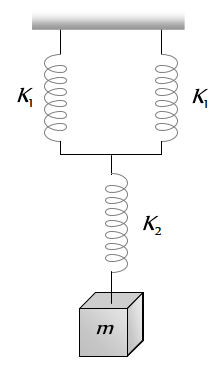
What will be the force constant of the spring system shown in the figure
- A
$\frac{K_1}{2}+K_2$
- ✓
$\left[\frac{1}{2 K_1}+\frac{1}{K_2}\right]^{-1}$
- C
$\frac{1}{2 K_1}+\frac{1}{K_2}$
- D
$\left[\frac{2}{K_1}+\frac{1}{K_1}\right]^{-1}$
AnswerCorrect option: B. $\left[\frac{1}{2 K_1}+\frac{1}{K_2}\right]^{-1}$
View full question & answer→MCQ 231 Mark
Which of the following expressions represent simple harmonic motion
- $x=A \sin (\omega t+\delta)$
- $x=B \cos (\omega t+\phi)$
- $x=A \tan (\omega t+\phi)$
- $x=A \sin \omega t \cos \omega t$
- A
$1 , 2$ and $3$
- B
$1 , 3$ and $4$
- C
$1, 2$ and $4$
- D
$2 , 3$ and $4$
Answer$ x=a \sin \omega t \cos \omega t=\frac{a}{2} \sin 2 \omega t$
View full question & answer→MCQ 241 Mark
The P.E. of a particle executing SHM at a distance $x$ from its equilibrium position is
- ✓
$\frac{1}{2} m \omega^2 x^2$
- B
$\frac{1}{2} m \omega^2 a^2$
- C
$\frac{1}{2} m \omega^2\left(a^2-x^2\right)$
- D
AnswerCorrect option: A. $\frac{1}{2} m \omega^2 x^2$
View full question & answer→MCQ 251 Mark
A particle is executing S.H.M. If its amplitude is $2 m$ and periodic time 2 seconds, then the maximum velocity of the particle will be
- A
$\pi m / s$
- ✓
$\sqrt{2 \pi} m / s$
- C
$2 \pi m / s$
- D
$4 \pi m / s$
AnswerCorrect option: B. $\sqrt{2 \pi} m / s$
(c) $v_{\max }=\omega a=\frac{2 \pi}{T} \times a \Rightarrow v_{\max }=\frac{2 \times \pi \times 2}{2}=2 \pi \mathrm{m} / \mathrm{s}$
View full question & answer→MCQ 261 Mark
A particle executes S.H.M. with a period of 6 second and amplitude of $3 cm$. lts maximum speed in $cm / sec$ is
- A
$\pi / 2$
- ✓
$\pi$
- C
$2 \pi$
- D
$3 \pi$
Answer(b) $v_{\max }=a \omega=a \frac{2 \pi}{T}=3 \times \frac{2 \pi}{6}=\pi \mathrm{cm} / \mathrm{s}$
View full question & answer→MCQ 271 Mark
A simple pendulum is vibrating in an evacuated chamber, it will oscillate with
Answer(b) As it is clear that in vacuum, the bob will not experience any frictional force. Hence, there shall be no dissipation therefore, it will oscillate with constant amplitude.
View full question & answer→MCQ 281 Mark
A simple pendulum hangs from the ceiling of a car. If the car accelerates with a uniform acceleration, the frequency of the simple pendulum will
Answer(a) In this case frequency of oscillation is given by $n=\frac{1}{2 \pi} \sqrt{\frac{\sqrt{g^2+a^2}}{l}}$ where $a$ is the acceleration of car. If $a$ increases then $n$ also increases.
View full question & answer→MCQ 291 Mark
A simple harmonic wave having an amplitude $a$ and time period $T$ is represented by the equation $y=5 \sin \pi(t+4) m$. Then the value of amplitude $$ in $(m)$ and time period $(T)$ in second are
- A
$\quad a=10, T=2$
- B
$a=5, T=1$
- C
$ a=10, T=1$
- ✓
$ a=5, T=2$
AnswerCorrect option: D. $ a=5, T=2$
(d) $y=5 \sin (\pi t+4 \pi)$, comparing it with standard equation
$ y=a \sin (\omega t+\phi)=a \sin \left(\frac{2 \pi t}{T}+\phi\right) $
$ a=5 m \text { and } \frac{2 \pi t}{T}=\pi t \Rightarrow T=2 \mathrm{sec}$
View full question & answer→MCQ 301 Mark
The springs shown are identical. When $A=4 kg$, the elongation of spring is $1 cm$. If $B=6 kg$, the elongation produced by it is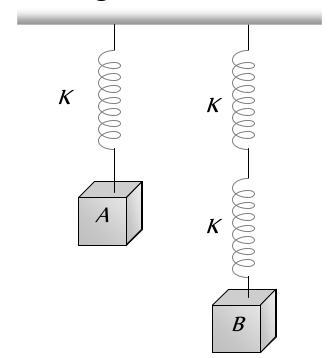
- A
$4 cm$
- ✓
$3 cm$
- C
$2 cm$
- D
$1 cm$
AnswerCorrect option: B. $3 cm$
$ F=k x \Rightarrow m g=k x \Rightarrow m \propto k x $
$ \text { Hence } \frac{m_1}{m_2}=\frac{k_1}{k_2} \times \frac{x_1}{x_2} \Rightarrow \frac{4}{6}=\frac{k}{k / 2} \times \frac{1}{x_2}$
$ \Rightarrow x_2=3 \mathrm{~cm} .$
View full question & answer→MCQ 311 Mark
A particle executes SHM in a line $4 cm$ long. Its velocity when passing through the centre of line is $12 cm / s$. The period will be
- A
$2.047 s$
- ✓
$1.047 s$
- C
$3.047 s$
- D
$0.047 s$
AnswerCorrect option: B. $1.047 s$
(b) Length of the line $=$ Distance between extreme positions of oscillation $=4 \mathrm{~cm}$So, Amplitude $a=2 \mathrm{~cm}$.also $v_{\max }=12 \mathrm{~cm} / \mathrm{s}$.$\begin{aligned}& \because v_{\max }=\omega a=\frac{2 \pi}{T} a \\& \Rightarrow T=\frac{2 \pi a}{v_{\max }}=\frac{2 \times 3.14 \times 2}{12}=1.047 \mathrm{sec}\end{aligned}$
View full question & answer→MCQ 321 Mark
In a seconds pendulum, mass of bob is $30 \ gm$. If it is replaced by $90 \ gm$ mass. Then its time period will
- A
$1 \sec$
- ✓
$2 \sec$
- C
$4 \sec$
- D
$3 \sec$
AnswerCorrect option: B. $2 \sec$
$2 \sec$
View full question & answer→MCQ 331 Mark
A simple pendulum hanging from the ceiling of a stationary lift has a time period $T$. When the lift moves downward with constant velocity, the time period is $T$, then
AnswerCorrect option: B. $2 > 1$
$2 > 1$
View full question & answer→MCQ 341 Mark
A particle executing simple harmonic motion along $y-$ axis has its motion described by the equation $y=A \sin (\omega t)+B$. The amplitude of the simple harmonic motion is
- A
$A$
- B
$B$
- C
$A+B$
- D
$\sqrt{A+B}$
Answer$A$ The amplitude is a maximum displacement from the mean position.
View full question & answer→MCQ 351 Mark
The velocity of a particle in simple harmonic motion at displacement $y$ from mean position is
AnswerCorrect option: B. $\omega \sqrt{a^2-y^2}$
View full question & answer→MCQ 361 Mark
A particle is performing simple harmonic motion with amplitude $A$ and angular velocity $\omega$. The ratio of maximum velocity to maximum acceleration is
- A
$\omega$
- ✓
$1 / \omega$
- C
$\omega$
- D
$A \omega$
AnswerCorrect option: B. $1 / \omega$
(b) $\frac{v_{\max }}{A_{\max }}=\frac{a \omega}{a \omega^2}=\frac{1}{\omega}$
View full question & answer→MCQ 371 Mark
A spring having a spring constant $~ K$ ' is loaded with a mass ' $m$ '. The spring is cut into two equal parts and one of these is loaded again with the same mass. The new spring constant is
- A
$K / 2$
- B
$K$
- ✓
$2 K$
- D
$K^2$
Answer(c) Spring constant $(k) \propto \frac{1}{\text { Lengthofthe } \operatorname{spirng}(l)}$ as length becomes half, $k$ becomes twice is $2 k$.
View full question & answer→MCQ 381 Mark
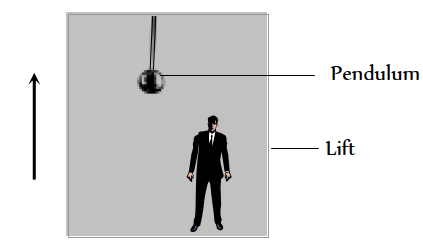
A man measures the period of a simple pendulum inside a stationary lift and finds it to be $T$ sec. If the lift accelerates upwards with an acceleration $g / 4$, then the period of the pendulum will be
- A
$T$
- B
$\frac{T}{4}$
- ✓
$\frac{2 T}{\sqrt{5}}$
- D
$2 T \sqrt{5}$
AnswerCorrect option: C. $\frac{2 T}{\sqrt{5}}$
In stationary lift $T=2 \pi \sqrt{\frac{l}{g}}$In upward moving lift $T^{\prime}=2 \pi \sqrt{\frac{l}{(g+a)}}$ ($a=$ Acceleration of lift)
$\Rightarrow \frac{T^{\prime}}{T}=\sqrt{\frac{g}{g+a}}=\sqrt{\frac{g}{\left(g+\frac{g}{4}\right)}}=\sqrt{\frac{4}{5}} \Rightarrow T^{\prime}=\frac{2 T}{\sqrt{5}}$
View full question & answer→MCQ 391 Mark
A particle is vibrating in a simple harmonic motion with an amplitude of $4 cm$. At what displacement from the equilibrium position, is its energy half potential and half kinetic
- A
$1 cm$
- B
$\sqrt{2} cm$
- C
$3 cm$
- ✓
$2 \sqrt{2} cm$
AnswerCorrect option: D. $2 \sqrt{2} cm$
(d) Let $x$ be the point where K.E. = P.E.Hence $\frac{1}{2} m \omega^2\left(a^2-x^2\right)=\frac{1}{2} m \omega^2 x^2$$\Rightarrow 2 x^2=a^2 \Rightarrow x=\frac{a}{\sqrt{2}}=\frac{4}{\sqrt{2}}=2 \sqrt{2} \mathrm{~cm}$
View full question & answer→MCQ 401 Mark
A particle moves such that its acceleration $a$ is given by $a=-b x$, where $x$ is the displacement from equilibrium position and $b$ is a constant. The period of oscillation is
- A
$2 \pi \sqrt{b}$
- ✓
$\frac{2 \pi}{\sqrt{b}}$
- C
$\frac{2 \pi}{b}$
- D
$2 \sqrt{\frac{\pi}{b}}$
AnswerCorrect option: B. $\frac{2 \pi}{\sqrt{b}}$
(b)$\text { In the given case, } \frac{\text { Displacement }}{\text { Acceleration }}=\frac{1}{b}$$\therefore$ Time period $T=2 \pi \sqrt{\frac{\text { Displacement }}{\text { Acceleration }}}=\frac{2 \pi}{\sqrt{b}}$
View full question & answer→MCQ 411 Mark
A mass $m$ is suspended from a spring of length $/$ and force constant $K$. The frequency of vibration of the mass is $f_1$. The spring is cut into two equal parts and the same mass is suspended from one of the parts. The new frequency of vibration of mass is $f_2$. Which of the following relations between the frequencies is correct
- A
$f_1=\sqrt{2} f_2$
- B
$f_1=f_2$
- C
$f_1=2 f_2$
- ✓
$f_2=\sqrt{2} f_1$
AnswerCorrect option: D. $f_2=\sqrt{2} f_1$
(d) When spring is cut into two equal parts then spring constant of each part will be $2 K$ and so using $n \propto \sqrt{K}$, new frequency will be $\sqrt{2}$ times i.e. $f_2=\sqrt{2} f_1$.
View full question & answer→MCQ 421 Mark
Which of the following statements is not true ? In the case of a simple pendulum for small amplitudes the period of oscillation is
- A
Directly proportional to square root of the length of the pendulum
- B
Inversely proportional to the square root of the acceleration due to gravity
- ✓
Dependent on the mass, size and material of the bob
- D
Independent of the amplitude
AnswerCorrect option: C. Dependent on the mass, size and material of the bob
View full question & answer→MCQ 431 Mark
A pendulum suspended from the ceiling of a train has a period $T$, when the train is at rest. When the train is accelerating with a uniform acceleration $a$, the period of oscillation will
View full question & answer→MCQ 441 Mark
A simple pendulum consisting of a ball of mass $m$ tied to a thread of length $l$ is made to swing on a circular arc of angle $\theta$ in a vertical plane. At the end of this arc, another ball of mass $m$ is placed at rest. The momentum transferred to this ball at rest by the swinging ball is
- ✓
- B
$m \theta \sqrt{\frac{g}{l}}$
- C
$\frac{m \theta}{l} \sqrt{\frac{l}{g}}$
- D
$\frac{m}{l} 2 \pi \sqrt{\frac{l}{g}}$
Answer(a) No momentum will be transferred because, at extreme position the velocity of bob is zero.
View full question & answer→MCQ 451 Mark
A simple pendulum is made of a body which is a hollow sphere containing mercury suspended by means of a wire. If a little mercury is drained off, the period of pendulum will
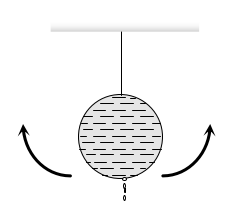
Answer(b) When a little mercury is drained off, the position of c.g. of ball falls (w.r.t. fixed and) so that effective length of pendulum increases hence $T$ increase.
View full question & answer→MCQ 461 Mark
The time period of a second's pendulum is $2 \sec$. The spherical bob which is empty from inside has a mass of $50 \ gm$. This is now replaced by another solid bob of same radius but having different mass of $100\ gm$. The new time period will be
- A
$4 \sec$
- B
$1 \sec$
- ✓
$2 \sec$
- D
$8 \sec$
AnswerCorrect option: C. $2 \sec$
$2 \sec$
View full question & answer→MCQ 471 Mark
- A
All S.H.M.'s have fixed time period
- ✓
All motion having same time period are S.H.M.
- C
In S.H.M. total energy is proportional to square of amplitude
- D
Phase constant of S.H.M. depends upon initial conditions
AnswerCorrect option: B. All motion having same time period are S.H.M.
View full question & answer→MCQ 481 Mark
The time period of a mass suspended from a spring is $T$. If the spring is cut into four equal parts and the same mass is suspended from one of the parts, then the new time period will be
- A
$T$
- ✓
$\frac{T}{2}$
- C
$2 T$
- D
$\frac{T}{4}$
AnswerCorrect option: B. $\frac{T}{2}$
By cutting spring in four equal parts force constant $(K)$ of each parts becomes four times $\left(\because k \propto \frac{1}{l}\right)$
so by using $T=2 \pi \sqrt{\frac{m}{K}} ;$ time period will be half i.e. $T^{\prime}=T / 2$
View full question & answer→MCQ 491 Mark
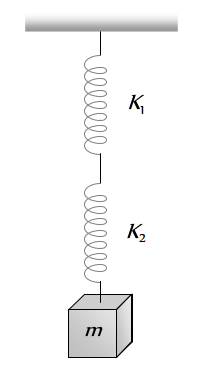
A mass $M$ is suspended by two springs of force constants $K$ and $K$ respectively as shown in the diagram. The total elongation (stretch) of the two springs is
- A
$\frac{M g}{K_1+K_2}$
- ✓
$\frac{M g\left(K_1+K_2\right)}{K_1 K_2}$
- C
$\frac{M g K_1 K_2}{K_1+K_2}$
- D
$\frac{K_1+K_2}{K_1 K_2 M g}$
AnswerCorrect option: B. $\frac{M g\left(K_1+K_2\right)}{K_1 K_2}$
$ \text { For series combination } k_{e q}=\frac{k_1 k_2}{k_1+k_2} $
$ F=k_{e q} x \Rightarrow m g=\left(\frac{k_1 k_2}{k_1+k_2}\right) x \Rightarrow x=\frac{m g\left(k_1+k_2\right)}{k_1 k_2}$
View full question & answer→MCQ 501 Mark
A body is moving in a room with a velocity of $20 m / s$ perpendicular to the two walls separated by 5 meters. There is no friction and the collisions with the walls are elastic. The motion of the body is
- A
- ✓
Periodic but not simple harmonic
- C
Periodic and simple harmonic
- D
Periodic with variable time period
AnswerCorrect option: B. Periodic but not simple harmonic
(b) Body collides elastically with walls of room. So, there will be no loss in its energy and it will remain colliding with walls of room, so it's motion will be periodic.There is no change in energy of the body, hence there is no acceleration, so it's motion is not SHM.
View full question & answer→