MCQ 1011 Mark
A quarter horse power motor runs at a speed of $600$ r.p.m. Assuming $40 \%$ efficiency the work done by the motor in one rotation will be
- ✓
$7.46 \mathrm{~J}$
- B
$7400 \mathrm{~J}$
- C
- D
$74.6 \mathrm{~J}$
AnswerCorrect option: A. $7.46 \mathrm{~J}$
Motor makes $600$ revolution per minute $\therefore n=600 \frac{\text { revolution}}{\text { minute }}=10 \frac{\mathrm{rev}}{\mathrm{sec}}$
$(\therefore)$ Time requiredforonerevolution$=\frac{1}{10} \mathrm{sec}$
Energy required for one revolution $=$ power $\times$ time $=\frac{1}{4} \times 746 \times \frac{1}{10}=\frac{746}{40} \mathrm{~J}$
But work done$(=40)$ of input$=40 \% \times \frac{746}{40}=\frac{40}{100} \times \frac{746}{40}=7.46\mathrm{~J}$
View full question & answer→MCQ 1021 Mark
A car of mass $1000 \mathrm{~kg}$ accelerates uniformly from rest to a velocity of $54 \mathrm{~km} /$ hour in $5 \mathrm{~s}$. The average power of the engine during this period in watts is (neglect friction)
- A
$2000 \mathrm{~W}$
- ✓
$22500 \mathrm{~W}$
- C
$5000 \mathrm{~W}$
- D
$2250 \mathrm{~W}$
AnswerCorrect option: B. $22500 \mathrm{~W}$
(b) Power $=\frac{\text { Work done }}{\text { time }}=\frac{\text { Increase in K.E. }}{\text { time }} $
$P=\frac{\frac{1}{2} m v^2}{t}=\frac{\frac{1}{2} \times 10^3 \times(15)^2}{5}=22500 \mathrm{~W}$
View full question & answer→MCQ 1031 Mark
A body of mass $2 \mathrm{~kg}$ makes an elastic collision with another body at rest and continues to move in the original direction with one fourth of its original speed. The mass of the second body which collides with the first body is
- A
$2 \mathrm{~kg}$
- ✓
$1.2 \mathrm{~kg}$
- C
$3 \mathrm{~kg}$
- D
$1.5 \mathrm{~kg}$
AnswerCorrect option: B. $1.2 \mathrm{~kg}$
(b) $m_1=2 \mathrm{~kg}$ and $v_1=\left(\frac{m_1-m_2}{m_1+m_2}\right) u_1=\frac{u_1}{4}$ (given)By solving we get $m_2=1.2 \mathrm{~kg}$
View full question & answer→MCQ 1041 Mark
A particle of mass $\mathrm{m}$ at rest is acted upon by a force $F$ for a time $t$. Its Kinetic energy after an interval $t$ is
- A
$\frac{F^2 t^2}{m}$
- ✓
$\frac{F^2 t^2}{2 m}$
- C
$\frac{F^2 t^2}{3 m}$
- D
$\frac{F t}{2 m}$
AnswerCorrect option: B. $\frac{F^2 t^2}{2 m}$
(b) Kinetic energy $E=\frac{P^2}{2 m}=\frac{(F t)^2}{2 m}=\frac{F^2 t^2}{2 m} \quad[$As$P=F t]$
View full question & answer→MCQ 1051 Mark
A body of mass $10 \mathrm{~kg}$ at rest is acted upon simultaneously by two forces $4 \mathrm{~N}$ and $3 \mathrm{~N}$ at right angles to each other. The kinetic energy of the body at the end of $10 \mathrm{sec}$ is
- A
$100 \mathrm{~J}$
- B
$300 \mathrm{~J}$
- C
$50 \mathrm{~J}$
- ✓
$125 \mathrm{~J}$
AnswerCorrect option: D. $125 \mathrm{~J}$
(d) Net force on body $=\sqrt{4^2+3^2}=5 \mathrm{~N}$
$\therefore a=F / m=5 / 10=1 / 2 \mathrm{~m} / \mathrm{s}^2 $
$\text { Kinetic energy }=\frac{1}{2} m v^2=\frac{1}{2} m(a t)^2=125 \mathrm{~J}$
View full question & answer→MCQ 1061 Mark
A truck of mass $30,000 \mathrm{~kg}$ moves up an inclined plane of slope $1$ in $100$ at a speed of $30 \mathrm{kmph}$. The power of the truck is (given $\left.g=10 \mathrm{~ms}^{-1}\right)$
- ✓
$25 \mathrm{~kW}$
- B
$10 \mathrm{~kW}$
- C
$5 \mathrm{~kW}$
- D
$2.5 \mathrm{~kW}$
AnswerCorrect option: A. $25 \mathrm{~kW}$
As truck is moving on an incline plane therefore only component of weight $( mg \sin \theta$ ) will oppose the upward motion
$\text { Power }=\text { force } \times \text { velocity }$
$P=m g \sin \theta \times v$
$=30000 \times 10 \times\left(\frac{1}{100}\right) \times \frac{30 \times 5}{18}=25\ kW$
View full question & answer→MCQ 1071 Mark
The bob $A$ of a simple pendulum is released when the string makes an angle of $45^{\circ}$ with the vertical. It hits another bob $B$ of the same material and same mass kept at rest on the table. If the collision is elastic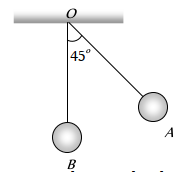
- A
Both $A$ and $B$ rise to the same height
- B
Both $A$ and $B$ come to rest at $B$
- C
Both $A$ and $B$ move with the same velocity of $A$
- ✓
A comes to rest and $B$ moves with the velocity of $A$
AnswerCorrect option: D. A comes to rest and $B$ moves with the velocity of $A$
(d) Due to the same mass of $A$ and $B$ as well as due to elastic collision velocities of spheres get interchanged after the collision.
View full question & answer→MCQ 1081 Mark
The relationship between the force $F$ and position $x$ of a body is as shown in figure. The work done in displacing the body from $x=1 \mathrm{~m}$ to $x=5 m$ will be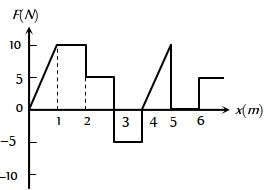
- A
$30 \mathrm{~J}$
- ✓
$15 \mathrm{~J}$
- C
$25 \mathrm{~J}$
- D
$20 \mathrm{~J}$
AnswerCorrect option: B. $15 \mathrm{~J}$
View full question & answer→MCQ 1091 Mark
A body of mass $4 \mathrm{~kg}$ moving with velocity $12 \mathrm{~m} / \mathrm{s}$ collides with another body of mass $6 \mathrm{~kg}$ at rest. If two bodies stick together after collision, then the loss of kinetic energy of system is
- A
- B
$288 \mathrm{~J}$
- ✓
$172.8 \mathrm{~J}$
- D
$144 \mathrm{~J}$
AnswerCorrect option: C. $172.8 \mathrm{~J}$
$\text { Loss in K.E. }= \frac{m_1 m_2}{2\left(m_1+m_2\right)}\left(u_1-u_2\right)^2 $
$ =\frac{4 \times 6}{2 \times 10} \times(12-0)^2=172.8\mathrm{~J}$
View full question & answer→MCQ 1101 Mark
A bullet moving with a speed of $100 \mathrm{~ms}^{-1}$ can just penetrate two planks of equal thickness. Then the number of such planks penetrated by the same bullet when the speed is doubled will be
View full question & answer→MCQ 1111 Mark
A force $\vec{F}=5 \hat{i}+6 \hat{j}-4 \hat{k}$ acting on a body, produces a displacement $\vec{s}=6 \vec{i}+5 \vec{k}$. Work done by the force is
- A
$18 \ units$
- B
$15\ units$
- C
$12 \ units$
- ✓
$10\ units$
AnswerCorrect option: D. $10\ units$
(d) $\quad W=\vec{F} \cdot\vec{s}=(5\hat{i+6}\hat{j}-4\hat{k})\cdot(6\hat{i+5}\hat{k})=30-20=10\ units$
View full question & answer→MCQ 1121 Mark
A sphere collides with another sphere of identical mass. After collision, the two spheres move. The collision is inelastic. Then the angle between the directions of the two spheres is
AnswerCorrect option: D. Different from $90^{\circ}$
(d) Angle will be $90^{\circ}$ if collision is perfectly elastic
View full question & answer→MCQ 1131 Mark
A $50 \mathrm{~kg}$ man with $20 \mathrm{~kg}$ load on his head climbs up 20 steps of $0.25 m$ height each. The work done in climbing is
- A
$5 \mathrm{~J}$
- B
$350 \mathrm{~J}$
- C
$100 \mathrm{~J}$
- ✓
$3430 \mathrm{~J}$
AnswerCorrect option: D. $3430 \mathrm{~J}$
(d) Total mass $=(50+20)=70 \mathrm{~kg} $
Total height $=20 \times 0.25=5 \mathrm{~m} $
$\therefore \text { Work done }=m g h=70 \times 9.8 \times 5=3430 \mathrm{~J}$
View full question & answer→MCQ 1141 Mark
A man does a given amount of work in $10 \mathrm{sec}$. Another man does the same amount of work in $20 \mathrm{sec}$. The ratio of the output power of first man to the second man is
AnswerCorrect option: C. $2 / 1$
Power $=\frac{W}{t}$. If $W$ is constant then $P \propto \frac{1}{t}$
i.e$(\frac{P_1}{P_2}=\frac{t_2}{t_1}=\frac{20}{10}=\frac{2}{1})$
View full question & answer→MCQ 1151 Mark
If the heart pushes $1 \mathrm{cc}$ of blood in one second under pressure $20000 \mathrm{~N} / \mathrm{m}$ the power of heart is
AnswerCorrect option: A. $0.02 W$
(a) Power $=\frac{\text { workdone}} {\text{time}}=\frac{\text{pressure} \times \text { change in volume }}{\text { time }} $
$=\frac{20000 \times 1 \times 10^{-6}}{1}=2 \times 10^{-2}=0.02 \mathrm{~W}$
View full question & answer→MCQ 1161 Mark
A bullet of mass $50 \mathrm{gram}$ is fired from a $5 \mathrm{~kg}$ gun with a velocity of $1 \mathrm{~km} / \mathrm{s}$. the speed of recoil of the gun is
- A
$5 \mathrm{~m} / \mathrm{s}$
- B
$1 \mathrm{~m} / \mathrm{s}$
- C
$0.5 \mathrm{~m} / \mathrm{s}$
- ✓
$10 \mathrm{~m} / \mathrm{s}$
AnswerCorrect option: D. $10 \mathrm{~m} / \mathrm{s}$
According to conservation of momentum:
$m _{ B } v _{ B }+ m _{ G } v _{ G }=0 \Rightarrow v _{ G }=-\frac{ m _{ B } v _{ B }}{ m _{ G }} $
$v _{ G }=\frac{-50 \times 10^{-3} \times 10^3}{5}=-10 m / s$
View full question & answer→MCQ 1171 Mark
A ball hits a vertical wall horizontally at $10 \mathrm{~m} / \mathrm{s}$ bounces back at 10 $\mathrm{m} / \mathrm{s}$
AnswerCorrect option: C. There is an acceleration because there is a momentum change
(c) As the ball bounces back with same speed so change in momentum $=2 \mathrm{mv}$ and we know that force $=$ rate of change of momentum i.e. force will act on the ball so there is an acceleration.
View full question & answer→MCQ 1181 Mark
If the K.E. of a body is increased by $300 \%$, its momentum will increase by
- ✓
$100 \%$
- B
$150 \%$
- C
$\sqrt{300} \%$
- D
$175 \%$
AnswerCorrect option: A. $100 \%$
(a) Let initial kinetic energy, $E_1=E$Final kinetic energy, $E_2=E+300 \%$ of $E=4 E$
$\text { As } P \propto \sqrt{E} \Rightarrow \frac{P_2}{P_1}=\sqrt{\frac{E_2}{E_1}}=\sqrt{\frac{4 E}{E}}=2 \Rightarrow P_2=2 P_1 $
$\Rightarrow P_2=P_1+100 \% \text { of } P_1$
i.e. Momentum will increase by $100 \%$.
View full question & answer→MCQ 1191 Mark
A body is moved along a straight line by a machine delivering constant power. The distance moved by the body in time $t$ is proportional to
- A
$t^{1 / 2}$
- B
$t^{3 / 4}$
- ✓
$t^{3 / 2}$
- D
$t^2$
AnswerCorrect option: C. $t^{3 / 2}$
(c)$P=F v=m a v=m\left(\frac{d v}{d t}\right) v \Rightarrow \frac{P}{m} d t=v d v $
$\Rightarrow w \frac{P}{m\times t}=\frac{v^2}{2}\Rightarrow v=\left(\frac{2P}{m}\right)^{1/ 2}(t)^{1 / 2} $
$\text { Now } s=\int v d t=\int\left(\frac{2 P}{m}\right)^{1 / 2}t^{1/2} d t$
$\therefore s=\left(\frac{2P}{m}\right)^{1/2}\left[\frac{2t^{3/2}}{3}\right]$
$\Rightarrow s\propto t^{3/2}$
View full question & answer→MCQ 1201 Mark
A lorry and a car moving with the same K.E. are brought to rest by applying the same retarding force, then
- A
Lorry will come to rest in a shorter distance
- B
Car will come to rest in a shorter distance
- ✓
Both come to rest in a same distance
- D
AnswerCorrect option: C. Both come to rest in a same distance
(c) Stoppingdistance $=\frac{\text { kineticenergy }}{\text { retarding force }} \Rightarrow s=\frac{1}{2} \frac{\mathrm{mu}^2}{\mathrm{~F}}$If lorry and car both possess same kinetic energy and retarding force is also equal then both come to rest in the same distance.
View full question & answer→MCQ 1211 Mark
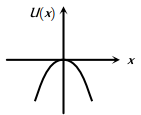
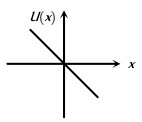
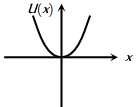
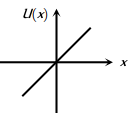
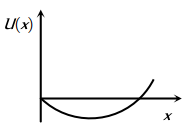
A particle is placed at the origin and a force $F=k x$ is acting on it (where $k$ is positive constant). If $U(0)=0$, the graph of $U(x)$ versus $x$ will be (where $U$ is the potential energy function)
Answer(a) $U=-\int F d x=-\int k x d x=-k \frac{x^2}{2}$This is the equation of parabolasymmetric to $U$ axis in negative direction
View full question & answer→MCQ 1221 Mark
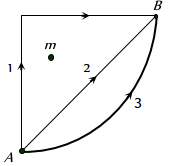
If $W_1, W_2$ and $W_3$ represent the work done in moving a particle from $A$ to $B$ along three different paths $1, 2$ and $3$ respectively (as shown) in the gravitational field of a point mass $\mathrm{m}$, find the correct relation between $W_1, W_2$ and $W_3$
- A
$W_1>W_2>W_3$
- ✓
$W_1=W_2=W_3$
- C
$W_2=W_1>W_3$
- D
$W_2>W_1>W_3$
AnswerCorrect option: B. $W_1=W_2=W_3$
The force of gravity is a conservative force. As we know, the work done by a conservative force is independent of the path taken and is only reliant on the motion's end points.
Because $w_1, w_2$, and $w_3$ in the provided pattern have the same end point $A$ and $B$ as illustrated in the diagram below.
So, the correct relation between is $W _1= W _2= W _3$.
View full question & answer→MCQ 1231 Mark
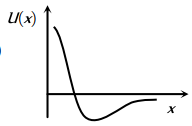
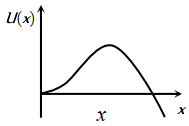
A particle which is constrained to move along the $x$-axis, is subjected to a force in the same direction which varies with the distance $x$ of the particle from the origin as $F(x)=-k x+a x^3$. Here $k$ and $a$ are positive constants. For $x \geq 0$, the functional from of the potential energy $U(x)$ of the particle is
Answer$F=\frac{-d U}{d x} \Rightarrow d U=-F d x $
$\Rightarrow U=\int_0^x\left(-K x+a x^3\right) d x=\frac{k x^2}{2}-\frac{a x^4}{4} $
$\therefore \text { We get } U=0 \text { at } x=0 \text { and } x=\sqrt{2 k / a}$ and also $U=$ negative for $(x >\sqrt{2 k / a}$.So $F=0$ at $x=0$i.e. slope of $U-x$ graph is zero at $x=0$.
View full question & answer→MCQ 1241 Mark
Two particles of masses $m_1$ and $m_2$ in projectile motion have velocities $\vec{v}_1$ and $\vec{v}_2$ respectively at time $t=0$. They collide at time $t_0$. Their velocities become $\vec{v}_1{ }^{\prime}$ and $\vec{v}_2{ }^{\prime}$ at time $2 t_0$ while still moving in air. The value of $\left|\left(m_1 \overrightarrow{v_1^{\prime}}+m_2 \overrightarrow{v_2^{\prime}}\right)-\left(m_1 \overrightarrow{v_1}+m_2 \overrightarrow{v_2}\right)\right|$ is
- A
- B
$\left(m_1+m_2\right) g t_0$
- ✓
$2\left(m_1+m_2\right) g t_0$
- D
$\frac{1}{2}\left(m_1+m_2\right) g t_0$
AnswerCorrect option: C. $2\left(m_1+m_2\right) g t_0$
The momentum of the two-particle system, at $t=0$ is $\vec{P}_i=m_1 \vec{v}_1+m_2 \vec{v}_2$
Collision between the two does not affect the total momentum of the system.
A constant external force $\left(m_1+m_2\right) g$ acts on the system.
The impulse given by this force, in time $t=0$ to $t=2 t_0$ is $(\left(m_1+m_2\right)) g \times 2 t_0$
$\therefore$ Change in momentum in this interval
$=[m_1\vec{v_1^{\prime}}+m_2 \vec{v}_2^{\prime}]-\left(m_1 \vec{v_1+m_2}\vec{v_2}\right)$
$=2\left(m_1+m_2\right)gt_0$
View full question & answer→MCQ 1251 Mark
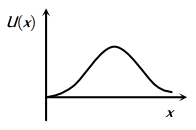
A particle free to move along the $x$-axis has potential energy given by $U(x)=k\left[1-\exp (-x)^2\right]$ for $-\infty \leq x \leq+\infty$, where $k$ is a positive constant of appropriate dimensions. Then
- A
At point away from the origin, the particle is in unstable equilibrium
- B
For any finite non-zero value of $x$, there is a force directed away from the origin
- C
If its total mechanical energy is $k / 2$, it has its minimum kinetic energy at the origin
- ✓
For small displacements from $x=0$, the motion is simple harmonic
AnswerCorrect option: D. For small displacements from $x=0$, the motion is simple harmonic
Potential energy of the particle $U=k\left(1-e^{-x^2}\right)$
Force onparticle $(F=\frac{-d U}{d x}=-k\left[-e^{-x^2} \times(-2 x)\right]$
$F=-2 k x e^{-x^2}=-2kx\left[1x^2\frac{x^4}{2 !}-\ldots . .\right]$
For small displacement $F=-2 k x \Rightarrow F \propto-x$ i.e. motion is simple harmonic motion.
View full question & answer→MCQ 1261 Mark
A force $\boldsymbol{F}=-K(y \boldsymbol{i}+x \boldsymbol{j})$ (where $K$ is a positive constant) acts on a particle moving in the $x y$-plane. Starting from the origin, the particle is taken along the positive $x$-axis to the point $(a, 0)$ and then parallel to the $y$-axis to the point $(a, a)$. The total work done by the force $F$ on the particles is
- A
$-2 K a^2$
- B
$2 K a^2$
- ✓
$-K a^2$
- D
$K a^2$
AnswerCorrect option: C. $-K a^2$
While moving from $(0,0)$ to $(a, 0)$ Along positive $x$-axis $(y=0\therefore\vec{F}=-k x \hat{j})$
i.e. force is in negative $y$-direction while displacement is in positive $x$-direction.
$\therefore W_1=0$Because force is perpendicular to displacement Then particle moves from $(a, 0)$ to $(a, a)$ along a line parallel to $y$-axis $(x=+a)$ during this $\vec{F}=-k(y \hat{i}+a \hat{J})$
The first component of force, $-k y \hat{i}$ will not contributeany work because this component is along negative $x$-direction $(-\hat{i})$
while displacement is in positive $\quad y$-direction $(a, 0)$ to $(a, a)$.
The second component of force i.e. $-k a \hat{j}$ will perform negative work
$\therefore W_2=(-k a \hat{j})(\hat{a j})=(-k a)(a)=-k a^2$
So net work done on the particle $W=W_1+W_2$$=0+\left(-k a^2\right)=-k a^2$
View full question & answer→MCQ 1271 Mark
A ball hits the floor and rebounds after inelastic collision. In this case
- A
The momentum of the ball just after the collision is the same as that just before the collision
- B
The mechanical energy of the ball remains the same in the collision
- ✓
The total momentum of the ball and the earth is conserved
- D
The total energy of the ball and the earth is conserved
AnswerCorrect option: C. The total momentum of the ball and the earth is conserved
(c) By the conservation of momentum in the absence of external force total momentum of the system (ball + earth) remains constant.
View full question & answer→MCQ 1281 Mark
A uniform chain of length $L$ and mass $M$ is lying on a smooth table and one third of its length is hanging vertically down over the edge of the table. If $g$ is acceleration due to gravity, the work required to pull the hanging part on to the table is
- A
$M g L$
- B
$M g L / 3$
- C
$\mathrm{MgL} / 9$
- ✓
$M g L / 18$
AnswerCorrect option: D. $M g L / 18$
View full question & answer→MCQ 1291 Mark
Two putty balls of equal mass moving with equal velocity in mutually perpendicular directions, stick together after collision. If the balls were initially moving with a velocity of $45 \sqrt{2} \mathrm{~ms}^{-1}$ each, the velocity of their combined mass after collision is
AnswerCorrect option: B. $45 \mathrm{~ms}^{-1}$
View full question & answer→MCQ 1301 Mark
Two bodies $A$ and $B$ having masses in the ratio of $3: 1$ possess the same kinetic energy. The ratio of their linear momenta is then
- A
$3: 1$
- B
$9: 1$
- C
$1: 1$
- ✓
$\sqrt{3}: 1$
AnswerCorrect option: D. $\sqrt{3}: 1$
(d)$\left.P=\sqrt{2 m E} \therefore \frac{P_1}{P_2}=\sqrt{\frac{m_1}{m_2}} \text { (if } E=\text { constant }\right) $
$\therefore \frac{P_1}{P_2}=\sqrt{\frac{3}{1}}$
View full question & answer→MCQ 1311 Mark
A force of $5 N$, making an angle $\theta$ with the horizontal, acting on an object displaces it by $0.4 \mathrm{~m}$ along the horizontal direction. If the object gains kinetic energy of $1,$ the horizontal component of the force is
- A
$1.5 \mathrm{~N}$
- ✓
$2.5 \mathrm{~N}$
- C
$3.5 \mathrm{~N}$
- D
$4.5 \mathrm{~N}$
AnswerCorrect option: B. $2.5 \mathrm{~N}$
Work done on the body = K.E.gained by the body
$Fs\cos\theta=1\Rightarrow F\cos\theta=\frac{1}{s}=\frac{1}{0.4}=2.5 \mathrm{~N}$
View full question & answer→MCQ 1321 Mark
A $10$ H.P. motor pumps out water from a well of depth $20 \mathrm{~m}$ and fills a water tank of volume $22380$ litres at a height of $10 \mathrm{~m}$ from the ground. the running time of the motor to fill the empty water tank is $\left(g=10 \mathrm{~ms}^{-2}\right)$
- A
$5$ minutes
- B
$10$ minutes
- ✓
$15$ minutes
- D
$20$ minutes
AnswerCorrect option: C. $15$ minutes
$\text { Volume of water to raise }=22380 I =22380 \times 10\ m $
$ P=\frac{m g h}{t}=\frac{V \rho g h}{t} \Rightarrow t=\frac{V \rho g h}{P} $
$ t=\frac{22380 \times 10^{-3} \times 10^3 \times 10 \times 10}{10 \times 746}=15\ min$
View full question & answer→MCQ 1331 Mark
A ball is projected vertically down with an initial velocity from a height of $20 \mathrm{~m}$ onto a horizontal floor. During the impact it loses $50 \%$ of its energy and rebounds to the same height. The initial velocity of its projection is
- ✓
$20 \mathrm{~ms}^{-1}$
- B
$15 \mathrm{~ms}^{-1}$
- C
$10 \mathrm{~ms}^{-1}$
- D
$5 \mathrm{~ms}^{-1}$
AnswerCorrect option: A. $20 \mathrm{~ms}^{-1}$
View full question & answer→MCQ 1341 Mark
A body of mass $m_1$ moving with a velocity $3 \mathrm{~ms}$ collides with another body at rest of mass $m_2$. After collision the velocities of the two bodies are $2 \mathrm{~ms}$ and $5 \mathrm{~ms}$ respectively along the direction of motion of $m_1$ The ratio $m_1 / m_2$ is
- A
$\frac{5}{12}$
- ✓
- C
$\frac{1}{5}$
- D
$\frac{12}{5}$
View full question & answer→MCQ 1351 Mark
At high altitude, a body explodes at rest into two equal fragments with one fragment receiving horizontal velocity of $10 \mathrm{~m} / \mathrm{s}$. Time taken by the two radius vectors connecting point of explosion to fragments to make $90^{\circ}$ is
- A
$10 \mathrm{~s}$
- B
$4 s$
- ✓
$2 s$
- D
$1 s$
View full question & answer→MCQ 1361 Mark
Two bodies of masses $2 m$ and $m$ have their K.E. in the ratio $8: 1$, then their ratio of momenta is
- A
$1: 1$
- B
$2: 1$
- ✓
$4: 1$
- D
$8: 1$
AnswerCorrect option: C. $4: 1$
$p=\sqrt{2 m E}$
$ \therefore \frac{p_1}{p_2}=\sqrt{\frac{m_1}{m_2}}\frac{E_1}{E_2}=\sqrt{\frac{2}{1} \times \frac{8}{1}}=\frac{4}{1}$
View full question & answer→MCQ 1371 Mark
Two particles having position vectors $\overrightarrow{r_1}=(3 \hat{i}+5 \hat{j})$ metres and $\overrightarrow{r_2}=(-5 \hat{i}-3 \hat{j})$ metres are moving with velocities $\vec{v}_1=(4 \hat{i}+3 \hat{j}) \mathrm{m} / \mathrm{s}$ and $\vec{v}_2=(\alpha \hat{i}+7 \hat{j}) \mathrm{m} / \mathrm{s}$. If they collide after 2 seconds, the value of ' $\alpha$ ' is
View full question & answer→MCQ 1381 Mark
Two identical blocks $A$ and $B$, each of mass ' $m$ ' resting on smooth floor are connected by a light spring of natural length $L$ and spring constant K, with the spring at its natural length. A third identical block ' $C$ (mass $m$ ) moving with a speed $v$ along the line joining $A$ and $B$ collides with $A$. the maximum compression in the spring is
- ✓
$v \sqrt{\frac{m}{2 k}}$
- B
$m \sqrt{\frac{v}{2 k}}$
- C
$\sqrt{\frac{m v}{k}}$
- D
$\frac{m v}{2 k}$
AnswerCorrect option: A. $v \sqrt{\frac{m}{2 k}}$
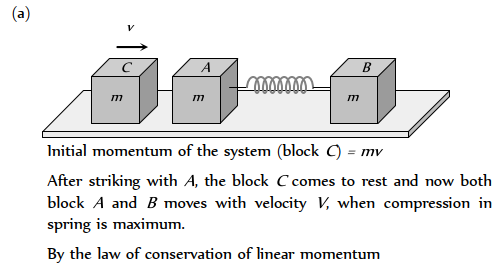
$m v=(m+m) V \Rightarrow V=\frac{v}{2}$
By the law of conservation of energy K.E. of block $C=$ K.E. of system + P.E. of system
$\frac{1}{2} m v^2=\frac{1}{2}(2 m) V^2+\frac{1}{2} k x^2 $
$\Rightarrow \frac{1}{2} mv^2=\frac{1}{2}(2m\left(\frac{v}{2}\right)^2+\frac{1}{2} k x^2 $
$\Rightarrow k x^2=\frac{1}{2} m v^2 $
$\Rightarrow x=v\sqrt{\frac{m}{2k}}$ View full question & answer→MCQ 1391 Mark
A body of mass $6 \mathrm{~kg}$ is under a force which causes displacement in it given by $S=\frac{t^2}{4}$ metres where $t$ is time. The work done by the force in 2 seconds is
- A
$12 \mathrm{~J}$
- B
$9 \mathrm{~J}$
- C
$6 J$
- ✓
$3 \mathrm{~J}$
AnswerCorrect option: D. $3 \mathrm{~J}$
(d)$s=\frac{t^2}{4} \therefore d s=\frac{t}{2} d t $
$F=m a=\frac{m d^2 s}{d t^2}=\frac{6 d^2}{d t^2}\left[\frac{t^2}{4}\right]=3 N$
Now $W=\int_0^2Fds=\int_0^2 3 \frac{t}{2} d t=\frac{3}{2}\left[\frac{t^2}{2}\right]_0^2=\frac{3}{4}\left[(2)^2(0)^2\right]=3 J$
View full question & answer→MCQ 1401 Mark
A force applied by an engine of a train of mass $2.05 \times 10^6 \mathrm{~kg}$ changes its velocity from $5 \mathrm{~m} / \mathrm{s}$ to $25 \mathrm{~m} / \mathrm{s}$ in 5 minutes. The power of the engine is
- ✓
$1.025 M \mathrm{MW}$
- B
$2.05 \mathrm{MW}$
- C
$5 M W$
- D
$6 \mathrm{MW}$
AnswerCorrect option: A. $1.025 M \mathrm{MW}$
(b)
Power $=\frac{\text { Workdone }}{\text { time }}=\frac{\frac{1}{2} m\left(v^2-u^2\right)}{t} $
$P=\frac{1}{2} \times \frac{2.05 \times10^6\times\left[(25)^2-\left(5^2\right)\right]}{5 \times 60} $
$P=2.05\times10^6\mathrm{~W}=2.05\mathrm{MW}$
View full question & answer→MCQ 1411 Mark
A particle falls from a height $h$ upon a fixed horizontal plane and rebounds. If $e$ is the coefficient of restitution, the total distance travelled before rebounding has stopped is
- ✓
$h\left(\frac{1+e^2}{1-e^2}\right)$
- B
$h\left(\frac{1-e^2}{1+e^2}\right)$
- C
$\frac{h}{2}\left(\frac{1-e^2}{1+e^2}\right)$
- D
$\frac{h}{2}\left(\frac{1+e^2}{1-e^2}\right)$
AnswerCorrect option: A. $h\left(\frac{1+e^2}{1-e^2}\right)$
View full question & answer→MCQ 1421 Mark
A metal ball falls from a height of 32 metre on a steel plate. If the coefficient of restitution is 0.5 , to what height will the ball rise after second bounce
- ✓
$2 \mathrm{~m}$
- B
$4 \mathrm{~m}$
- C
$8 \mathrm{~m}$
- D
$16 \mathrm{~m}$
AnswerCorrect option: A. $2 \mathrm{~m}$
(a) $h_n=h e^{2 n}=32\left(\frac{1}{2}\right)^4=\frac{32}{16}=2 m$(here $n=2, e=1 /2$)
View full question & answer→MCQ 1431 Mark
Two bodies of different masses $m_1$ and $m_2$ have equal momenta.Their kinetic energies $E_1$ and $E_2$ are in the ratio
- A
$\sqrt{m_1}: \sqrt{m_2}$
- B
$m_1: m_2$
- ✓
$m_2: m_1$
- D
$m_1^2: m_2^2$
AnswerCorrect option: C. $m_2: m_1$
$E=\frac{P^2}{2 m}$ if bodies possess equal linear momenta then $E\propto\frac{1}{m}\text { i.e. } \frac{E_1}{E_2}=\frac{m_2}{m_1}$
View full question & answer→MCQ 1441 Mark
A gun fires a bullet of mass $50 \mathrm{gm}$ with a velocity of $30 \mathrm{~m} \mathrm{sec}{ }^{-1}$.Because of this the gun is pushed back with a velocity of $1 \mathrm{~m} \mathrm{sec}{ }^{-1}$. The mass of the gun is
- A
$15 \mathrm{~kg}$
- B
$30 \mathrm{~kg}$
- ✓
$1.5 \mathrm{~kg}$
- D
$20 \mathrm{~kg}$
AnswerCorrect option: C. $1.5 \mathrm{~kg}$
(c) $m_G=\frac{m_B v_B}{v_G} \frac{50 \times 10^{-3} \times 30}{1}=1.5 \mathrm{~kg}$
View full question & answer→MCQ 1451 Mark
A rifle bullet loses $1 / 20$ of its velocity in passing through a plank. The least number of such planks required just to stop the bullet is
View full question & answer→MCQ 1461 Mark
A body of mass $2 \mathrm{~kg}$ is thrown up vertically with K.E. of $490$ joules. If the acceleration due to gravity is $9.8 \mathrm{~m} / \mathrm{s}^2$, then the height at which the K.E. of the body becomes half its original value is given by
- A
$50 \mathrm{~m}$
- ✓
$12.5 \mathrm{~m}$
- C
$25 \mathrm{~m}$
- D
$10 \mathrm{~m}$
AnswerCorrect option: B. $12.5 \mathrm{~m}$
Let $h$ is that height at which the kinetic energy of the body becomes half itsoriginal value i.e. half of its kinetic energy will convert in to potential energy
$[\therefore mgh=\frac{490}{2} \Rightarrow 2 \times 9.8 \times h=\frac{490}{2} \Rightarrow h=12.5 \mathrm{~m} \text {.}]$
View full question & answer→MCQ 1471 Mark
An electric motor exerts a force of $40 \mathrm{~N}$ on a cable and pulls it by a distance of $30 \mathrm{~m}$ in one minute. The power supplied by the motor (in Watts) is
Answer(a) $P=F v=F \times \frac{s}{t}=40 \times \frac{30}{60}=20 \mathrm{~W}$
View full question & answer→MCQ 1481 Mark
A body of mass ' $M$ ' collides against a wall with a velocity $v$ and retraces its path with the same speed. The change in momentum is (take initial direction of velocity as positive)
- A
- B
$2 \mathrm{Mv}$
- C
$\mathrm{Mv}$
- ✓
$-2 M v$
AnswerCorrect option: D. $-2 M v$
(d) Change in momentum $=m \vec{v}_2-m \vec{v}_1=-m v-m v=-2 m v$
View full question & answer→MCQ 1491 Mark
The energy stored in wound watch spring is
MCQ 1501 Mark
Two springs have their force constant as $k_1$ and $k_2\left(k_1>k_2\right)$. When they are stretched by the same force
- A
No work is done in case of both the springs
- B
Equal work is done in case of both the springs
- ✓
More work is done in case of second spring
- D
More work is done in case of first spring
AnswerCorrect option: C. More work is done in case of second spring
$W=\frac{F^2}{2 k}$If both springs are stretched by same force then(W\propto\frac{1}{k}$As $k_1>k_2$ therefore $W_1
View full question & answer→