MCQ 11 Mark
If the points $A (-1,3,2), B (-4,2,-2)$ and $C (5,5, \lambda)$ are collinear then the value of $\lambda$ is
AnswerDeterminant of these point should be zero
$\left|\begin{array}{ccc}-1 & 3 & 2 \\ -4 & 2 & -2 \\ 5 & 5 & \lambda\end{array}\right|=0$
$-1(2 \lambda+10)-3(-4 \lambda+10)+2(-20-10)=0$
$10 \lambda=10+30+60=100$
$\lambda=10$
View full question & answer→MCQ 21 Mark
The point of discontinuity of the function $f ( x )=\left\{\begin{array}{ll}2 x+3, & \text { if } x \leq 2 \\ 2 x-3, & \text { if } x>2\end{array}\right.is$
View full question & answer→MCQ 31 Mark
The scalar product of two nonzero vectors $\vec{a}$ and $\vec{b}$ is defined as
- ✓
$\vec{a} \cdot \vec{b}=|\vec{a}||\vec{b}| \cos \theta$
- B
$\vec{a} \cdot \vec{b}=2|\vec{a}||\vec{b}| \cos \theta$
- C
$\vec{a} \cdot \vec{b}=2|\vec{a}||\vec{b}| \sin \theta$
- D
$\vec{a} \cdot \vec{b}=|\vec{a}||\vec{b}| \sin \theta$
AnswerCorrect option: A. $\vec{a} \cdot \vec{b}=|\vec{a}||\vec{b}| \cos \theta$
(a) $\vec{a} \cdot \vec{b}=|\vec{a}||\vec{b}| \cos \theta$
Explanation: The scalar product of two nonzero vectors $\vec{a}$ and $\vec{b}$ is defined as: $\vec{a} \cdot \vec{b}=|\vec{a}||\vec{b}| \cos \theta$.
View full question & answer→MCQ 41 Mark
The solution of the differential equation $\left(x^2+1\right) \frac{d y}{d x}+\left(y^2+1\right)=0$, is
- ✓
$y=\frac{1-x}{1+x}$
- B
$y=\frac{1+x}{1-x}$
- C
$y=2+x^2$
- D
$Y x( x -1)$
AnswerCorrect option: A. $y=\frac{1-x}{1+x}$
(a) $y=\frac{1-x}{1+x}$
Explanation: $y=\frac{1-x}{1+x}$
View full question & answer→MCQ 51 Mark
If $A$ and $B$ are two events such that $P(A \cup B)=\frac{5}{6}, P(A \cap B)=\frac{1}{3}$ and $P(\bar{B})=\frac{1}{2}$ then the events $A$ and $B$ are
AnswerGiven: $P(A \cup B)=\left(\frac{5}{6}\right), P(A \cap B)=\left(\frac{1}{3}\right)$ and
$P(\bar{B})=\left(\frac{1}{2}\right), P(B)=1-P(\bar{B})=1-\frac{1}{2}=\frac{1}{2}$
$\Rightarrow P(B)=\frac{1}{2}$
$\Rightarrow P(A)=\frac{2}{3}$
Now, $P(A \cup B)=P(A)+P(B)-P(A \cap B)$
$\frac{5}{6}=P(A)+\frac{1}{2}-\frac{1}{3}$
$P(A)=\frac{5}{6}-\frac{1}{2}+\frac{1}{3}=\frac{5}{6}-\frac{1}{6}=\frac{4}{6}=\frac{2}{3}$
$P(A) \cdot P(B)=\frac{2}{3} \times \frac{1}{2}=\frac{1}{3}=P(A \cap B)$
$\Rightarrow$ Hence, these are independent.
View full question & answer→MCQ 61 Mark
If $A=\left[\begin{array}{ll}3 & 1 \\ 7 & 5\end{array}\right]$ and $A ^2+ xI = yA$ then the values of $x$ and $y$ are
- A
$x = 6, y = 6$
- B
$x = 5 ,y = 8$
- ✓
$x = 8, y = 8$
- D
$x = 6, y = 8$
AnswerCorrect option: C. $x = 8, y = 8$
$A ^2+ xI = yA$
$\begin{array}{l}\left(\begin{array}{ll}3 & 1 \\ 7 & 5\end{array}\right)\left(\begin{array}{ll}3 & 1 \\ 7 & 5\end{array}\right)+x\left(\begin{array}{ll}1 & 0 \\ 0 & 1\end{array}\right)=y\left(\begin{array}{ll}3 & 1 \\ 7 & 5\end{array}\right) \\ \end{array}$
$\left(\begin{array}{cc}16 & 8 \\ 56 & 32\end{array}\right)+x\left(\begin{array}{ll}1 & 0 \\ 0 & 1\end{array}\right)=y\left(\begin{array}{ll}3 & 1 \\ 7 & 5\end{array}\right) $
$ 8\left(\begin{array}{ll}2 & 1 \\ 7 & 4\end{array}\right)+x\left(\begin{array}{ll}1 & 0 \\ 0 & 1\end{array}\right)=y\left(\begin{array}{ll}3 & 1 \\ 7 & 5\end{array}\right)$
Comparing $\text{L.H.S.}$ and $\text{R.H.S.} \ x = 8, y = 8$
View full question & answer→MCQ 71 Mark
The two adjacent side of a triangle are represented by the vectors $\vec{a}=3 \hat{i}+4 \hat{j}$ and $\vec{b}=-5 \hat{i}+7 \hat{j}$ The area of the triangle is
- A
$41$ sq units
- B
$36$ sq units
- C
$37$ sq units
- ✓
$\frac{41}{2}$ sq units
AnswerCorrect option: D. $\frac{41}{2}$ sq units
$\vec{a}=3 \hat{\imath}+4 \hat{\jmath}$
$\vec{b}=-5 \hat{\imath}+7 \hat{\jmath}$
For area of triangle we require $\frac{1}{2}|\vec{a} \times \vec{b}|$
$\vec{a} \times \vec{b}=41 \hat{k}$
$\frac{1}{2}|\vec{a} \times \vec{b}|=\frac{1}{2} \sqrt{41^2}=\frac{41}{2}$
View full question & answer→MCQ 81 Mark
The corner points of the feasible region determined by the system of linear inequalities are $(0, 0), (4, 0), (2, 4),$ and $(0, 5).$ If the maximum value of $z = ax + i$ by, where $a, b>0$ occurs at both $(2,4)$ and $(4,0)$, then:
- A
$3a = b$
- B
$2a = b$
- ✓
$a = 2b$
- D
$a = b$
AnswerCorrect option: C. $a = 2b$
The maximum value of $'z\ '$ occurs at $(2,4)$ and $(4,0)$
$\therefore$ Value of $z$ at $(2,4)=$ value of $z$ at $(4,0)$
$a(2)+b(4)=a(4)+b(0)$
$2 a+4 b=4 a+0$
$4 b=4 a-2 a$
$4 b=2 a$
$a=2 b$
View full question & answer→MCQ 91 Mark
Conisder the matrices
$A=\left[\begin{array}{rrr}
2 & 1 & 3 \\
3 & -2 & 1 \\
-1 & 0 & 1
\end{array}\right], B=\left[\begin{array}{rr}
1 & -2 \\
2 & 1 \\
4 & 3
\end{array}\right], C=\left[\begin{array}{lll}
1 & 2 & 6
\end{array}\right]
$
Then, which of the following is not defined?
Answer(a) BA
Explanation: The given matrices are
$A=\left[\begin{array}{rrr}2 & 1 & 3 \\3 & -2 & 1 \\-1 & 0 & 1\end{array}\right], B=\left[\begin{array}{rr}1 & -2 \\2 & 1 \\4 & 3\end{array}\right] \text {, and } C=\left[\begin{array}{lll}1 & 2 & 6\end{array}\right]$
The order of $A$ is $3 \times 3$, order of $B$ is $3 \times 2$ and order of $C$ is $1 \times 3$.
$\therefore CA , AB$ and CB are all defined.
But BA is not defined as number of columns in B is not equal to the number of rows in A .
View full question & answer→MCQ 101 Mark
$\int_{-\pi}^\pi \sin ^5 x d x=?$
- A
$\frac{5 \pi}{16}$
- B
$2 \pi$
- ✓
$0$
- D
$\frac{3 \pi}{4}$
Answer(c) 0
Explanation: If f is an odd function,
$\int_{-a}^a f(x) d x=0$
as, $\int_0^a f(x) d x=-\int_{-a}^0 f(x) d x$
$f(x)=\sin ^5 x$
$f(-x)=\sin ^5(-x)$
Therefore, $f(x)$ is odd number $\int_{-\pi}^\pi \sin ^5 x d x=0$
View full question & answer→MCQ 111 Mark
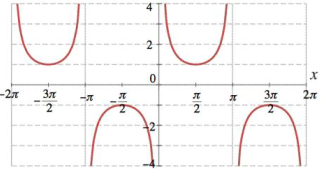
Range of $\operatorname{coses}^{-1} X$ is
- A
$\left[\frac{-\pi}{2}, \frac{\pi}{2}\right]$
- B
$\left[\frac{-\pi}{2}, \frac{\pi}{2}\right]-\{0\}$
- C
$\left[\frac{-\pi}{2}, \frac{\pi}{2}\right]-\{1\}$
- D
$\left(\frac{-\pi}{2}, \frac{\pi}{2}\right)$
View full question & answer→MCQ 121 Mark
The maximum value of Z = 4x + 3y subject to constraint $x+y \leq 10, x y \geq 0$ is
View full question & answer→MCQ 131 Mark
The differential equation of the form $\frac{d y}{d x}=f\left(\frac{y}{x}\right)$ is called
- A
non-homogeneous differential equation
- ✓
homogeneous differential equation
- C
partial differential equation
- D
linear differential equation
AnswerCorrect option: B. homogeneous differential equation
(b) homogeneous differential equation
Explanation: The differential equation of the form $\frac{d y}{d x}= f \left(\frac{y}{x}\right)$ or $\frac{d z}{d y}= g \left(\frac{x}{y}\right)$ is called a homogeneous differential equation.
View full question & answer→MCQ 141 Mark
The angle between the lines 2x = 3y = - z and 6x = - y = - 4z is
- ✓
$90^{\circ}$
- B
$0^{\circ}$
- C
$45^{\circ}$
- D
$30^{\circ}$
AnswerCorrect option: A. $90^{\circ}$
(a) $90^{\circ}$
Explanation: $90^{\circ}$
View full question & answer→MCQ 151 Mark
The value of p and q for which the function $f ( x )=\left\{\begin{array}{ll}\frac{\sin (p+1) x+\sin x}{x} & , x<0 \\ q & , x=0 \\ \frac{\sqrt{x+b x^2}-\sqrt{x}}{x^{\frac{3}{2}}} & , x>0\end{array}\right.$ is continuous for all $x \in R$, are
- ✓
$p =-\frac{3}{2}, q =\frac{1}{2}$
- B
$p=-\frac{3}{2}, q=-\frac{1}{2}$
- C
$p =\frac{5}{2}, q =\frac{7}{2}$
- D
$p=\frac{1}{2}, q=\frac{3}{2}$
AnswerCorrect option: A. $p =-\frac{3}{2}, q =\frac{1}{2}$
(a) $p =-\frac{3}{2}, q =\frac{1}{2}$
Explanation: $p =-\frac{3}{2}, q =\frac{1}{2}$
View full question & answer→MCQ 161 Mark
If A is an invertible matrix of order 3 and $|A|=5$, then find $|\operatorname{adj} A|$.
Answer(a) 25
Explanation:$|A|=5,|\operatorname{adj} A|=|A|^{3-1}=|A|^2=5^2=25$
View full question & answer→MCQ 171 Mark
If $x, y, z$ are non $-$ zero real numbers, then the inverse of matrix $A=\left[\begin{array}{lll}x & 0 & 0 \\ 0 & y & 0 \\ 0 & 0 & z\end{array}\right]$ is
- A
$\frac{1}{x y z}\left[\begin{array}{lll}1 & 0 & 0 \\ 0 & 1 & 0 \\ 0 & 0 & 1\end{array}\right]$
- ✓
$\left[\begin{array}{ccc} x ^{-1} & 0 & 0 \\ 0 & y ^{-1} & 0 \\ 0 & 0 & z ^{-1}\end{array}\right]$
- C
$\frac{1}{x y z}\left[\begin{array}{lll}x & 0 & 0 \\ 0 & y & 0 \\ 0 & 0 & z\end{array}\right]$
- D
$\frac{5 y z}{x y z}\left[\begin{array}{lll}1 & 0 & 0 \\ 0 & 1 & 0 \\ 0 & 0 & 1\end{array}\right]$
AnswerCorrect option: B. $\left[\begin{array}{ccc} x ^{-1} & 0 & 0 \\ 0 & y ^{-1} & 0 \\ 0 & 0 & z ^{-1}\end{array}\right]$
Here, $A=\left[\begin{array}{lll}x & 0 & 0 \\ 0 & y & 0 \\ 0 & 0 & z\end{array}\right]$
Clearly, we can see that
$\operatorname{adj} A=\left[\begin{array}{lll}y z & 0 & 0 \\ 0 & x z & 0 \\ 0 & 0 & x y\end{array}\right] \text { and }|A|=x y z $
$ \therefore A^{-1}=\frac{\operatorname{adj} A}{|A|}=\frac{1}{x y z}\left[\begin{array}{lll}y z & 0 & 0 \\ 0 & x z & 0 \\ 0 & 0 & x y\end{array}\right] $
$ =\left[\begin{array}{lll}x^{-1} & 0 & 0 \\ 0 & y^{-1} & 0 \\ 0 & 0 & z^{-1}\end{array}\right]$
View full question & answer→MCQ 181 Mark
If $A=\left[\begin{array}{ll}3 & 4 \\ 5 & 2\end{array}\right]$ and 2A + B is a null matrix, then B is equal to:
- A
$\left[\begin{array}{ll}-5 & -8 \\ -10 & -3\end{array}\right]$
- B
$\left[\begin{array}{ll}5 & 8 \\ 10 & 3\end{array}\right]$
- ✓
$\left[\begin{array}{ll}-6 & -8 \\ -10 & -4\end{array}\right]$
- D
$\left[\begin{array}{ll}6 & 8 \\ 10 & 4\end{array}\right]$
AnswerCorrect option: C. $\left[\begin{array}{ll}-6 & -8 \\ -10 & -4\end{array}\right]$
(c) $\left[\begin{array}{ll}-6 & -8 \\ -10 & -4\end{array}\right]$
Explanation: $\left[\begin{array}{ll}-6 & -8 \\ -10 & -4\end{array}\right]$
View full question & answer→