Questions

Case study (4 Marks)

🎯

Test yourself on this topic

3 questions · timed · auto-graded

Question 14 Marks
Read the following text carefully and answer the questions that follow:
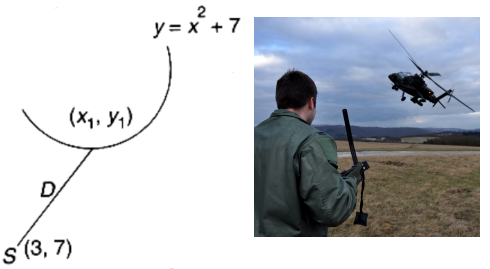
An Apache helicopter of the enemy is flying along the curve given by $y=x^2+7$. A soldier, placed at $(3,7)$ want to shoot down the helicopter when it is nearest to him.
Image
$i.$ If $P \left( x _1, y _1\right)$ be the position of a helicopter on curve $y=x^2+7$ then find distance $D$ from $P$ to soldier place at $(3.7).(1)$
$ii.$ Find the critical point such that distance is minimum. $(1)$
$iii$. Verify by second derivative test that distance is minimum at $(1, 8). (2)$
OR
Find the minimum distance between soldier and helicopter? $(2)$
Answer
$i.\ P \left( x _1, y _1\right)$ is on the curve $y = x ^2+7$
$ \Rightarrow y_1=x_1^2+7$
Distance from $p \left(x_1, x_1^2+7\right)$ and $(3,7)$
$D=\sqrt{\left(x_1-3\right)^2+\left(x_1^2+7-7\right)^2}$
$\Rightarrow \sqrt{\left(x_1-3\right)^2+\left(x_1^2\right)^2}$
$\Rightarrow D=\sqrt{x_1^4+x_1^2-6 x_1+9}$
$ii.\ D=\sqrt{x_1^4+x_1^2-6 x_1+9}$
$D^{\prime}=x_1^4+x_1^2-6 x_1+9$
$\frac{d D^{\prime}}{d x}=4 x_1^3+2 x_1-6=0$
$\frac{d D^{\prime}}{d x}=2 x_1^3+x_1-3=0$
$\Rightarrow\left(x_1-1\right)\left(2 x_1^2+2 x_1+3\right)=0$
$x _1=1$ and $2 x_1^2+2 x _1+3=0$ gives no real roots
The critical point is $(1,8)$.
$iii.\ \frac{d D^{\prime}}{d x}=4 x_1^3+2 x_1-6$
$\frac{d^2 D^{\prime}}{d x^2}=12 x_1^2+2$
$\frac{d^2 D^{\prime}}{d x^2}{x_1=1}=12+2=14;0$
Hence distance is minimum at $(1,8)$.
OR
$D=\sqrt{x_1^4+x_1^2-6 x_1+9}$
$D=\sqrt{1+1-6+9}=\sqrt{5} \text { units }$
View full question & answer
Question 24 Marks
Read the following text carefully and answer the questions that follow:
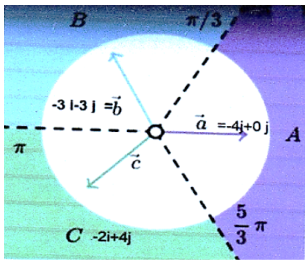
Three friends Ganesh, Dinesh and Ramesh went for playing a Tug of war game. Team $A, B,$ and $C$ belong to Ganesh, Dinesh and Ramesh respectively.
Teams $A, B, C$ have attached a rope to a metal ring and is trying to pull the ring into their own area $($team areas shown below$)$.
Team $A$ pulls with $F _1=4 \hat{i}+0 \hat{j} KN$
Team $B \rightarrow F _2=-2 \hat{i}+4 \hat{j} KN$
Team $C \rightarrow F _3=-3 \hat{i}-3 \hat{j} KN$
Image
$i$. Which team will win the game? $(1)$
$ii$. What is the magnitude of the teams combine Force? $(1)$
$iii.$  What is the magnitude of the force of Team $B? (2)$
OR
How many $KN$ Force is applied by Team $A? (2)$
Answer
$i$. Force applied by team $A$
$=\sqrt{4^2+0^2} =4 N$
Force applied by team $B$
$=\sqrt{(-2)^2+4^2}$
$=\sqrt{4+16}$
$=\sqrt{20}$
$=2 \sqrt{5} N$
Force applied by team $C$
$=\sqrt{(-3)^2+(-3)^2}$
$=\sqrt{9+9}=\sqrt{18}=3 \sqrt{2}$
Hence, the force applied by team $B$ is maximum.
So, Team $'B\ '$ will win.
$ii$. Sum of force applied by team $A, B$ and $C$
$=(4+(-2)+(-3)) \hat{i}+(0+4+(-3)) \hat{j}$
$=-\hat{i}+\hat{j}$
Magnitude of team combine force
$=\sqrt{(-1)^2+(1)^2}$
$=\sqrt{2} N$
$iii$. Force applied by team $B$
$=\sqrt{(-2)^2+4^2}$
$=\sqrt{4+16}$
$=\sqrt{20}$
$=2 \sqrt{5} N$
OR
Force applied by team $A$
$=\sqrt{4^2+0^2}$
$=4 N$
View full question & answer
Question 34 Marks
Read the following text carefully and answer the questions that follow:
For an audition of a reality singing competition, interested candidates were asked to apply under one of the two musical genres$-$folk or classical and under one of the two age categories$-$below $18$ or $18$ and above.
The following information is known about the $2000$ application received:
$i. 960$ of the total applications were the folk genre.
$ii. 192$ of the folk applications were for the below $18$ category.
$iii. 104$ of the classical applications were for the $18$ and above category.
Questions:
$i.$ What is the probability that an application selected at random is for the $18$ and above category provided it is under the classical genre? Show your work. $(1)$
$ii.$ An application selected at random is found to be under the below $18$ category. Find the probability that it is under the folk genre. Show your work. $(1)$
$iii.$ If $P(A)=0.4, P(B)=0.8$ and $P(B \mid A)=0.6$, then $P(A \cup B)$ is equal to. $(2)$
$OR$
$iv.$ If $A$ and $B$ are two independent events with $P ( A )=\frac{3}{5}$ and $P ( B )=\frac{4}{9}$, then find $P \left( A ^{\prime} \cap B ^{\prime}\right). (2)$
Answer
According to given information, we construct the following table.
Given, total applications $= 2000$
  Folk Genre Classical Genre
  $960 ($given$)$ $2000-960=1040$
Below $18$ $192 ($given$)$ $1040-104-936$
$18$ or Above $18$ $960-192=768$ $104 ($given$)$
Let $E_1=$ Event that application for folk genre
$E_2 =$ Event that application for classical genre
$A =$ Event that application for below $18$
$B =$ Event that application for $18$ or above $18$
$\therefore P\left(E_2\right)=\frac{1040}{2000}$
$\text { and } P\left(B \cap E_2\right)=\frac{104}{2000}$
Required Probability $=\frac{P\left(B \cap E_2\right)}{P\left(E_2\right)}$
$=\frac{\frac{104}{2000}}{\frac{1040}{200}}=\frac{1}{10}$
$ii.$ Required probability $=P\left(\frac{\text { folk }}{\text { below } 18}\right)$
$=P\left(\frac{E_1}{A}\right)$
$=\frac{P\left(E_1 \cap A\right)}{P(A)}$
Now$, P \left( E _1 \cap A\right)=\frac{192}{2000}$
and $P(A)=\frac{192+936}{2000}=\frac{1128}{2000}$
$\therefore$ Required probability $=\frac{\frac{192}{2000}}{\frac{1128}{2000}}=\frac{192}{1128}=\frac{8}{47}$
$iii$. Here,
$P(A)=0.4, P(B)=0.8 \text { and } P(B \mid A)=0.6$
$\because P(B \mid A)=\frac{P(B \cap A)}{P(A)}$
$\Rightarrow P(B \cap A)=P(B \mid A) \cdot P(A)$
$=0.6 \times 0.4=0.24$
$\because P(A \cup B)=P(A)+P(B)-P(A \cap B)$
$=0.4+0.8-0.24$
$=1.2-0.24=0.96$
$OR$
Since, $A$ and $B$ are independent events, $A ^{\prime}$ and $B ^{\prime}$ are also independent. Therefore,
$P\left(A^{\prime} \cap B^{\prime}\right)=P^{\prime}\left(A^{\prime}\right) \cdot P\left(B^{\prime}\right)$
$=(1-P(A)(1-P(B))$
$=\left(1-\frac{3}{5}\right)\left(1-\frac{4}{9}\right)$
$=\frac{2}{5} \cdot \frac{5}{9}$
$=\frac{2}{9}$
View full question & answer
Case study (4 Marks) - Mathematics STD 12 Science Questions - Vidyadip