Questions

Case study (4 Marks)

🎯

Test yourself on this topic

3 questions · timed · auto-graded

Question 14 Marks
Read the following text carefully and answer the questions that follow:
The relation between the height of the plant$ (y$ in $\ cm)$ with respect to exposure to sunlight is governed by the following equation $y=4 x-\frac{1}{2} x^2$ where x is the number of days exposed to sunlight.
Image
$i.$ Find the rate of growth of the plant with respect to sunlight. $(1)$
$ii.$ What is the number of days it will take for the plant to grow to the maximum height? $(1)$
$iii.$ Verify that height of the plant is maximum after four days by second derivative test and find the maximum height of plant. $(2)$
OR
What will be the height of the plant after $2$ days? $(2)$
Answer
$i.$ The rate of growth $=\frac{d y}{d x}$
$=\frac{d\left(4 x-\frac{1}{2} x^2\right)}{d x}$
$=4-x$
$ii.$ For the height to be maximum or minimum
$\frac{d y}{d x}=0$
$\Rightarrow \frac{d y}{d x}=\frac{d\left(4 x-\frac{1}{2} x^2\right)}{d x}=4-\frac{1}{2} \cdot 2 x=0$
$\frac{d y}{d x}=4-x=0$
$\Rightarrow x=4$
$\therefore$ Number of required days $=4$
$iii. \frac{d y}{d x}=4- x$
$\Rightarrow \frac{d^2 y}{d x^2}=-1<0$
$\Rightarrow$ Function attains maximum value at $x=4$
We have
$y=4 x-\frac{1}{2} x^2$
$\therefore$ when $x=4$ the height of the plant will be maximum which is $y=4 \times 4-\frac{1}{2} \times(4)^2=16-8=8\ cm$
OR
We have, $y =4 x -\frac{1}{2} x^2$
$\therefore$ When $x=4$ the height of the plant will be maximum which is
$y=4 \times 4-\frac{1}{2} \times(4)^2$
$=8-2=6 \ cm$
View full question & answer
Question 24 Marks
Read the following text carefully and answer the questions that follow:
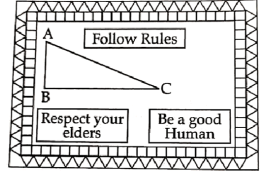
The slogans on chart papers are to be placed on a school bulletin board at the points $A, B$  and $C$ displaying $A ($follow Rules$), B ($Respect your elders$)$ and $C $(Be a good human$)$. The coordinates of these points are $(1, 4, 2), (3, -3, -2)$ and $(-2, 2, 6),$ respectively.
Image
$i$. If $\vec{a}, \vec{b}$ and $\vec{c}$ be the position vectors of points $A, B, C,$ respectively, then find $|\vec{a}+\vec{b}+\vec{c}|$.
$ii.$ If $\vec{a}=4 \hat{i}+6 \hat{j}+12 \hat{k},$ then find the unit vector in direction of $\vec{a}. (1)$
$iii.$ Find area of $\triangle ABC. (2)$
OR
Write the triangle law of addition for $\triangle ABC$. Suppose, if the given slogans are to be placed on a straight line, then the value of $|\vec{a} \times \vec{b}+\vec{b} \times \vec{c}+\vec{c} \times \vec{a}|. (2)$
Answer
$i$. Here,
Position vector of $A$ is $\vec{a}=\hat{i}+4 \hat{j}+2 \hat{k}$
Position vector of $B$ is $\vec{b}=3 \hat{i}-3 \hat{j}-2 \hat{k}$
Position vector of $C$ is $\vec{c}=-2 \hat{i}+2 \hat{j}+6 \hat{k}$
$\therefore \vec{a}+\vec{b}+\vec{c}=(1+3-2) \hat{i}+(4-3+2) \hat{j}+(2-2+6) \hat{k}$
$=2 \hat{i}+3 \hat{j}+6 \hat{k}$
Thus, $|\vec{a}+\vec{b}+\vec{c}|=\left|\sqrt{(2)^2+(3)^2+(6)^2}\right|$
$=|\sqrt{4+9+16}|$
$=\sqrt{29}$
$ii$. Given, $\vec{a}=4 \hat{i}+6 \hat{j}+12 \hat{k}$,
$|\vec{a}|=\sqrt{4^2+6^2+12^2}=14$
Therefore, the unit vector in direction of $\vec{a}$ is given by
$\hat{a}=\frac{\vec{a}}{|\vec{a}|}=\frac{4 \hat{i}+6 \hat{j}+12 \hat{k}}{14}$
$=\frac{4}{14} \hat{i}+\frac{6}{14} \hat{j}+\frac{12}{14} \hat{k}$
$=\frac{2}{7} \hat{i}+\frac{3}{7} \hat{j}+\frac{6}{7} \hat{k}$
$iii$. We have, $A (1,4,2), B (3,-3,-2)$ and $C (-2,2,6)$
Now, $\overrightarrow{A B}=\vec{b}-\vec{a}=2 \hat{i}-7 \hat{j}-4 \hat{k}$
and $\overrightarrow{A C}=\vec{c}-\vec{a}=-3 \hat{i}-2 \hat{j}+4 \hat{k}$
$\therefore \overrightarrow{A B} \times \overrightarrow{A C}=\left|\begin{array}{ccc} \hat{i} & \hat{j} & \hat{k} \\ 2 & -7 & -4 \\ -3 & -2 & 4\end{array}\right|$
$=\hat{i}(-28-8)-\hat{j}(8-12)+\hat{k}(-4-21)$
$=-36 \hat{i}+4 \hat{j}-25 \hat{k}$
$\text { Now, }|\overrightarrow{A B} \times \overrightarrow{A C}|=\sqrt{(-36)^2+4^2+(-25)^2}$
$=|\sqrt{1296+16+625}|=\sqrt{1937}$
$\therefore \text { Area of } \triangle ABC =\frac{1}{2}|\overrightarrow{A B} \times \overrightarrow{A C}|$
$=\frac{1}{2} \sqrt{1937} \text { sq. units }$
OR
Triangle law of addition for $\triangle ABC$ is given by
$\overrightarrow{A B}+\overrightarrow{B C}+\overrightarrow{C A}=\overrightarrow{0}$
If the given points lie on the straight line, then the points will be collinear and so area of $\triangle ABC =0$
Then, $|\vec{a} \times \vec{b}+\vec{b} \times \vec{c}+\vec{c} \times \vec{a}|=0$.
Also, if $a, b, c$ are the position vector of the three vertices $A, B$ and $C$ of, $\triangle ABC$ then area of triangle is $\frac{1}{2}|\vec{a} \times \vec{b}+\vec{b} \times \vec{c}+\vec{c} \times \vec{a}|$
View full question & answer
Question 34 Marks
Read the following text carefully and answer the questions that follow:
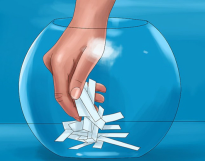
To teach the application of probability a maths teacher arranged a surprise game for $5$ of his students namely Govind, Girish, Vinod, Abhishek and Ankit. He took a bowl containing tickets numbered $1$ to $50$ and told the students go one by one and draw two tickets simultaneously from the bowl and replace it after noting the numbers.
Image
$i.$ Teacher ask Govind, what is the probability that tickets are drawn by Abhishek, shows a prime number on one ticket and a multiple of $4$ on other ticket? $(1)$
$ii$. Teacher ask Girish, what is the probability that tickets drawn by Ankit, shows an even number on first ticket and an odd number on second ticket? $(1)$
$iii$. Teacher asks Abhishek, what is the probability that tickets drawn by Vinod, shows a multiple of $4$ on one ticket and a multiple $5$ on other ticket? $(2)$
OR
Teacher asks Vinod, what is the probability that both tickets drawn by Girish shows odd number? $(2)$
Answer
$i$. Required probability $= P($one ticket with prime number and other ticket with a multiple of $4)$
$=2\left(\frac{15}{50} \times \frac{12}{49}\right)=\frac{36}{245}$
$ii. P($First ticket shows an even number and second ticket shows an odd number$)$
$=\frac{25}{50} \times \frac{25}{49}=\frac{25}{98}$
$iii$. Required probability $= P($one number is a multiple of $4$ and other is a multiple of $5) = P($multiple of $5$ on first ticket and multiple of $4$ on second ticket$) + P($multiple of $4$ on first ticket and multiple of $5$ on second ticket$)$
$=\frac{10}{50} \times \frac{12}{49}+\frac{12}{50} \times \frac{10}{49}$
$=\frac{12}{245}+\frac{12}{245}$
$=\frac{25}{245}$
$=\frac{5}{49}$
OR
Probability that both tickets drawn by Girish shows odd number
$=\frac{25}{50} \times \frac{24}{49}$
$=\frac{12}{49}$
View full question & answer
Case study (4 Marks) - Mathematics STD 12 Science Questions - Vidyadip