MCQ 11 Mark
If $a, b, c, d $ be the position vectors of the points $A, B, C$ and $D$ respectively referred to same origin $O$ such that no three of these points are collinear and $a + c = b + d,$ then quadrilateral $ABCD$ is a
Answerd
(d) Given $a + c = b + d \Rightarrow \frac{1}{2}(a + c) = \frac{1}{2}(b + d)$
Here, mid points of $\overrightarrow {AC} $ and $\overrightarrow {BD} $ coincide, where
$\overrightarrow {AC} $ and $\overrightarrow {BD} $ are diagonals. In addition, we know that diagonals of a parallelogram bisect each other.
Hence quadrilateral is parallelogram.
View full question & answer→MCQ 21 Mark
If the resultant of two forces is of magnitude $ P$ and equal to one of them and perpendicular to it, then the other force is
- ✓
$P\sqrt 2 $
- B
$P$
- C
$P\sqrt 3 $
- D
AnswerCorrect option: A. $P\sqrt 2 $
a
(a) $|\overrightarrow {AB} | = \,|Q|\, = \sqrt {{P^2} + {P^2}} = P\sqrt 2 $.
View full question & answer→MCQ 31 Mark
If $OP = 8$ and $\overrightarrow {OP} $ makes angles ${45^o}$ and ${60^o}$ with $OX-$ axis and $OY-$axis respectively, then $\overrightarrow {OP} = $
- A
$8\,(\sqrt 2 i + j \pm k)$
- ✓
$4\,(\sqrt 2 i + j \pm k)$
- C
$\frac{1}{4}(\sqrt 2 i + j \pm k)$
- D
$\frac{1}{8}(\sqrt 2 i + j \pm k)$
AnswerCorrect option: B. $4\,(\sqrt 2 i + j \pm k)$
b
(b) Trick : Here is the only vector $4(\sqrt 2 i + j \pm k)$, whose length is $8.$
View full question & answer→MCQ 41 Mark
If $a$ is non zero vector of modulus $ a $ and $m$ is a non-zero scalar, then $ma$ is a unit vector if
- A
$m = \pm 1$
- B
$m = \,\,|a|$
- ✓
$m = \frac{1}{{|a|}}$
- D
$m = \pm \,2$
AnswerCorrect option: C. $m = \frac{1}{{|a|}}$
c
(c) $ma $ is a unit vector if and only if $|m\,a|$ ==> $m$
$⇒$ $m = \frac{1}{{|a|}}$.
View full question & answer→MCQ 51 Mark
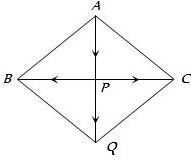
$P$ is a point on the side $BC $ of the $\Delta \,ABC$ and $ Q$ is a point such that $\overrightarrow {PQ} $ is the resultant of $\overrightarrow {AP} ,\,\overrightarrow {PB} ,\,\overrightarrow {PC} .$ Then $ABQC $ is a
Answerc
(c) $\overrightarrow {AP} + \overrightarrow {PB} + \overrightarrow {PC} = \overrightarrow {PQ} $ or $\overrightarrow {AP} + \overrightarrow {PB} = \overrightarrow {PQ} + \overrightarrow {CP} $
or $\overrightarrow {AB} = \overrightarrow {CQ} $.
Hence it is a parallelogram.
View full question & answer→MCQ 61 Mark
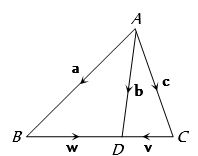
In the figure, a vector $x$ satisfies the equation $x - w = v$. Then $x =$
- A
$2a + b + c$
- ✓
$-a + 2b - c$
- C
$a + b + 2c$
- D
$a + b + c$
AnswerCorrect option: B. $-a + 2b - c$
b
(b) $v = b + c$…..$(i)$
$w = b + a$…..$(ii)$
We have, $x = v + w = a + 2b + c$.
View full question & answer→MCQ 71 Mark
If $ABCD $ is a parallelogram, $\overrightarrow {AB} = 2\,i + 4\,j - 5\,k$ and $\overrightarrow {AD} = \,i + 2\,j + 3\,k,$ then the unit vector in the direction of $BD $ is
- A
$\frac{1}{{\sqrt {69} }}\,(i + 2j - 8k)$
- B
$\frac{1}{{69}}\,(i + 2j - 8\,k)$
- ✓
$\frac{1}{{\sqrt {69} }}\,( - i - 2j + 8k)$
- D
$\frac{1}{{69}}\,( - i - 2j + 8\,k)$
AnswerCorrect option: C. $\frac{1}{{\sqrt {69} }}\,( - i - 2j + 8k)$
c
(c) Since $\overrightarrow {AB} + \overrightarrow {BD} = \overrightarrow {AD} \Rightarrow \overrightarrow {BD} = \overrightarrow {AD} - \overrightarrow {AB} $
$ = (i + 2j + 3k) - (2i + 4j - 5k) = - i - 2j + 8k$
Hence unit vector in the direction of $\overrightarrow {BD} $ is
$\frac{{ - i - 2j + 8k}}{{| - i - 2j + 8k|}} = \frac{{ - i - 2j + 8k}}{{\sqrt {69} }}.$
View full question & answer→MCQ 81 Mark
$p = 2a - 3b,\,\,\,q = a - 2b + c,\,\,r = - 3a + b + 2c;$ where $a, b $ and $c $ being non-zero, non-coplanar vectors, then the vector $ - 2a + 3b - c$ is equal to
- A
$p - 4q$
- ✓
$\frac{{ - 7q + r}}{5}$
- C
$2p - 3q + r$
- D
$4p - 2r$
AnswerCorrect option: B. $\frac{{ - 7q + r}}{5}$
b
(b) Let $ - 2a + 3b - c = xp + yq + zr$
$\therefore \,2x + y - 3z = - 2,$ $ - 3x - 2y + z = 3$ and $y + 2z = - 1$
Solving these, we get $x = 0,$ $y = - \frac{7}{5},$ $z = \frac{1}{5}$
$ - 2a + 3b - c = \frac{{( - 7q + r)}}{5}.$
Trick : Check alternates one by one
i.e., $(a)$ $p - 4q = - 2a + 5b - 4c$
$(b)$ $\frac{{ - 7q + r}}{5} = - 2a + 3b - c$.
View full question & answer→MCQ 91 Mark
In a trapezium, the vector $\overrightarrow {BC} = \lambda \overrightarrow {AD} .$ We will then find that $p = \overrightarrow {AC} + \overrightarrow {BD} $ is collinear with $\overrightarrow {AD} ,$ If $p = \mu \overrightarrow {AD} ,$ then
- ✓
$\mu = \lambda + 1$
- B
$\lambda = \mu + 1$
- C
$\lambda + \mu = 1$
- D
$\mu = 2 + \lambda $
AnswerCorrect option: A. $\mu = \lambda + 1$
a
(a) We have, $p = \overrightarrow {AC} + \overrightarrow {BD} = \overrightarrow {AC} + \overrightarrow {BC} + \overrightarrow {CD} = \overrightarrow {AC} + \lambda \overrightarrow {AD} + \overrightarrow {CD} $
$ = \lambda \,\overrightarrow {AD} + (\overrightarrow {AC} + \overrightarrow {CD} ) = \lambda \,\overrightarrow {AD} + \overrightarrow {AD} = (\lambda + 1)\overrightarrow {AD} .$
Therefore $p = \mu \overrightarrow {AD} \Rightarrow \mu = \lambda + 1.$
View full question & answer→MCQ 101 Mark
$A, B, C, D, E $ are five coplanar points, then $\overrightarrow {DA} + \overrightarrow {DB} + \overrightarrow {DC} + \overrightarrow {AE} + \overrightarrow {BE} + \overrightarrow {CE} $ is equal to
- A
$\overrightarrow {DE} $
- ✓
$3\,\overrightarrow {DE} $
- C
$2\,\overrightarrow {DE} $
- D
$4\,\overrightarrow {ED} $
AnswerCorrect option: B. $3\,\overrightarrow {DE} $
b
(b) $A,\,B,\,C,\,D,\,E$ are five co-planar points.
$\overrightarrow {DA} + \overrightarrow {DB} + \overrightarrow {DC} + \overrightarrow {AE} + \overrightarrow {BE} + \overrightarrow {CE} $
=$(\overrightarrow {DA} + \overrightarrow {AE} ) + (\overrightarrow {DB} + \overrightarrow {BE} ) + (\overrightarrow {DC} + \overrightarrow {CE} )$
= $\overrightarrow {DE} + \overrightarrow {DE} + \overrightarrow {DE} $=$3\overrightarrow {DE} .$
View full question & answer→MCQ 111 Mark
Five points given by $ A, B, C, D, E $ are in a plane. Three forces $\overrightarrow {AC} ,\,\,\overrightarrow {AD} $ and $\overrightarrow {AE} $ act at A and three forces $\overrightarrow {CB} ,\,\,\overrightarrow {DB} ,\,\,\overrightarrow {EB} $ act at $ B$. Then their resultant is
- A
$2\overrightarrow {AC} $
- ✓
$3\overrightarrow {AB} $
- C
$3\overrightarrow {DB} $
- D
$2\overrightarrow {BC} $
AnswerCorrect option: B. $3\overrightarrow {AB} $
b
(b) Points $A, B, C, D, E$ are in a plane.
Resultant $ = (\overrightarrow {AC} + \overrightarrow {AD} + \overrightarrow {AE} ) + (\overrightarrow {CB} + \overrightarrow {DB} + \overrightarrow {EB} )$
$ = (\overrightarrow {AC} + \overrightarrow {CB} ) + (\overrightarrow {AD} + \overrightarrow {DB} ) + (\overrightarrow {AE} + \overrightarrow {EB} )$
$ = \overrightarrow {AB} + \overrightarrow {AB} + \overrightarrow {AB} = 3\overrightarrow {AB} $.
View full question & answer→MCQ 121 Mark
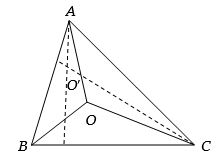
If $ O $ be the circumcentre and $ O'$ be the orthocentre of the triangle $ABC$ , then $\overrightarrow {O'A} + \overrightarrow {O'B} + \overrightarrow {O'C} = $
- A
$\overrightarrow {OO} '$
- ✓
$2\,\overrightarrow {O'O} $
- C
$2\,\overrightarrow {OO'} $
- D
$0$
AnswerCorrect option: B. $2\,\overrightarrow {O'O} $
b
(b) $\overrightarrow {O'A} = \overrightarrow {O'O} + \overrightarrow {OA} $
$\overrightarrow {O'B} = \overrightarrow {O'O} + \overrightarrow {OB} $
$\overrightarrow {O'C} = \overrightarrow {O'O} + \overrightarrow {OC} $
$ \Rightarrow \overrightarrow {O'A} + \overrightarrow {O'B} + \overrightarrow {O'C} $
$ = 3\overrightarrow {O'O} + \overrightarrow {OA} + \overrightarrow {OB} + \overrightarrow {OC} $
Since $\overrightarrow {OA} + \overrightarrow {OB} + \overrightarrow {OC} = \overrightarrow {OO'} = - \overrightarrow {O'O} $
$\therefore $ $\overrightarrow {O'A} + \overrightarrow {O'B} + \overrightarrow {O'C} = 2\overrightarrow {O'O} $.
View full question & answer→MCQ 131 Mark
If the position vectors of the points $A$ and $B$ are $i + 3j - k$ and $3i - j - 3k,$ then what will be the position vector of the mid point of $AB$
- A
$i + 2j - k$
- ✓
$2i + j - 2k$
- C
$2i + j - k$
- D
$i + j - 2k$
AnswerCorrect option: B. $2i + j - 2k$
b
(b) $\frac{{3i - j - 3k + i + 3j - k}}{2} = 2i + j - 2k.$
View full question & answer→MCQ 141 Mark
$ABCDE$ is a pentagon. Forces $\overrightarrow {AB} ,\,\overrightarrow {AE} ,\,\overrightarrow {DC} ,\,\overrightarrow {ED} $ act at a point. Which force should be added to this system to make the resultant $ 2 \overrightarrow {AC} $
- A
$\overrightarrow {AC} $
- B
$\overrightarrow {AD} $
- ✓
$\overrightarrow {BC} $
- D
$\overrightarrow {BD} $
AnswerCorrect option: C. $\overrightarrow {BC} $
c
(c) $\overrightarrow {AE} + \overrightarrow {ED} + \overrightarrow {DC} + \overrightarrow {AB} = \overrightarrow {AD} + \overrightarrow {DC} + \overrightarrow {AB} $$ = \overrightarrow {AC} + \overrightarrow {AB} .$
Obviously, if $\overrightarrow {BC} $ is added to this system, then it will be $\overrightarrow {AC} + \overrightarrow {AB} + \overrightarrow {BC} = \overrightarrow {AC} + \overrightarrow {AC} = 2\overrightarrow {AC} .$
View full question & answer→MCQ 151 Mark
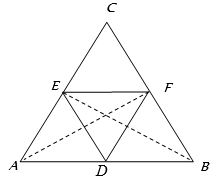
If $D,\,E,\,F$ are respectively the mid points of $AB,\,AC$ and $BC$ in $\Delta ABC$, then $\overrightarrow {BE} $$ + \overrightarrow {AF} = $
AnswerCorrect option: A. $\overrightarrow {DC} $
a
(a) $\overrightarrow {BE} + \overrightarrow {AF} $$ = \overrightarrow {OE} - \overrightarrow {OB} + \overrightarrow {OF} - \overrightarrow {OA} $
$\overrightarrow {BE} + \overrightarrow {AF} = \frac{{\overrightarrow {OA} + \overrightarrow {OC} }}{2} - \overrightarrow {OB} + \frac{{\overrightarrow {OB} + \overrightarrow {OC} }}{2} - \overrightarrow {OA} $
$\overrightarrow {BE} + \overrightarrow {AF} = \overrightarrow {OC} - \frac{{\overrightarrow {OA} + \overrightarrow {OB} }}{2} = \overrightarrow {OC} - \overrightarrow {OD} = \overrightarrow {DC} $.
View full question & answer→MCQ 161 Mark
If $a = i - j$ and $b = i + k$, then a unit vector coplanar with $a $ and $ b $ and perpendicular to $a$ is
Answerd
(d) $c = \lambda a + \mu b = (\lambda + \mu )i - \lambda j + \mu k$
Now, $c.a = 0 \Rightarrow 2\lambda + \mu = 0 \Rightarrow \mu = - 2\lambda $
Therefore, $c = - \lambda i - \lambda j - 2\lambda k = (\sqrt 6 )( - \lambda )\left[ {\frac{{i + j + 2k}}{{\sqrt 6 }}} \right]$
Hence, unit vector $ = \frac{{(i + j + 2k)}}{{\sqrt 6 }}$.
View full question & answer→MCQ 171 Mark
If the position vectors of the points $A, B, C $ be $i + j,\,\,\,i - j$ and $a\,\,i + b\,j + c\,k$ respectively, then the points $A, B, C $ are collinear if
- A
$a = b = c = 1$
- B
$a = 1,\,\,b$ and $c$ are arbitrary scalars
- C
$a = b = c = 0$
- ✓
$c = 0,\,\,a = 1$ and b is arbitrary scalars
AnswerCorrect option: D. $c = 0,\,\,a = 1$ and b is arbitrary scalars
d
(d) Here $\overrightarrow {AB} = - 2j,$ $\overrightarrow {BC} = (a - 1)i + (b + 1)j + ck$
The points are collinear, then $\overrightarrow {AB} = k\,(\overrightarrow {BC} )$
$ - 2j = k\{ (a - 1)i + (b + 1)\,j + ck\} $
On comparing, $k\,(a - 1) = 0$, $k(b + 1) = - 2,$ $kc = 0$.
Hence $c = 0,$ $a = 1$ and $b$ is arbitrary scalar.
View full question & answer→MCQ 181 Mark
If the points $a + b,\,\,a - b$ and $a + k\,b$ be collinear, then $k =$
Answerd
(d) $\overrightarrow {AB} = \lambda \overrightarrow {BC} $,
$\overrightarrow {AB} = - 2b,$ $\overrightarrow {BC} = (k + 1)b$
$\forall \,\,k \in R \Rightarrow \overrightarrow {AB} = \lambda \overrightarrow {BC} .$
View full question & answer→MCQ 191 Mark
If the position vectors of the points $A, B, C$ be $a,\;b$, $3a - 2b$ respectively, then the points $A, B, C$ are
- ✓
- B
- C
Form a right angled triangle
- D
Answera
(a) Here $\overrightarrow {AB} = b - a$ and $\overrightarrow {AC} = (3a - 2b) - (a) = - 2(b - a)$
Therefore, it is of the form $\overrightarrow {AB} = m\overrightarrow {AC} .$
Hence $A, B, C$ are collinear.
View full question & answer→MCQ 201 Mark
If $a, b, c $ are non-collinear vectors such that for some scalars $x, y, z,$ $xa + yb + zc = 0,$ then
- ✓
$x = 0,\,\,y = 0,\,\,z = 0$
- B
$x \ne 0,\,\,y \ne 0,\,\,z = 0$
- C
$x = 0,\,\,y \ne 0,\,\,z \ne 0$
- D
$x \ne 0,\,\,y \ne 0,\,\,z \ne 0$
AnswerCorrect option: A. $x = 0,\,\,y = 0,\,\,z = 0$
View full question & answer→MCQ 211 Mark
The vectors $3\,i + j - 5\,k$ and $a\,i + b\,j - 15\,k$ are collinear, if
- A
$a = 3,\,\,b = 1$
- B
$a = 9,\,\,b = 1$
- C
$a = 3,\,\,b = 3$
- ✓
$a = 9,\,\,b = 3$
AnswerCorrect option: D. $a = 9,\,\,b = 3$
d
(d) $\frac{3}{a} = \frac{1}{b} = \frac{{ - 5}}{{ - 15}} \Rightarrow a = 9,\,\,b = 3.$
View full question & answer→MCQ 221 Mark
If the position vectors of the points $ A$ and $B$ be $2\,i + 3\,j - k$ and $ - 2\,i + 3\,j + 4\,k,$ then the line $AB$ is parallel to
- A
$xy-$ plane
- B
$yz-$ plane
- ✓
$zx-$ plane
- D
AnswerCorrect option: C. $zx-$ plane
c
(c) $\overrightarrow {AB} = - 4i + 5k$, which is a vector lying in a plane parallel to $xz - $ plane.
View full question & answer→MCQ 231 Mark
The points with position vectors $10\,i + 3\,j,\,\,12\,i - 5\,j$ and $a\,i + 11\,j$ are collinear, if $a = $
Answerc
(c) If given points be $A,\,\,B,\,\,C$ then $\overrightarrow {AB} = k(\overrightarrow {BC} )$
or $2i - 8j = k[(a - 12)i + 16j] \Rightarrow k = \frac{{ - 1}}{2}$
Also, $2 = k(a - 12) \Rightarrow a = 8.$
View full question & answer→MCQ 241 Mark
If the position vectors of $ A, B, C, D$ are $2\,i + j,$ $i - 3\,j,$ $3\,i + 2\,j$ and $i + \lambda j$ respectively and $\overrightarrow {AB} ||\overrightarrow {CD} $ , then $\lambda $ will be
Answerb
(b) $\overrightarrow {AB} = - i - 4j,$ $\overrightarrow {CD} = - 2i + (\lambda - 2)j$
So ,$\frac{{ - 1}}{{ - 2}} = \frac{{ - 4}}{{\lambda - 2}}$, $\lambda - 2 = - 8$ or $\lambda = - 6.$
View full question & answer→MCQ 251 Mark
If the vectors $3\,i + 2\,j - k$ and $6\,i - 4xj + yk$ are parallel, then the value of $ x$ and $y $ will be
- ✓
$-1, -2$
- B
$1, -2$
- C
$-1, 2$
- D
$1, 2$
AnswerCorrect option: A. $-1, -2$
a
(a) Obviously, $\frac{3}{6} = \frac{2}{{ - 4x}} = - \frac{1}{y} \Rightarrow x = - 1$ and $y = - 2.$
View full question & answer→MCQ 261 Mark
The vectors $a, b $ and $ a + b $ are
Answerb
(b) These are coplanar because $1(a) + 1(b) = a + b$.
View full question & answer→MCQ 271 Mark
If $ a, b, c$ are the position vectors of three collinear points, then the existence of $x, y, z$ is such that
- A
$xa + yb + zc = 0,\,\,x + y + z \ne 0$
- B
$xa + yb + zc \ne 0,\,\,x + y + z = 0$
- C
$xa + yb + zc \ne 0,\,\,x + y + z \ne 0$
- ✓
$xa + yb + zc = 0,\,\,x + y + z = 0$
AnswerCorrect option: D. $xa + yb + zc = 0,\,\,x + y + z = 0$
d
(d) It is a fundamental concept.
View full question & answer→MCQ 281 Mark
The vectors $a$ and $b$ are non-collinear. The value of $x$ for which the vectors $c = (x - 2)\,a + b$ and $d = (2x + 1)\,a - b$ are collinear, is
- A
$1$
- B
$\frac{1}{2}$
- ✓
$\frac{1}{3}$
- D
AnswerCorrect option: C. $\frac{1}{3}$
c
(c) Since $c = (x - 2)a + b$ and $d = (2x + 1)a - b$ are collinear, therefore $c = \lambda d$
$ \Rightarrow (x - 2)a + b = \lambda (2x + 1)a - \lambda b$
or $[(x - 2) - \lambda (2x + 1)]a + (\lambda + 1)b = 0$
$(x - 2) - \lambda (2x + 1) = 0,\lambda + 1 = 0$
$(\because \,a,b$ are linearly independent)
$ \Rightarrow x - 2 + 2x + 1 = 0 \Rightarrow x = \frac{1}{3}.$
View full question & answer→MCQ 291 Mark
The vectors $i + 2j + 3k,$ $\lambda i + 4j + 7k,$ $ - 3i - 2j - 5k$ are collinear, if $\lambda$ equals
Answera
(a) $\left| {\begin{array}{*{20}{c}}1&2&3\\\lambda &4&7\\{ - 3}&{ - 2}&{ - 5}\end{array}} \right|\, = 0 \Rightarrow \lambda = 3.$
View full question & answer→MCQ 301 Mark
The position vectors of four points $ P, Q, R, S$ are $2a + 4c,\,$ $5a + 3\sqrt 3 \,b + 4c,$ $ - 2\sqrt 3 b + c$ and $2a + c$ respectively, then
- ✓
$\overrightarrow {PQ} $ is parallel to $\overrightarrow {RS} $
- B
$\overrightarrow {PQ} $ is not parallel to $\overrightarrow {RS} $
- C
$\overrightarrow {PQ} $ is equal to $\overrightarrow {RS} $
- D
$\overrightarrow {PQ} $ is parallel and equal to $\overrightarrow {RS} $
AnswerCorrect option: A. $\overrightarrow {PQ} $ is parallel to $\overrightarrow {RS} $
a
(a) $\overrightarrow {PQ} = 3a + 3\sqrt 3 b$ and $\overrightarrow {RS} = 2a + 2\sqrt 3 b$
Hence $\overrightarrow {PQ} \,||\,\overrightarrow {RS} $.
View full question & answer→MCQ 311 Mark
If $a = (1,\,\, - 1)$ and $b = ( - \,2,\,m)$ are two collinear vectors, then $m =$
Answerc
(c) Condition for collinearity, $b = \lambda a$
$ \Rightarrow ( - 2i + mj) = \lambda (i - j)$
Comparison of coefficient, we get
$ \Rightarrow \lambda = - 2$ and $ - \lambda = m.$ So, $m = 2$.
View full question & answer→MCQ 321 Mark
If three points $ A, B, C$ are collinear, whose position vectors are $i - 2j - 8k,\,\,5i - 2k$ and $11\,i + \,3\,j + 7k$ respectively, then the ratio in which $B $ divides $ AC$ is
Answerb
(b) Let the $B$ divide $AC$ in ratio $\lambda :1$, then
$5i - 2k = \frac{{\lambda (11i + 3j + 7k) + i - 2j - 8k}}{{\lambda + 1}}$
$ \Rightarrow 3\lambda - 2 = 0$ $ \Rightarrow \lambda = \frac{2}{3}$ $ i.e., ratio = 2 : 3.$
View full question & answer→MCQ 331 Mark
If $ a$ and $ b $ are two non-collinear vectors and $x\,a + y\,b = 0$
- A
$x = 0$, but $ y$ is not necessarily zero
- B
$y = 0$, but $x$ is not necessarily zero
- ✓
$x = 0$, $y = 0$
- D
AnswerCorrect option: C. $x = 0$, $y = 0$
c
(c) If $a,\,\,b$ are two non-zero, non-collinear vectors and $x, y$ are two scalars such that $xa + yb = 0,$ then $x = 0,\,\,y = 0$.
Because otherwise one will be a scalar multiple of the other and hence collinear which is a contradiction.
View full question & answer→MCQ 341 Mark
If three points $A, B $ and $ C$ have position vectors $(1,\,x,\,3),\,\,(3,\,4,\,7)$ and $(y,-2-5)$ respectively and if they are collinear, then $(x,\,y) = $
- ✓
$(2, -3)$
- B
$(-2, 3)$
- C
$(2, 3)$
- D
$(-2, -3)$
AnswerCorrect option: A. $(2, -3)$
a
(a) If A, B, C are collinear. Then $\overrightarrow {AB} = \lambda \,\overrightarrow {BC} $
==> $2i + (4 - x)j + 4k = \lambda \,[(y - 3)i - 6j - 12k]$
$ \Rightarrow \,\,\,2 = (y - 3)\lambda $ .....$(i)$
and $4 - x = - 6\,\lambda $ .....$(ii)$
==> $4 = - 12\,\lambda \,\,\,\,\, \Rightarrow \,\,\lambda = \frac{{ - 1}}{3}$
By $(i),$ $y = - 3$ and by $(ii),$ $x = 2$; $\therefore \,\,\,(x,\,y) = (2,\, - 3).$
View full question & answer→MCQ 351 Mark
The value of $ k $ for which the vectors $a = i - j$ and $b = - 2\,i + k\,j$ are collinear is
- ✓
$2$
- B
$\frac{1}{2}$
- C
$\frac{1}{3}$
- D
$3$
Answera
(a) Since $a$ and $b$ are collinear, we have $a = mb$ for some scalar $m$.
==> $i - j = m{\rm{ }}( - 2i + kj)$
==> $i - j = - 2mi + kmj$
==> $ - 2m = 1,\,km = - 1$
$m = - \frac{1}{2},$ So $k = 2$.
View full question & answer→MCQ 361 Mark
The value of $b $ such that scalar product of the vectors $(i + j + k)$ with the unit vector parallel to the sum of the vectors $(2i + 4j - 5k)$ and $(bi + 2j + 3k)$ is $1$ , is
Answerd
(d) Parallel vector $ = (2 + b)i + 6j - 2k$
Unit vector $ = \frac{{(2 + b)i + 6j - 2k}}{{\sqrt {{b^2} + 4b + 44} }}$
According to the condition, $1 = \frac{{(2 + b) + 6 - 2}}{{\sqrt {{b^2} + 4b + 44} }}$
$ \Rightarrow {b^2} + 4b + 44 = {b^2} + 12b + 36$ $ \Rightarrow 8b = 8 \Rightarrow b = 1.$
View full question & answer→MCQ 371 Mark
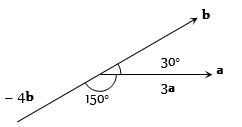
If the angle between $a $ and $ b $ be ${30^o}$, then the angle between $3 a$ and -$ 4 b$ will be ............ $^o$
Answera
(a) It is obvious from figure.
View full question & answer→MCQ 381 Mark
Let the value of $p = (x + 4y)\,a + (2x + y + 1)\,b$ and $q = (y - 2x + 2)\,a + (2x - 3y - 1)\,b,$ where $a $ and $b $ are non-collinear vectors. If $3p = 2q,$ then the value of $x $ and $y$ will be
- A
$-1, 2$
- ✓
$2, -1$
- C
$1, 2$
- D
$2, 1$
AnswerCorrect option: B. $2, -1$
b
(b) Here, $3p = (3x + 12y)\,a + (6x + 3y + 3)b$
$2q = (2y - 4x + 4)\,a + (4x - 6y - 2)\,b$
On comparing, we get $3x + 12y = 2y - 4x + 4$
==> $7x + 10y = 4$ …..$(i)$
and $2x + 9y = - 5$ …..$(ii)$
On solving equations, we get $x = 2,\,\, - 1.$
View full question & answer→MCQ 391 Mark
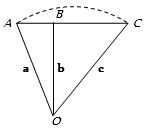
The point $B$ divides the arc $AC$ of a quadrant of a circle in the ratio $1 : 2$. If $O$ is the centre and $\overrightarrow {OA} = a$ and $\overrightarrow {OB} = b,$ then the vector $\overrightarrow {OC} $ is
- A
$b - 2a$
- B
$a\,.\,b \ge 0$
- ✓
$3b - 2a$
- D
AnswerCorrect option: C. $3b - 2a$
c
(c) $\overrightarrow {OC} = \frac{{3b - 2a}}{{3 - 2}} = 3b - 2a$ {$\because $ $AC : BC = 3:2 (externally)$}
View full question & answer→MCQ 401 Mark
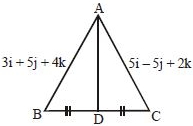
The vectors $\overrightarrow {AB\,} \, = \,3\hat i\, + \,5\hat j\, + \,\,4\hat k\,\,and\,\,\overrightarrow {AC} \, = \,5\hat i\, - 5\hat j\, + 2\hat k$ are the sides of a triangle $ABC.$ The length of the median through $A$ is .............. $\mathrm{unit}$
- A
$\sqrt {13} $
- B
$2\sqrt 5$
- ✓
$5$
- D
$10$
Answerc
$P.V.$ of $\overrightarrow {AD} = \frac{{(3 + 5)i + (5 - 5)j + (4 + 2)k}}{2}$
$\overrightarrow {{\rm{AD}}} = \frac{{8{\rm{i}} + 6{\rm{k}}}}{2} = 4{\rm{i}} + 3{\rm{k}}$
$\therefore $ Length of median $=|\overrightarrow{\mathrm{AD}}|=\sqrt{16+9}=5$ $unit.$
View full question & answer→MCQ 411 Mark
If $a, b, c$ are mutually perpendicular vectors of equal magnitudes, then the angle between the vectors $a$ and $a + b + c$ is
AnswerCorrect option: C. ${\cos ^{ - 1}}\frac{1}{{\sqrt 3 }}$
c
(c) Since $a,\,\,b$ and $c$ are mutually perpendicular, so $a\,.\,b = b\,.\,c = c\,.\,a = 0$
Angle between $a$ and $a + b + c$ is $\cos \theta = \frac{{a.(a + b + c)}}{{|a||a + b + c|}}$ .....$(i)$
Now $|a| = |b| = |c| = a$
$|a + b + c{|^2} = {a^2} + {b^2} + {c^2} + 2\,a\,.\,b + 2\,b\,.\,c + 2\,c\,.\,a$
$ = {a^2} + {a^2} + {a^2} + 0 + 0 + 0$
$\Rightarrow |a + b + c{|^2} = 3{a^2} \Rightarrow |a + b + c| = \sqrt 3 a$
Putting this value in $(i),$ we get $\theta = {\cos ^{ - 1}}\frac{1}{{\sqrt 3 }}.$
View full question & answer→MCQ 421 Mark
If $a, b, c$ are mutually perpendicular unit vectors, then $|a + b + c|\,\, = $
AnswerCorrect option: A. $\sqrt 3 $
a
(a) Three mutually perpendicular unit vectors $ = a$, $b$ and $c$.
Therefore $|a|\, = \,|b|\, = \,|c|\, = 1$ and $a.b = b.c = c.a = 0$.
We know that
$|a + b + c{|^2} = (a + b + c)\,.\,(a + b + c) = \,\,|a{|^2} + |b{|^2}$
$ + |c{|^2} + 2(a\,.\,b\,\, + b\,.\,c\, + c\,.\,a) = 1 + 1 + 1 + 0 = 3$
or $|a + b + c|\, = \sqrt 3 .$
View full question & answer→MCQ 431 Mark
If the angle between the vectors $ a $ and $ b $ be $\theta$ and $a\,.\,b = \cos \theta ,$ then the true statement is
- A
$a$ and $b$ are equal vectors
- B
$a $ and $ b$ are like vectors
- C
$a $ and $b$ are unlike vectors
- ✓
$a$ and $ b$ are unit vectors
AnswerCorrect option: D. $a$ and $ b$ are unit vectors
d
(d) Obviously $a,\,\,b$ are unit vectors.
View full question & answer→MCQ 441 Mark
If the vector $i + j + k$ makes angles $\alpha ,\,\beta ,\,\gamma $ with vectors $i,\,j,k$ respectively, then
- A
$\alpha = \beta \ne \gamma $
- B
$\alpha = \gamma \ne \beta $
- C
$\beta = \gamma \ne \alpha $
- ✓
$\alpha = \beta = \gamma $
AnswerCorrect option: D. $\alpha = \beta = \gamma $
d
(d) Angle between $i + j + k$ and $i$ is equal to
${\cos ^{ - 1}}\left\{ {\frac{{(i + j + k)\,.\,i}}{{|i + j + k|\,\,|i|}}} \right\} \Rightarrow \alpha = {\cos ^{ - 1}}\left( {\frac{1}{{\sqrt 3 }}} \right)$
Similarly angle between $i + j + k$ and $j$ is $\beta = {\cos ^{ - 1}}\left( {\frac{1}{{\sqrt 3 }}} \right)$ and between $i + j + k$ and
$k$ is $\gamma = {\cos ^{ - 1}}\left( {\frac{1}{{\sqrt 3 }}} \right)\,.$
Hence $\alpha = \beta = \gamma .$
View full question & answer→MCQ 451 Mark
If a unit vector lies in $yz-$ plane and makes angles of ${30^o}$ and ${60^o}$ with the positive $y-$ axis and $z-$ axis respectively, then its components along the co-ordinate axes will be
- A
$\frac{{\sqrt 3 }}{2},\,\,\frac{1}{2},\,0$
- ✓
$0,\,\,\frac{{\sqrt 3 }}{2},\,\,\frac{1}{2}$
- C
$\frac{{\sqrt 3 }}{2},\,\,0,\,\,\frac{1}{2}$
- D
$0,\,\,\frac{1}{2},\,\frac{{\sqrt 3 }}{2}$
AnswerCorrect option: B. $0,\,\,\frac{{\sqrt 3 }}{2},\,\,\frac{1}{2}$
b
(b) Let unit vector be $yi + zk,$ then $\sqrt {{y^2} + {z^2}} = 1$ …..$(i)$
Since given that $\cos 30^\circ = \frac{{(yj + zk)\,.\,(yj)}}{{|yj + zk|\,\,|yj|}}$
$ \Rightarrow \frac{{{y^2}}}{{\left( {\sqrt {{y^2} + {z^2}} } \right)\,y}} = \frac{{\sqrt 3 }}{2} \Rightarrow y = \frac{{\sqrt 3 }}{2}$,
$(\,\sqrt {{y^2} + {z^2}} = 1$by $(i)$)
Similarly, $\cos 60^\circ = \frac{{(yj + zk)\,.\,zk}}{{|yj + zk|\,\,|zk|}} \Rightarrow z = \frac{1}{2}$
Hence the components of unit vector are $0,\,\,\frac{{\sqrt 3 }}{2},\,\,\frac{1}{2}.$
Trick : Since the vector lies in $yz - $plane, so it will be either $0i + \frac{{\sqrt 3 }}{2}j + \frac{1}{2}k$ or $0i + \frac{1}{2}j + \frac{{\sqrt 3 }}{2}k.$
But the vector $\frac{{\sqrt 3 }}{2}j + \frac{1}{2}k$ makes angle $30^\circ $with $y - $ axis and that of $60^\circ $ with $z-$ axis.
View full question & answer→MCQ 461 Mark
If $p = i - 2j + 3k$ and $q = 3i + j + 2k,$ then a vector along r which is linear combination of $ p$ and $ q$ and also perpendicular to $ q$ is
AnswerCorrect option: C. $ - \frac{1}{2}\,(i + 5j - 4k)$
c
(c) $r = p + \lambda \,q \Rightarrow r\,.\,q = p\,.\,q + \lambda \,q\,.\,q$
$ \Rightarrow 0 = 7 + 14\lambda \,\, \Rightarrow \lambda \,\, = - \frac{1}{2}$
Therefore, $r = - \frac{1}{2}(i + 5j - 4k).$
View full question & answer→MCQ 471 Mark
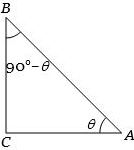
If in a right angled triangle $ABC$, the hypotenuse $AB = p,$ then $\overrightarrow {AB} \,\,.\,\,\overrightarrow {AC} + \overrightarrow {BC} \,.\,\,\overrightarrow {BA} + \overrightarrow {CA} \,\,.\,\,\overrightarrow {CB} $ is equal to
- A
$2{p^2}$
- B
$\frac{{{p^2}}}{2}$
- ✓
${p^2}$
- D
AnswerCorrect option: C. ${p^2}$
c
(c) We have $\overrightarrow {AB} \,.\,\overrightarrow {AC} + \overrightarrow {BC} \,.\,\overrightarrow {BA} + \overrightarrow {CA} \,.\,\overrightarrow {CB} $
$(AB)\,(AC)\cos \theta + (BC)\,(BA)\cos ({90^o} - \theta ) + 0$
=$AB(AC\cos \theta + BC\sin \theta ) = AB\left( {\frac{{{{(AC)}^2}}}{{AB}} + \frac{{{{(BC)}^2}}}{{AB}}} \right)$
$ = A{C^2} + B{C^2} = A{B^2} = {p^2}$.
View full question & answer→MCQ 481 Mark
$A, B, C, D $ are any four points, then$\overrightarrow {AB} \,\,.\,\,\overrightarrow {CD} \,\, + \,\overrightarrow {\,BC} \,\,.\,\,\overrightarrow {AD} \,\, + \overrightarrow {CA} \,\,.\,\,\overrightarrow {BD} \,\, = $
- A
$2\,\,\overrightarrow {AB} \,\,.\,\,\overrightarrow {BC} \,\,.\,\,\overrightarrow {CD} $
- B
$\overrightarrow {AB} \,\, + \,\,\overrightarrow {BC} \,\, + \,\,\overrightarrow {CD} $
- C
$5\sqrt 3 $
- ✓
$0$
Answerd
(d) $\overrightarrow {AD} = \overrightarrow {AB} + \overrightarrow {BC} + \overrightarrow {CD} = a + b + c$
$\overrightarrow {AC} = \overrightarrow {AB} + \overrightarrow {BC} = a + b$ or $\overrightarrow {CA} = - (a + b)$
$\overrightarrow {BD} = \overrightarrow {BC} + \overrightarrow {CD} = b + c$
Therefore, $\overrightarrow {AB} \,.\,\overrightarrow {CD} + \overrightarrow {BC} \,.\,\overrightarrow {AD} + \overrightarrow {CA} \,.\,\overrightarrow {BD} $
$ = a\,.\,c + b\,.(a + b + c) + ( - a - b)\,.\,(b + c)$
$ = a\,.\,c + b\,.\,a + b\,.\,b + b\,.\,c - a\,.\,b - a\,.\,c - b\,.\,b - b\,.\,c$
$ = 0$.
View full question & answer→MCQ 491 Mark
If vectors satisfy the condition $|a - c| = |b - c|$, then $(b - a)\,.\,\left( {c - \frac{{a + b}}{2}} \right)$ is equal to
Answera
(a) $(b - a)\,.\,\left( {c - \frac{{a + b}}{2}} \right) = b\,.\,c - b\,.\,\left( {\frac{{a + b}}{2}} \right)\, - a\,.\,c + \frac{a}{2}(a + b)$
and $|a - c|\, = \,|b - c|$ $ \Rightarrow $ $\,|a - c{|^2}\, = \,|b - c{|^2}$
$\therefore a + b = 2c$
Therefore, $(b - a).\,\left( {c - \frac{{a + b}}{2}} \right) = 0.$
View full question & answer→MCQ 501 Mark
If $a\,.i\,=a\,.\,(i+j)=a\,.\,(i+j+k)$ , then $a = $
Answera
(a) Let $a = xi + yj + zk$.
Then $a\,.\,i = (xi + yj + zk)\,.\,i = x$ and $a\,.\,(i + j) = x + y$ and $a\,.\,(i + j + k) = x + y + z$
Given that $x = x + y = x + y + z$
Now $x = x + y\,\,\, \Rightarrow y = 0$ and $x + y = x + y + z\,\, \Rightarrow \,\,z = 0$
Hence $x = 1$; $\therefore \,\,a = i$.
View full question & answer→