MCQ 1511 Mark
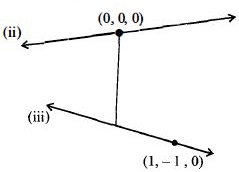
Equation of the line of the shortest distance between the lines $\frac{x}{1} = \frac{y}{{ - 1}} = \frac{z}{1}$ and $\frac{{x - 1}}{0} = \frac{{y + 1}}{{ - 2}} = \frac{z}{1}$ is
- A
$\frac{x}{1} = \frac{y}{{ - 1}} = \frac{z}{{ - 2}}$
- ✓
$\frac{{x - 1}}{1} = \frac{{y + 1}}{{ - 1}} = \frac{z}{{ - 2}}$
- C
$\frac{{x - 1}}{1} = \frac{{y + 1}}{{ - 1}} = \frac{z}{1}$
- D
$\frac{x}{{ - 2}} = \frac{y}{1} = \frac{z}{2}$
AnswerCorrect option: B. $\frac{{x - 1}}{1} = \frac{{y + 1}}{{ - 1}} = \frac{z}{{ - 2}}$
b
Let equation of the required line be
$\frac{{x - {x_1}}}{a} = \frac{{y - {y_1}}}{b} = \frac{{z - {z_1}}}{c}$ .....$(i)$
Given two lines
$\frac{x}{1}=\frac{y}{-1}=\frac{z}{1}$ .........$(ii)$
and $\frac{x-1}{0}=\frac{y+1}{0}=\frac{z}{1}$ .....$(iii)$
since the line $(i)$ is perpendicular to both the lines $(ii)$ and $(iii)$, therefore
$a-b+c=0$ ....$(iv)$
$-2 b+c=0$ .....$(v)$
From $(iv)$ and $(v)$ $c=2 b$ and $a+b=0$ which are not satisfy by options $(c)$ and $(d)$. Hence options $(c)$ and $(d)$ are rejected.
Thus point $\left(x_{1}, y_{1}, z_{1}\right)$ on the required line will be either $(0,0,0)$ or $(1,-1,0)$.
Now foot of the perpendicular from point $(0,0,0)$ to the line $(iii)$
$=(1,-2 r-1, r)$
The direction ratios of the line joining the points $(0,0,0)$ and $(1,-2 r-1, r)$ are $1,-2 r-1, r$
Since sum of the $x$ and $y$ -coordinate of direction ratio of the required line is $0 .$
$\therefore 1-2 r-1-0, \Rightarrow r=0$
Hence direction ratio are $1,-1,0$
But the $z$-direction ratio of the required line is twice the $y$ -direction ratio of the required line
i.e. $0=2(-1),$ which is not true.
Hence the shortest line does not pass through the point $(0,0,0) .$ Therefore option $(a)$ is also rejected.
View full question & answer→MCQ 1521 Mark
If the lines $\frac{{x - 2}}{1} = \frac{{y - 3}}{1} = \frac{{z - 4}}{{ - k}}$ and $\frac{{x - 1}}{k} = \frac{{y - 4}}{2} = \frac{{z - 5}}{1}$ are coplanar then $k $ can have
Answerc
$[a-c, b, d]=0$
$\left| {\begin{array}{*{20}{c}}
{2 - 1}&{3 - 4}&{4 - 5}\\
1&1&{ - k}\\
k&2&1
\end{array}} \right| = 0$
$\left| {\begin{array}{*{20}{c}}
1&{ - 1}&{ - 1}\\
1&1&{ - k}\\
k&2&1
\end{array}} \right| = 0$
$\Rightarrow 1(1+2 k)+\left(1+k^{2}\right)-(2-k)=0$
$\Rightarrow k^{2}+2 k+k=0$
$\Rightarrow k^{2}+3 k=0$
$\Rightarrow \mathrm{k}=\mathrm{0},-3$
View full question & answer→MCQ 1531 Mark
The acute angle between two lines such that the direction cosines $l, m, n,$ of each of them satisfy the equations $l+ m + n = 0$ and $l^2 + m^2 - n^2 = 0$ is ..…… $^o$
Answerc
Let $l_{1}, m_{1}, n_{1}$ and $l_{2}, m_{2}, n_{2}$ be thed.c of line $1$ and $2$ respectively, then as given $l_{1}+m_{1}+n_{1}=0$
and $l_{2}+m_{2}+n_{2}=0$
and $l_{1}^{2}+m_{1}^{2}-n_{1}^{2}=0$ and
$l_{2}^{2}+m_{2}^{2}-n_{2}^{2}=0$
$\left(\because l+m+n=0 \text { and } l^{2}+m^{2}-n^{2}=0\right)$
Angle between lines, $\theta$ is $\cos \theta=l_{1} l_{2}+m_{1} m_{2}+n_{1} n_{2}$
As given $l^{2}+m^{2}=n^{2}$ and $l+m=-n$ $\Rightarrow(-n)^{2}-2 l m=n^{2} \Rightarrow 2 l m=0$ or $l m=0$
So $l_{1} m_{1}=0, l_{2} m_{2}=0$
If $l_{1}=0, m_{1} \neq 0$ then $l_{1} m_{2}=0$
If $m_{1}=0, l_{1} \neq 0$ then $l_{2} m_{1}=0$
If $I_{2}=0, m_{2} \neq 0$ then $l_{2} m_{1}=0$
If $m_{2}=0, l_{2} \neq 0$ then $l_{1} m_{2}=0$
Also $l_{1} l_{2}=0$ and $m_{1} m_{2}=0$
$l^{2}+m^{2}-n^{2}=l^{2}+m^{2}+n^{2}-2 n^{2}=0$
$\Rightarrow 1-2 n^{2}=0 \Rightarrow n=\pm \frac{1}{\sqrt{2}}$
$\therefore n_{1}=\pm \frac{1}{\sqrt{2}}, n_{2}=\pm \frac{1}{\sqrt{2}}$
$\therefore \cos \theta=\frac{1}{2} \theta=60^{\circ}$ (acute angle)
View full question & answer→MCQ 1541 Mark
If two lines $L_1$ and $L_2$ in space, are defined by ${L_1} = \{ x = \sqrt \lambda y + \left( {\sqrt \lambda - 1} \right),z = \left( {\sqrt \lambda - 1} \right)y + \sqrt \lambda \} $ and ${L_2} = \{ x = \sqrt \mu y + \left( {1 - \sqrt \mu } \right),z = \left( {1 - \sqrt \mu } \right)y + \sqrt \mu \} $ then $L_1$ is perpendicular to $L_2$, for all non-negative reals $\lambda $ and $ \mu $, such that
AnswerCorrect option: D. $\lambda = \mu $
d
For $L_{1}$
$x=\sqrt{\lambda} y+(\sqrt{\lambda}-1) \Rightarrow y=\frac{x-(\sqrt{\lambda}-1)}{\sqrt{\lambda}}$ .....$(i)$
$z=(\sqrt{\lambda}-1) y+\sqrt{\lambda} \Rightarrow y=\frac{z-\sqrt{\lambda}}{\sqrt{\lambda}-1}$ ......$(ii)$
From $(i)$ and $(ii)$
$\frac{x-(\sqrt{\lambda}-1)}{\sqrt{\lambda}}=\frac{y-0}{1}=\frac{z-\sqrt{\lambda}}{\sqrt{\lambda}-1}$ ....$(A)$
The equation $(\mathrm{A})$ is the equation of line $\mathrm{L}_{1}$
Similarly equation ofline $\mathrm{L}_{2}$ is
$x-\frac{(1-\sqrt{\mu})}{\sqrt{\mu}}=\frac{y-0}{1}=\frac{z-\sqrt{\mu}}{1-\sqrt{\mu}}$ ....$(B)$
Since $\mathrm{L}_{1} \perp \mathrm{L}_{2},$ therefore
$\sqrt{\lambda} \sqrt{\mu}+1 \times 1+(\sqrt{\lambda}-1)(1-\sqrt{\mu})=0$
$\Rightarrow \sqrt{\lambda}+\sqrt{\mu}=0 \Rightarrow \sqrt{\lambda}=-\sqrt{\mu}$
$\Rightarrow \lambda=\mu$
View full question & answer→MCQ 1551 Mark
Let $\gamma \in R$ be such that the lines $L_1: \frac{x+11}{1}=\frac{y+21}{2}=\frac{z+29}{3}$ and $L_2: \frac{x+16}{3}=\frac{y+11}{2}=\frac{z+4}{\gamma}$ intersect. Let $R_1$ be the point of intersection of $L_1$ and $L_2$. Let $O=(0,0,0)$, and $\hat{n}$ denote a unit normal vector to the plane containing both the lines $L_1$ and $L_2$.
Match each entry in $List-I$ to the correct entry in $List-II$.
| $List-I$ |
$List-II$ |
| ($P$) $\gamma$ equals |
($1$) $-\hat{i}-\hat{j}+\hat{k}$ |
| ($Q$) A possible choice for $\hat{n}$ is |
($2$) $\sqrt{\frac{3}{2}}$ |
| ($R$) $\overline{O R_1}$ equals |
($3$) $1$ |
| ($S$) A possible value of $\overline{O R_1} \cdot \hat{n}$ is |
($4$) $\frac{1}{\sqrt{6}} \hat{i}-\frac{2}{\sqrt{6}} \hat{j}+\frac{1}{\sqrt{6}} \hat{k}$ |
| |
($5$) $\sqrt{\frac{2}{3}}$ |
The correct option is
- A
$(P) \rightarrow (3)( Q ) \rightarrow (4)( R ) \rightarrow(1)( S ) \rightarrow(2)$
- B
$(P) \rightarrow (5)( Q ) \rightarrow (4)( R ) \rightarrow(1)( S ) \rightarrow(2)$
- ✓
$(P) \rightarrow (3) (Q) \rightarrow (4) (R) \rightarrow (1) (S) \rightarrow (5)$
- D
$(P) \rightarrow (3) (Q) \rightarrow (1) (R) \rightarrow (4) (S) \rightarrow (5)$
AnswerCorrect option: C. $(P) \rightarrow (3) (Q) \rightarrow (4) (R) \rightarrow (1) (S) \rightarrow (5)$
c
$L _1: \frac{ x +11}{1}=\frac{ y +21}{2}=\frac{ z +29}{3}= a$
$L _2: \frac{ x +16}{3}=\frac{ y +11}{2}=\frac{ z +4}{\gamma}= b$
$x = a -11=3 b -16 \quad \Rightarrow a -3 b =-5$ $. . . (1)$
$y =2 a -21=2 b -11 \Rightarrow 2 a -2 b =10$ $. . . (2)$
$z=3 a-29=b r-4 \Rightarrow 3 a-b \gamma=25$ $. . . (3)$
from $(1)$ and $(2) $
$a =10, b =5$
Now from $(3)$
$3(10)-5 \gamma=25 \quad \therefore \gamma=1$
$R _1 \equiv(-1,-1,1)$
$OR _1=-\hat{ i }-\hat{ j }+\hat{ k }$
$\overrightarrow{ n }=\left|\begin{array}{lll} i & j & k \\ 1 & 2 & 3 \\ 3 & 2 & 1\end{array}\right|=-4 \hat{ i }-(-8) \hat{ j }-4 \hat{ k }$
$\overrightarrow{ n }=-4 \hat{ i }+8 \hat{ j }+4 \hat{ k }=-4(\hat{ i }-2 \hat{ j }+\hat{ k })$
$\hat{ n }= \pm \frac{4(\hat{ i }-2 \hat{ j }+\hat{ k })}{4 \sqrt{6}}= \pm \frac{(\hat{ i }-2 \hat{ j }+\hat{ k })}{\sqrt{6}}$
$\overrightarrow{ OR } \cdot \hat{ n }= \pm(-\hat{ i }-\hat{ j }+\hat{ k })\left(\frac{\hat{ i }-2 \hat{ j }+\hat{ k }}{\sqrt{6}}\right)= \pm \frac{2}{\sqrt{6}}= \pm \sqrt{\frac{4}{6}}= \pm \sqrt{\frac{2}{3}}$
View full question & answer→MCQ 1561 Mark
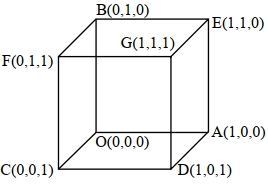
Let $Q$ be the cube with the set of vertices $\left\{\left(\mathrm{x}_1, \mathrm{x}_2, \mathrm{x}_3\right) \in \mathbb{R}^3: \mathrm{x}_1, \mathrm{x}_2, \mathrm{x}_3\{0,1\}\right\}$. Let $\mathrm{F}$ be the set of all twelve lines containing the diagonals of the six faces of the cube $Q$. Let $S$ be the set of all four lines containing the main diagonals of the cube $\mathrm{Q}$; for instance, the line passing through the vertices $(0,0,0)$ and $(1,1,1)$ is in $\mathrm{S}$. For lines $\ell_1$ and $\ell_2$, let $\mathrm{d}\left(\ell_1, \ell_2\right)$ denote the shortest distance between them. Then the maximum value of $\mathrm{d}\left(\ell_1, \ell_2\right)$, as $\ell_1$ varies over $\mathrm{F}$ and $\ell_2$ varies over $\mathrm{S}$, is
- ✓
$\frac{1}{\sqrt{6}}$
- B
$\frac{1}{\sqrt{8}}$
- C
$\frac{1}{\sqrt{3}}$
- D
$\frac{1}{\sqrt{12}}$
AnswerCorrect option: A. $\frac{1}{\sqrt{6}}$
a
DR' $S$ of $O G=1,1,1$
DR'S of $\mathrm{AF}=-1,1,1$
DR'S of $C E=1,1,-1$
DR'S of $\mathrm{BD}=1,-1,1$
Equation of $\mathrm{OG} \Rightarrow \frac{\mathrm{x}}{1}=\frac{\mathrm{y}}{1}=\frac{\mathrm{z}}{1}$
Equation of $A B \Rightarrow \frac{x-1}{1}=\frac{y}{-1}=\frac{z}{0}$
Normal to both the line's
$=\left|\begin{array}{ccc}\hat{i} & \hat{j} & \hat{k} \\ 1 & 1 & 1 \\ 1 & -1 & 0\end{array}\right|=\hat{i}+\hat{j}-2 \hat{k}$
$\overrightarrow{\mathrm{OA}}=\hat{i}$
$\text { S.D. }=\frac{|\hat{i} \cdot(\hat{i}+\hat{j}-2 \hat{k})|}{|\hat{i}+\hat{j}-2 \hat{k}|}=\frac{1}{\sqrt{6}}$
View full question & answer→MCQ 1571 Mark
Let $\ell_1$ and $\ell_2$ be the lines $\overrightarrow{\mathfrak{1}}_1=\lambda(\hat{\mathrm{i}}+\hat{\mathrm{j}}+\hat{\mathrm{k}})$ and $\vec{r}_2=(\hat{\mathrm{j}}-\hat{\mathrm{k}})+\mu(\hat{\mathrm{i}}+\hat{\mathrm{k}})$, respectively. Let $\mathrm{X}$ be the set of all the planes $\mathrm{H}$ that contain the line $\ell_1$. For a plane $\mathrm{H}$, let $\mathrm{d}(\mathrm{H})$ denote the smallest possible distance between the points of $\ell_2$ and $H$. Let $\mathrm{H}_0$ be plane in $X$ for which $\mathrm{d}\left(\mathrm{H}_0\right)$ is the maximum value of $\mathrm{d}(\mathrm{H})$ as $\mathrm{H}$ varies over all planes in $\mathrm{X}$.
Match each entry in List-$I$ to the correct entries in List-$II$.
| List-$I$ |
List-$II$ |
| ($P$) The value of $\mathrm{d}\left(\mathrm{H}_0\right)$ is |
($1$) $\sqrt{3}$ |
| ($Q$) The distance of the point $(0,1,2)$ from $\mathrm{H}_0$ is |
($2$) $\frac{1}{\sqrt{3}}$ |
| ($R$) The distance of origin from $\mathrm{H}_0$ is |
($3$) $0$ |
| ($S$) The distance of origin from the point of intersection of planes $\mathrm{y}=\mathrm{z}, \mathrm{x}=1$ and $\mathrm{H}_0$ is |
($4$) $\sqrt{2}$ |
| |
($5$) $\frac{1}{\sqrt{2}}$ |
The corret option is :
- A
$(\mathrm{P}) \rightarrow(2)(\mathrm{Q}) \rightarrow(4)(\mathrm{R}) \rightarrow(5)(\mathrm{S}) \rightarrow(1)$
- ✓
$(\mathrm{P}) \rightarrow(5)(\mathrm{Q}) \rightarrow(4)(\mathrm{R}) \rightarrow(3) (S) \rightarrow (1)$
- C
$(P) \rightarrow (2) (Q) \rightarrow (1) (R) \rightarrow (3) (S) \rightarrow (2)$
- D
$(\mathrm{P}) \rightarrow(5)(\mathrm{Q}) \rightarrow(1)(\mathrm{R}) \rightarrow(4) (S) \rightarrow(2)$
AnswerCorrect option: B. $(\mathrm{P}) \rightarrow(5)(\mathrm{Q}) \rightarrow(4)(\mathrm{R}) \rightarrow(3) (S) \rightarrow (1)$
b
$L_1: \vec{r}_1=\lambda(\hat{i}+\hat{j}+\hat{k})$
$L_2: \vec{r}_2=\hat{j}-\hat{k}+\mu(\hat{i}+\hat{k})$
Let system of planes are
$a x+b y+c z=0$ $. . . . . . . (1)$
$\because \text { It contain } L_1$
$\therefore a+b+c=0$ $. . . . . . (2)$
$\text { For largest possi }$
$\therefore a+c=0$ $. . . . . .(3)$
$\Rightarrow b=0$
For largest possible distance between plane ($1$) and $\mathrm{L}_2$ the line $\mathrm{L}_2$ must be parallel to plane ($1$)
$\therefore a+c=0$
$\Rightarrow b=0$
$\therefore$ Plane $\mathrm{H}_0: \mathrm{x}-\mathrm{z}=0$
Now $\mathrm{d}\left(\mathrm{H}_0\right)=\perp$ distance from point $(0,1,-1)$ on $\mathrm{L}_2$ to plane.
$\Rightarrow \mathrm{d}\left(\mathrm{H}_0\right)=\left|\frac{0+1}{\sqrt{2}}\right|=\frac{1}{\sqrt{2}}$
$\therefore \mathrm{P} \rightarrow 5$
$\text { for ' } Q \text { ' distance }=\left|\frac{2}{\sqrt{2}}\right|=\sqrt{2}$
$\therefore Q \rightarrow 4$
$\therefore(0,0,0)$ lies on plane
$\therefore R \rightarrow 3$
for 'S' $x=z ; y=z ; x=1$
$\therefore$ point of intersection $\mathrm{p}(1,1,1)$.
$\therefore \mathrm{OP}=\sqrt{1+1+1}=\sqrt{3}$
$\therefore \mathrm{S} \rightarrow 2$
$\therefore$ option $[B]$ is correct
View full question & answer→MCQ 1581 Mark
Let $L _1$ and $L _2$ denotes the lines
$\overrightarrow{ r }=\hat{ i }+\lambda(-\hat{ i }+2 \hat{ j }+2 \hat{ k }), \lambda \in R \text { and }$
$\overrightarrow{ r }=\mu(2 \hat{ i }-\hat{ j }+2 \hat{ k }), \mu \in R$
respectively. If $L _3$ is a line which is perpendicular to both $L _1$ and $L _2$ and cuts both of them, then which of the following options describe(s) $L _3$ ?
$(1)$ $\overrightarrow{ r }=\frac{1}{3}(2 \hat{ i }+\hat{ k })+ t (2 \hat{ i }+2 \hat{ j }-\hat{ k }), t \in R$
$(2)$ $\overrightarrow{ i }=\frac{2}{9}(2 \hat{ i }-\hat{ j }+2 \hat{ k })+ t (2 \hat{ i }+2 \hat{ j }-\hat{ k }), t \in R$
$(3)$ $\overrightarrow{ r }=t(2 \hat{ i }+2 \hat{ j }-\hat{ k }), t \in R$
$(4)$ $\overrightarrow{ r }=\frac{2}{9}(4 \hat{ i }+\hat{ j }+\hat{ k })+ t (2 \hat{ i }+2 \hat{ j }-\hat{ k }), t \in R$
- ✓
$1,2,4$
- B
$1,2,3$
- C
$1,2$
- D
$1,3$
AnswerCorrect option: A. $1,2,4$
a
Points on $L _1$ and $L _2$ are respectively $A (1-\lambda, 2 \lambda, 2 \lambda)$ and $B (2 \mu,-\mu, 2 \mu)$
So, $\overline{ AB }=(2 \mu+\lambda-1) \hat{ i }+(-\mu-2 \lambda) \hat{ j }+(2 \mu-2 \lambda) \hat{ k }$
and vector along their shortest distance $=2 \hat{i}+2 \hat{j}-\hat{k}$.
Hence, $\frac{2 \mu+\lambda-1}{2}=\frac{-\mu-2 \lambda}{2}=\frac{2 \mu-2 \lambda}{-1}$
$\Rightarrow \lambda=\frac{1}{9} \& \mu=\frac{2}{9}$
Hence, $A \equiv\left(\frac{8}{9}, \frac{2}{9}, \frac{2}{9}\right)$ and $B \equiv\left(\frac{4}{9},-\frac{2}{9}, \frac{4}{9}\right)$
$\Rightarrow$ Mid point of $AB \equiv\left(\frac{2}{3}, 0, \frac{1}{3}\right)$
View full question & answer→MCQ 1591 Mark
Three lines
$L _1: \overrightarrow{ r }=\lambda \hat{ i }, \lambda \in R ,$
$L _2: \overrightarrow{ r }=\hat{ k }+\mu \hat{ j }, \mu \in R \text { and }$
$L _3: \overrightarrow{ r }=\hat{ i }+\hat{ j }+ vk , v \in R$
are given. For which point(s) $Q$ on $L_2$ can we find a point $P$ on $L_1$ and a point $R$ on $L_3$ so that $P$, $Q$ and $R$ are collinear?
$(1)$ $\hat{k}+\hat{j}$ $(2)$ $\hat{ k }$ $(3)$ $\hat{ k }+\frac{1}{2} \hat{ j }$ $(4)$ $\hat{k}-\frac{1}{2} \hat{j}$
Answerd
Let $P(\lambda, 0,0), Q(0, \mu, 1), R(1,1, v)$ be points. $L_1, L_2$ and $L_3$ respectively
Since $P , Q , R$ are collinear, $\overline{ PQ }$ iscollinear with $\overline{ QR }$
Hence $\frac{-\lambda}{1}=\frac{\mu}{1-\mu}=\frac{1}{v-1}$
For every $\mu \in R-\{0,1\}$ there exist unique $\lambda, v \in R$
Hence $Q$ cannot have coordinates $(0,1,1)$ and $(0,0,1)$.
View full question & answer→MCQ 1601 Mark
From a point $P(\lambda, \lambda, \lambda)$, perpendiculars $P Q$ and $P R$ are drawn respectively on the lines $y=x, z=1$ and $y$ $=-x, z=-1$. If $P$ is such that $\angle Q P R$ is a right angle, then the possible value(s) of $\lambda$ is(are)
- A
$\sqrt{2}$
- B
$1$
- ✓
$-1$
- D
$-\sqrt{2}$
Answerc
Line is
$\frac{x-0}{1}=\frac{y-0}{1}=\frac{z-0}{1}=\alpha $$\quad..............(1)$
$Q(\alpha, \alpha, 1)$
Direction ratio of $PQ$ are
$\lambda-\alpha, \lambda-\alpha, \lambda-1$
Since $PQ$ is perpendicular to $(1)$
$\therefore \quad \lambda-\alpha+\lambda-\alpha+0=0 $
$ \lambda=\alpha$
$\therefore \quad$ Direction ratio of $P Q$ are
$0,0, \lambda-1$
Another line is
$\frac{x-0}{-1}= \frac{y-0}{1}=\frac{z+1}{0}=\beta $
$\therefore \quad R(-\beta, \beta,-1) $
$\therefore \quad \text { Direction ratio of PR are } $
$ \lambda+\beta, \lambda-\beta, \lambda+1$
Since $P Q$ is perpendicular to $(ii)$
$\therefore -\lambda-\beta+\lambda-\beta=0 $
$ \beta=0 $
$\therefore \quad R(0,0,-1) $
$\text { and } \text { Direction ratio of } P Q \text { are } \lambda, \lambda, \lambda+1 $
$\text { Since } P Q \perp PR $
$\therefore 0+0+\lambda^2-1=0 \Rightarrow \lambda= \pm 1 \Rightarrow B, C$
For $\lambda=1$ the point is on the line so it will be rejected.
$\Rightarrow \quad \lambda=-1$
View full question & answer→MCQ 1611 Mark
A line $l$ passing through the origin is perpendicular to the lines
$l_1:(3+ t ) \hat{ i }+(-1+2 t ) \hat{ j }+(4+2 t ) \hat{ k },-\infty< t <\infty $
$l_2:(3+2 t ) \hat{ i }+(3+2 t ) \hat{ j }+(2+ s ) \hat{ k },-\infty< s <\infty$
Then, the coordinate$(s)$ of the point$(s)$ on $l_2$ at a distance of $\sqrt{17}$ from the point of intersection of $l$ and $l_1$ is(are)
$(A)$ $\left(\frac{7}{3}, \frac{7}{3}, \frac{5}{3}\right)$ $(B)$ $(-1,,-1,0)$ $(C)$ $(1,1,1)$ $(D)$ $\left(\frac{7}{9}, \frac{7}{9}, \frac{8}{9}\right)$
- A
$(A,C)$
- ✓
$(B,D)$
- C
$(B,C)$
- D
$(C,D)$
AnswerCorrect option: B. $(B,D)$
b
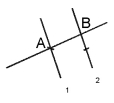
Let equation of line $\ell$ is
$\ell: \frac{ x -0}{ a }=\frac{ y -0}{ b }=\frac{ z -0}{ c }= k$
This line $\ell$ is perpendicular to given line $\ell_1$ and $\ell_2$.
Hence
$a+2 b+2 c=0 $
$2 a+2 b+c=0 $
$\frac{a}{-2}=\frac{b}{3}=\frac{c}{-2}$
Hence equation of $\ell$ is $\frac{ x }{-2}=\frac{ y }{3}=\frac{ z }{-2}= k _1, \quad k _2$
for $\ell_1$ for $\ell_2$
Now $A \left(-2 k _1, 3 k _1,-2 k _1\right) \quad B \left(-2 k _2, 3 k _2,-2 k _2\right)$
Point A satisfied $\ell_1$
$-2 k_1 \hat{i}+3 k_1 \hat{j}-2 k_1 \hat{k}=(3+t) \hat{i}+(-1+2 t) \hat{j}+(4+2 t) \hat{k} $
$3+t=-2 k_1 \quad \ldots \ldots . .(1) $
$-1+2 t=3 k_1 \quad \ldots \ldots .(2) $
$4+2 t=-2 k_1 \quad \ldots \ldots .(3)$
$(2)$ and $(3)$ $-5=5 k_1 \Rightarrow k_1=-1 \Rightarrow A(2,-3,2)$
Let any point on $\ell_2(3+2 S, 3+2 S, 2+S)$
Given$\quad\sqrt{(1+2 S)^2+(6+2 S)^2+(S)^2}=\sqrt{17} $
$9 S^2+28 S+37=17 $
$9 S^2+28 S+20=0 $
$9 S^2+18 S+10 S+20=0 $
$9 S(S+2)+10(S+2)=0 $
$S=-2,-10 / 9$
Hence $(-1,-1,0),(7 / 9,7 / 9,8 / 9)$
View full question & answer→MCQ 1621 Mark
Two lines $L_1: x=5, \frac{y}{3-\alpha}=\frac{z}{-2}$ and $L_2: x=\alpha, \frac{y}{-1}=\frac{z}{2-\alpha}$ are coplanar. Then $\alpha$ can take value$(s)$
$(A)$ $1$ $(B)$ $2$ $(C)$ $3$ $(D)$ $4$
- A
$(A,C)$
- B
$(B,D)$
- C
$(B,C)$
- ✓
$(A,D)$
AnswerCorrect option: D. $(A,D)$
d
$\frac{x-5}{0}=\frac{-y}{\alpha-3}=\frac{z}{-2} $
$\frac{x-\alpha}{0}=\frac{y}{-1}=\frac{z}{2-\alpha}$
$\left|\begin{array}{ccc}5-\alpha & 0 & 0 \\ 0 & 3-\alpha & -2 \\ 0 & -1 & 2-\alpha\end{array}\right|=0$
$(5-\alpha)((3-\alpha)(2-\alpha)-2)=0 $
$\left(\alpha^2-5 \alpha+6-2\right)=0 $
$(\alpha-5)\left(\alpha^2-5 \alpha+4\right)=0 $
$\alpha=1,4,5$
View full question & answer→MCQ 1631 Mark
If the straight lines $\frac{x-1}{2}=\frac{y+1}{k}=\frac{z}{2}$ and $\frac{x+1}{5}=\frac{y+1}{2}=\frac{z}{k}$ are coplanar, then the plane$(s)$ containing these two lines is(are)
$(A)$ $y+2 z=-1$ $(B)$ $y+z=-1$ $(C)$ $y-z=-1$ $(D)$ $y-2 z=-1$
- A
$(B,D)$
- ✓
$(B,C)$
- C
$(A,D)$
- D
$(C,D)$
AnswerCorrect option: B. $(B,C)$
b
For co-planer lines $[\vec{a}-\vec{c} \vec{b} \vec{d}]=0$
$\vec{a} \equiv(1,-1,0), \vec{c}=(-1,-1,0) $
$\vec{b}=2 \hat{i}+k \hat{j}+2 \hat{k} \quad \vec{d}=5 \hat{i}+2 \hat{j}+k \hat{k}$
Now $\left|\begin{array}{lll}2 & 0 & 0 \\ 2 & k & 2 \\ 5 & 2 & k\end{array}\right|=0 \quad \Rightarrow \quad k= \pm 2$
$\overrightarrow{ n }_1=\overrightarrow{ b }_1 \times \overrightarrow{ d }_1=6 \hat{ j }-6 \hat{ k } \text { for } k =2 $
$\overrightarrow{ n }_2=\overrightarrow{ b }_2 \times \overrightarrow{ d }_2=14 \hat{ j }+14 \hat{ k } \text { for } k =-2$
so the equation of planes are $(\vec{r}-\vec{a}) \vec{n}_1=0 \Rightarrow y-z=-1$ $\qquad$............$(1)$
$(\vec{r}-\vec{a}) \vec{n}_2=0 \Rightarrow y+z=-1$
$\qquad$.............$(2)$
View full question & answer→MCQ 1641 Mark
Match the statements in column-$I$ with those in column-$II$.
| column-$I$ |
column-$II$ |
| $(A)$ A line from the origin meets the lines $\frac{x-2}{1}=\frac{y-1}{-2}=\frac{z+1}{1}$ and $\frac{x-\frac{8}{3}}{2}=\frac{y+3}{-1}=\frac{z-1}{1}$ at $P$ and $Q$ respectively. If length $P Q=d$, then $d^2$ is |
$(p)$ $-4$ |
| $(B)$ The values of $x$ satisfying $\tan ^{-1}(x+3)-\tan ^{-1}(x-3)=\sin ^{-1}\left(\frac{3}{5}\right)$ are |
$(q)$ $0$ |
| $(C)$ Non-zero vectors $\vec{a}, \vec{b}$ and $\overrightarrow{\mathrm{c}}$ satisfy $\vec{a} \cdot \vec{b}=0$, $(\vec{b}-\vec{a}) \cdot(\vec{b}+\vec{c})=0$ and $2|\vec{b}+\vec{c}|=|\vec{b}-\vec{a}|$. If $\vec{a}=\mu \vec{b}+4 \vec{c}$, then the possible values of $\mu$ are |
$(r)$ $4$ |
| $(D)$ Let $f$ be the function on $[-\pi, \pi]$ given by $f(0)=9$ and $f(x)=$ $\sin \left(\frac{9 x}{2}\right) / \sin \left(\frac{x}{2}\right)$ for $x \neq 0$. The value of $\frac{2}{\pi} \int_{-\pi}^\pi f(x) d x$ is |
$(s)$ $5$ |
| |
$(t)$ $6$ |
- A
$A-r\ \ B-p, s\ \ C-q, t\ \ D-r$
- B
$A-t\ \ B-p, t\ \ C-q, t\ \ D-t$
- C
$A- s\ \ B-p, q\ \ C-p, q\ \ D-s$
- ✓
$A-t\ \ B-p, r\ \ C-q, s\ \ D-r$
AnswerCorrect option: D. $A-t\ \ B-p, r\ \ C-q, s\ \ D-r$
d
$(A)-(t)$
Let the line be $\frac{x}{a}=\frac{y}{b}=\frac{z}{c}$ intersects the lines
$\Rightarrow \mathrm{S} . \mathrm{D}=0 \Rightarrow \mathrm{a}+3 \mathrm{~b}+5 \mathrm{c}=0 \text { and } 3 \mathrm{a}+\mathrm{b}-5 \mathrm{c}=0 \Rightarrow \mathrm{a}: \mathrm{b}: \mathrm{c}:: 5 \mathrm{r}:-5 \mathrm{r}: 2 \mathrm{r}$
on solving with given lines we get points of intersection $\mathrm{P} \equiv(5,-5,2)$ and $\mathrm{Q} \equiv\left(\frac{10}{3},-\frac{10}{3}, \frac{8}{3}\right)$ $\Rightarrow \mathrm{PQ}^2=\mathrm{d}^2=6$.
$(B)-(p), (r)$
$ \tan ^{-1}(\mathrm{x}+3)-\tan ^{-1}(\mathrm{x}-3)=\sin ^{-1}(3 / 5) $
$ \Rightarrow \tan ^{-1} \frac{(x+3)-(x-3)}{1+\left(x^2-9\right)}=\tan ^{-1} \frac{3}{4} \Rightarrow \frac{6}{x^2-8}=\frac{3}{4} $
$ \therefore \mathrm{x}^2-8=8 $
$ \text { or } \mathrm{x}= \pm 4 \text {. }$
$(C)-(q), (s)$
As $\bar{a}=\mu \vec{b}+4 \vec{c} \Rightarrow \mu(|\vec{b}|)=-4 \vec{b} \cdot \vec{c}$ and $|\vec{b}|^2=4 \vec{a} \cdot \vec{c}$ and $|\vec{b}|^2+\vec{b} \cdot \vec{c}-\vec{d} \cdot \vec{c}=0$ Again, as $2|\vec{b}+\vec{c}|=|\vec{b}-\vec{a}|$
Solving and eliminating $\vec{b} \cdot \vec{c}$ and eliminating $|\vec{a}|^2$ we get $\left(2 \mu^2-10 \mu\right)|\vec{b}|^2=0 \Rightarrow \mu=0$ and $5$ .
$(D)-(r)$
$ \mathrm{I}=\frac{2}{\pi} \int_{-\pi}^\pi \frac{\sin 9(x / 2)}{\sin (x / 2)} d x=\frac{2}{\pi} \times 2 \int_0^\pi \frac{\sin 9(x / 2)}{\sin (x / 2)} d x $
$ \mathrm{x} / 2=\theta \Rightarrow \mathrm{dx}=2 \mathrm{~d} \theta $
$ \mathrm{x}=0, \theta=0 $
$ \mathrm{x}=\pi \theta=\pi / 2 $
$ \mathrm{I}=\frac{8}{\pi} \int_0^{\pi / 2} \frac{\sin 9 \theta}{\sin \theta} d \theta $
$ =\frac{8}{\pi} \int_0^{\pi / 2} \frac{(\sin 9 \theta-\sin 7 \theta)}{\sin \theta}+\frac{(\sin 7 \theta-\sin 5 \theta)}{\sin \theta}+\frac{(\sin 5 \theta-\sin 3 \theta)}{\sin \theta}+\frac{(\sin 3 \theta-\sin \theta)}{\sin \theta}+\frac{\sin \theta}{\sin \theta} d \theta$
$ =\frac{16}{\pi} \int_0^{\pi / 2}(\cos 8 \theta+\cos 6 \theta+\cos 4 \theta+\cos 2 \theta+1) d \theta+\frac{8}{\pi} \int_0^{\pi / 2} d \theta $
$ =\frac{16}{\pi}\left[\frac{\sin 8 \theta}{8}+\frac{\sin 6 \theta}{6}+\frac{\sin 4 \theta}{4}+\frac{\sin 2 \theta}{2}\right]+\frac{8}{\pi}[\theta]_0^{\pi / 2}=0+\frac{8}{\pi} \times\left[\frac{\pi}{2}-0\right]=4$
View full question & answer→MCQ 1651 Mark
If the lines $\frac{{x - 1}}{2} = \frac{{y + 1}}{3} = \frac{{z - 1}}{4}$ and $\frac{{x - 3}}{1} = \frac{{y - k}}{1} = \frac{z}{1}$ intersect, then $k =$
- A
$\frac{2}{9}$
- ✓
$\frac{9}{2}$
- C
$0$
- D
AnswerCorrect option: B. $\frac{9}{2}$
b
(b) Any point on $\frac{{x - 1}}{2} = \frac{{y + 1}}{3} = \frac{{z - 1}}{4}$ $ = \lambda $ is,
$(2\lambda + 1,\,3\lambda - 1,\,4\lambda + 1);\,\,\lambda \in R$
Any point on $\frac{{x - 3}}{1} = \frac{{y - k}}{2} = \frac{z}{1}$$ = \mu $ is,
$(\mu + 3,\,2\mu + k,\,\mu );\,\mu \in R$
The given lines intersect if and only if the system of equations (in $\lambda \,$ and $\mu $)
$2\lambda + 1 = \mu + 3.....(i)$
$3\lambda - 1 = 2\mu + k.....(ii)$
$4\lambda + 1 = \mu .....(iii)$
has a unique solution.
Solving $(i)$ and $(iii),$
we get $\lambda = \frac{{ - 3}}{2},\,\mu = - 5$
From $(ii)$, we get $\frac{{ - 9}}{2} - 1 = - 10 + k$
$\Rightarrow k = \frac{9}{2}$.
View full question & answer→MCQ 1661 Mark
If the points $(0, 1, 2), (2, -1, 3)$ and $(1, -3, 1)$ are the vertices of a triangle, then the triangle is
Answerb
(b) Here $a = \sqrt {4 + 4 + 1} = \sqrt 9 ,\,\,$
$b = \sqrt {1 + 4 + 4} = \sqrt 9 $
and $c = \sqrt {1 + 16 + 1} = \sqrt {18} $.
Obviously it is a right angled and isosceles triangle.
View full question & answer→MCQ 1671 Mark
If the points $(-1, 3, 2), (-4, 2, -2)$ and $(5,\,\,5,\,\,\lambda )$ are collinear, then $\lambda $=
Answerd
(d) $\frac{{ - 4 + 1}}{{5 + 4}} = \frac{{2 - 3}}{{5 - 2}} = \frac{{ - 2 - 2}}{{\lambda + 2}}$ or $\lambda + 2 = 12$ or $\lambda = 10$.
View full question & answer→MCQ 1681 Mark
The direction cosines of the normal to the plane $2x + 3y - 6z = 5$ are
- A
$2,\,\,3,\,\, - 6$
- ✓
$\frac{2}{7},\,\frac{3}{7},\, - \frac{6}{7}$
- C
$\frac{2}{5},\,\,\frac{3}{5},\, - \frac{6}{5}$
- D
AnswerCorrect option: B. $\frac{2}{7},\,\frac{3}{7},\, - \frac{6}{7}$
b
(b) Direction ratios of normal to the plane are $(2, 3, -6)$
$\therefore $ Direction cosines are, $\left( {\frac{2}{{\sqrt {49} }},\,\frac{3}{{\sqrt {49} }},\, - \frac{6}{{\sqrt {49} }}} \right)$
or $\left( {\frac{2}{7},\,\frac{3}{7},\,\frac{{ - 6}}{7}} \right)$.
View full question & answer→MCQ 1691 Mark
The point dividing the line joining the points $(1,\,\,2,\,\,3)$ and $(3,\,\, - 5,\,\,6\,)$ in the ratio $3:\, - 5$ is
- A
$\left( {2,\,\frac{{ - 25}}{2},\,\frac{3}{2}} \right)$
- ✓
$\left( { - 2,\,\frac{{25}}{2},\,\frac{{ - 3}}{2}} \right)$
- C
$\left( {2,\,\,\frac{{25}}{2},\,\frac{3}{2}} \right)$
- D
AnswerCorrect option: B. $\left( { - 2,\,\frac{{25}}{2},\,\frac{{ - 3}}{2}} \right)$
b
(b) $x = \frac{{ - 5 + 9}}{{ - 2}} = - 2,\,\,y = \frac{{ - 5\,(2) + 3\,( - 5)}}{{ - 2}} = \frac{{25}}{2}$
$z = \frac{{ - 5\,(3) + 3\,(6)}}{{ - 2}} = - \frac{3}{2}$.
View full question & answer→MCQ 1701 Mark
From which of the following the distance of the point $(1,\,\,2,\,\,3)$ is $\sqrt {10} $
- A
- B
$x$ - axis
- ✓
$y$ - axis
- D
$z$ - axis
AnswerCorrect option: C. $y$ - axis
c
(c) Distance from origin $ = \sqrt {1 + 4 + 9} = \sqrt {14} $
and from $y$ - axis $ = \sqrt {1 + 9} = \sqrt {10} $.
View full question & answer→MCQ 1711 Mark
If $\alpha ,\,\,\beta ,\,\gamma $ be the angles which a line makes with the positive direction of co-ordinate axes, then ${\sin ^2}\alpha + {\sin ^2}\beta + {\sin ^2}\gamma = $
Answera
(a) Since ${\cos ^2}\alpha + {\cos ^2}\beta + {\cos ^2}\gamma = 1$
$\, \Rightarrow \,\Sigma {\sin ^2}\alpha = 3 - 1 = 2$.
View full question & answer→MCQ 1721 Mark
If $\alpha$, $\beta$, $\gamma$ be the direction angles of a vector and $\cos \alpha = \frac{{14}}{{15}}$, $\cos \beta = \frac{1}{3}$ then $\cos \gamma $=
- ✓
$ \pm \frac{2}{{15}}$
- B
$\frac{1}{5}$
- C
$ \pm \frac{1}{{15}}$
- D
AnswerCorrect option: A. $ \pm \frac{2}{{15}}$
a
(a) ${\cos ^2}\alpha + {\cos ^2}\beta + {\cos ^2}\gamma = 1$
$ \Rightarrow \,\,\cos \,\gamma = \sqrt {1 - {{\left( {\frac{{14}}{{15}}} \right)}^2} - {{\left( {\frac{1}{3}} \right)}^2}} $
$ = \sqrt {\frac{8}{9} - \left( {\frac{{196}}{{225}}} \right)} = \pm \frac{2}{{15}}$.
View full question & answer→MCQ 1731 Mark
Distance of the point $(1, 2, 3)$ from the co-ordinate axes are
- A
$13, 10, 5$
- ✓
$\sqrt {13} ,\sqrt {10} ,\sqrt 5 $
- C
$\sqrt 5 ,\sqrt {13} ,\sqrt {10} $
- D
$\frac{1}{{\sqrt {13} }},\frac{1}{{\sqrt {10} }},\frac{1}{{\sqrt 5 }}$
AnswerCorrect option: B. $\sqrt {13} ,\sqrt {10} ,\sqrt 5 $
b
(b) From $x$-axis$ = \sqrt {{y^2} + {z^2}} = \sqrt {4 + 9} = \sqrt {13} $
From $y$-axis $ = \sqrt {1 + 9} = \sqrt {10} $
From $z$-axis $ = \sqrt {1 + 4} = \sqrt 5 $.
View full question & answer→MCQ 1741 Mark
If the centroid of triangle whose vertices are $(a,1, 3), (-2, b, -5)$ and $(4, 7, c)$ be the origin, then the values of $a, b, c$ are
- A
$-2, -8, -2$
- B
$2, 8, -2$
- ✓
$-2, -8, 2$
- D
$7, -1, 0$
AnswerCorrect option: C. $-2, -8, 2$
c
(c) $0 = \frac{{a - 2 + 4}}{3}\,\, $
$\Rightarrow \,\,a = - 2,\,\,0 = \frac{{1 + b + 7}}{3}\,$
$\Rightarrow \,\,b = - \,8$
and $0 = \frac{{3 - 5 + c}}{3}\,\,$
$\Rightarrow \,\,c = 2$.
View full question & answer→MCQ 1751 Mark
Which of the following set of points are non- collinear
- A
$(1, -1, 1), (-1, 1, 1), (0, 0, 1)$
- B
$(1, 2, 3), (3, 2, 1), (2, 2, 2)$
- ✓
$(-2,4, -3), (4, -3, -2), (-3, -2, 4)$
- D
$(2, 0, -1), (3, 2, -2), (5, 6, -4)$
AnswerCorrect option: C. $(-2,4, -3), (4, -3, -2), (-3, -2, 4)$
c
(c) Check option $(c)$,
$\frac{{4 - ( - 2)}}{{ - 3 - 4}} \ne \frac{{ - 3 - 4}}{{ - 2 - ( - 3)}}$
Therefore, this set of points is non-collinear.
View full question & answer→MCQ 1761 Mark
If a line makes angles of ${30^o}$ and ${45^o}$ with $x$ - axis and $y$ - axis, then the angle made by it with $z$ - axis is
- A
${45^o}$
- B
${60^o}$
- C
${120^o}$
- ✓
Answerd
(d) $\cos \gamma = \sqrt {1 - \frac{3}{4} - \frac{1}{2}} = \sqrt {\frac{{ - 1}}{4},} $
which is not possible.
View full question & answer→MCQ 1771 Mark
If the length of a vector be $21$ and direction ratios be $2, -3, 6$ then its direction cosines are
- A
$\frac{2}{{21}},\frac{{ - 1}}{7},\frac{2}{7}$
- ✓
$\frac{2}{7},\frac{{ - 3}}{7},\frac{6}{7}$
- C
$\frac{2}{7},\frac{3}{7},\frac{6}{7}$
- D
AnswerCorrect option: B. $\frac{2}{7},\frac{{ - 3}}{7},\frac{6}{7}$
b
(b) D.c.'s are $\frac{2}{{\sqrt {{2^2} + {{( - 3)}^2} + {6^2}} }},\,\,\frac{{ - 3}}{{\sqrt {49} }}{\rm\ {and}}\,\frac{6}{{\sqrt {49} }}$
or $\frac{2}{7},\,\frac{{ - 3}}{7},\,\,\frac{6}{7}$.
View full question & answer→MCQ 1781 Mark
If the co-ordinates of the points $P,\,Q,R,\,S$ be $(1, 2, 3), (4, 5, 7), (-4, 3, -6)$ and $(2, 0, 2)$ respectively, then
- A
$PQ\ ||\ RS$
- B
$PQ\, \bot \,RS$
- C
$PQ = RS$
- ✓
Answerd
(d) Find angle between the lines $PQ$ and $RS$,
we get that neither $PQ\,\,||\,\,RS$ nor $PQ\,\, \bot \,\,RS.$ also $PQ \ne RS.$
View full question & answer→MCQ 1791 Mark
If the co-ordinates of the points $A,B,C,D$ be $(2, 3, -1), (3, 5, -3), (1, 2, 3)$ and $(3, 5, 7)$ respectively, then the projection of $AB$ on $CD$ is
Answera
(a) Since $AB$ and $CD$ are perpendicular,
therefore projection of $AB$ on $CD$ is $0$.
View full question & answer→MCQ 1801 Mark
If the co-ordinates of the points $P$ and $Q$ be $(1, -2, 1)$ and $(2, 3, 4)$ and $O$ be the origin, then
- A
$OP = OQ$
- ✓
$OP\, \bot \,OQ$
- C
$OP\ ||\ OQ$
- D
AnswerCorrect option: B. $OP\, \bot \,OQ$
b
(b) ${a_1}{a_2} + {b_1}{b_2} + {c_1}{c_2} = 0,$
so $OP \bot \,OQ$.
View full question & answer→MCQ 1811 Mark
$xy$ - plane divides the line joining the points $(2, 4, 5)$ and $(-4, 3, -2)$ in the ratio
Answerb
(b) Required ratio$ = - \left( {\frac{5}{{ - 2}}} \right) = \frac{5}{2}$ i.e., $5 : 2$.
View full question & answer→MCQ 1821 Mark
If $A\,(1\,,\,\,2,\,\, - 1)$ and $B( - 1,\,\,0,\,\,1)$ are given, then the co-ordinates of $P $ which divides $AB$ externally in the ratio $1:2$, are
- A
$\frac{1}{3}(1,\,4, - 1)$
- ✓
$(3, 4, -3)$
- C
$\frac{1}{3}(3,\,4, - 3)$
- D
AnswerCorrect option: B. $(3, 4, -3)$
b
(b) $\left[ {\frac{{2 + 1}}{1},\,\,\frac{{4 - 0}}{1},\,\frac{{ - 2 - 1}}{1}} \right] = (3,\,\,4,\,\, - 3)$.
View full question & answer→MCQ 1831 Mark
The point of intersection of the line joining the points $(3, 4, 1)$ and $(5, 1, 6)$ and the $xy$ - plane is
- A
$(13,\,23,\,0)$
- ✓
$\left( {\frac{{13}}{5},\frac{{23}}{5},0} \right)$
- C
$(-13, 23, 0)$
- D
$\left( { - \frac{{13}}{5},\frac{{23}}{5},0} \right)$
AnswerCorrect option: B. $\left( {\frac{{13}}{5},\frac{{23}}{5},0} \right)$
b
(b) For $xy$ - plane, $z = 0 \Rightarrow \frac{{6\lambda + 1}}{{\lambda + 1}} = 0\,\, $
$\Rightarrow \,\,\lambda = - \frac{1}{6}$
$\therefore \,\,x = \frac{{ - \,5 + 18}}{5} = \frac{{13}}{5},\,\,\,y = \frac{{ - 1 + 24}}{5} = \frac{{23}}{5}$.
View full question & answer→MCQ 1841 Mark
If the co-ordinates of $A$ and $B$ be $(1, 2, 3)$ and $(7, 8, 7)$, then the projections of the line segment $AB$ on the co-ordinate axes are
- ✓
$6, 6, 4$
- B
$4, 6, 4$
- C
$3, 3, 2$
- D
$2, 3, 2$
AnswerCorrect option: A. $6, 6, 4$
a
(a) Here, ${x_2} - {x_1} = 6$, ${y_2} - {y_1} = 6$,
${z_2} - {z_1} = 4$ and d.c's of $x,\,y,\,z$ - axes are $(1,0,0), (0,1,0), (0, 0, 1)$ respectively.
Now projection = $({x_2} - {x_1})l + ({y_2} - {y_1})m + ({z_2} - {z_1})n$
$\therefore $ Projections of line $AB$ on co-ordinate axes are $6, 6, 4$ respectively.
View full question & answer→MCQ 1851 Mark
Points $(-2, 4, 7), (3, -6, -8)$ and $(1, -2, -2)$ are
- ✓
- B
Vertices of an equilateral triangle
- C
Vertices of an isosceles triangle
- D
Answera
(a) Here, $\frac{{(3 - ( - 2))}}{{1 - 3}} = \frac{{ - 6 - 4}}{{ - 2 - ( - 6)}} = \frac{{ - 8 - 7}}{{ - 2 - ( - 8)}}$
==> $ - \frac{5}{2} = - \frac{5}{2} = - \frac{5}{2}$ Obviously, points are collinear.
View full question & answer→MCQ 1861 Mark
If the points $A(9,\,\,8,\, - 10)$, $B(3,\,\,2,\,\, - 4)$ and $C(5,\,\,4,\, - 6)$ be collinear, then the point $C$ divides the line $AB$ in the ratio
- ✓
$2:1$
- B
$3:1$
- C
$1:2$
- D
$-1 : 2$
Answera
(a) Let point $C$ divides the line $AB$ in the ratio $1\,\,:\,\,\lambda $.
$\therefore \,\,5 = \frac{{9\lambda + 3}}{{\lambda + 1}}\,\,$
$\Rightarrow \,\,4\lambda = 2\,\, $
$\Rightarrow \,\,\lambda = \frac{1}{2}$
Hence required ratio is $2 : 1$.
View full question & answer→MCQ 1871 Mark
The projections of a line on the co-ordinate axes are $4, 6, 12$. The direction cosines of the line are
- ✓
$\frac{2}{7},\frac{3}{7},\frac{6}{7}$
- B
$2, 3, 6$
- C
$\frac{2}{{11}},\frac{3}{{11}},\frac{6}{{11}}$
- D
AnswerCorrect option: A. $\frac{2}{7},\frac{3}{7},\frac{6}{7}$
a
(a) Direction cosines $ = \left( {\frac{4}{{\sqrt {16 + 36 + 144} }},\frac{6}{{14}},\frac{{12}}{{14}}} \right)$
or $\left( {\frac{2}{7},\frac{3}{7},\frac{6}{7}} \right)$.
View full question & answer→MCQ 1881 Mark
The line joining the points $( - 2,\,\,1,\, - 8)$ and $(a,\,b,\,c)$ is parallel to the line whose direction ratios are $6, 2, 3.$ The values of $a,b,c$ are
- ✓
$4, 3, -5$
- B
$1, 2, -13/2$
- C
$10, 5, -2$
- D
AnswerCorrect option: A. $4, 3, -5$
a
(a) According to question, $\frac{{a + 2}}{6} = \frac{{b - 1}}{2} = \frac{{c + 8}}{3}\,$
$ \Rightarrow \,\,a = 4,\,\,b = 3,\,\,c = - 5$.
View full question & answer→MCQ 1891 Mark
The co-ordinates of the point in which the line joining the points $(3,\,\;5,\; - 7)$ and $( - 2,\,\;1,\,\;8)$ is intersected by the plane $yz$ are given by
- ✓
$\left( {0,\,\frac{{13}}{5},\,\,2} \right)$
- B
$\left( {0,\, - \frac{{13}}{5},\, - 2} \right)$
- C
$\left( {0, - \frac{{13}}{5},\frac{2}{5}} \right)$
- D
$\left( {0,\frac{{13}}{5},\frac{2}{5}} \right)$
AnswerCorrect option: A. $\left( {0,\,\frac{{13}}{5},\,\,2} \right)$
a
(a) Ratio = $ - \left( {\frac{3}{{ - 2}}} \right) = \frac{3}{2}$
Required co-ordinates of the points are,
$\,\,\left[ {\frac{{6 - 6}}{5},\frac{{10 + 3}}{5},\frac{{ - 14 + 24}}{5}} \right] = \left( {0,\,\frac{{13}}{5},\,\,2} \right)$.
View full question & answer→MCQ 1901 Mark
The co-ordinates of a point which is equidistant from the points $(0,\,0,\;0),(a,\,0,\,0),(0,\,\,b,\,\,0)$ and $(0,\,0,\,c)$ are given by
- ✓
$\left( {\frac{a}{2},\frac{b}{2},\frac{c}{2}} \right)$
- B
$\left( { - \frac{a}{2}, - \frac{b}{2},\frac{c}{2}} \right)$
- C
$\left( {\frac{a}{2},\,\, - \frac{b}{2},\, - \frac{c}{2}} \right)$
- D
$\left( { - \frac{a}{2}\,\,,\frac{b}{2},\, - \frac{c}{2}} \right)$
AnswerCorrect option: A. $\left( {\frac{a}{2},\frac{b}{2},\frac{c}{2}} \right)$
a
(a) Let point be $(x,\,y,\,z),$ then ${x^2} + {y^2} + {z^2}$
= ${(x - a)^2} + {y^2} + {z^2} = {x^2} + {(y - b)^2} + {z^2} = {x^2} + {y^2} + {(z - c)^2}$
Therefore $x = \frac{a}{2},\,\,y = \frac{b}{2}$ and $z = \frac{c}{2}$.
View full question & answer→MCQ 1911 Mark
The projection of the line segment joining the points $(-1, 0, 3)$ and $(2, 5, 1)$ on the line whose direction ratios are $6, 2, 3$ is
- A
$\frac{{10}}{7}$
- ✓
$\frac{{22}}{7}$
- C
$\frac{{18}}{7}$
- D
AnswerCorrect option: B. $\frac{{22}}{7}$
b
(b) Obviously, the projection
= $[2 - ( - 1)]\frac{6}{7} + [5 - 0]\frac{2}{7} + [1 - 3]\frac{6}{7}$
= $\frac{{18 + 10 - 6}}{7}$= $\frac{{22}}{7}$.
View full question & answer→MCQ 1921 Mark
Points $(1, 1, 1), (-2, 4, 1), (-1, 5, 5)$ and $(2, 2, 5)$ are the vertices of a
Answerb
(b) Let $A = (1,\,1,\,1)$;
$B = ( - 2,\,4,\,1)$;
$C = ( - 1,\,5,5)$
$D = (2,\,2,\,5)$
$AB = \sqrt {9 + 9 + 0} = 3\sqrt 2 ,\,\,$
$BC = \sqrt {1 + 1 + 16} = 3\sqrt 2 $
and $CD = 3\sqrt 2 $
and $AD = 3\,\sqrt 2 .$
Hence it is a square.
View full question & answer→MCQ 1931 Mark
If ${l_1},\,{m_1},\,{n_1}$ and ${l_2},{m_2},{n_2}$ are the direction cosines of two perpendicular lines, then the direction cosine of the line which is perpendicular to both the lines, will be
- ✓
$({m_1}{n_2} - {m_2}{n_1}),\,\,({n_1}{l_2} - {n_2}{l_1}),\,({l_1}{m_2} - {l_2}{m_1})$
- B
$({l_1}{l_2} - {m_1}{m_2}),\,({m_1}{m_2} - {n_1}{n_2}),\,({n_1}{n_2} - {l_1}{l_2})$
- C
$\frac{1}{{\sqrt {l_1^2 + m_1^2 + n_1^2} }},\frac{1}{{\sqrt {l_2^2 + m_2^2 + n_2^2} }},\frac{1}{{\sqrt 3 }}$
- D
$\frac{1}{{\sqrt 3 }},\frac{1}{{\sqrt 3 }},\frac{1}{{\sqrt 3 }}$
AnswerCorrect option: A. $({m_1}{n_2} - {m_2}{n_1}),\,\,({n_1}{l_2} - {n_2}{l_1}),\,({l_1}{m_2} - {l_2}{m_1})$
a
(a) Let lines are ${l_1}x + {m_1}y + {n_1}z + d = 0$ …..$(i)$
and ${l_2}x + {m_2}y + {n_2}z + d = 0$ .....$(ii)$
If $lx + my + nz + d = 0$ is perpendicular to $(i)$ and $(ii),$
then, $l{l_1} + m{m_1} +n{n_1} = 0,\,\,l{l_2} + m{m_2} + n{n_2} = 0\,$
$ \Rightarrow {\rm{ }}\,\frac{l}{{{m_1}{n_2} - {m_2}{n_1}}} = \frac{m}{{{n_1}{l_2} - {l_1}{n_2}}} = \frac{n}{{{l_1}{m_2} - {l_2}{m_1}}} = d$
Therefore, direction cosines are
$({m_1}{n_2} - {m_2}{n_1}),\,\,({n_1}{l_2} - {l_1}{n_2}),\,({l_1}{m_2} - {l_2}{m_1})$.
View full question & answer→MCQ 1941 Mark
If a line makes the angle $\alpha ,\beta ,\gamma $ with three dimensional co-ordinate axes respectively, then $\cos 2\alpha + \cos 2\beta + \cos 2\gamma = $
Answerb
(b) $\cos \,2\alpha + \cos \,2\beta + \cos \,2\gamma $
$ = 2\,{\cos ^2}\alpha - 1 + 2\,{\cos ^2}\beta - 1 + 2\,{\cos ^2}\gamma - 1$
$ = 2\,({\cos ^2}\alpha + {\cos ^2}\beta + {\cos ^2}\gamma ) - 3 = 2 - 3 = - 1.$
View full question & answer→MCQ 1951 Mark
Perpendicular distance of the point $(3, 4, 5)$ from the $y$ - axis, is
- ✓
$\sqrt {34} $
- B
$\sqrt {41} $
- C
$4$
- D
$5$
AnswerCorrect option: A. $\sqrt {34} $
a
(a) Required distance $ = \sqrt {{3^2} + {5^2}} = \sqrt {34} $.
View full question & answer→MCQ 1961 Mark
The plane $XOZ$ divides the join of $(1,\, - 1,\,\,5)$ and $(2, 3, 4)$ in the ratio $\lambda :1$, then $\lambda $ is
- A
$-3$
- B
$3$
- C
$ - \frac{1}{3}$
- ✓
$\frac{1}{3}$
AnswerCorrect option: D. $\frac{1}{3}$
d
(d) Since $ZOX$ plane i.e. $y = 0$ divides the join of $(1,-1, 5)$ and $(2, 3, 4)$ in the ratio $\lambda \,\,:1$.
$\therefore \,\,\,\frac{{3\lambda - 1}}{{\lambda + 1}} = 0\,\, $
$\Rightarrow \,\,\lambda = \frac{1}{3}$.
View full question & answer→MCQ 1971 Mark
The co-ordinates of a point $P$ are $(3, 12, 4)$ with respect to origin $O$, then the direction cosines of $OP$ are
- A
$3, 12, 4$
- B
$\frac{1}{4},\frac{1}{3},\frac{1}{2}$
- C
$\frac{3}{{\sqrt {13} }},\frac{1}{{\sqrt {13} }},\frac{2}{{\sqrt {13} }}$
- ✓
$\frac{3}{{13}},\frac{{12}}{{13}},\frac{4}{{13}}$
AnswerCorrect option: D. $\frac{3}{{13}},\frac{{12}}{{13}},\frac{4}{{13}}$
d
(d) Required direction cosines are
$\frac{3}{{\sqrt {{3^2} + {{12}^2} + {4^2}} }},\,\,\frac{{12}}{{\sqrt {{3^2} + {{12}^2} + {4^2}} }},\,\,\frac{4}{{\sqrt {{3^2} + {{12}^2} + {4^2}} }}$
$i.e.$, $\frac{3}{{13}},\frac{{12}}{{13}},\frac{4}{{13}}$.
View full question & answer→MCQ 1981 Mark
The direction cosines of the normal to the plane $x + 2y - 3z + 4 = 0$ are
- ✓
$ - \frac{1}{{\sqrt {14} }}, - \frac{2}{{\sqrt {14} }},\frac{3}{{\sqrt {14} }}$
- B
$\frac{1}{{\sqrt {14} }},\frac{2}{{\sqrt {14} }},\frac{3}{{\sqrt {14} }}$
- C
$ - \frac{1}{{\sqrt {14} }},\frac{2}{{\sqrt {14} }},\frac{3}{{\sqrt {14} }}$
- D
AnswerCorrect option: A. $ - \frac{1}{{\sqrt {14} }}, - \frac{2}{{\sqrt {14} }},\frac{3}{{\sqrt {14} }}$
a
(a) The direction cosines of the normal to the plane are
$\frac{1}{{\sqrt {{1^2} + {2^2} + {3^2}} }},\frac{2}{{\sqrt {{1^2} + {2^2} + {3^2}} }},\frac{{ - \,3}}{{\sqrt {{1^2} + {2^2} + {3^2}} }}$
$i.e.$, $\frac{1}{{\sqrt {14} }},\frac{2}{{\sqrt {14} }},\frac{{ - \,3}}{{\sqrt {14} }}$.
But $x + 2y - 3z + 4 = 0$ can be written as $ - x - 2y + 3z - 4 = 0$.
Thus the direction cosines are $\frac{{ - 1}}{{\sqrt {14} }},\frac{{ - 2}}{{\sqrt {14} }},\frac{3}{{\sqrt {14} }}$.
View full question & answer→MCQ 1991 Mark
The direction cosines of the line $\frac{{3x + 1}}{{ - 3}} = \frac{{3y + 2}}{6} = \frac{z}{{ - 1}}$ are
- A
$\left( {\frac{1}{3},\frac{2}{3},\,0} \right)$
- B
$\left( { - 1,\frac{2}{3},\,1} \right)$
- C
$\left( { - \frac{1}{2},\,{\rm{ }}1,\, - \frac{1}{2}} \right)$
- ✓
$\left( { - \frac{1}{{\sqrt 6 }},\frac{2}{{\sqrt 6 }}, - \frac{1}{{\sqrt 6 }}} \right)$
AnswerCorrect option: D. $\left( { - \frac{1}{{\sqrt 6 }},\frac{2}{{\sqrt 6 }}, - \frac{1}{{\sqrt 6 }}} \right)$
d
(d) Change the given equation in standard form, we get, $\,\,\frac{{x + \frac{1}{3}}}{{ - 1}} = \frac{{y + \frac{2}{3}}}{2} = \frac{z}{{ - 1}}$
So direction cosine are,$\left( {\frac{{ - 1}}{{\sqrt 6 }},\,\frac{2}{{\sqrt 6 }},\frac{{ - 1}}{{\sqrt 6 }}} \right)$.
View full question & answer→MCQ 2001 Mark
The co-ordinates of the point which divides the join of the points $(2, -1, 3)$ and $(4, 3, 1)$ in the ratio $3 : 4$ internally are given by
- A
$\frac{2}{7},\frac{{20}}{7},\frac{{10}}{7}$
- B
$\frac{{15}}{7},\frac{{20}}{7},\frac{3}{7}$
- C
$\frac{{10}}{7},\frac{{15}}{7},\frac{2}{7}$
- ✓
$\frac{{20}}{7},\frac{5}{7},\frac{{15}}{7}$
AnswerCorrect option: D. $\frac{{20}}{7},\frac{5}{7},\frac{{15}}{7}$
d
(d) From $x = \frac{{{m_1}{x_2} + {m_2}{x_1}}}{{{m_1} + {m_2}}},\,\,y = \frac{{{m_1}{y_2} + {m_2}{y_1}}}{{{m_1} + {m_2}}}$,
$z = \frac{{{m_1}{z_2} + {m_2}{z_1}}}{{{m_1} + {m_2}}}$;
$x = \frac{{20}}{7},\,\,y = \frac{5}{7},\,\,z = \frac{{15}}{7}.$
View full question & answer→