MCQ 1011 Mark
The domain of the function $\operatorname{cosec}^{-1}\left(\frac{1+\mathrm{x}}{\mathrm{x}}\right)$ is :
- A
$\left(-1,-\frac{1}{2}\right] \cup(0, \infty)$
- B
$\left[-\frac{1}{2}, 0\right) \cup[1, \infty)$
- C
$\left(-\frac{1}{2}, \infty\right)-\{0\}$
- ✓
$\left[-\frac{1}{2}, \infty\right)-\{0\}$
AnswerCorrect option: D. $\left[-\frac{1}{2}, \infty\right)-\{0\}$
d
$\frac{1+x}{x} \in(-\infty,-1] \cup[1, \infty)$
$\frac{1}{x} \in(-\infty,-2] \cup[0, \infty)$
$x \in\left[-\frac{1}{2}, 0\right) \cup(0, \infty)$
$x \in\left[-\frac{1}{2}, \infty\right)-\{0\}$
View full question & answer→MCQ 1021 Mark
If $\left(\sin ^{-1} x\right)^{2}-\left(\cos ^{-1} x\right)^{2}=a ; 0\,<\,x\,<\,1, a \neq 0$, then the value of $2 \mathrm{x}^{2}-1$ is :
- A
$\cos \left(\frac{4 \mathrm{a}}{\pi}\right)$
- ✓
$\sin \left(\frac{2 \mathrm{a}}{\pi}\right)$
- C
$\cos \left(\frac{2 \mathrm{a}}{\pi}\right)$
- D
$\sin \left(\frac{4 \mathrm{a}}{\pi}\right)$
AnswerCorrect option: B. $\sin \left(\frac{2 \mathrm{a}}{\pi}\right)$
b
$\text { Given } \mathrm{a}=\left(\sin ^{-1} \mathrm{x}\right)^{2}-\left(\cos ^{-1} \mathrm{x}\right)^{2}$
$=\left(\sin ^{-1} \mathrm{x}+\cos ^{-1} \mathrm{x}\right)\left(\sin ^{-1} \mathrm{x}-\cos ^{-1} \mathrm{x}\right)$
$=\frac{\pi}{2}\left(\frac{\pi}{2}-2 \cos ^{-1} \mathrm{x}\right)$
$\Rightarrow 2 \cos ^{-1} \mathrm{x}=\frac{\pi}{2}-\frac{2 \mathrm{a}}{\pi}$
$\Rightarrow \cos ^{-1}\left(2 \mathrm{x}^{2}-1\right)=\frac{\pi}{2}-\frac{2 \mathrm{a}}{\pi}$
$\Rightarrow 2 \mathrm{x}^{2}-1=\cos \left(\frac{\pi}{2}-\frac{2 \mathrm{a}}{\pi}\right)$
View full question & answer→MCQ 1031 Mark
The sum of possible values of $x$ for $\tan ^{-1}( x +1)+\cot ^{-1}\left(\frac{1}{ x -1}\right)=\tan ^{-1}\left(\frac{8}{31}\right)$ is
- ✓
$-\frac{32}{4}$
- B
$-\frac{31}{4}$
- C
$-\frac{30}{4}$
- D
$-\frac{33}{4}$
AnswerCorrect option: A. $-\frac{32}{4}$
a
$\tan ^{-1}(x+1)+\cot ^{-1}\left(\frac{1}{x-1}\right)=\tan ^{-1} \frac{8}{31}$
Taking tangent both sides :-
$\frac{(x+1)+(x-1)}{1-\left(x^{2}-1\right)}=\frac{8}{31}$
$\Rightarrow \frac{2 x}{2-x^{2}}=\frac{8}{31}$
$\Rightarrow 4 x^{2}+31 x-8=0$
$\Rightarrow x =-8, \frac{1}{4}$
But, if $x=\frac{1}{4}$
$\tan ^{-1}(x+1) \in\left(0, \frac{\pi}{2}\right)$
$\& \cot ^{-1}\left(\frac{1}{x-1}\right) \in\left(\frac{\pi}{2}, \pi\right)$
$\Rightarrow LHS >\frac{\pi}{2} \& RHS <\frac{\pi}{2}$
(Not possible)
Hence, $x=-8$
View full question & answer→MCQ 1041 Mark
Given that the inverse trigonometric functions take principal values only. Then, the number of real values of $x$ which satisfy $\sin ^{-1}\left(\frac{3 x}{5}\right)+\sin ^{-1}\left(\frac{4 x}{5}\right)=\sin ^{-1} x$ is equal to:
Answerc
$\sin ^{-1} \frac{3 x}{5}+\sin ^{-1} \frac{4 x}{5}=\sin ^{-1} x$
$\sin ^{-1}\left(\frac{3 x}{5} \sqrt{1-\frac{16 x^{2}}{25}}+\frac{4 x}{5} \sqrt{1-\frac{9 x^{2}}{25}}\right)=\sin ^{-1} x$
$\frac{3 x}{5} \sqrt{1-\frac{16 x^{2}}{25}}+\frac{4 x}{5} \sqrt{1-\frac{9 x^{2}}{25}}=x$
$x=0,3 \sqrt{25-16 x^{2}}+4 \sqrt{25-9 x^{2}}=25$
$4 \sqrt{25-9 x^{2}}=25-3 \sqrt{25-16 x^{2}}$ squaring we get
$16\left(25-9 x^{2}\right)=625+9\left(25-16 x^{2}\right)-150 \sqrt{25-16 x^{2}}$
$400=625+225-150 \sqrt{25-16 x^{2}}$
$\sqrt{25-16 x^{2}}=3 \Rightarrow 25-16 x^{2}=9$
$\Rightarrow x^{2}=1$
Put $x=0,1,-1$ in the original equation We see that all values satisfy the original equation.
Number of solution $=3$
View full question & answer→MCQ 1051 Mark
The number of solutions of the equation $\sin ^{-1}\left[x^{2}+\frac{1}{3}\right]+\cos ^{-1}\left[x^{2}-\frac{2}{3}\right]=x^{2}$ for $x \in[-1,1],$ and $[x]$ denotes the greatest integer less than or equal to $x$, is ...... .
Answerb
Given equation
$\sin ^{-1}\left[x^{2}+\frac{1}{3}\right]+\cos ^{-1}\left[x^{2}-\frac{2}{3}\right]=x^{2}$
Now, $\sin ^{-1}\left[x^{2}+\frac{1}{3}\right]$ is defined if
$-1 \leq x^{2}+\frac{1}{3}<2 \Rightarrow \frac{-4}{3} \leq x^{2}<\frac{5}{3}$
$\Rightarrow 0 \leq x^{2}<\frac{5}{3} ......(1)$
and $\cos ^{-1}\left[ x ^{2}-\frac{2}{3}\right]$ is defined if
$-1 \leq x^{2}-\frac{2}{3}<2 \Rightarrow \frac{-1}{3} \leq x^{2}<\frac{8}{3}$
$\Rightarrow 0 \leq x^{2}<\frac{8}{3}......(2)$
So, form $(1)$ and $(2)$ we can conclude
$0 \leq x^{2}<\frac{5}{3}$
Case $- I$ if $0 \leq x ^{2}<\frac{2}{3}$
$\sin ^{-1}(0)+\cos ^{-1}(-1)=x^{2}$
$\Rightarrow x +\pi= x ^{2}$
$\Rightarrow x^{2}=\pi$
but $\pi \notin\left[0, \frac{2}{3}\right)$
$\Rightarrow$ No value of $'x'$
Case $- II$ if $\frac{2}{3} \leq x^{2}<\frac{5}{3}$
$\sin ^{-1}(1)+\cos ^{-1}(0)= x ^{2}$
$\Rightarrow \frac{\pi}{2}+\frac{\pi}{2}= x ^{2}$
$\Rightarrow x^{2}=\pi$
but $\pi \notin\left[\frac{2}{3}, \frac{5}{3}\right)$
$\Rightarrow$ No value of $'x'$
So, number of solutions of the equation is $zero.$
View full question & answer→MCQ 1061 Mark
If $\frac{\sin ^{-1} x}{a}=\frac{\cos ^{-1} x}{b}=\frac{\tan ^{-1} y}{c} ; 0< x< 1,$ then the value of $\cos \left(\frac{\pi c }{ a + b }\right)$ is
AnswerCorrect option: C. $\frac{1-y^{2}}{1+y^{2}}$
c
$\frac{\sin ^{-1} x }{ r }= a , \frac{\cos ^{-1} x }{ r }= b , \frac{\tan ^{-1} y }{ r }= c$
So, $a+b=\frac{\pi}{2 r}$
$\cos \left(\frac{\pi c }{ a + b }\right)=\cos \left(\frac{\pi \tan ^{-1} y }{\frac{\pi}{2 r } r }\right)$
$=\cos \left(2 \tan ^{-1} y \right),$ let $\tan ^{-1} y =\theta$
$=\cos (2 \theta)$
$=\frac{1-\tan ^{2} \theta}{1+\tan ^{2} \theta}=\frac{1- y ^{2}}{1+ y ^{2}}$
View full question & answer→MCQ 1071 Mark
If $0 < a , b < 1,$ and $\tan ^{-1} a +\tan ^{-1} b =\frac{\pi}{4},$ then the value of
$(a+b)-\left(\frac{a^{2}+b^{2}}{2}\right)+\left(\frac{a^{3}+b^{3}}{3}\right)-\left(\frac{a^{4}+b^{4}}{4}\right)+\ldots$ is ..... .
AnswerCorrect option: A. $\log _{ e } 2$
a
$\tan ^{-1} a +\tan ^{-1} b =\frac{\pi}{4} \quad 0< a , b <1$
$\Rightarrow \frac{a+b}{1-a b}=1$
$a+b=1-a b$
$(a+1)(b+1)=2$
Now $\left[ a -\frac{ a ^{2}}{2}+\frac{ a ^{3}}{3}+\ldots\right]+\left[ b -\frac{ b ^{2}}{2}+\frac{ b ^{3}}{3}+\ldots\right]$
$=\log _{e}(1+a)+\log _{e}(1+b)$
$\left(\because\right.$ expansion of $\left.\log _{ e }(1+ x )\right)$
$=\log _{e}[(1+a)(1+b)]$
$=\log _{e} 2$
View full question & answer→MCQ 1081 Mark
If $\sum_{r=1}^{50} \tan ^{-1} \frac{1}{2 r^{2}}=p$, then the value of $\tan p$ is :
- A
$\frac{101}{102}$
- B
$\frac{51}{50}$
- C
$100$
- ✓
$\frac{50}{51}$
AnswerCorrect option: D. $\frac{50}{51}$
d
$\sum_{r=1}^{50} \tan ^{-1}\left(\frac{2}{4 r^{2}}\right)=\sum_{r=1}^{50} \tan ^{-1}\left(\frac{(2 r+1)-(2 r-1)}{1+(2 r+1)(2 r-1)}\right)$
$\sum_{r=1}^{50} \tan ^{-1}(2 r+1)-\tan ^{-1}(2 r-1)$
$\tan ^{-1}(101)-\tan ^{-1} 1 \Rightarrow \tan ^{-1} \frac{50}{51}$
View full question & answer→MCQ 1091 Mark
Let $\mathrm{M}$ and $\mathrm{m}$ respectively be the maximum and minimum values of the function $f(x)=\tan ^{-1}(\sin x+\cos x)$ in $\left[0, \frac{\pi}{2}\right]$, Then the value of $\tan (\mathrm{M}-\mathrm{m})$ is equal to:
- A
$2+\sqrt{3}$
- B
$2-\sqrt{3}$
- C
$3+2 \sqrt{2}$
- ✓
$3-2 \sqrt{2}$
AnswerCorrect option: D. $3-2 \sqrt{2}$
d
Let $g(x)=\sin x+\cos x=\sqrt{2} \sin \left(x+\frac{\pi}{4}\right)$
$g(x) \in[1, \sqrt{2}]$ for $x \in[0, \pi / 2]$
$f(x)=\tan ^{-1}(\sin x+\cos x) \in\left[\frac{\pi}{4}, \tan ^{-1} \sqrt{2}\right]$
$\tan \left(\tan ^{-1} \sqrt{2}-\frac{\pi}{4}\right)=\frac{\sqrt{2}-1}{1+\sqrt{2}} \times \frac{\sqrt{2}-1}{\sqrt{2}-1}=3-2 \sqrt{2}$
View full question & answer→MCQ 1101 Mark
The domain of the function
$f(x)=\sin ^{-1}\left(\frac{3 x^{2}+x-1}{(x-1)^{2}}\right)+\cos ^{-1}\left(\frac{x-1}{x+1}\right)$ is :
- A
$\left[0, \frac{1}{4}\right]$
- B
$[-2,0] \cup\left[\frac{1}{4}, \frac{1}{2}\right]$
- ✓
$\left[\frac{1}{4}, \frac{1}{2}\right] \cup\{0\}$
- D
$\left[0, \frac{1}{2}\right]$
AnswerCorrect option: C. $\left[\frac{1}{4}, \frac{1}{2}\right] \cup\{0\}$
c
$f(x)=\sin ^{-1}\left(\frac{3 x^{2}+x-1}{(x-1)^{2}}\right)+\cos ^{-1}\left(\frac{x-1}{x+1}\right)$
$-1 \leq \frac{x-1}{x+1} \leq 1 \Rightarrow 0 \leq x<\infty...(1)$
$-1 \leq \frac{3 x^{2}+x-1}{(x-1)^{2}} \leq 1 \Rightarrow x \in\left[\frac{-1}{4}, \frac{1}{2}\right] \cup\{0\}...(2)$
$(1) \,\&\,(2)$
$\Rightarrow \text { Domain }=\left[\frac{1}{4}, \frac{1}{2}\right] \cup\{0\}$
View full question & answer→MCQ 1111 Mark
The number of real roots of the equation $\tan ^{-1} \sqrt{x(x+1)}+\sin ^{-1} \sqrt{x^{2}+x+1}=\frac{\pi}{4}$ is:
Answera
$\tan ^{-1} \sqrt{x^{2}+x}+\sin ^{-1} \sqrt{x^{2}+x+1}=\frac{\pi}{4}$
For equation to be defined,
$x^{3}+x \geq 0$
$\Rightarrow x^{2}+x+1 \geq 1$
$\therefore$ Only possibility that the equation is defined
$x^{2}+x=0 \Rightarrow x=0 ; x=-1$
None of these values satisfy
$\therefore$ No of roots $=0$
View full question & answer→MCQ 1121 Mark
If $\cot ^{-1}(\alpha)=\cot ^{-1} 2+\cot ^{-1} 8+\cot ^{-1} 18$ $+\cot ^{-1} 32+\ldots . .$ upto $100$ terms, then $\alpha$ is
- ✓
$1.01$
- B
$1.00$
- C
$1.02$
- D
$1.03$
AnswerCorrect option: A. $1.01$
a
$\operatorname{Cot}^{-1}(\alpha)=\cot ^{-1}(2)+\cot ^{-1}(8)+\cot ^{-1}(18)+\ldots .$
$=\sum_{n=1}^{100} \tan ^{-1}\left(\frac{2}{4 n^{2}}\right)$
$=\sum_{n=1}^{100} \tan ^{-1}\left(\frac{(2 n+1)-(2 n-1)}{1+(2 n+1)(2 n-1)}\right)$
$=\sum_{n=1}^{100} \tan ^{-1}(2 n+1)-\tan ^{-1}(2 n-1)$
$=\tan ^{-1} 201-\tan ^{-1} 1$
$=\tan ^{-1}\left(\frac{200}{202}\right)$
$\therefore \cot ^{-1}(\alpha)=\cot ^{-1}\left(\frac{202}{200}\right)$
$\alpha=1.01$
View full question & answer→MCQ 1131 Mark
$2 \pi-\left(\sin ^{-1} \frac{4}{5}+\sin ^{-1} \frac{5}{13}+\sin ^{-1} \frac{16}{65}\right)$ is equal to
- A
$\frac{7 \pi}{4}$
- B
$\frac{5 \pi}{4}$
- ✓
$\frac{3 \pi}{2}$
- D
$\frac{\pi}{2}$
AnswerCorrect option: C. $\frac{3 \pi}{2}$
c
$2 \pi-\left(\sin ^{-1}\left(\frac{4}{5}\right)+\sin ^{-1}\left(\frac{5}{13}\right)+\sin ^{-1}\left(\frac{16}{65}\right)\right)$
$=2 \pi-\left(\tan ^{-1}\left(\frac{4}{3}\right)+\tan ^{-1}\left(\frac{5}{12}\right)+\tan ^{-1}\left(\frac{16}{63}\right)\right)$
$=2 \pi-\left(\tan ^{-1}\left(\frac{63}{16}\right)+\tan ^{-1}\left(\frac{16}{63}\right)\right)$
$=2 \pi-\frac{\pi}{2}=\frac{3 \pi}{2}$
View full question & answer→MCQ 1141 Mark
If $S$ is the sum of the first $10$ terms of the series $\tan ^{-1}\left(\frac{1}{3}\right)+\tan ^{-1}\left(\frac{1}{7}\right)+\tan ^{-1}\left(\frac{1}{13}\right)+\tan ^{-1}\left(\frac{1}{21}\right)+\ldots$ then $\tan ( S )$ is equal to
- A
$\frac{5}{11}$
- B
$-\frac{6}{5}$
- C
$\frac{10}{11}$
- ✓
$\frac{5}{6}$
AnswerCorrect option: D. $\frac{5}{6}$
d
$S=\tan ^{-1}\left(\frac{1}{3}\right)+\tan ^{-1}\left(\frac{1}{7}\right)+\tan ^{-1}\left(\frac{1}{13}\right)+\ldots$
$S=\tan ^{-1}\left(\frac{2-1}{1+1.2}\right)+\tan ^{-1}\left(\frac{3-2}{1+2 \times 3}\right)+\tan ^{-1}$
$\left(\frac{4-3}{1+3 \times 4}\right)+\ldots+\tan ^{-1}\left(\frac{11-10}{1+10 \times 11}\right)$
$S =\left(\tan ^{-1} 2-\tan ^{-1} 1\right)+\left(\tan ^{-1} 3-\tan ^{-1} 2\right)+$
$\left(\tan ^{-1} 4-\tan ^{-1} 3\right)+\ldots . .+\left(\tan ^{-1}(11)-\tan ^{-1}(10)\right)$
$\tan ( S )=\frac{11-1}{1+11 \times 1}=\frac{10}{12}=\frac{5}{6}$
View full question & answer→MCQ 1151 Mark
The domain of the function $f(x)=\sin ^{-1}\left(\frac{|x|+5}{x^{2}+1}\right)$ is $(-\infty,-\mathrm{a}] \cup[\mathrm{a}, \infty) .$ Then $a$ is equal to
- ✓
$\frac{1+\sqrt{17}}{2}$
- B
$\frac{\sqrt{17}-1}{2}$
- C
$\frac{\sqrt{17}}{2}+1$
- D
$\frac{\sqrt{17}}{2}$
AnswerCorrect option: A. $\frac{1+\sqrt{17}}{2}$
a
$f(x)=\sin \left(\frac{|x|+5}{x^{2}+1}\right)$
For domain :
$-1 \leq \frac{|x|+5}{x^{2}+1} \leq 1$
since $|x|+5 \& x^{2}+1$ is always positive
So $\frac{|x|+5}{x^{2}+1} \geq 0 \forall x \in R$
So for domain :
$\frac{|x|+5}{x^{2}+1} \leq 1$
$\Rightarrow|x|+5 \leq x^{2}+1$
$\Rightarrow 0 \leq x^{2}-|x|-4$
$\Rightarrow 0 \leq\left(|x|-\frac{1+\sqrt{17}}{2}\right)\left(|x|-\frac{1-\sqrt{17}}{2}\right)$
$\Rightarrow|x| \geq \frac{1+\sqrt{17}}{2}$ or $|x| \leq \frac{1-\sqrt{17}}{2} \quad($ Rejected $)$
$\Rightarrow x \in\left(-\infty,-\frac{1+\sqrt{17}}{2}\right] \cup\left[\frac{1+\sqrt{17}}{2}, \infty\right)$
So, $a=\frac{1+\sqrt{17}}{2}$
View full question & answer→MCQ 1161 Mark
The value of $\cot \left( {\sum\limits_{n = 1}^{19} {{{\cot }^{ - 1}}\left( {1 + \sum\limits_{p = 1}^n {2p} } \right)} } \right)$ is
- ✓
$\frac{21}{19}$
- B
$\frac{19}{21}$
- C
$\frac{22}{23}$
- D
$\frac{23}{22}$
AnswerCorrect option: A. $\frac{21}{19}$
a
$\cot \left[ {\sum\limits_{n = 1}^{19} {{{\cot }^{ - 1}}\left( {1 + \sum\limits_{p = 1}^n {2q} } \right)} } \right]$
$ = \cot \left[ {\sum\limits_{n = 1}^{19} {{{\cot }^{ - 1}}\left( {1 + {n^2} + n} \right)} } \right]$
$ = \cot \left[ {\sum\limits_{n = 1}^{19} {{{\tan }^{ - 1}}\left( {\frac{1}{{1 + {n^2} + n}}} \right)} } \right]$
$ = \cot \left[ {\sum\limits_{n = 1}^{19} {{{\tan }^{ - 1}}\left( {n + 1} \right) - {{\tan }^{ - 1}}1} } \right]$
$ = \cot \left[ {{{\tan }^{ - 1}}20 - {{\tan }^{ - 1}}1} \right]$
$ = \cot \left( {{{\tan }^{ - 1}}\frac{{19}}{{21}}} \right)$
$ \Rightarrow \frac{{21}}{{19}}$
View full question & answer→MCQ 1171 Mark
All $x$ satisfying the inequality ${\left( {{{\cot }^{ - 1}}\,x} \right)^2} - 7\left( {{{\cot }^{ - 1}}\,x} \right) + 10 > 0$, lie in the interval
- A
$\left( { - \infty ,\cot \,5} \right) \cup \left( {\cot \,4,\cot \,2} \right)$
- ✓
$\left( {\cot \,2,\infty } \right)$
- C
$\left( { - \infty ,\cot \,5} \right) \cup \left( {\cot \,2,\infty } \right)$
- D
$\left( {\cot \,5,\cot \,4} \right)$
AnswerCorrect option: B. $\left( {\cot \,2,\infty } \right)$
b
$\left( {{{\cot }^{ - 1}}\left( x \right) - \left( 5 \right)} \right)\left( {{{\cot }^{ - 1}}\left( x \right) - 2} \right) > 0$
$ \Rightarrow {\cot ^{ - 1}}\left( x \right) \in \left( { - \infty ,2} \right) \cup \left( {5,\infty } \right)$
Put $0 < {\cot ^{ - 1}}\left( x \right) < \pi $
$ \Rightarrow {\cot ^{ - 1}}\left( x \right) \Rightarrow \left( {0,2} \right)$
$ \Rightarrow x \in \left( {\cot 2,\infty } \right)$
View full question & answer→MCQ 1181 Mark
The value of ${\sin ^{ - 1}}\,\left( {\frac{{12}}{{13}}} \right) - {\sin ^{ - 1}}\,\left( {\frac{3}{5}} \right)$ is equal to
- A
$\pi - {\cos ^{ - 1}}\,\left( {\frac{{33}}{{65}}} \right)$
- B
$\pi - {\sin ^{ - 1}}\,\left( {\frac{{63}}{{65}}} \right)$
- C
$\frac{\pi }{2} - {\cos ^{ - 1}}\,\left( {\frac{9}{{65}}} \right)$
- ✓
$\frac{\pi }{2} - {\sin ^{ - 1}}\,\left( {\frac{56}{{65}}} \right)$
AnswerCorrect option: D. $\frac{\pi }{2} - {\sin ^{ - 1}}\,\left( {\frac{56}{{65}}} \right)$
d
${\sin ^{ - 1}}\left( {\frac{{12}}{{13}}} \right) - {\sin ^{ - 1}}\left( {\frac{3}{5}} \right)$
${\sin ^{ - 1}}\left( {x\sqrt {1 - {y^2}} - y\sqrt {1 - {x^2}} } \right)$
$ = {\sin ^1}\left( {\frac{{33}}{{65}}} \right) = {\cos ^{ - 1}}\left( {\frac{{56}}{{65}}} \right) = \frac{\pi }{2} - {\sin ^{ - 1}}\left( {\frac{{56}}{{65}}} \right)$
View full question & answer→MCQ 1191 Mark
If ${\cos ^{ - 1}}\left( {\frac{2}{{3x}}} \right) + {\cos ^{ - 1}}\,\left( {\frac{3}{{4x}}} \right) = \frac{\pi }{2},\,x > \frac{3}{4}$ then $x$ is equal to
- ✓
$\frac{{\sqrt {145} }}{{12}}$
- B
$\frac{{\sqrt {145} }}{{10}}$
- C
$\frac{{\sqrt {146} }}{{12}}$
- D
$\frac{{\sqrt {145} }}{{11}}$
AnswerCorrect option: A. $\frac{{\sqrt {145} }}{{12}}$
a
${\cos ^{ - 1}}\left( {\frac{2}{{3x}}} \right) + {\cos ^{ - 1}}\left( {\frac{3}{{4x}}} \right) = \frac{\pi }{2}\left( {x > \frac{3}{4}} \right)$
${\cos ^{ - 1}}\left( {\frac{2}{{3x}} \times \frac{3}{{4x}} - \sqrt {1 - \frac{4}{{9{x^2}}}} \sqrt {1 - \frac{9}{{16{x^2}}}} } \right) = \frac{\pi }{2}$
$ \Rightarrow \frac{1}{{2{x^2}}} = \frac{{\sqrt {9{x^2} - 4} \sqrt {16{x^2} - 9} }}{{12{x^2}}}$
$ \Rightarrow 6 = \sqrt {9{x^2} - 4} \sqrt {16{x^2} - 9} $
Square both side
$36 = 144{x^4} - 81{x^2} - 64{x^2} + 36$
$ \Rightarrow 144{x^4} = 145{x^2}$
$ \Rightarrow {x^4} = \frac{{145{x^2}}}{{144}}\,\,\,\,\,\,\,\,\,\, \Rightarrow x = \pm \frac{{\sqrt {145} }}{{12}},0$
$\therefore x > \frac{3}{4}$ hence $x = \frac{{\sqrt {145} }}{{12}}$
View full question & answer→MCQ 1201 Mark
If $x\, = \,{\sin ^{ - 1}}(\sin \,10)$ and $y = \,{\cos ^{ - 1}}\,(\cos \,10)$ , then $y -x$ is equal to
AnswerCorrect option: A. $\pi $
a
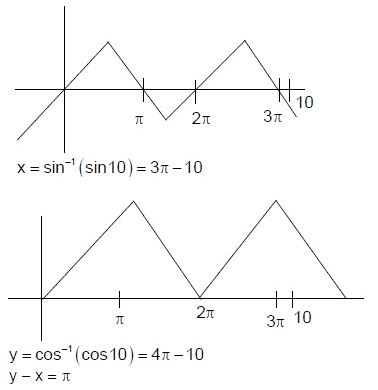
View full question & answer→MCQ 1211 Mark
Considering only the principal values of inverse functions, the set $A = \left\{ {x \geq \,:\,{{\tan }^{ - 1}}\,\left( {2x} \right) + {{\tan }^{ - 1}}\,\left( {3x} \right)\, = \frac{\pi }{4}} \right\}$
- A
- B
contains more than two elements
- ✓
- D
Answerc
${\tan ^{ - 1}}2x + {\tan ^{ - 1}}3x = \frac{\pi }{2}$
Taking tangent on both side, we get $\frac{{2x + 3x}}{{1 - 6{x^2}}} = 1$
$ \Rightarrow 6{x^2} + 5x - 1 = 0 \Rightarrow \left( {x + 1} \right)\left( {6x - 1} \right) = 0$
$ \Rightarrow x = \frac{1}{6}$ {$-1$is rejected as it does not satisfies the given equation}
Hence number of element in $S$ is one.
View full question & answer→MCQ 1221 Mark
If $\alpha = {\cos ^{ - 1}}\,\left( {\frac{3}{5}} \right),\beta = {\tan ^{ - 1}}\,\left( {\frac{1}{3}} \right)$, where $0 < \alpha ,\beta < \frac{\pi }{2}$, then $\alpha - \beta $ is equal to
- ✓
${\sin ^{ - 1}}\,\left( {\frac{9}{{5\sqrt {10} }}} \right)$
- B
${\cos ^{ - 1}}\,\left( {\frac{9}{{5\sqrt {10} }}} \right)$
- C
${\tan ^{ - 1}}\,\left( {\frac{9}{{5\sqrt {10} }}} \right)$
- D
${\tan ^{ - 1}}\,\left( {\frac{9}{{14}}} \right)$
AnswerCorrect option: A. ${\sin ^{ - 1}}\,\left( {\frac{9}{{5\sqrt {10} }}} \right)$
a
$\cos \alpha = \frac{3}{5},\tan \beta \frac{1}{3}$
$ \Rightarrow \tan \alpha = \frac{4}{3}$
$ \Rightarrow \tan \left( {\alpha - \beta } \right) = \frac{{\frac{4}{3} - \frac{1}{3}}}{{1 + \frac{4}{3},\frac{1}{3}}} = \frac{9}{{13}}$
$ \Rightarrow \sin \left( {\alpha - \beta } \right) = \frac{9}{{5\sqrt {10} }}$
$ \Rightarrow \alpha - \beta = {\sin ^{ - 1}}\left( {\frac{9}{{5\sqrt {10} }}} \right)$
View full question & answer→MCQ 1231 Mark
If ${\cos ^{ - 1}}\,x\, - \,{\cos ^{ - 1}}\,\frac{y}{2}\, = \,\alpha ,$ where $ - {\kern 1pt} 1\, \le \,x\, \le \,1,\,$ $- {\kern 1pt} 2\, \le \,y\, \le \,2,$ $x\, \le \,\,\frac{y}{2},$ then for all $x, y, 4x^2 -4xy\,\,cos\,\alpha + y^2$ is equal to
- A
$4\,{\sin ^2}\,\alpha \, - \,2{x^2}{y^2}$
- B
$4\,{\cos ^2}\,\alpha \, + \,2{x^2}{y^2}$
- C
$2{\sin ^2}\,\alpha \,$
- ✓
$4{\sin ^2}\,\alpha \,$
AnswerCorrect option: D. $4{\sin ^2}\,\alpha \,$
d
${\cos ^{ - 1}}x - {\cos ^{ - 1}}\frac{y}{2} = \alpha $
$\cos \left( {{{\cos }^{ - 1}}x - {{\cos }^{ - 1}}\frac{y}{2}} \right) = \cos \alpha $
$ \Rightarrow x \times \frac{y}{2} + \sqrt {1 - {x^2}} \sqrt {1 - \frac{{{y^2}}}{4}} = \cos \alpha $
$ \Rightarrow {\left( {\cos \alpha - \frac{{xy}}{2}} \right)^2} = \left( {1 - {x^2}} \right)\left( {1 - \frac{{{y^2}}}{4}} \right)$
${x^2} + \frac{{{y^2}}}{4} - xy\cos \alpha = 1 - {\cos ^2}\alpha = {\sin ^2}\alpha $
View full question & answer→MCQ 1241 Mark
The value of ${\tan ^{ - 1}}\left[ {\frac{{\sqrt {1 + {x^2}} + \sqrt {1 - {x^2}} }}{{\sqrt {1 + {x^2}} - \sqrt {1 - {x^2}} }}} \right]\,,\,\left| x \right| < \frac{1}{2},\,x \ne 0\,,$ is equal to
- ✓
$\frac{\pi }{4} + \frac{1}{2}\,{\cos ^{ - 1}}\,{x^2}$
- B
$\frac{\pi }{4} + \,{\cos ^{ - 1}}\,{x^2}$
- C
$\frac{\pi }{4} - \frac{1}{2}\,{\cos ^{ - 1}}\,{x^2}$
- D
$\frac{\pi }{4} - \,{\cos ^{ - 1}}\,{x^2}$
AnswerCorrect option: A. $\frac{\pi }{4} + \frac{1}{2}\,{\cos ^{ - 1}}\,{x^2}$
a
Lat ${x^2} = \cos \,2\theta \,\,\,\,\,\, \Rightarrow \,\,\theta = \frac{1}{2}{\cos ^{ - 1}}{x^2}$
$ \Rightarrow {\tan ^{ - 1}}\left[ {\frac{{\sqrt {1 + {x^2}} + \sqrt {1 - {x^2}} }}{{\sqrt {1 + {x^2}} - \sqrt {1 - {x^2}} }}} \right] = $
${\tan ^{ - 1}}\left[ {\frac{{\sqrt {1 + \cos \,2\theta } + \sqrt {1 - \cos \,2\theta } }}{{\sqrt {1 + \cos \,2\theta } - \sqrt {1 - \cos \,2\theta } }}} \right]$
$ \Rightarrow {\tan ^{ - 1}}\left[ {\frac{{1 + \tan \,\theta }}{{1 - \tan \,\theta }}} \right]$
$ = {\tan ^{ - 1}}\left[ {\tan \left( {\frac{\pi }{4} + \theta } \right)} \right]$
$ = \frac{\pi }{4} + \frac{1}{2}{\cos ^{ - 1}}{x^2}$
View full question & answer→MCQ 1251 Mark
A value of $x$ satisfying the equation $\sin \left[ {{{\cot }^{ - 1}}\left( {1 + x} \right)} \right] = \cos \left[ {{{\tan }^{ - 1}}\,x} \right]$ , is
- ✓
$-\frac{1}{2}$
- B
$-1$
- C
$0$
- D
$\frac{1}{2}$
AnswerCorrect option: A. $-\frac{1}{2}$
a
$\sin \left[ {{{\cot }^{ - 1}}\left( {1 + x} \right)} \right] = \cos \left( {{{\tan }^{ - 1}}x} \right)$
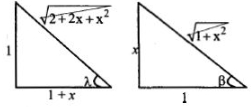
$\cot \lambda = 1 + x$
$\tan \beta = x$
$\sin \lambda = \cos \beta $
$\frac{1}{{\sqrt {{x^2}} + 2x + 2}} = \frac{1}{{1\sqrt {1 + {x^2}} }}$
${x^2} + 2x + 2 = {x^2} + 1$
$\boxed{x = - 1/2}$
View full question & answer→MCQ 1261 Mark
Suppose ${\tan ^{ - 1}}y = {\tan ^{ - 1}}x + {\tan ^{ - 1}}\left( {\frac{{2x}}{{1 - {x^2}}}} \right)$ , where $\left| x \right| < \frac{1}{{\sqrt 3 }}$, then one of the value of $ y $ is
- A
$\frac{3x+x^3}{1+3x^2}$
- B
$\frac{3x-x^3}{1+3x^2}$
- C
$\frac{3x+x^3}{1-3x^2}$
- ✓
$\frac{3x-x^3}{1-3x^2}$
AnswerCorrect option: D. $\frac{3x-x^3}{1-3x^2}$
d
$\tan ^{-1} y=\tan ^{-1} x+\tan ^{-1} \frac{2 x}{1-x^{2}}$
$|x|<\frac{1}{\sqrt{3}}$
$\Rightarrow \quad \tan ^{-1} \frac{2 x}{1-x^{2}}=2 \tan ^{-1} x$
$\Rightarrow \quad \tan ^{-1} y=\tan ^{-1} x+2 \tan ^{-1} x$
$ = 3{\tan ^{ - 1}}x$
$=\tan ^{-1} \frac{3 x-x^{3}}{1-3 x^{2}}$
$\Rightarrow \quad y=\frac{3 x-x^{3}}{1-3 x^{2}}$
View full question & answer→MCQ 1271 Mark
If $f(x)\, = \,2\,{\tan ^{ - 1}}\,x\, + \,{\sin ^{ - 1}}\,\left( {\frac{{2x}}{{1 + {x^2}}}} \right),x > 1\,$ then $f\,(5)$ is equal to
- A
$\,{\tan ^{ - 1}}\left( {\frac{{65}}{{156}}} \right)$
- B
$\frac {\pi }{2}$
- ✓
$\pi $
- D
$\,4\,\,{\tan ^{ - 1}}(5)$
AnswerCorrect option: C. $\pi $
c
$f\left( x \right) = 2{\tan ^{ - 1}}x + {\sin ^{ - 1}}\left( {\frac{{2x}}{{1 + {x^2}}}} \right)$
$ \Rightarrow f\left( x \right) = 2{\tan ^{ - 1}}x + \pi - 2{\tan ^{ - 1}}x$
$ \Rightarrow f\left( x \right) = \pi $
$ \Rightarrow f\left( 5 \right) = \pi $
View full question & answer→MCQ 1281 Mark
The principal value of ${\tan ^{ - 1}}\left( {\cot \frac{{43\pi }}{4}} \right)$ is
- A
$-\frac{3\pi}{4}$
- B
$\frac{3\pi}{4}$
- ✓
$-\frac{\pi}{4}$
- D
$\frac{\pi}{4}$
AnswerCorrect option: C. $-\frac{\pi}{4}$
c
Consider
${\tan ^{ - 1}}\left[ {\cot \frac{{43\pi }}{4}} \right]$
$ = {\tan ^{ - 1}}\left[ {\cot \left( {10\pi + \frac{{43\pi }}{4}} \right)} \right]$
$ = {\tan ^{ - 1}}\left[ {\cot \frac{{3\pi }}{4}} \right]$
[$\because $ $\cot \left( {2n\pi + \theta } \right) = \cot \theta $]
$ = {\tan ^{ - 1}}\left[ {\tan \left( {\frac{\pi }{2} - \frac{{3\pi }}{4}} \right)} \right]$
$ = \frac{\pi }{2} - \frac{{3\pi }}{4} = \frac{{2\pi - 3\pi }}{4} = \frac{{ - \pi }}{4}$
View full question & answer→MCQ 1291 Mark
Statement $I:$ The equation ${({\sin ^{ - 1}}\,x)^3} + {({\cos ^{ - 1}}\,x)^3} - a{\pi ^3} = 0$ has a solution for all $a \ge \frac{1}{{32}}.$
Statement $II:$ For any $x \in R ,$ ${\sin ^{ - 1}}\,x + {\cos ^{ - 1}}\,x = \frac{\pi }{2}$ and $0 \le {\left( {{{\sin }^{ - 1}}\,x - \frac{\pi }{4}} \right)^2} \le \frac{{9{\pi ^2}}}{{16}}$
- ✓
Both statements $I$ and $II$ are true.
- B
Both statements $I$ and $II$ are false.
- C
Statement $I$ is true and statement $II$ is false
- D
Statement $I$ is false and statement $II$ is true.
AnswerCorrect option: A. Both statements $I$ and $II$ are true.
a
${\sin ^{ - 1}}x \in \left[ { - \frac{\pi }{2},\frac{\pi }{2}} \right]$
$ \Rightarrow - \frac{{3\pi }}{4} \le \left( {{{\sin }^{ - 1}}x - \frac{\pi }{4}} \right) \le \frac{\pi }{4}$
$0 \le {\left( {{{\sin }^{ - 1}}x - \frac{\pi }{4}} \right)^2} \le \frac{9}{{16}}{\pi ^2}\,\,\,\,\,\,\,.....\left( 1 \right)$
Statement $II$ is true
${\left( {{{\sin }^{ - 1}}x} \right)^3} + {\left( {{{\cos }^{ - 1}}x} \right)^3} = a{\pi ^3}$
$\left( {{{\sin }^{ - 1}}x + {{\cos }^{ - 1}}x} \right)\left[ {{{\left( {{{\sin }^{ - 1}}x + {{\cos }^{ - 1}}x} \right)}^2} - 3{{\sin }^{ - 1}}x{{\cos }^{ - 1}}x} \right] = a{\pi ^3}$
$ \Rightarrow \frac{{{\pi ^2}}}{4} - 3{\sin ^{ - 1}}x{\cos ^{ - 1}}x = 2a{\pi ^2}$
$ \Rightarrow {\sin ^{ - 1}}x\left( {\frac{\pi }{2} - {{\sin }^{ - 1}}x} \right) = \frac{{{\pi ^2}}}{{12}}\left( {1 - 8a} \right)$
$ \Rightarrow {\left( {{{\sin }^{ - 1}}x - \frac{\pi }{4}} \right)^2} = \frac{{{\pi ^2}}}{{12}}\left( {1 - 8a} \right) + \frac{{{\pi ^2}}}{{16}}$
$ \Rightarrow {\left( {{{\sin }^{ - 1}}x - \frac{\pi }{4}} \right)^2} = \frac{{{\pi ^2}}}{{48}}\left( {32a - 1} \right)$
Putting this value in equation $(1)$
$0 \le \frac{{{\pi ^2}}}{{48}}\left( {32a - 1} \right) \le \frac{9}{{16}}{\pi ^2}$
$ \Rightarrow 0 \le 32a - 1 \le 27$
$\frac{1}{{32}} \le a \le \frac{7}{8}$
Statement - $I$ is also true.
View full question & answer→MCQ 1301 Mark
A value of $x$ for which $\sin \,\left( {{{\cot }^{ - 1}}\,\left( {1 + x} \right)} \right) = \cos \,\left( {{{\tan }^{ - 1}}\,x} \right)$, is
- ✓
$ - \frac{1}{2}$
- B
$1$
- C
$0$
- D
$ \frac{1}{2}$
AnswerCorrect option: A. $ - \frac{1}{2}$
a
$\sin \left( {{{\cot }^{ - 1}}\left( {1 + x} \right)} \right) = \cos \left( {{{\tan }^{ - 1}}x} \right)$
$ \Rightarrow \cos e{c^2}\left( {{{\cot }^{ - 1}}\left( {1 + x} \right)} \right) = {\sec ^2}\left( {{{\tan }^{ - 1}}x} \right)$
$ \Rightarrow 1 + {\left[ {\cot \left( {{{\cot }^{ - 1}}\left( {1 + x} \right)} \right)} \right]^2}$ $ = 1 + {\left[ {\sec \left( {{{\tan }^{ - 1}}x} \right)} \right]^2}$
$ \Rightarrow {\left( {1 + x} \right)^2} = {x^2} \Rightarrow x = - \frac{1}{2}$
View full question & answer→MCQ 1311 Mark
Let $x \in \left( {0,1} \right)$. The set of all $x$ such that ${\sin ^{ - 1}}\,x > {\cos ^{ - 1}}\,x$, is the interval
- A
$\left( {\frac{1}{2},\frac{1}{{\sqrt 2 }}} \right)$
- ✓
$\left( {\frac{1}{{\sqrt 2 }},1} \right)$
- C
$(0, 1)$
- D
$\left( {0,\frac{{\sqrt 3 }}{2}} \right)$
AnswerCorrect option: B. $\left( {\frac{1}{{\sqrt 2 }},1} \right)$
b
Given ${\sin ^{ - 1}}x > {\cos ^{ - 1}}x$ where $x \in \left( {0,1} \right)$
$ \Rightarrow {\sin ^{ - 1}}x > \frac{\pi }{2} - {\sin ^{ - 1}}x$
$ \Rightarrow 2{\sin ^{ - 1}}x > \frac{\pi }{2} \Rightarrow {\sin ^{ - 1}}x > \frac{\pi }{4}$
$ \Rightarrow x > \sin \frac{\pi }{2} \Rightarrow x > \frac{1}{{\sqrt 2 }}$
MNaximum value of ${\sin ^{ - 1}}x$ is $\frac{\pi }{2}$
So, maximum value of $x$ is $1$. So,
$x \in \left( {\frac{1}{{\sqrt 2 }},1} \right)$.
View full question & answer→MCQ 1321 Mark
$S = {\tan ^{ - 1}}\left( {\frac{1}{{{n^2} + n + 1}}} \right) + {\tan ^{ - 1}}\left( {\frac{1}{{{n^2} + 3n + 3}}} \right) + ..... + {\tan ^{ - 1}}\left( {\frac{1}{{1 + \left( {n + 19} \right)\left( {n + 20} \right)}}} \right)$ , then $tan\,S$ is equal to
- A
$\frac{{20}}{{401 + 20n}}$
- B
$\frac{n}{{{n^2} + 20n + 1}}$
- ✓
$\frac{20}{{{n^2} + 20n + 1}}$
- D
$\frac{n}{{401 + 20n}}$
AnswerCorrect option: C. $\frac{20}{{{n^2} + 20n + 1}}$
c
we know that,
${\tan ^{ - 1}}\frac{1}{{1 + 2}} + {\tan ^{ - 1}}\frac{1}{{1 + 2 \times 3}} + {\tan ^{ - 1}}\frac{1}{{1 + 3 \times 4}} + ... + $
${\tan ^{ - 1}}\frac{1}{{1 + \left( {n - 1} \right)n}} + {\tan ^{ - 1}}\frac{1}{{1 + n\left( {n + 1} \right)}} + .... + $
${\tan ^{ - 1}}\frac{1}{{1 + \left( {n + 19} \right)\left( {n + 20} \right)}} = {\tan ^{ - 1}}\frac{{n + 19}}{{n + 21}}$
$ \Rightarrow {\tan ^{ - 1}}\frac{{n + 1}}{{n + 1}} + {\tan ^{ - 1}}\frac{1}{{1 + n\left( {n + 1} \right)}} + {\tan ^{ - 1}}\frac{1}{{1 + n\left( {n + 1} \right)\left( {n + 2} \right)}}$
$ + .... + {\tan ^{ - 1}}\frac{1}{{1 + \left( {n + 19} \right)\left( {n + 20} \right)}} = {\tan ^{ - 1}}\frac{{n + 19}}{{n + 21}}$
${\tan ^{ - 1}}\frac{1}{{1 + n\left( {n + 1} \right)}} + {\tan ^{ - 1}}\frac{1}{{1 + n\left( {n + 1} \right)\left( {n + 2} \right)}} + ... + $
${\tan ^{ - 1}}\frac{1}{{1 + \left( {n + 19} \right)\left( {n + 20} \right)}} = {\tan ^{ - 1}}\frac{{n + 19}}{{n + 21}} - {\tan ^{ - 1}}\frac{{n - 1}}{{n + 1}}$
${\tan ^{ - 1}}\left( {\frac{1}{{{n^2} + n + 1}}} \right) + {\tan ^{ - 1}}\left( {\frac{1}{{{n^2} + 3n + 3}}} \right) + .... + $
${\tan ^{ - 1}}\frac{1}{{1 + \left( {n + 19} \right)\left( {n + 20} \right)}}$
$ = {\tan ^{ - 1}}\left( {\frac{{\frac{{n + 19}}{{n + 21}} - \frac{{n - 1}}{{n + 1}}}}{{1 + \frac{{n + 19}}{{n + 21}} \times \frac{{n - 1}}{{n + 1}}}}} \right)$
$ = {\tan ^{ - 1}}\frac{{20}}{{{n^2} + 20n + 1}} = S$
$\therefore {\tan ^{ - 1}}S = \frac{{20}}{{{n^2} + 20n + 1}}$
View full question & answer→MCQ 1331 Mark
Considering only the principal values of the inverse trigonometric functions, the value of $\tan \left(\sin ^{-1}\left(\frac{3}{5}\right)-2 \cos ^{-1}\left(\frac{2}{\sqrt{5}}\right)\right)$
- A
$\frac{7}{24}$
- ✓
$\frac{-7}{24}$
- C
$\frac{-5}{24}$
- D
$\frac{5}{24}$
AnswerCorrect option: B. $\frac{-7}{24}$
b
$\begin{array}{l}\tan \left(\tan ^{-1}\left(\frac{3}{4}\right)-2 \tan ^{-1}\left(\frac{1}{2}\right)\right) \\ \tan \left(\tan ^{-1}\left(\frac{3}{4}\right)-\tan ^{-1}\left(\frac{2 \times \frac{1}{2}}{1-\frac{1}{4}}\right)\right) \\ \tan \left(\tan ^{-1}\left(\frac{3}{4}\right)-\tan ^{-1}\left(\frac{4}{3}\right)\right) \\ \tan \left(\tan ^{-1}\left(\frac{\frac{3}{4}-\frac{4}{3}}{1+1}\right)\right) \\ \frac{9-16}{24}=\frac{-7}{24}\end{array}$
View full question & answer→MCQ 1341 Mark
For any $y \in \mathbb{R}$, let $\cot ^{-1}(y) \in(0, \pi)$ and $\tan ^{-1}(y) \in\left(-\frac{\pi}{2}, \frac{\pi}{2}\right)$. Then the sum of all the solutions of the equation $\tan ^{-1}\left(\frac{6 y}{9-y^2}\right)+\cot ^{-1}\left(\frac{9-y^2}{6 y}\right)=\frac{2 \pi}{3}$ for $0<|y|<3$, is equal to
- A
$2 \sqrt{3}-3$
- B
$3-2 \sqrt{3}$
- ✓
$4 \sqrt{3}-6$
- D
$6-4 \sqrt{3}$
AnswerCorrect option: C. $4 \sqrt{3}-6$
c
$\text { Case-I }: y \in(-3,0)$
$\tan ^{-1}\left(\frac{6 y}{9-y^2}\right)+\pi+\tan ^{-1}\left(\frac{6 y}{9-y^2}\right)=\frac{2 \pi}{3}$
$2 \tan ^{-1}\left(\frac{6 y}{9-y^2}\right)=-\frac{\pi}{3}$
$y^2-6 \sqrt{3} y-9=0 \Rightarrow y=3 \sqrt{3}-6(\because y \in(-3,0))$
$\text { Case-I : } y \in(0,3)$
$2 \tan ^{-1}\left(\frac{6 y}{9-y^2}\right)=\frac{2 \pi}{3} \Rightarrow \sqrt{3} y^2+6 y-9 \sqrt{3}=0$
$y=\sqrt{3} \text { or } y=-3 \sqrt{3} \text { (rejected) }$
$\text { sum }=\sqrt{3}+3 \sqrt{3}-6=4 \sqrt{3}-6$
View full question & answer→MCQ 1351 Mark
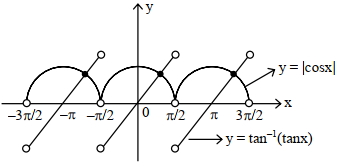
Let $\tan ^{-1}(x) \in\left(-\frac{\pi}{2}, \frac{\pi}{2}\right)$, for $x \in \mathbb{R}$. Then the number of real solutions of the equation $\sqrt{1+\cos (2 x)}=\sqrt{2} \tan ^{-1}(\tan x)$ in the set $\left(-\frac{3 \pi}{2},-\frac{\pi}{2}\right) \cup\left(-\frac{\pi}{2}, \frac{\pi}{2}\right) \cup\left(\frac{\pi}{2}, \frac{3 \pi}{2}\right)$ is equal to
Answerd
$\sqrt{2}|\cos x|=\sqrt{2} \cdot \tan ^{-1}(\tan x)$
$|\cos x|=\tan ^{-1} \tan x$
No. of solutions $=3$
View full question & answer→MCQ 1361 Mark
For any $y \in \mathbb{R}$, let $\cot ^{-1}(y) \in(0, \pi)$ and $\tan ^{-1}(y) \in\left(-\frac{\pi}{2}, \frac{\pi}{2}\right)$. Then the sum of all the solutions of the equation $\tan ^{-1}\left(\frac{6 y}{9-y^2}\right)+\cot ^{-1}\left(\frac{9-y^2}{6 y}\right)=\frac{2 \pi}{3}$ for $0<|y|<3$, is equal to
- A
$2 \sqrt{3}-3$
- B
$3-2 \sqrt{3}$
- ✓
$4 \sqrt{3}-6$
- D
$6-4 \sqrt{3}$
AnswerCorrect option: C. $4 \sqrt{3}-6$
c
$\text { Case-I }: y \in(-3,0)$
$\tan ^{-1}\left(\frac{6 y}{9-y^2}\right)+\pi+\tan ^{-1}\left(\frac{6 y}{9-y^2}\right)=\frac{2 \pi}{3}$
$2 \tan ^{-1}\left(\frac{6 y}{9-y^2}\right)=-\frac{\pi}{3}$
$y^2-6 \sqrt{3} y-9=0 \Rightarrow y=3 \sqrt{3}-6(\because y \in(-3,0))$
$\text { Case-I : } y \in(0,3)$
$2 \tan ^{-1}\left(\frac{6 y}{9-y^2}\right)=\frac{2 \pi}{3} \Rightarrow \sqrt{3} y^2+6 y-9 \sqrt{3}=0$
$y=\sqrt{3} \text { or } y=-3 \sqrt{3} \text { (rejected) }$
$\text { sum }=\sqrt{3}+3 \sqrt{3}-6=4 \sqrt{3}-6$
View full question & answer→MCQ 1371 Mark
Considering only the principal values of the inverse trigonometric functions, the value of
$\frac{3}{2} \cos ^{-1} \sqrt{\frac{2}{2+\pi^2}}+\frac{1}{4} \sin ^{-1} \frac{2 \sqrt{2} \pi}{2+\pi^2}+\tan ^{-1} \frac{\sqrt{2}}{\pi}$ is. . . .
- ✓
$2.35$
- B
$2.40$
- C
$2.45$
- D
$2.50$
AnswerCorrect option: A. $2.35$
a
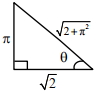
$\cos ^{-1} \sqrt{\frac{2}{2+\pi^2}}=\tan ^{-1} \frac{\pi}{\sqrt{2}}$
$\sin ^{-1}\left(\frac{2 \sqrt{2} \pi}{2+\pi^2}\right)=\sin ^{-1}\left(\frac{2 \times \frac{\pi}{\sqrt{2}}}{1+\left(\frac{\pi}{\sqrt{2}}\right)^2}\right)$
$=\pi-2 \tan ^{-1}\left(\frac{\pi}{\sqrt{2}}\right)$
$\left(\text { As, } \sin ^{-1}\left(\frac{2 x}{1+x^2}\right)=\pi-2 \tan ^{-1} x, x \geq 1\right)$
$\text { and } \tan ^{-1} \frac{\sqrt{2}}{\pi}=\cot ^{-1}\left(\frac{\pi}{\sqrt{2}}\right)$
$\therefore \text { Expression }=\frac{3}{2}\left(\tan ^{-1} \frac{\pi}{\sqrt{2}}\right)+\frac{1}{4}\left(\pi-2 \tan ^{-1} \frac{\pi}{\sqrt{2}}\right)+\cot ^{-1}\left(\frac{\pi}{\sqrt{2}}\right)$
$=\left(\frac{3}{2}-\frac{2}{4}\right) \tan ^{-1} \frac{\pi}{\sqrt{2}}+\frac{\pi}{4}+\cot ^{-1} \frac{\pi}{\sqrt{2}}$
$=\left(\tan ^{-1} \frac{\pi}{\sqrt{2}}+\cot ^{-1} \frac{\pi}{\sqrt{2}}\right)+\frac{\pi}{4}$
$=\frac{\pi}{2}+\frac{\pi}{4}=\frac{3 \pi}{4}$
$=2.35 \text { or } 2.36$
View full question & answer→MCQ 1381 Mark
For any positive integer $n$, let $S_n:(0, \infty) \rightarrow R$ be defined by
$S_n(x)=\sum_{k=1}^n \cot ^{-1}\left(\frac{1+k(k+1) x^2}{x}\right)$
where for any $x \in R , \cot ^{-1} x \in(0, \pi)$ and $\tan ^{-1}(x) \in\left(-\frac{\pi}{2}, \frac{\pi}{2}\right)$. Then which of the following
statements is (are) $TRUE$?
$(A)$ $S _{10}( x )=\frac{\pi}{2}-\tan ^{-1}\left(\frac{1+11 x ^2}{10 x }\right)$, for all $x >0$
$(B)$ $\lim _{n \rightarrow \infty} \cot \left(S_n(x)\right)=x$, for all $x>0$
$(C)$ The equation $S_3(x)=\frac{\pi}{4}$ has a root in $(0, \infty)$
$(D)$ $\tan \left( S _{ n }( x )\right) \leq \frac{1}{2}$, for all $n \geq 1$ and $x >0$
- A
$A,C$
- B
$A,D$
- ✓
$A,B$
- D
$A,B,C$
Answerc
$S_n(x)=\sum_{k=1}^n \tan ^{-1}\left(\frac{x}{1+k x(k x+x)}\right)$
$=\sum_{k=1}^n \tan ^{-1}\left(\frac{(k x+x)-(k x)}{1+(k x+x)(k x)}\right)$
$S_n(x)=\tan ^{-1}(n x+x)-\tan ^{-1} x=\tan ^{-1}\left(\frac{ nx }{1+(n+1) x^2}\right)$
$\text { (A) } S_{10}(x)=\tan ^{-1} \frac{10 x}{1+11 x^2}=\frac{\pi}{2}-\tan ^{-1}$$\left(\frac{1+11 x^2}{10 x}\right)(x>0)$
$(B)$ $\lim _{n \rightarrow \infty} \cot \left(S_n(x)\right)=\lim _{n \rightarrow \infty} \frac{\frac{1}{n}+\left(1+\frac{1}{n}\right) x^2}{x}=x(x>0)$
$(C)$ $S_3(x)=\tan ^{-1} \frac{3 x}{1+4 x^2}=\frac{\pi}{4} \Rightarrow 4 x^2-3 x+1=0 \Rightarrow x \notin R$
$(D)$ $\tan \left( S _{ n }( x )\right)=\frac{ nx }{1+( n +1) x ^2} ; \forall n \geq 1 ; x >0$
We need to check the validity of $\frac{ nx }{1+( n +1) x ^2} \leq \frac{1}{2} \forall n \geq 1 ; x >0 ; n \in N$
$\Rightarrow 2 nx \leq( n +1) x ^2+1$
$\Rightarrow( n +1) x ^2-2 nx +1 \geq 0 \forall n \geq 1 ; x >0 ; n \in N$
Discriminant of $y=(n+1) x^2-2 n x+1$ is
$D=4 n^2-4(n+1) \text { and } n \in N$
$D >0$ for $n \geq 2 \Rightarrow \exists$ some $x >0$
for which $y <0$ as both roots of $y =0$ will be positive.
$y =( n +1) x ^2-2 nx +1, n \geq 2$
So, $y \geq 0 \forall n \geq 1 ; \forall x >0 ; n \in N$ is false.
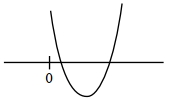
View full question & answer→MCQ 1391 Mark
The value of $\sec ^{-1}\left(\frac{1}{4} \sum_{k=0}^{10} \sec \left(\frac{7 \pi}{12}+\frac{k \pi}{2}\right) \sec \left(\frac{7 \pi}{12}+\frac{(k+1) \pi}{2}\right)\right)$ in the interval $\left[-\frac{\pi}{4}, \frac{3 \pi}{4}\right]$ equals
Answera
$\begin{array}{l}\sec ^{-1}\left(\frac{1}{4} \sum_{k=0}^{10} \frac{1}{\cos \left(\frac{7 \pi}{12}+\frac{k \pi}{12}\right) \cos \left(\frac{7 \pi}{12}+\frac{(k+1) \pi}{2}\right)}\right) \\ =\sec ^{-1}\left(\frac{1}{4} \sum_{k=0}^{10} \frac{\sin \left(\frac{7 \pi}{12}+\frac{(k+1) \pi}{2}-\left(\frac{7 \pi}{12}+\frac{k \pi}{2}\right)\right)}{\cos \left(\frac{7 \pi}{12}+\frac{k \pi}{2}\right) \cdot \cos \left(\frac{7 \pi}{12}+\frac{(k+1) \pi}{2}\right)}\right) \\ =\sec ^{-1}\left(\frac{1}{4}\left(\sum_{k=0}^{10} \tan \left(\frac{7 \pi}{12}+(k+1) \frac{\pi}{2}\right)-\tan \left(\frac{7 \pi}{12}+\frac{k \pi}{2}\right)\right)\right) \\ =\sec ^{-1}\left(\frac{1}{4}\left(\tan \left(\frac{11 \pi}{2}+\frac{7 \pi}{12}\right)-\tan \left(\frac{7 \pi}{12}\right)\right)\right) \\ =\sec ^{-1}\left(\frac{1}{4}\left(-\cot \frac{7 \pi}{12}-\tan \frac{7 \pi}{12}\right)\right) \\ =\sec ^{-1}\left(\frac{1}{4}\left(-\frac{1}{\sin \frac{7 \pi}{12} \cos \frac{7 \pi}{12}}\right)\right) \\ =\sec ^{-1}\left(-\frac{1}{2} \times \frac{1}{\sin \frac{7 \pi}{6}}\right)=\sec ^{-1}(1)=0.00 \\\end{array}$
View full question & answer→MCQ 1401 Mark
If $\alpha=3 \sin ^{-1}\left(\frac{6}{11}\right)$ and $\beta=3 \cos ^{-1}\left(\frac{4}{9}\right)$, where the inverse trigonometric functions take only the principal values, then the correct option$(s)$ is(are)
$(A)$ $\cos \beta > 0$ $(B)$ $\sin \beta < 0$ $(C)$ $\cos (\alpha+\beta) > 0$ $(D)$ $\cos \alpha < 0$
- A
$(A,B,C)$
- B
$(A,B,D)$
- C
$(A,C,D)$
- ✓
$(B,C,D)$
AnswerCorrect option: D. $(B,C,D)$
d
$\frac{\pi}{2} < \alpha < \pi, \pi<\beta < \frac{3 \pi}{2} \Rightarrow \frac{3 \pi}{2}< \alpha+\beta < \frac{5 \pi}{2}$
$\Rightarrow \sin \beta<0 ; \cos \alpha < 0$
$\Rightarrow \cos (\alpha+\beta) > 0$
View full question & answer→MCQ 1411 Mark
Let $f:[0,4 \pi] \rightarrow[0, \pi]$ be defined by $f(x)=\cos ^{-1}(\cos x)$. The number of points $x \in[0,4 \pi]$ satisfying the equation $f(x)=\frac{10-x}{10}$ is
Answerb
$f(x)=\left(\sin ^{-1}\right) x \in[0,4 \pi]$
$f(x)=\frac{10-x}{10}=1-\frac{x}{10}$
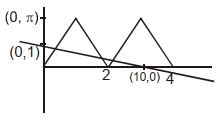
View full question & answer→MCQ 1421 Mark
The value of $\cot \left(\sum_{n=1}^{23} \cot ^{-1}\left(1+\sum_{k=1}^n 2 k\right)\right)$ is
- A
$\frac{23}{25}$
- ✓
$\frac{25}{23}$
- C
$\frac{23}{24}$
- D
$\frac{24}{23}$
AnswerCorrect option: B. $\frac{25}{23}$
b
$\cot \sum_{n=1}^{23} \cot ^{-1}(1+2+4+6+\ldots . .+2 n) $
$\cot \sum \cot ^{-1}(1+n(n+1)) $
$\cot \sum \tan ^{-1} \frac{(n+1)-n}{1+n(n+1)} $
$\cot \sum_{n=1}^{23}\left(\tan ^{-1}(n+1)-\tan ^{-1} n\right) $
$\cot \left(\tan ^{-1} 24-\tan ^{-1} 1\right) $
$\cot \left(\tan ^{-1} \frac{24-1}{1+24}\right) $
$\cot \left(\cot ^{-1} \frac{25}{23}\right)=\frac{25}{23}$
View full question & answer→MCQ 1431 Mark
Match List $I$ with List $II$ and select the correct answer using the code given below the lists :
| List $I$ |
List $II$ |
| $P$ $\quad\left(\frac{1}{y^2}\left(\frac{\cos \left(\tan ^{-1} y\right)+y \sin \left(\tan ^{-1} y\right)}{\cot \left(\sin ^{-1} y\right)+\tan \left(\sin ^{-1} y\right)}\right)^2+y^4\right)^{1 / 2}$ takes value |
$1.\quad$ $\frac{1}{2} \sqrt{\frac{5}{3}}$ |
| $Q.\quad$ If $\cos x+\cos y+\cos z=0=\sin x+\sin y+\sin z$ then possible value of $\cos \frac{x-y}{2}$ is |
$2.\quad$ $\sqrt{2}$ |
| $R.\quad$ If $\cos \left(\frac{\pi}{4}-x\right) \cos 2 x+\sin x \sin 2 x \sec x=\cos x \sin 2 x \sec x+$ $\cos \left(\frac{\pi}{4}+x\right) \cos 2 x$ then possible value of $\sec x$ is |
$3.\quad$ $\frac{1}{2}$ |
| $S.\quad$ If $\cot \left(\sin ^{-1} \sqrt{1-x^2}\right)=\sin \left(\tan ^{-1}(x \sqrt{6})\right), x \neq 0$, then possible value of $x$ is |
$4.\quad$ $1$ |
Codes: $ \quad P \quad Q \quad R \quad S $
- A
$\quad 4 \quad 3 \quad 1 \quad 2 $
- ✓
$\quad 4 \quad 3 \quad 2 \quad 1 $
- C
$\quad 3 \quad 4 \quad 2 \quad 1 $
- D
$\quad 3 \quad 4 \quad 1 \quad 2 $
AnswerCorrect option: B. $\quad 4 \quad 3 \quad 2 \quad 1 $
b
$(P)$ $\quad\left(\frac{1}{y^2}\left(\frac{\cos \left(\tan ^{-1} y\right)+y \sin \left(\tan ^{-1} y\right)}{\cot \left(\sin ^{-1} y\right)+\tan \left(\sin ^{-1} y\right)}\right)^2+y^4\right)^{1 / 2}$
$=\left[\frac{1}{y^2}\left[\frac{\left(\frac{1}{\sqrt{1+y^2}}+\frac{y \cdot y}{\sqrt{1+y^2}}\right)}{\left(\frac{\sqrt{1-y^2}}{y}+\frac{y}{\sqrt{1-y^2}}\right)}\right]^2+y^4\right]^{1 / 2}$
$=\left(\frac{1}{y^2} \cdot y^2\left(1-y^4\right)+y^4\right)^{1 / 2}=1$
$(Q)$ $\quad $$ \cos x+\cos y=-\cos z $
$ \sin x+\sin y=-\sin z $
$ 2+2 \cos (x-y)=1 $
$\Rightarrow \quad \cos (x-y)=-1 / 2$
$(R)\quad$ $\cos 2 x\left(\cos \left(\frac{\pi}{4}-x\right)-\cos \left(\frac{\pi}{4}+x\right)\right)+2 \sin ^2 x=2 \sin x \cos x $
$\cos 2 x(\sqrt{2} \sin x)+2 \sin ^2 x=2 \sin x \cos x $
$\sqrt{2} \sin x[\cos 2 x+\sqrt{2} \sin x-\sqrt{2} \cos x]=0 $
$\text { Either } \sin x=0 \text { OR } \cos ^2 x-\sin ^2 x=\sqrt{2}(\cos x-\sin x) $
$\sec x=1 \quad \text { OR } \cos x=\sin x $
$\Rightarrow \quad \sec x=\sqrt{2}$
$(S)$ $\quad \cot \left(\sin ^{-1} \sqrt{1-x^2}\right)=\sin \left(\tan ^{-1}(x \sqrt{6})\right)$
$Image$
$\frac{x}{\sqrt{1-x^2}} =\frac{x \sqrt{6}}{\sqrt{1+6 x^2}} $
$ \Rightarrow \quad 1+6 x^2=6-6 x^2 $
$ \Rightarrow \quad 12 x^2=5 $
$ x=\sqrt{\frac{5}{12}}==\frac{1}{2} \sqrt{\frac{5}{3}}$
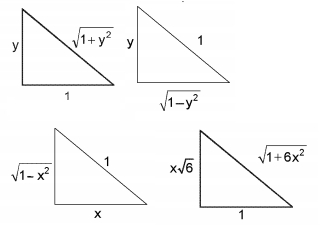
View full question & answer→MCQ 1441 Mark
If $0 < x < 1$, then $\sqrt{1+x^2}\left[\left\{x \cos \left(\cot ^{-1} x\right)+\sin \left(\cot ^{-1} x\right)\right\}^2-1\right]^{1 / 2}$ is equal to
- A
$\frac{x}{\sqrt{1+x^2}}$
- B
$x$
- ✓
$x \sqrt{1+x^2}$
- D
$\sqrt{1+x^2}$
AnswerCorrect option: C. $x \sqrt{1+x^2}$
c
$ \sqrt{1+x^2}\left[\left(x \cos \cot ^{-1} x+\sin \cot ^{-1} x\right)^2-1\right]^{1 / 2} $
$ =\sqrt{1+x^2}\left[\left(x \cos \cos ^{-1} \frac{x}{\sqrt{1+x^2}}+\sin \sin ^{-1} \frac{1}{\sqrt{1+x^2}}\right)^2-1\right]^{1 / 2} $
$ =\sqrt{1+x^2}\left[\left(\frac{x^2}{\sqrt{1+x^2}}+\frac{1}{\sqrt{1+x^2}}\right)^2-1\right]^{1 / 2} $
$ =\sqrt{1+x^2}\left(x^2+1-1\right)^{1 / 2}=x \sqrt{1+x^2}$
View full question & answer→MCQ 1451 Mark
Let $(\mathrm{x}, \mathrm{y})$ be such that
$\sin ^{-1}(a x)+\cos ^{-1}(y)+\cos ^{-1}(b x y)=\frac{\pi}{2} .$
Match the statements in Column $I$ with the statements in Column $II$ and indicate your answer by darkening the appropriate bubbles in the $4 \times 4$ matrix given in the $ORS$.
| Column $I$ |
Column $II$ |
| $(A)$ If $a=1$ and $b=0$, then ( $x, y$ ) |
$(p)$ lies on the circle $x^2+y^2=1$ |
| $(B)$ If $a=1$ and $b=1$, then $(x, y)$ |
$(q)$ lies on $\left(x^2-1\right)\left(y^2-1\right)=0$ |
| $(C)$ If $a=1$ and $b=2$, then ( $x, y)$ |
$(r)$ lies on $y=x$ |
| $(D)$ If $a=2$ and $b=2$, then $(x, y)$ |
$(s)$ lies on $\left(4 x^2-1\right)\left(y^2-1\right)=0$ |
- ✓
$A \rightarrow p ; B \rightarrow q ; C \rightarrow p ; D \rightarrow s$
- B
$A \rightarrow q ; B \rightarrow s ; C \rightarrow s ; D \rightarrow q$
- C
$A \rightarrow q ; B \rightarrow r ; C \rightarrow p ; D \rightarrow r$
- D
$A \rightarrow r ; B \rightarrow s ; C \rightarrow q ; D \rightarrow p$
AnswerCorrect option: A. $A \rightarrow p ; B \rightarrow q ; C \rightarrow p ; D \rightarrow s$
a
$(A)$ If $\mathrm{a}=1, \mathrm{~b}=0$
then $\sin ^{-1} x+\cos ^{-1} y=0$
$ \Rightarrow \sin ^{-1} x=-\cos ^{-1} y $
$ \Rightarrow x^2+y^2=1 .$
$(B) $If $a=1$ and $b=1$, then
$ \sin ^{-1} x+\cos ^{-1} y+\cos ^{-1} x y=\frac{\pi}{2} $
$ \Rightarrow \cos ^{-1} x-\cos ^{-1} y=\cos ^{-1} x y $
$ \Rightarrow x y+\sqrt{1-x^2} \sqrt{1-y^2}=x y$
(taking sine on both the sides)
$(C)$ If $\mathrm{a}=1, \mathrm{~b}=2$
$ \Rightarrow \sin ^{-1} x+\cos ^{-1} y+\cos ^{-1}(2 x y)= \frac{\pi}{2} $
$ \Rightarrow \sin ^{-1} x+\cos ^{-1} y=\sin ^{-1}(2 x y) $
$ \Rightarrow x y+\sqrt{1-x^2} \sqrt{1-y^2}=2 x y $
$ \Rightarrow x^2+y^2=1 \text { (on squaring). }$
$(D)$ If $a=2$ and $b=2$ then
$ \sin ^{-1}(2 x)+\cos ^{-1}(y)+\cos ^{-1}(2 x y)=\frac{\pi}{2} $
$ \Rightarrow 2 x y+\sqrt{1-4 x^2} \sqrt{1-y^2}=2 x y $
$ \Rightarrow\left(4 x^2-1\right)\left(y^2-1\right)=0 .$
View full question & answer→MCQ 1461 Mark
If $\sin ({\cot ^{ - 1}}(x + 1) = \cos ({\tan ^{ - 1}}x)$, then $ x =$
- ✓
$ - \frac{1}{2}$
- B
$\frac{1}{2}$
- C
$0$
- D
$\frac{9}{4}$
AnswerCorrect option: A. $ - \frac{1}{2}$
a
(a) $\sin [{\cot ^{ - 1}}(x + 1)] = \sin \left( {{{\sin }^{ - 1}}\frac{1}{{\sqrt {{x^2} + 2x + 2} }}} \right)$
$ = \frac{1}{{\sqrt {{x^2} + 2x + 2} }}$
$\cos ({\tan ^{ - 1}}x) = \cos \left( {{{\cos }^{ - 1}}\frac{1}{{\sqrt {1 + {x^2}} }}} \right) = \frac{1}{{\sqrt {1 + {x^2}} }}$
Thus, $\frac{1}{{\sqrt {{x^2} + 2x + 2} }} = \frac{1}{{\sqrt {1 + {x^2}} }}$
$ \Rightarrow {x^2} + 2x + 2 = 1 + {x^2}$
$ \Rightarrow $ $x = - \frac{1}{2}$.
View full question & answer→MCQ 1471 Mark
If ${\sin ^{ - 1}}\left( {x - \frac{{{x^2}}}{2} + \frac{{{x^3}}}{4} - ....} \right) + {\cos ^{ - 1}}\left( {{x^2} - \frac{{{x^4}}}{2} + \frac{{{x^6}}}{4} - ...} \right) = \frac{\pi }{2}$ for $0 < {\rm{ }}|x|{\rm{ }} < \sqrt 2 ,$ then $x$ equals
- A
$\frac{1}{2}$
- ✓
$1$
- C
$ - \frac{1}{2}$
- D
$-1$
Answerb
(b) We know that ${\sin ^{ - 1}}y + {\cos ^{ - 1}}y = \frac{\pi }{2},|y|\, \le \,1$
$\therefore $ According to question,
$x - \frac{{{x^2}}}{2} + \frac{{{x^3}}}{4} - ... = {x^2} - \frac{{{x^4}}}{2} + \frac{{{x^6}}}{4}...$
==> $\frac{x}{{1 + \frac{x}{2}}} = \frac{{{x^2}}}{{1 + \frac{{{x^2}}}{2}}},$
==> $\frac{x}{{2 + x}} = \frac{{{x^2}}}{{2 + {x^2}}}$
==> $2x + {x^3} = 2{x^2} + {x^3}$ ==> $x = {x^2}$
$\therefore \,x - {x^2} = 0\, \Rightarrow x(1 - x) = 0\, \Rightarrow x = 0$ and $x = 1$,
but $x \ne 0.$ So, $x = 1$.
View full question & answer→MCQ 1481 Mark
The number of real solutions of ${\tan ^{ - 1}}\sqrt {x(x + 1)} + {\sin ^{ - 1}}\sqrt {{x^2} + x + 1} = \frac{\pi }{2}$ is
Answerc
(c) ${\tan ^{ - 1}}\sqrt {x(x + 1)} + {\sin ^{ - 1}}\sqrt {{x^2} + x + 1} = \frac{\pi }{2}$
${\tan ^{ - 1}}\sqrt {x(x + 1)} $ is defined when
$x(x + 1) \ge 0$…..$(i)$
${\sin ^{ - 1}}\sqrt {{x^2} + x + 1} $ is defined when
$0 \le x(x + 1) + 1 \le 1$ or $0 \le x(x + 1) \le 0$…..$(ii)$
From $(i)$ and $(ii),$ $x(x + 1) = 0$
or $x = 0$ and $-1. $
Hence number of solution is $2.$
View full question & answer→MCQ 1491 Mark
If we consider only the principal values of the inverse trigonometric functions, then the value of $\tan \left( {{{\cos }^{ - 1}}\frac{1}{{5\sqrt 2 }} - {{\sin }^{ - 1}}\frac{4}{{\sqrt {(17)} }}} \right)$ is
- A
$\sqrt {29/3} $
- B
$29/3$
- C
$\sqrt {3/29} $
- ✓
$3/29$
AnswerCorrect option: D. $3/29$
d
(d) $\tan \left( {{{\cos }^{ - 1}}\frac{1}{{5\sqrt 2 }} - {{\sin }^{ - 1}}\frac{4}{{\sqrt {17} }}} \right)$
$ = \tan ({\tan ^{ - 1}}7 - {\tan ^{ - 1}}4)$ $ = \tan \left[ {{{\tan }^{ - 1}}\left( {\frac{{7 - 4}}{{1 + 28}}} \right)} \right] = \frac{3}{{29}}$.
View full question & answer→MCQ 1501 Mark
$\tan ({\cos ^{ - 1}}x)$ is equal to
AnswerCorrect option: A. $\frac{{\sqrt {1 - {x^2}} }}{x}$
a
(a) Let ${\cos ^{ - 1}}x = \theta .$ Then $x = \cos \theta $
$ \Rightarrow \,\,\tan \theta = \sqrt {{{\sec }^2}\theta - 1} $
$ = \sqrt {\frac{1}{{{x^2}}} - 1} = \sqrt {\frac{{1 - {x^2}}}{x}} $
$\therefore \,\,\tan \,({\cos ^{ - 1}}x) = \tan \theta = \frac{{\sqrt {1 - {x^2}} }}{x}$.
View full question & answer→