Question types

1. Electric charges and fields question types

725 questions across 1 question group — pick any mix to generate a Physics paper with step-by-step answer keys.

725
Questions
1
Question groups
5
Question types
Sample Questions

1. Electric charges and fields questions

One sample from each question group in this chapter. Select any group above to see the full set with answer keys.

If $\oint_s \vec{E} \cdot \overrightarrow{d S}=0$ over a surface, then:
  • A
    the electric field inside the surface is necessarily uniform.
  • the number of flux lines entering the surface must be equal to the number of flux lines leaving it.
  • C
    the magnitude of electric field on the surface is constant.
  • D
    all the charges must necessarily be inside the surface.

Answer: B.

View full solution
An electric dipole is placed at an angle of $30^{\circ}$ with an electric field of intensity $2 \times 10^5\,NC ^{-1}$. It experiences a torque equal to $4\,Nm$. Calculate the magnitude of charge on the dipole, if the dipole length is $2\,cm$.
  • $2\,mC$
  • B
    $8\,mC$
  • C
    $6\,mC$
  • D
    $4\,mC$

Answer: A.

View full solution
The ratio of coulomb's electrostatic force to the gravitational force between an electron and a proton separated by some distance is $2.4 \times 10^{39}$. The ratio of the proportionality constant, $K=\frac{1}{4 \pi \varepsilon_0}$ to the Gravitational constant $G$ is nearly (Given that the charge of the proton and electron each $=1.6 \times 10^{-19}\; C$, the mass of the electron $=9.11 \times 10^{-31}\; kg$, the mass of the proton $=1.67 \times 10^{-27}\,kg$ ):
  • $10^{20}$
  • B
    $10^{30}$
  • C
    $10^{40}$
  • D
    $10$

Answer: A.

View full solution
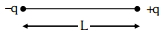
Two point charges $-q$ and $+q$ are placed at a distance of $L$, as shown in the figure.

The magnitude of electric field intensity at a distance $R ( R \gg L )$ varies as :

  • $\frac{1}{ R ^{3}}$
  • B
    $\frac{1}{ R ^{4}}$
  • C
    $\frac{1}{ R ^{6}}$
  • D
    $\frac{1}{ R ^{2}}$ 

Answer: A.

View full solution
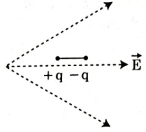
A dipole is placed in an electric field as shown. In which direction will it move ?
  • A
    towards the left as its potential energy will increase.
  • towards the right as its potential energy will decrease.
  • C
    towards the left as its potential energy will decrease.
  • D
    towards the right as its potential energy will increase.

Answer: B.

View full solution

Generate a 1. Electric charges and fields paper free

Pick question groups from the list above, set marks and difficulty, and export a branded PDF with step-by-step answer keys. First 3 chapters free — no signup.

Download App