MCQ 11 Mark
Given below are two statements:
Statement $I$: Atoms are electrically neutral as they contain equal number of positive and negative charges.
Statement $II$: Atoms of each element are stable and emit their characteristic spectrum.
In the light of the above statements, choose the most appropriate answer from the options given below.
- A
Both Statement $I$ and Statement $II$ are incorrect
- ✓
Statement I is correct but Statement $II$ is incorrect
- C
Statement $I$ is incorrect but Statement $II$ is correct
- D
Both Statement I and Statement $II$ are correct
AnswerCorrect option: B. Statement I is correct but Statement $II$ is incorrect
b
Statement $I$ is true as atoms are electrically neutral because they contain equal number of positive and negative charges.
Statement $II$ is wrong as atom of most of the elements are stable and emit characteristic spectrum. But this statement is not true for every atom.
View full question & answer→MCQ 21 Mark
Match List $I$ with List $II$.
| List $I$ (Spectral Lines of Hydrogen for transitions from) |
List $II$ (Wavelengths ($nm$)) |
| $A$ $n_2=3 \text { to } n_1=2$ |
$I$ $410.2$ |
| $B$ $n_2=4 \text { to } n_1=2$ |
$II$ $434.1$ |
| $C$ $n_2=5 \text { to } n_1=2$ |
$III$ $656.3$ |
| $D$ $n_2=6 \text { to } n_1=2$ |
$IV$ $486.1$ |
Choose the correct answer from the options given below:
AnswerCorrect option: A. $A-III, B-IV, C-II, D-I$
a
$\text { Energy difference } \Delta E=\frac{h c}{\lambda}$
$\therefore \lambda \propto \frac{1}{\Delta E}$
$(\Delta E)_{6-2}>(\Delta E)_{5-2}>(\Delta E)_{4-2}>(\Delta E)_{3-2}$
$\lambda_{6-2}<\lambda_{5-2}<\lambda_{4-2}<\lambda_{3-2}$
$A-III, B-IV, C-II, D-I$
View full question & answer→MCQ 31 Mark
In hydrogen spectrum, the shortest wavelength in the Balmer series is $\lambda$. The shortest wavelength in the Bracket series is $........\,\lambda$
Answerc
Shortest wavelength in Balmer series when transition of $e^{-}$from $\infty$ to $n=2$
$\because \frac{1}{\lambda}= Rz ^2\left[\frac{1}{2^2}-\frac{1}{\infty^2}\right]$
$\frac{1}{\lambda}=\frac{ R }{4}$
Shortest wavelength is Bracket series when transition of $e^{-}$from $\infty$ to $n=4$
$\frac{1}{\lambda^{\prime}}= R (1)^2\left[\frac{1}{4^2}-\frac{1}{\infty^2}\right] \Rightarrow \frac{1}{\lambda^{\prime}}=\frac{ R }{16}$
Eq. $(1)$/Eq.$(2)$
$\frac{\lambda^{\prime}}{\lambda}=\frac{R}{4} \times \frac{16}{R} \Rightarrow \lambda^{\prime}=4 \lambda$
View full question & answer→MCQ 41 Mark
The radius of inner most orbit of hydrogen atom is $5.3 \times 10^{-11}\,m$.$........\mathring A$ is the radius of third allowed orbit of hydrogen atom.
- ✓
$4.77$
- B
$0.53$
- C
$1.06$
- D
$1.59$
AnswerCorrect option: A. $4.77$
a
Radius of $n ^{\text {th }}$ orbit in Hydrogen Atom
$r _{ n }=0.53 \times \frac{ n ^2}{ Z } \mathring A$
So, radius of third orbit
$r_3=0.53 \times \frac{(3)^2}{(1)} \mathring A=4.77 \mathring A$
View full question & answer→MCQ 51 Mark
The minimum wavelength of $X$-rays produced by an electron accelerated through a potential difference of $V_{\text {volts }}$ is proportional to :
- A
$V^2$
- B
$\sqrt{V}$
- ✓
$\frac{1}{V}$
- D
$\frac{1}{\sqrt{V}}$
AnswerCorrect option: C. $\frac{1}{V}$
c
Minimum wavelength of $X-$Rays is
$\lambda_{\min }=\frac{ hC }{ eV }$
hence $\lambda_{\min } \propto \frac{1}{V}$
So Ans. $\left(\frac{1}{ V }\right)$
View full question & answer→MCQ 61 Mark
Let $R _1$ be the radius of the second stationary orbit and $R_2$ be the radius of the fourth stationary orbit of an electron in Bohr's model. The ratio $\frac{ R _1}{ R _2}$ is
AnswerCorrect option: A. $0.25$
a
$R ( n )=0.529 \frac{ n ^2}{ z }$
$\frac{ R _1( n =2)}{ R _2( n =4)}=\frac{2^2}{4^2}=\frac{1}{4}=0.25$
View full question & answer→MCQ 71 Mark
Let $T_{1}$ and $T_{2}$ be the energy of an electron in the first and second excited states of hydrogen atom, respectively. According to the Bohr's model of an atom, the ratio $T _{1}: T _{2}$ is
- A
$4: 1$
- B
$4: 9$
- ✓
$9: 4$
- D
$1: 4$
AnswerCorrect option: C. $9: 4$
c
First excited state $\Rightarrow n =2$
$T _{1}=-13.6 \frac{ z ^{2}}{ n ^{2}}=-\frac{13.6}{4} eV$
Second excited state $\Rightarrow n =3$
$T _{2}=-13.6 \frac{ z ^{2}}{ n ^{2}}=-\frac{13.6}{9} eV$
$T _{1}: T _{2}=\frac{1}{4}: \frac{1}{9}=9: 4$
View full question & answer→MCQ 81 Mark
For which one of the following, Bohr model in not valid $?$
AnswerCorrect option: A. Singly lonised neon atom $(Ne^+)$
a
Bohr model is applicable for only single electron species.
View full question & answer→MCQ 91 Mark
The total energy of an electron in the $n^{t h}$ stationary orbit of the hydrogen atom can be obtained by
- A
$E_{n}=-13.6 \times n^{2} \;eV$
- B
$E_{n}=\frac{13.6}{n^{2}} \;eV$
- ✓
$E_{n}=-\frac{13.6}{n^{2}} \;eV$
- D
$E_{n}=-\frac{1.36}{n^{2}} \;eV$
AnswerCorrect option: C. $E_{n}=-\frac{13.6}{n^{2}} \;eV$
c
Energy of electron in $n^{\text {th }}$ orbit of hydrogen atom, $E_{n}=-\frac{13.6}{n^{2}} e V$
View full question & answer→MCQ 101 Mark
The total energy of an electron in an atom in an orbit is $-3.4 \;eV.$ Its kinetic and potential energies are, respectively
- A
$-3.4\;eV, -3.4 \;eV$
- B
$-3.4\; e V,-6.8\; e V$
- ✓
$3.4 \;eV, -6.8\; eV$
- D
$3.4\; eV, 3.4 \;eV$
AnswerCorrect option: C. $3.4 \;eV, -6.8\; eV$
c
$TE =-3.4\; eV$
$\mathrm{KE}=-\mathrm{T.E} \quad \mathrm{PE}=2 \mathrm{TE}$
$\Rightarrow \mathrm{KE}=+3.4 \mathrm{eV} \quad \Rightarrow \mathrm{PE}=-6.8 \mathrm{eV}$
View full question & answer→MCQ 111 Mark
The radius of the first permitted Bohr orbit for the electron, in a hydrogen atom equals $0.51 \mathring A$ and its ground state energy equals $-13.6\; eV$. If the electron in the hyrogen atom is replaced by muon ($\mu^{-}$) [charge same as electron and mass $207 \mathrm{m}_{e}$], the first Bohr radius and ground state energy will be
- A
$0.53 \times 10^{-13}\; \mathrm{m},-3.6\; \mathrm{eV}$
- B
$25.6 \times 10^{-13} \;\mathrm{m},-2.8 \;\mathrm{eV}$
- ✓
$2.56 \times 10^{-13} \;\mathrm{m},-2.8 \;\mathrm{keV}$
- D
$2.56 \times 10^{-13}\; \mathrm{m},-13.6\; \mathrm{eV}$
AnswerCorrect option: C. $2.56 \times 10^{-13} \;\mathrm{m},-2.8 \;\mathrm{keV}$
c
According to the question, mass of muon,
$m_m=207 m_e$
When all other quantities remain uncharged,
$r \propto \frac{n^2}{m}$ and $E \propto \frac{m}{n^2}$
$\therefore r_m=\frac{r_e m_e}{m_m}=\frac{0.53 \times 10^3}{207}=2.56 \times 10^{-13} m$
$\text { and } E_m=\frac{E_e m_m}{m_e}=-(13.6 \times 207)=-2.8\; keV$
View full question & answer→MCQ 121 Mark
The ratio of kinetic energy to the total energy of an electron in a Bohr orbit of the hydrogen atom is
- A
$1:1\;$
- ✓
$\;1: - 1$
- C
$1: - 2$
- D
$\;2: - 1$
AnswerCorrect option: B. $\;1: - 1$
b
In a Bohr orbit of the hydrogen atom, Kinetic energy $=\,-$ (Total energy)
So, Kinetic energy : Total energy $=1:-\,1$
View full question & answer→MCQ 131 Mark
If the longest wavelength in the ultraviolet region of hydrogen spectrum is $\lambda_{0}$ then the shortest wavelength in its infrared region is
- A
$\frac{{20}}{3}{\lambda _0}$
- B
$\;\frac{{36}}{5}{\lambda _0}$
- ✓
$\;\frac{{27}}{4}{\lambda _0}$
- D
$\;\frac{{46}}{7}{\lambda _0}$
AnswerCorrect option: C. $\;\frac{{27}}{4}{\lambda _0}$
c
longest wavelength in the ultraviolet region
$\frac{1}{\lambda_{0}}= R \left(1-\frac{1}{4}\right) \Rightarrow \frac{1}{\lambda_{0}}=\frac{3}{4} R \ldots$
shortest wavelength in its infrared region
$\frac{1}{\lambda^{\prime}}= R \left(\frac{1}{9}\right) R \quad \frac{\lambda^{\prime}}{\lambda_{0}}=\frac{27}{4}$
View full question & answer→MCQ 141 Mark
The ratio of wavelengths of the last line of Balmer series and the last line of Lyman series is
Answerb
The wavelength of last line of Balmer series
$\frac{1}{\lambda_{B}}=R c\left(\frac{1}{2^{2}}-\frac{1}{\infty^{2}}\right)=\frac{R c}{4}$
The wavelength of last line of Lyman series
$\frac{1}{{{\lambda _L}}} = Rc\left( {\frac{1}{{{1^2}}} - \frac{1}{{{\infty ^2}}}} \right) = Rc$
$\therefore \quad \frac{{{l_B}}}{{{\lambda _L}}} = \frac{4}{1} = 4$
View full question & answer→MCQ 151 Mark
When an $\alpha -$particle of mass $m$ moving with velocity $v$ bombards on a heavy nucleus of charge $Z_e$ , its distance of closest approach from the nucleus depends on $m$ as
- A
$\frac{1}{{{m^2}}}$
- B
$m$
- ✓
$\frac{1}{m}$
- D
$\frac{1}{{\sqrt m }}$
AnswerCorrect option: C. $\frac{1}{m}$
c
Distance of closest approach when an $\alpha$ particle of mass $m$ moving with velocity $v$ is bombarded on a heavy nucleus of charge $Z e,$ is given by
$r_{0}=\frac{Z e^{2}}{\pi \varepsilon_{0} m v^{2}} $ $\therefore r_{0} \propto \frac{1}{m}$
View full question & answer→MCQ 161 Mark
If an electron in a hydrogen atom jumps from the $3^{rd}$ orbit to the $2^{nd}$ orbit, it emits a photon of wavelength $\lambda$. when it jumps from the $4^{th}$ orbit to the $3^{rd}$ orbit, the corresponding wavelength of the photon will be
- ✓
$\frac{{20}}{7}\lambda $
- B
$\;\frac{{20}}{{13}}\lambda $
- C
$\;\frac{{16}}{{25}}\lambda $
- D
$\;\frac{9}{{16}}\lambda $
AnswerCorrect option: A. $\frac{{20}}{7}\lambda $
a
$\frac{1}{\lambda}=R\left(\frac{1}{n_{f}^{2}}-\frac{1}{n_{i}^{2}}\right)$
so, $\frac{1}{\lambda}=R\left(\frac{1}{2^{2}}-\frac{1}{3^{2}}\right)=\frac{5 R}{36}$
and $\frac{1}{\lambda^{\prime}}=R\left(\frac{1}{3^{2}}-\frac{1}{4^{2}}\right)=\frac{7 R}{144}$
$\therefore \lambda^{\prime}=\frac{144}{7} \times \frac{5 \lambda}{36}=\frac{20 \lambda}{7}$
View full question & answer→MCQ 171 Mark
Given the value of Ryderg constant is $10^7\,\,m^{-1}$ , the wave number of the last line of the Balmer series in hydrogen spectrum will be
- A
$0.5 \times 10^7\;m^{-1}$
- ✓
$0.25 \times 10^7\;m^{-1}$
- C
$2.5 \times 10^7\;m^{-1}$
- D
$0.025 \times 10^4\;m^{-1}$
AnswerCorrect option: B. $0.25 \times 10^7\;m^{-1}$
b
Here, $R=10^{7} \mathrm{m}^{-1}$
The wave number of the last line of the Balmer series in hydrogen spectrum is given by
$\frac{1}{\lambda } = R\left( {\frac{1}{{{2^2}}} - \frac{1}{{{\infty ^2}}}} \right) = $ $\frac{R}{4} = \frac{{{{10}^7}}}{4} = 0.25 \times {10^7}{{\text{m}}^{ - 1}}$
View full question & answer→MCQ 181 Mark
The Rutherford $\alpha$-particle experiment shows that most of the $\alpha$-particles pass through almost unscattered while some are scattered through large angles. What information does it give about the structure of the atom
- A
- B
The whole mass of the atom is concentrated in a small centre called nucleus
- C
Nucleus is positively charged
- ✓
Answerd
Rutherford concluded from the $\alpha$-particle scattering experiment that
$(i)$ Most of the space inside the atom is empty because most of the -particles passed through the gold foil without getting deflected.
$(ii)$ Very few particles were deflected from their path, indicating that the positive charge of the atom occupies very little space.
$(iii)$ A very small fraction of $\alpha$-particles were deflected by $1800$,indicating that all the positive charge and mass of the gold atom were concentrated in a very small volume within the atom.
From the data, he also calculated that the radius of the nucleus is about 105 times less than the radius of the atom.
On the basis of his experiment, Rutherford put forward the nuclear model of an atom, which had the following features:
$(i)$ There is a positively charged centre in an atom called the nucleus. Nearly all the mass of an atom resides in the nucleus.
$(ii)$ The electrons revolve around the nucleus in circular paths.
$(iii)$ The size of the nucleus is very small as compared to the size of the atom
View full question & answer→MCQ 191 Mark
$\alpha - $ particles of energy $400\, KeV$ are bombarded on nucleus of $_{82}Pb$. In scattering of $\alpha - $ particles, its minimum distance from nucleus will be
- A
$0.59 \,nm$
- B
$0.59\,Å$
- C
$5.9 \,pm$
- ✓
$0.59\, pm$
AnswerCorrect option: D. $0.59\, pm$
d
(d) Suppose closest distance is $r$, according to conservation of energy.
$400 \times {10^3} \times 1.6 \times {10^{ - 19}} = 9 \times {10^9}\frac{{(ze)\,(2e)}}{r}$
$ \Rightarrow 6.4 \times {10^{ - 14}}$$ = \frac{{9 \times {{10}^9} \times (82 \times 1.6 \times {{10}^{ - 19}}) \times (2 \times 1.6 \times {{10}^{ - 19}})}}{r}$
$ \Rightarrow r = 5.9 \times {10^{ - 13}}m = 0.59\,pm$.
View full question & answer→MCQ 201 Mark
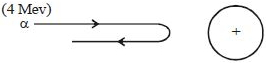
An $\alpha$-particle of energy $4\ MeV$ is scattered through $180^o $ by a fixed uranium nucleus. The distance of the closest approach is of the order of
- A
$1\ Å$
- B
${10^{ - 10}}\ cm$
- ✓
${10^{ - 12}}\ cm$
- D
${10^{ - 15}}\ cm$
AnswerCorrect option: C. ${10^{ - 12}}\ cm$
c
$r$ is called closet approach
$\Delta \mathrm{K} \cdot \mathrm{E} \cdot=\Delta \mathrm{P} \cdot \mathrm{E}$
$4 \times 10^{6}=\frac{9 \times 10^{9} \times 2 \times 92 \times 1.6 \times 10^{-19}}{r}$
$r=662.4 \times 10^{-16} \mathrm{\,m}$
$=6.62 \times 10^{-14} \mathrm{\,m} \Rightarrow 6.62 \times 10^{-12} \mathrm{\,cm}$
View full question & answer→MCQ 211 Mark
In gold foil experiment number of deflected $\alpha -$ particles at angle $90^o$ is $63$ than number of $\alpha -$ particle deflected at $120^o$ is
Answerd
$\mu \,\propto \,\frac{1}{{{{\left( {\sin \frac{\theta }{2}} \right)}^4}}}$
View full question & answer→MCQ 221 Mark
In Rutherford's experiment, number of particles scattered at $90^{\circ}$ angle are $x$ per second. Number particles scattered per second at angle $60^{\circ}$ is
Answerb
(b)
$N(\theta) \propto \frac{Z^2}{\sin ^4\left(\frac{\theta}{2}\right) E^2}$
$\text { or } N (\theta) \propto \frac{1}{\sin ^4\left(\frac{\theta}{2}\right)}$
$\theta=60^{\circ}$ and $90^{\circ}$
$\therefore \frac{N(90)}{N(60)} \propto \frac{\sin ^4 30}{\sin ^4 45}$
$N\left(90^{\circ}\right)=x$
$N\left(60^{\circ}\right)=4 x$
View full question & answer→MCQ 231 Mark
For the Bohr's first orbit of circumference $2\pi r$, the de-Broglie wavelength of revolving electron will be
- ✓
$2\pi r$
- B
$\pi r$
- C
$\frac{1}{{2\pi r}}$
- D
$\frac{1}{{4\pi r}}$
AnswerCorrect option: A. $2\pi r$
a
(a) $mvr = \frac{{nh}}{{2\pi }}$ According to Bohr’s theory
==> $2\pi r = n\,\left( {\frac{h}{{mv}}} \right) = n\lambda $ for $n = 1$, $\lambda = 2\pi r$
View full question & answer→MCQ 241 Mark
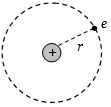
The kinetic energy of the electron in an orbit of radius $r$ in hydrogen atom is ($e =$ electronic charge)
AnswerCorrect option: B. $\frac{{{e^2}}}{{2r}}$
b
(b)Potential energy of electron in $n^{th}$ orbit of radius $r$ in $H-$atom $U=-\frac{{{e}^{2}}}{r}$ (in $CGS$)
$\because K.E. =\frac{1}{2}|P.E.|$ ==> $K=\frac{{{e}^{2}}}{2r}$
View full question & answer→MCQ 251 Mark
The radius of electron's second stationary orbit in Bohr's atom is $R$. The radius of the third orbit will be
- A
$3 R$
- ✓
$2.25 R$
- C
$9 R$
- D
$\frac{R}{3}$
AnswerCorrect option: B. $2.25 R$
b
(b) $ r \propto {n^2}$ ==> $\frac{{{r_{(n = 2)}}}}{{{r_{(n = 3)}}}} = \frac{4}{9}$ ==> ${r_{(n = 3)}} = \frac{9}{4}R = 2.25\,R$
View full question & answer→MCQ 261 Mark
If $m$ is mass of electron, $v$ its velocity, $r$ the radius of stationary circular orbit around a nucleus with charge $Ze$, then from Bohr's first postulate, the kinetic energy $K = \frac{1}{2}m{v^2}$of the electron in $C.G.S.$ system is equal to
AnswerCorrect option: A. $\frac{1}{2}\frac{{Z{e^2}}}{r}$
a
(a) In the revolution of electron, coulomb force provides the necessary centripetal force
==> $\frac{{z{e^2}}}{{{r^2}}} = \frac{{m{v^2}}}{r}$ ==> $m{v^2} = \frac{{z{e^2}}}{r}$
$\therefore$ $ K.E.$ $ = \frac{1}{2}m{v^2} = \frac{{z{e^2}}}{{2r}}$
View full question & answer→MCQ 271 Mark
According to Bohr's theory, the expressions for the kinetic and potential energy of an electron revolving in an orbit is given respectively by
- ✓
$ + \frac{{{e^2}}}{{8\pi {\varepsilon _0}r}}$ and $ - \frac{{{e^2}}}{{4\pi {\varepsilon _0}r}}$
- B
$ + \frac{{8\pi {\varepsilon _0}{e^2}}}{r}$ and $ - \frac{{4\pi {\varepsilon _0}{e^2}}}{r}$
- C
$ - \frac{{{e^2}}}{{8\pi {\varepsilon _0}r}}$ and $ - \frac{{{e^2}}}{{4\pi {\varepsilon _0}r}}$
- D
$ + \frac{{{e^2}}}{{8\pi {\varepsilon _0}r}}$ and $ + \frac{{{e^2}}}{{4\pi {\varepsilon _0}r}}$
AnswerCorrect option: A. $ + \frac{{{e^2}}}{{8\pi {\varepsilon _0}r}}$ and $ - \frac{{{e^2}}}{{4\pi {\varepsilon _0}r}}$
a
(a) $P.E.$ $ = - \frac{{k{e^2}}}{r} = - \frac{{{e^2}}}{{4\pi {\varepsilon _0}r}}$;
$K.E.$ $ = - \frac{1}{2}({\rm{P}}{\rm{.E}}{\rm{.}}) = \frac{{{e^2}}}{{8\pi {\varepsilon _0}r}}$
View full question & answer→MCQ 281 Mark
According to Bohr's theory the moment of momentum of an electron revolving in second orbit of hydrogen atom will be
- A
$2\pi h$
- B
$\pi h$
- ✓
$\frac{h}{\pi }$
- D
$\frac{{2h}}{\pi }$
AnswerCorrect option: C. $\frac{h}{\pi }$
c
(c) Angular momentum $L = n\left( {\frac{h}{{2\pi }}} \right)$
For this case $n=2,$ hence $L = 2 \times \frac{h}{{2\pi }} = \frac{h}{\pi }$
View full question & answer→MCQ 291 Mark
The radius of hydrogen atom in its ground state is $5.3 \times {10^{ - 11}}m$. After collision with an electron it is found to have a radius of $21.2 \times {10^{ - 11}}m$. What is the principal quantum number $n$ of the final state of the atom $n=.........$
Answerb
(b) $r \propto {n^2}\; \,\,i.e.\,\,\frac{{{r_f}}}{{{r_i}}} = {\left( {\frac{{{n_f}}}{{{n_i}}}} \right)^2}$
==> $\frac{{21.2 \times {{10}^{ - 11}}}}{{5.3 \times {{10}^{ - 11}}}} = {\left( {\frac{n}{1}} \right)^2}$ ==> ${n^2} = 4$ ==>$ n = 2$
View full question & answer→MCQ 301 Mark
Minimum excitation potential of Bohr's first orbit in hydrogen atom is.....$V$
- A
$13.6$
- B
$3.4 $
- ✓
$10.2$
- D
$3.6$
AnswerCorrect option: C. $10.2$
c
(c) Excitation potential$ = \frac{{{\rm{Excitation \,\,energy}}}}{{\rm{e}}}$
Minimum excitation energy corresponds to excitation from $n = 1$ to $n = 2$
Minimum excitation energy in hydrogen atom $ = - 3.4 - ( - 13.6) = + 10.2\,eV$
so minimum excitation potential $= 10.2\, eV.$
View full question & answer→MCQ 311 Mark
When an electron in hydrogen atom is excited, from its $4^{th}$ to $5^{th}$ stationary orbit, the change in angular momentum of electron is (Planck’s constant: $h = 6.6 \times {10^{ - 34}}J{\rm{ - s}}$)
- A
$4.16 \times {10^{ - 34}}\,J{\rm{ - }}s$
- B
$3.32 \times {10^{ - 34}}\,J{\rm{ - }}s$
- ✓
$1.05 \times {10^{ - 34}}\,J{\rm{ - }}s$
- D
$2.08 \times {10^{ - 34}}\,J{\rm{ - }}s$
AnswerCorrect option: C. $1.05 \times {10^{ - 34}}\,J{\rm{ - }}s$
c
(c) Change in the angular momentum
$\Delta L = {L_2} - {L_1} = \frac{{{n_2}h}}{{2\pi }} - \frac{{{n_1}h}}{{2\pi }}$$ \Rightarrow \Delta L = \frac{h}{{2\pi }}({n_2} - {n_1})$
$ = \frac{{6.6 \times {{10}^{ - 34}}}}{{2 \times 3.14}}(5 - 4)$$ = 1.05 \times {10^{ - 34}}J{\rm{ - }}S$
View full question & answer→MCQ 321 Mark
In Bohr’s model, if the atomic radius of the first orbit is ${r_0}$, then the radius of the fourth orbit is
- A
${r_0}$
- B
$4{r_0}$
- C
${r_0}/16$
- ✓
$16{r_0}$
AnswerCorrect option: D. $16{r_0}$
d
${r_n} \propto {n^2} \Rightarrow \frac{{{r_4}}}{{{r_1}}} = {\left( {\frac{4}{1}} \right)^2} = \frac{{16}}{1} \Rightarrow {r_4} = 16\;{r_1} \Rightarrow {r_4} = 16\;{r_0}$
View full question & answer→MCQ 331 Mark
The ratio of the speed of the electron in the first Bohr orbit of hydrogen and the speed of light is equal to (where $e, h$ and $c$ have their usual meanings)
- A
$2\pi hc/{e^2}$
- B
${e^2}h/2\pi c$
- C
${e^2}c/2\pi h$
- ✓
$2\pi {e^2}/hc$
AnswerCorrect option: D. $2\pi {e^2}/hc$
d
(d) Speed of electron in $n^{th}$ orbit (in $CGS$) ${v_n} = \frac{{2\pi Z{e^2}}}{{nh}}$ $(k = 1)$
For first orbit ${H_2}$; $n = 1$ and $Z = 1$
So $v = \frac{{2\pi {e^2}}}{h}$ ==> $\frac{v}{c} = \frac{{2\pi {e^2}}}{{hc}}$
View full question & answer→MCQ 341 Mark
Energy of an electron in $n^{th}$ orbit of hydrogen atom is $\left( {k = \frac{1}{{4\pi {\varepsilon _0}}}} \right)$
- ✓
$ - \frac{{2{\pi ^2}{k^2}m{e^4}}}{{{n^2}{h^2}}}$
- B
$ - \frac{{4{\pi ^2}\,m\,k{e^2}}}{{{n^2}{h^2}}}$
- C
$ - \frac{{{n^2}{h^2}}}{{2\pi \,k\,m{e^4}}}$
- D
$ - \frac{{{n^2}{h^2}}}{{4{\pi ^2}\,k\,m{e^2}}}$
AnswerCorrect option: A. $ - \frac{{2{\pi ^2}{k^2}m{e^4}}}{{{n^2}{h^2}}}$
a
According to Bohr's postulates, in a hydrogen atom a single electron revolves around a nucluss of charge $+l_{\text {; }}$;
So, $\frac{m v^2}{r}=\frac{k e^2}{r^2}$
$\Rightarrow m v^2=\frac{k e^2}{r}-\text { (1) }$
Again,
$\Rightarrow v=\frac{n h}{2 \pi m r}$
from equation $- (1)$
$\Rightarrow m\left(\frac{n h}{2 \pi m h}\right)^2=\frac{k e^2}{r}$
$\therefore r=\frac{n^2 h^2}{4 \pi^2 k m e^2}-\text { (2) }$
Potential energy, $E_p=-\frac{k_e^2}{r}=-\frac{4 \pi^2 k^2 m e^4}{n^2 h^2}$
Hence total energy of the electron in the $n-$the orbit, $E=E_K+E_p$
$=-\frac{2 \pi^2 k^2 m e^4}{n^2 h^2}$
View full question & answer→MCQ 351 Mark
Bohr's atom model assumes
- A
The nucleus is of infinite mass and is at rest
- B
Electrons in a quantized orbit will not radiate energy
- C
Mass of electron remains constant
- ✓
Answerd
(d) In $1913,$ Niels Bohr proposed a model for the hydrogen atom. The Bohr model was based on the following assumptions.
The electron in a hydrogen atom travels around the nucleus in a circular orbit. The nucleus is of infinite mass and is rest.
Electrons in a quantized orbit will not radiate energy. Mass of electron remains constant.
View full question & answer→MCQ 361 Mark
In a hypothetical Bohr hydrogen, the mass of the electron is doubled. The energy ${E_0}$ and the radius ${r_0}$ of the first orbit will be (${a_0}$ is the Bohr radius)
- ✓
${E_0} = - \;27.2\;eV;\;{r_0} = {a_0}/2$
- B
${E_0} = - \;27.2\;eV;\;{r_0} = {a_0}$
- C
${E_0} = - 13.6\;eV;\;{r_0} = {a_0}/2$
- D
${E_0} = - 13.6\;eV;\;{r_0} = {a_0}$
AnswerCorrect option: A. ${E_0} = - \;27.2\;eV;\;{r_0} = {a_0}/2$
a
(a) Here radius of electron orbit $r \propto 1/m$
and energy $E \propto m$, where $m$ is the mass of the electron.
Hence energy of hypothetical atom
${E_0} = 2 \times ( - 13.6\,eV) = - 27.2\,eV$ and radius ${r_0} = \frac{{{a_0}}}{2}$
View full question & answer→MCQ 371 Mark
In the Bohr model of the hydrogen atom, let $R, v$ and $E$ represent the radius of the orbit, the speed of electron and the total energy of the electron respectively. Which of the following quantity is proportional to the quantum number $n$
Answerd
(d) Rydberg constant $R = \frac{{{\varepsilon _0}{n^2}{h^2}}}{{\pi mZ{e^2}}}$
Velocity $v = \frac{{Z{e^2}}}{{2{\varepsilon _0}nh}}$
and energy $E = - \frac{{m{Z^2}{e^4}}}{{8\varepsilon _0^2{n^2}{h^2}}}$
Now, it is clear from above expressions $R\cdot v \propto n$
View full question & answer→MCQ 381 Mark
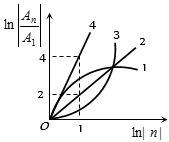
The figure shows a graph between $\ln \left| {\frac{{{A_n}}}{{{A_1}}}} \right|$ and $ln|n|$, where ${A_n}$ is the area enclosed by the nth orbit in a hydrogen like atom. The correct curve is
Answera
(a) ${A_n} = \pi r_n^2$
==> $\frac{{{A_n}}}{{{A_1}}} = {\left( {\frac{{{r_n}}}{{{r_1}}}} \right)^2} = {\left( {\frac{n}{1}} \right)^4}$ $(\because {r_n} \propto {n^2})$
Taking loge both the side ${\log _e}\frac{{{A_n}}}{{{A_1}}} = 4\,{\log _e}(n)$
Comparing it with $y = mx + c$, graph $(4)$ is correct.
View full question & answer→MCQ 391 Mark
The Bohr radius of the fifth electron of phosphorus (atomic number $= 15$) acting as dopant in silicon (relative dielectric constant $= 12$) is.......$Å$
- ✓
$10.6 $
- B
$0.53 $
- C
$21.2 $
- D
AnswerCorrect option: A. $10.6 $
a
(a)${r_n} = {\varepsilon _r}\left( {\frac{{{n^2}}}{Z}} \right)\,{a_o} = 12 \times \frac{{({5^2})}}{{15}} \times 0.53$
$= 10.6 Å.$
View full question & answer→MCQ 401 Mark
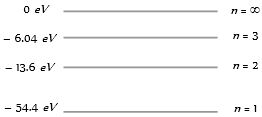
The energy level diagram for an hydrogen like atom is shown in the figure. The radius of its first Bohr orbit is
- ✓
$0.265\, \mathring A$
- B
$0.53\, \mathring A$
- C
$0.132\, \mathring A$
- D
AnswerCorrect option: A. $0.265\, \mathring A$
a
(a) We know that ${E_n} = - 13.6\frac{{{Z^2}}}{{{n^2}}}eV$ and
${r_n} = 0.53\frac{{{n^2}}}{Z}\mathring A $
Here for $n =1, E_1 = -54.4\, eV$
Therefore $ - \,54.4 = - 13.6\frac{{{Z^2}}}{{{1^1}}}$ ==> $Z = 2$
Hence radius of first Bohr orbit $r = \frac{{0.53\,{{(1)}^2}}}{2} = 0.265\mathring A$
View full question & answer→MCQ 411 Mark
The ratio of ionization energy of Bohr’s hydrogen atom and Bohr’s hydrogen like lithium atom is
- A
$1 ; 1$
- B
$1 : 3 $
- ✓
$1 : 9$
- D
AnswerCorrect option: C. $1 : 9$
c
(c) Energy of an electron in ground state of an atom (Bohr’s hydrogen like atom) is given as
$E = - 13.6\,{Z^2}eV$ ($Z =$ atomic number of the atom)
==> $E_{ionisation}= 13.6 Z^2$
==> $\frac{{{{({E_{ion}})}_H}}}{{{{({E_{ion}})}_{Li}}}} = {\left( {\frac{{{Z_H}}}{{{Z_{Li}}}}} \right)^2} = {\left( {\frac{1}{3}} \right)^2} = \frac{1}{9}$
View full question & answer→MCQ 421 Mark
Let $n_r$ and $n_b$ be respectively the number of photons emitted by a red bulb and a blue bulb of equal power in a given time.
- A
$n_r = n_b$
- B
$n_r < n_b$
- ✓
$n_r > n_b$
- D
AnswerCorrect option: C. $n_r > n_b$
c
$n_{r} \frac{h c}{\lambda_{r}}=n_{b} \frac{h c}{\lambda_{b}}$
$n_{r}=\frac{\lambda_{r}}{\lambda_{b}} n_{b}$
As $\lambda _r > \lambda _b$
$\therefore \ \boxed {n_r > n_b}$
View full question & answer→MCQ 431 Mark
Electron in a hydrogen atom is replaced by an identically charged particle muon with mass $207$ times that of electron. Now the radius of $K$ shell will be
- ✓
$2.56 \times 10^{-3} \,Å$
- B
$109.7\, Å$
- C
$1.21 \times 10^{-3} \,Å$
- D
$22174.4 \, Å$
AnswerCorrect option: A. $2.56 \times 10^{-3} \,Å$
a
The Bohr radius for the $K$ shell is given as
$a_{0}=\frac{h^{2} \varepsilon_{0}}{\pi m e^{2}}$
Therefore, the Bohr radius is inversely proportional to the mass of the orbiting particle.
$\therefore \frac{a_{0 e}}{a_{0 m}}=\frac{m_{m}}{m_{e}}$
$\therefore a_{0 m}=\frac{m_{e} a_{0 e}}{m_{m}}=\frac{m_{e} a_{0 e}}{207 m_{e}}$
$\therefore a_{0 m}=\frac{a_{0 e}}{207}=\frac{5.29 \times 10^{-11}}{207}=2.56 \times 10^{-13} \mathrm{m}$
$\therefore a_{0 m}=2.56 \times 10^{-3} A$
View full question & answer→MCQ 441 Mark
Consider the spectral line resulting from the transition $n = 2 \rightarrow n = 1$ in the atoms and ions given below. The shortest wavelength is produced by :
Answerd
We know that
$\frac{1}{\lambda}=R z^{2}\left[\frac{1}{n_{2}^{2}}-\frac{1}{n_{1}^{2}}\right] \Rightarrow \frac{1}{\lambda} \propto z^{2}$
$\lambda$ is shortest when $1 / \lambda$ is i.e., when $z$ is big $z$ is highest for lithum.
View full question & answer→MCQ 451 Mark
Choose the correct statement(s) for hydrogen and deuterium atoms (considering motion of nucleus)
- ✓
The radius of first Bohr orbit of deuterium is less than that of hydrogen
- B
The speed of electron in the first Bohr orbit of deuterium is more than that of hydrogen.
- C
The wavelength of first Balmer line of deuterium is more than that of hydrogen
- D
The angular momentum of electron in the first Bohr orbit of deuterium is more than that of hydrogen.
AnswerCorrect option: A. The radius of first Bohr orbit of deuterium is less than that of hydrogen
View full question & answer→MCQ 461 Mark
In a hypothetical system a particle of mass $m$ and charge $-3q$ is moving around a very heavy particle having charge $q$. Assuming Bohr’s model to be true to this system, the orbital velocity of mass $m$ when it is nearest to heavy particle is
- ✓
$\frac{{3{q^2}}}{{2{\varepsilon _0}h}}$
- B
$\frac{{3{q^2}}}{{4{\varepsilon _0}h}}$
- C
$\frac{{3q}}{{2{\varepsilon _0}h}}$
- D
$\frac{{3q}}{{4{\varepsilon _0}h}}$
AnswerCorrect option: A. $\frac{{3{q^2}}}{{2{\varepsilon _0}h}}$
a
${\frac{1}{4 \pi \varepsilon_{0}} \frac{(3 q)(q)}{r^{2}}=\frac{m v^{2}}{r}} $ .......$(1)$
${m v r=\frac{n h}{2 \pi}}$ .......$(2)$
$n=1$ .........$(3)$
View full question & answer→MCQ 471 Mark
particle is moving along $x-$ axis back and forth in a box of length $L$. Assuming de -broglie hypothesis applicable for the particle, and it is moving with constant speed in the box making perfectly elastic collisions to the walls. The possible value of momentum of the particle is (Note : $h$ is plank constant, $n$ is principal quantum number)
- ✓
$\frac{{nh}}{{2L}}$
- B
$\frac{{nh}}{{L}}$
- C
$\frac{{nh}}{{4L}}$
- D
$\frac{{2nh}}{{3L}}$
AnswerCorrect option: A. $\frac{{nh}}{{2L}}$
a
By de-broglie hypothesis
$\lambda=\frac{h}{p}$
${\rm{L}} = \frac{{{\rm{n}}\lambda }}{2}\,\,\,\,\,\,\lambda = \frac{{2{\rm{L}}}}{n}$
$\mathrm{p}=\frac{\mathrm{h}}{\lambda}=\mathrm{h} \frac{\mathrm{h}}{2 \mathrm{L}} \mathrm{p}=\frac{\mathrm{h}}{\lambda}=\frac{\mathrm{nh}}{2 \mathrm{L}}$
View full question & answer→MCQ 481 Mark
A hydrogen atom at rest emits a photon during its transition from $n = 2$ to $n = 1$ . Choose the $INCORRECT$ statement.
- A
De-Broglie wavelength of hydrogen atom during recoil will be same as wavelength of emitted photon.
- B
Energy of emitted photon will be less than $10.2\ eV$
- C
Kinetic energy of recoil $H-$ atom will be less than $10.2\ eV$
- ✓
Kinetic energy of recoil $H-$ atom will be equal to energy of emitted photon.
AnswerCorrect option: D. Kinetic energy of recoil $H-$ atom will be equal to energy of emitted photon.
d
Since initial momentum is zero. So final momentum is also zero. So momentum of hydrogen atom and photon will be equal.
View full question & answer→MCQ 491 Mark
For a hydrogen atom, when electron jump from $n = 2$ to $n = 1$, then wave length of radiation emitted found to be ${\lambda _0}$ .Then, for which transion of electron of a $‘He’$ atom, the wavelength of radiation emitted will be equal to '${\lambda _0}$ '
- A
$n = 3$ to $n = 2$
- ✓
$n = 4$ to $n = 2$
- C
$n = 4$ to $n = 3$
- D
$n = 8$ to $n = 4$
AnswerCorrect option: B. $n = 4$ to $n = 2$
b
$\frac{1}{\lambda}=\mathrm{Rz}^{2}\left[\frac{1}{\mathrm{n}_{\mathrm{f}}^{2}}-\frac{1}{\mathrm{n}_{\mathrm{i}}^{2}}\right]$
for $\mathrm{H}, \frac{1}{\lambda}=\mathrm{R}\left[\frac{1}{1}-\frac{1}{4}\right],$ for $\mathrm{H}_{\mathrm{e}}, \frac{1}{\lambda}=\mathrm{R}\left[\frac{1}{\left(\frac{\mathrm{n}_{\mathrm{f}}}{\mathrm{z}}\right)^{2}}-\frac{1}{\left(\frac{\mathrm{n}_{\mathrm{i}}}{\mathrm{z}}\right)^{2}}\right]$
$\Rightarrow \frac{\mathrm{n}_{\mathrm{f}}}{2}=1 \quad \Rightarrow \mathrm{n}_{\mathrm{f}}=2 | \frac{\mathrm{n}_{\mathrm{i}}}{\mathrm{z}}=2 \Rightarrow \mathrm{n}_{\mathrm{i}}=4$
View full question & answer→MCQ 501 Mark
An electron of stationary hydrogen atom passes from the fifth energy level to the ground level. The velocity that the atom acquired a result of photon emission will be: ($m$ is the mass of the atom, $R$ is Rydberg constant and $h$ is Planck's constant)
- A
$\frac{25m}{24hR}$
- B
$\frac{24m}{25hR}$
- ✓
$\frac{24hR}{25m}$
- D
$\frac{25hR}{24m}$
AnswerCorrect option: C. $\frac{24hR}{25m}$
c
$\frac{1}{\lambda}=\mathrm{R}\left[\frac{1}{(1)^{2}}-\frac{1}{(5)^{2}}\right]$
$\frac{1}{\lambda}=\frac{24}{25} \mathrm{R}$
$\mathrm{P}=\mathrm{mv}=\frac{\mathrm{h}}{\lambda}$
$v=\frac{h}{m \lambda}=\frac{24 h R}{25 m}$
View full question & answer→