MCQ 11 Mark
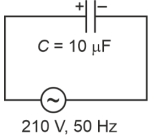
A $10 \mu \mathrm{F}$ capacitor is connected to a $210 \mathrm{~V}, 50 \mathrm{~Hz}$ source as shown in figure. The peak current in the circuit is nearly $(\pi=3.14)$ :
- ✓
$0.93 \mathrm{~A}$
- B
$1.20 \mathrm{~A}$
- C
$0.35 \mathrm{~A}$
- D
$0.58 \mathrm{~A}$
AnswerCorrect option: A. $0.93 \mathrm{~A}$
a
$\text { Capacitive Reactance } X_C=\frac{1}{\omega C}=\frac{1}{2 \pi f C}=\frac{1}{2 \times 3.14 \times 50 \times 10 \times 10^{-6}}$
$=\frac{1000}{3.14}$
$V_{\mathrm{ms}}=210 \mathrm{~V}$
$i_{\mathrm{ms}}=\frac{V_{\mathrm{ms}}}{X_C}=\frac{210}{X_C}$
$\text { Peak current }=\sqrt{2} i_{\text {mms }}=\sqrt{2} \times \frac{210}{1000} \times 3.14=0.932$
$=0.93 \mathrm{~A}$
View full question & answer→MCQ 21 Mark
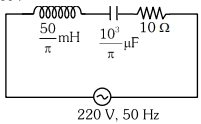
The net impedance of circuit (as shown in figure) will be $...........\,\Omega$
- A
$15$
- B
$10 \sqrt{2}$
- C
$25$
- ✓
$5 \sqrt{5}$
AnswerCorrect option: D. $5 \sqrt{5}$
d
$X_L =\frac{50}{ L } \times 10^{-3} \times 2 \pi \times 50=5\,\Omega$
$X_C =\frac{1}{2 \pi \times 50 \times \frac{10^3}{\pi} \times 10^{-6}}=10\,\Omega$
$Z =\sqrt{ R ^2+\left( X _{ L }- X _{ C }\right)^2}$
$=\sqrt{(10)^2+(5)^2}$
$=5 \sqrt{5}\,\Omega$
View full question & answer→MCQ 31 Mark
In a series $LCR$ circuit, the inductance $L$ is $10\,mH$, capacitance $C$ is $1\,\mu\,F$ and resistance $R$ is $100\,\Omega$. The frequency at which resonance occurs is :-
- ✓
$1.59\,kHz$
- B
$15.9\,rad / s$
- C
$15.9\,kHz$
- D
$1.59\,rad / s$
AnswerCorrect option: A. $1.59\,kHz$
a
a
$L =10 \times 10^{-3}\,H$
$C =1 \times 10^{-6}\,F$
$R =100\,\Omega$
At resonance $X_L=X_C$
$\omega L =\frac{1}{\omega C }$
$f =\frac{1}{2 \pi \sqrt{ LC }}=\frac{1}{2 \pi \sqrt{10 \times 10^{-3} \times 10^{-6}}}=1.59\,KHz$
View full question & answer→MCQ 41 Mark
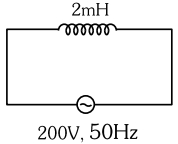
An inductor of inductance $2\,mH$ is connected to a $220\,V , 50\,Hz$ $a.c.$ source. Let the inductive reactance in the circuit is $X _1$. If a $220\,V$ dc source replaces the ac source in the circuit, then the inductive reactance in the circuit is $X _2 . X _1$ and $X _2$ respectively are
AnswerCorrect option: C. $0.628\,\Omega$, zero
c
For $AC\; X_L=\omega L \quad$ For $DC, \;\omega=0$
$X_1=100 \pi \times 2 \times 10^3$ $\quad X_L=\omega L$
$X_1=0.2\,\pi\,\Omega$ $\quad X_2=0$
$X_1=0.628\,\Omega$
View full question & answer→MCQ 51 Mark
A standard filament lamp consumes $100\,W$ when connected to $200\,V$ ac mains supply. The peak current through the bulb will be $........\,A$
AnswerCorrect option: A. $0.707$
a
$I _{ ms } V _{ rms }= P$
$I _{ ms } \times 200=100$
$I _{ ms }=\frac{1}{2}$
So, $I _{\text {peak }}= I _{ rms } \sqrt{2}$
$=\frac{1}{2} \times \sqrt{2}$
$=\frac{1}{\sqrt{2}}=0.707\,A$
View full question & answer→MCQ 61 Mark
A series LCR circuit with inductance $10\,H$, capacitance $10\,\mu F$, resistance $50\,\Omega$ is connected to an ac source of voltage, $V=200 \sin (100 t)$ volt. If the resonant frequency of the LCR circuit is $\nu_{0}$ and the frequency of the ac source is $v$, then:
- ✓
$v_{0}=v=\frac{50}{\pi}\,Hz$
- B
$v_{0}=\frac{50}{\pi}\,Hz , \nu=50\,Hz$
- C
$v=100 Hz ; v_{0}=\frac{100}{\pi}\,Hz$
- D
$v_{0}=\nu=50\,Hz$
AnswerCorrect option: A. $v_{0}=v=\frac{50}{\pi}\,Hz$
a
a
$\omega=100$
$v=\frac{\omega}{2 \pi}=\frac{100}{2 \pi}=\frac{50}{\pi} Hz$
Resonance frequency
$v_{0}=\frac{1}{2 \pi \sqrt{ LC }}=\frac{1}{2 \pi} \sqrt{\frac{1}{10 \times 10 \times 10^{-6}}}$
$=\frac{50}{\pi}\,Hz$
View full question & answer→MCQ 71 Mark
The peak voltage of the ac source is equal to:
- A
the $rms$ value of the ac source
- ✓
$\sqrt{2}$ times the $rms$ value of the $ac$ source
- C
$\frac{1}{\sqrt{2}}$ times the $rms$ value of the $ac$ source
- D
the value of voltage supplied to the circuit
AnswerCorrect option: B. $\sqrt{2}$ times the $rms$ value of the $ac$ source
b
Peak voltage is $\sqrt{2}$ times rms voltages in ac.
View full question & answer→MCQ 81 Mark
Given below are two statements :
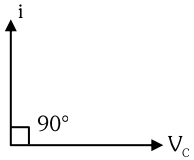
Statement$-I:$In an ac circuit, the current through a capacitor leads the voltage across it.
Statement$-II:$ In a.c. circuits containing pure capacitance only, the phase difference between the current and the voltage is $\pi$
In the light of the above statements, choose the most appropriate answer from the options given below
- A
Both statement$-I$ and statement$-II$ are correct
- B
Both statement$-I$ and statement$-II$ are incorrect
- ✓
Statement$-I$ is correct but statement$-II$ is incorrect
- D
Statement$-I$ is incorrect but statement$-II$ is correct
AnswerCorrect option: C. Statement$-I$ is correct but statement$-II$ is incorrect
c
View full question & answer→MCQ 91 Mark
A series $LCR$ circuit containing $5.0\, \mathrm{H}$ inductor, $80\, \mu \mathrm{F}$ capacitor and $40\, \Omega$ resistor is connected to $230 \,\mathrm{~V}$ variable frequency ac source. The angular frequencies of the source at which power transferred to the circuit is half the power at the resonant angular frequency are likely to be :
- A
$25\, \mathrm{rad} / \mathrm{s}$ and $75 \,\mathrm{rad} / \mathrm{s}$
- B
$50 \,\mathrm{rad} / \mathrm{s}$ and $25 \,\mathrm{rad} / \mathrm{s}$
- ✓
$46\, \mathrm{rad} / \mathrm{s}$ and $54 \,\mathrm{rad} / \mathrm{s}$
- D
$42 \,\mathrm{rad} / \mathrm{s}$ and $58 \,\mathrm{rad} / \mathrm{s}$
AnswerCorrect option: C. $46\, \mathrm{rad} / \mathrm{s}$ and $54 \,\mathrm{rad} / \mathrm{s}$
c
$\mathrm{Q}=\frac{\omega}{\Delta \omega}=\frac{\omega \mathrm{L}}{\mathrm{R}} \Rightarrow \Delta \omega=\mathrm{R} / \mathrm{L}=\frac{50}{4}=8\, \mathrm{rad} / \mathrm{sec}$
$\omega_{0}=\frac{1}{\sqrt{\mathrm{LC}}}=\frac{1}{\sqrt{5 \times 80 \times 10^{-6}}}=50\, \mathrm{rad} / \mathrm{sec}$
$\omega_{\min }=\omega_{0}-\frac{\Delta \omega}{2}=46\, \mathrm{rad} / \mathrm{sec}$
$\omega_{\max }=\omega_{0}-\frac{\Delta \omega}{2}=54 \,\mathrm{rad} / \mathrm{sec}$
View full question & answer→MCQ 101 Mark
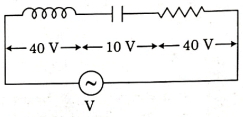
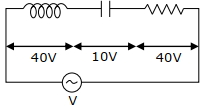
An inductor of inductance $L$, a capacitor of capacitance $\mathrm{C}$ and a resistor of resistance $'\mathrm{R}'$ are connected in series to an ac source of potential difference $'\mathrm{V}'$ volts as shown in figure.
Potential difference across $\mathrm{L}, \mathrm{C}$ and $\mathrm{R}$ is $40\, \mathrm{~V}$, $10\, \mathrm{~V}$ and $40\, \mathrm{~V}$, respectively. The amplitude of current flowing through $LCR$ series circuit is $10 \sqrt{2}\, \mathrm{~A} .$ The impedance of the circuit is .......... $\Omega$
- A
$4 \,\sqrt{2}$
- B
$5 / \sqrt{2}$
- C
$4$
- ✓
$5$
Answerd
$\mathrm{I}_{0}=10 \sqrt{2} \,\mathrm{~A}$
$\mathrm{I}_{\mathrm{RMS}}=\frac{\mathrm{I}}{\sqrt{2}}=10 \,\mathrm{~A}$
$V_{\mathrm{RMS}}=\sqrt{V_{\mathrm{R}}^{2}+\left(\mathrm{V}_{\mathrm{L}}-\mathrm{V}_{\mathrm{C}}\right)^{2}}$
$=\sqrt{(40)^{2}+(40-10)^{2}}$
$=50\, \mathrm{~V}$
$Z=\frac{\mathrm{V}_{\mathrm{RMS}}}{\mathrm{I}_{\mathrm{RM}}}=\frac{50 \mathrm{~V}}{10 \mathrm{~V}}=5 \,\Omega$
View full question & answer→MCQ 111 Mark
A light bulb and an inductor coil are connected to an ac source through a key as shown in the figure below. The key is closed and after sometime an iron rod is inserted into the interior of the inductor. The glow of the light bulb
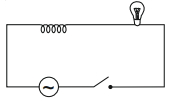
Answerb
As an iron rod is inserted, inductance of inductor will increase.
Hence impedance $z=\sqrt{R^{2}+(\omega L)^{2}},$ will increase,
so from $i=\frac{v}{z}$ current will decrease and from $P =\frac{ V _{0}^{2} R }{2 z ^{2}}$ power of bulb will decrease.
View full question & answer→MCQ 121 Mark
A $40\, \mu F$ capacitor is connected to a $200\, V , 50 \,Hz$ ac supply. The rms value of the current in the circult is, nearly $.......A$
- A
$25.1$
- B
$1.7$
- C
$2.05$
- ✓
$2.5$
Answerd
$I=\frac{V}{X_{C}}=\frac{V}{1 / C \omega}=V C \omega$
$=200 \times 40 \times 10^{-6} \times 2 \pi \times 50$
$=2.5 A$
View full question & answer→MCQ 131 Mark
A series $LCR$ circuit is connected to an ac voltage source. When $L$ is removed from the circuit, the phase difference between current and voltage is $\frac{\pi}{3} .$ If instead $C$ is removed from the circult, the phase difference is again $\frac{\pi}{3}$ between current and voltage. The power factor of the circuit is
Answerd
When $L$ removed $\tan \phi=\frac{ X _{ C }}{ R }$
When $L$ removed tan $\phi=\frac{ X _{ L }}{ R }$
$\frac{ X _{ C }}{ R }=\frac{ X _{ L }}{ R } \Rightarrow$ Resonance
$Z = R$
$\cos \phi=\frac{ R }{ Z }=\frac{ R }{ R }=1$
View full question & answer→MCQ 141 Mark
The variation of $EMF$ with time for four types of generators are shown in the figures. Which amongst them can be called $AC$ ?
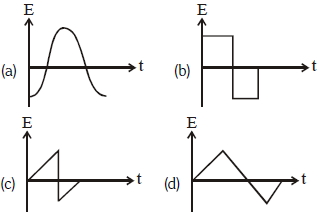
AnswerCorrect option: B. $(a), (b), (c)$ and $(d)$
b
Changing polarity is termed as $AC.$
View full question & answer→MCQ 151 Mark
A circuit when connected to an $A.C.$ source of $12\; V$ gives a current of $0.2\; A$. The same circuit when connected to a $D.C.$ source of $12\; V$, glves a current of $0.4\; A$. The circuit is
- ✓
series $LR$
- B
series $RC$
- C
series $LC$
- D
series $LCR$
AnswerCorrect option: A. series $LR$
a
$Z=\frac{12}{0.2}=60 \Omega$ and $\mathrm{R}=\frac{12}{0.4}=30 \Omega$
In D.C Source Capacitor a would provide Infinite resistance but current is present in the given circuit. it means resistor and Inductor are in circuit
View full question & answer→MCQ 161 Mark
An inductor $20\,\, mH,$ a capacitor $100\, \mu F$ and a resistor $50 \,\,\Omega$ are connected in series across a source of emf, $V=10 sin 314 \,t .$ The power loss in the circuit is ......$W$
- ✓
$0.79$
- B
$0.43$
- C
$1.13$
- D
$2.74$
AnswerCorrect option: A. $0.79$
a
Impedance $Z$ in an $ac$ circuit is
$Z=\sqrt{R^{2}+\left(X_{C}-X_{L}\right)^{2}} ;$ where $X_{C}=$ capacitive reactance and $X_{L}=$ inductive reactance.
Also $X_{C}=\frac{1}{\omega C}$ and $X_{L}=\omega L$
$\therefore \quad z=\sqrt{(50)^{2}+\left(\frac{1}{314 \times 100 \times 10^{-6}}-314 \times 20 \times 10^{-3}\right)^{2}}$
or $\quad Z=56\, \Omega$
The power loss in the circuit is $P_{a v}=\left(\frac{V_{r m s}}{Z}\right)^{2} R$
$\therefore \quad P_{a v}=\left(\frac{10}{(\sqrt{2}) 56}\right)^{2} \times 50=0.79\, \mathrm{W}$
View full question & answer→MCQ 171 Mark
Figure shows a circuit that contains three identical resistors with resistance $R = 9.0 \,\,\Omega$ each, two identical inductors with inductance $L = 2.0\, mH$ each, and an ideal battery with $emf\,\, = 18 \,\,V.$ The current $i$ through the battery just after the switch closed is
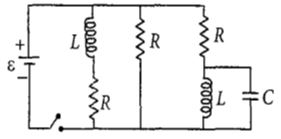
- A
$0.2\;A$
- ✓
$4.0\;A$
- C
$0\;A$
- D
$2\;mA$
AnswerCorrect option: B. $4.0\;A$
b
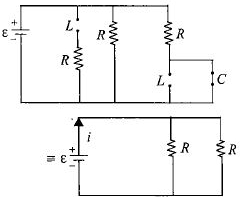
At time, $t=0$ i.e., when switch is closed, inductor in the circuit provides very high resistance (open circuit) while capacitor starts charging with maximum current (low resistance).
Equivalent circuit of the given circuit
Current drawn from battery,
$i=\frac{\varepsilon}{(R / 2)}=\frac{2 \varepsilon}{R}=\frac{2 \times 18}{9}=4 \,\mathrm{A}$
View full question & answer→MCQ 181 Mark
Which of the following combinations should be selected for better tuning of an $L-C-R$ circuit used for communication ?
- ✓
$R=15Ω , L=3.5 H ,C=30\mu F$
- B
$R=25Ω , L=1.5 H ,C=45\mu F$
- C
$R=20Ω , L=1.5 H ,C=35\mu F$
- D
$R=25Ω , L=2.5 H ,C=45\mu F$
AnswerCorrect option: A. $R=15Ω , L=3.5 H ,C=30\mu F$
a
Quality factor of an $L-C-R$ circuit is given by,
${Q=\frac{1}{R} \sqrt{\frac{L}{C}}} $
${Q_{1}=\frac{1}{15} \sqrt{\frac{3.5}{30 \times 10^{-6}}}=\frac{100}{15} \sqrt{\frac{35}{3}}=22.77} $
${Q_{2}=\frac{1}{25} \times \sqrt{\frac{1.5}{45 \times 10^{-6}}}=40 \times \sqrt{\frac{5}{90}}=9.43} $
${Q_{3}=\frac{1}{20} \sqrt{\frac{1.5}{35 \times 10^{-6}}}=50 \times \sqrt{\frac{3}{70}}=10.35} $
${Q_{4}=\frac{1}{25} \times \sqrt{\frac{2.5}{45 \times 10^{-6}}}=\frac{40}{\sqrt{30}}=7.30}$
Clearly $Q_{1}$ is maximum of $Q_{1}, Q_{2}, Q_{3},$ and $Q_{4}$.
Hence, option $(a)$ should be selected for better tuning of an $L-C-R$ circuit.
View full question & answer→MCQ 191 Mark
The potential differences across the resistance, capacitance and inductance are $80\,\, V, \,\,40 \,\,V$ and $100\,\, V$ respectively in an $L-C-R$ circuit. The power factor of this circuit is
Answera
$\text { Here, } V_{R}=80\, \mathrm{V}, V_{c}=40\, \mathrm{V}, V_{L}=100 \,\mathrm{V}$
Power factor, $\cos \phi=\frac{R}{Z}$
${=\frac{V_{R}}{V}=\frac{V_{R}}{\sqrt{V_{R}^{2}+\left(V_{L}-V_{C}\right)^{2}}}}$
${=\frac{80}{\sqrt{(80)^{2}+(100-40)^{2}}}=\frac{80}{100}=0.8}$
View full question & answer→MCQ 201 Mark
A small signal voltage $V(t) = V_0\,\, sin \omega \,t$ is applied across an ideal capacitor $C$
- ✓
Over a full cycle the capacitor $C$ does not consume any energy from the voltage source.
- B
Current $I(t)$ is in phase with voltage $V(t).$
- C
Current $I(t)$ leads voltage $V(t)$ by$180^o.$
- D
Current $I(t)$ lags voltage $V(t)$ by $90^o.$
AnswerCorrect option: A. Over a full cycle the capacitor $C$ does not consume any energy from the voltage source.
a
When an ideal capacitor is connected with an ac voltage source, current leads voltage by $90°$ . Since, energy stored in capacitor during charging is spent in maintaining charge on the capacitor during discharging . Hence over a full cycle the capacitor does not consume any energy from the voltage source
View full question & answer→MCQ 211 Mark
An inductor $20 \,\,mH,$ a capacitor $50\,\, \mu F$ and a resistor $40 \,\,\Omega$ are connected in series across a source of emf $V = 10 \,sin \,340t.$ The power loss in A.C. circuit is......$ W$
- A
$0.67$
- B
$0.76$
- C
$0.89$
- ✓
$0.51$
AnswerCorrect option: D. $0.51$
d
$\text { Here, } L=20\, \mathrm{mH}=20 \times 10^{-3}\, \mathrm{H}$
$C=50\, \mu \mathrm{F}=50 \times 10^{-6}\, \mathrm{F}$
$R=40\, \Omega, V=10\, \sin \,340\, t=V_{0} \sin \omega t$
$\omega=340 \,\mathrm{rad} \,\mathrm{s}^{-1}, V_{0}=10\, \mathrm{V}$
$X_{L}=\omega L=340 \times 20 \times 10^{-3}=6.8\, \Omega$
$X_{C}=\frac{1}{\omega C}=\frac{1}{340 \times 50 \times 10^{-6}}=\frac{10^{4}}{34 \times 5}=58.82 \,\Omega$
$Z=\sqrt{R^{2}+\left(X_{C}-X_{L}\right)^{2}}=\sqrt{(40)^{2}+(58.82-6.8)^{2}}$
$=\sqrt{(40)^{2}+(52.02)^{2}}=65.62\, \Omega$
The peak current in the circuit is
$I_{0}=\frac{V_{0}}{Z}=\frac{10}{65.62} \,\mathrm{A}, \cos \phi=\frac{R}{Z}=\left(\frac{40}{65.62}\right)$
Power loss in $A.C.$ circuit,
${=V_{\mathrm{rms}} I_{\mathrm{rms}} \cos \phi=\frac{1}{2} V_{0} I_{0} \cos \phi}$
${=\frac{1}{2} \times 10 \times \frac{10}{65.62} \times \frac{40}{65.62}=0.46 \,\mathrm{W}}$
View full question & answer→MCQ 221 Mark
A generator produces a voltage that is given by $V = 240\,sin \,120\,t$, where t is in seconds. The frequency and $ r.m.s.$ voltage are
- A
$60 Hz and 240 V $
- B
$19 Hz and 120 V$
- ✓
$19 Hz and 170 V$
- D
$754 Hz and 70 V$
AnswerCorrect option: C. $19 Hz and 170 V$
c
(c)$\nu = \frac{\omega }{{2\pi }} = \frac{{120 \times 7}}{{2 \times 22}} = 19\;Hz$
${V_{r.m.s.}} = \frac{{240}}{{\sqrt 2 }} = 120\sqrt 2 \approx 170\;V$
View full question & answer→MCQ 231 Mark
A resistance of $20$ ohms is connected to a source of an alternating potential $V = 220\,sin\,(100\,\pi t)$. The time taken by the current to change from its peak value to r.m.s value is
AnswerCorrect option: D. $2.5 \times {10^{ - 3}}$ $ sec $
d
(d)Peak value to r.m.s. value means, current becomes $\frac{1}{{\sqrt 2 }}$ times.
So from $i = {i_0}\sin 100\pi t \Rightarrow \frac{1}{{\sqrt 2 }} \times {i_0} = {i_0}\sin 100\pi t$
$ \Rightarrow \sin \frac{\pi }{4} = \sin 100\pi t \Rightarrow t = \frac{1}{{400}}sec$$ = 2.5 \times {10^{ - 3}}sec.$
View full question & answer→MCQ 241 Mark
If an ac main supply is given to be $220 V$. What would be the average e.m.f. during a positive half cycle.....$V$
Answera
(a)${V_{av}} = \frac{2}{\pi }{V_0} = \frac{2}{\pi } \times ({V_{rms}} \times \sqrt 2 ) = \frac{{2\sqrt 2 }}{\pi }.{V_{rms}}$
$ = \frac{{2\sqrt 2 }}{\pi } \times 220 = 198\;V$
View full question & answer→MCQ 251 Mark
A $280$ ohm electric bulb is connected to $200V$ electric line. The peak value of current in the bulb will be
Answera
(a)${i_{rms}} = \frac{{200}}{{280}} = \frac{5}{7}A.$ So ${i_0} = {i_{rms}} \times \sqrt 2 = \frac{5}{7} \times \sqrt 2 \approx 1A.$
View full question & answer→MCQ 261 Mark
If an alternating voltage is represented as $E = 141\,sin\, (628\,t),$ then the rms value of the voltage and the frequency are respectively
- A
$141V,\,628Hz$
- B
$100V,\,50Hz$
- ✓
$100V,\,100Hz$
- D
$141V,\,\,100Hz$
AnswerCorrect option: C. $100V,\,100Hz$
c
(c)$E = 141\sin (628\,t),$
${E_{rms}} = \frac{{{E_0}}}{{\sqrt 2 }} = \frac{{141}}{{1.41}} = 100V$and $2\pi f = 628$
$⇒$ $f = 100Hz$
View full question & answer→MCQ 271 Mark
An alternating voltage $E = 200\sqrt 2\, \sin\, (100\,t)$ is connected to a $1$ microfarad capacitor through an ac ammeter. The reading of the ammeter shall be......$mA$
Answerb
(b) Reading of ammeter $ = {i_{rms}} = \frac{{{V_{rms}}}}{{{X_C}}} = \frac{{{V_0}\omega C}}{{\sqrt 2 }}$
$ = \frac{{200\sqrt 2 \times 100 \times (1 \times {{10}^{ - 6}})}}{{\sqrt 2 }} = 2 \times {10^{ - 2}}A = 20\;mA$
View full question & answer→MCQ 281 Mark
The voltage of an ac source varies with time according to the equation $V = 100\sin \;100\pi t\,\cos \,100\pi t$ where $t$ is in seconds and $V$ is in volts. Then
- A
The peak voltage of the source is $100$ volts
- ✓
The peak voltage of the source is $50$ volts
- C
The peak voltage of the source is $100/\sqrt 2 $ volts
- D
The frequency of the source is $50\, Hz$
AnswerCorrect option: B. The peak voltage of the source is $50$ volts
b
(b) $V = 50 \times 2\,\sin \,100\pi t\,\cos \,100\pi t = 50\sin 200\pi t$
$ \Rightarrow \,\,{V_0} = 50\,Volts$ and $\nu = 100Hz$
View full question & answer→MCQ 291 Mark
The voltage of an $ac$ supply varies with time $(t)$ as $V = 120\sin 100\,\pi \,t\cos 100\pi \,t.$ The maximum voltage and frequency respectively are
- A
$120 \,volts, \,100 \,Hz$
- B
$\frac{{120}}{{\sqrt 2 }} \,volts, \,100 \,Hz$
- C
$60 \,volts, \,200 \,Hz$
- ✓
$60 \,volts, \,100 \,Hz$
AnswerCorrect option: D. $60 \,volts, \,100 \,Hz$
d
(d) $V = 120\,\,\sin 100\pi t\,\,\cos \,100\,\pi t$$ \Rightarrow \,V\, = 60\,\sin \,200\pi t$
${V_{\max }} = 60V\,$and $\nu = 100Hz$
View full question & answer→MCQ 301 Mark
In a certain circuit current changes with time according to $i = 2\sqrt t .$ r.m.s. value of current between $t = 2$ to $t = 4s$ will be
- A
$3A$
- B
$3\sqrt 3 A$
- ✓
$2\sqrt 3 A$
- D
$(2 - \sqrt 2 )A$
AnswerCorrect option: C. $2\sqrt 3 A$
c
(c)$\overline {{i^2}} = \frac{{\int_{}^{} {{i^2}dt} }}{{\int_{}^{} {dt} }} = \frac{{\int_2^4 {(4t)} dt}}{{\int_2^4 {dt} }} = \frac{{4\int_2^4 {t\;dt} }}{2}$$ = 2\left[ {\frac{{{t^2}}}{2}} \right]_2^4 = \left[ {{t^2}} \right]_2^4 = 12$
$ \Rightarrow {i_{rms}} = \sqrt {\overline {{i^2}} } = \sqrt {12} = 2\sqrt 3 \;A$
View full question & answer→MCQ 311 Mark
If $i = {t^2}$ $0 < t < T$ then $r.m.s$. value of current is
AnswerCorrect option: C. $\frac{{{T^2}}}{{\sqrt 5 }}$
c
(c) ${i_{rms}} = \sqrt {\frac{1}{T}\int_0^T {{i^2}dt} } = \frac{{{T^2}}}{{\sqrt 5 }}$
View full question & answer→MCQ 321 Mark
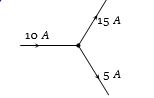
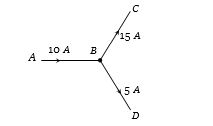
Is it possible
- ✓
- B
- C
- D
Insufficient data to reply
Answera
(a)Yes, in $AC$ if branch $AB$ has $R,\,BC$ has a capacitor $C$, and $BD$ has a pure inductance $L$
View full question & answer→MCQ 331 Mark
The $r.m.s$. voltage of the wave form shown is......$V$
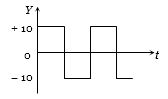
Answera
(a) ${V_{rms}} = \sqrt {\frac{1}{T}\int_0^T {{{10}^2}dt} } = 10\;V$
View full question & answer→MCQ 341 Mark
What is the $r.m.s$. value of an alternating current which when passed through a resistor produces heat which is thrice of that produced by a direct current of $2$ amperes in the same resistor......$amp$
AnswerCorrect option: C. $3.46$
c
(c) Heat produced by $ac = 3 \times$ Heat produced by $dc$
$\therefore$ $i_{rms}^2Rt = 3 \times {i^2}Rt$ ==> $l_{rms}^2 = 3 \times {2^2}$
==> ${i_{rms}} = 2\sqrt 3 = 3.46\,A$
View full question & answer→MCQ 351 Mark
The direct current which would give the same heating effect in an equal constant resistance as the current shown in figure, i.e. the $r.m.s.$ current, is.....$A$
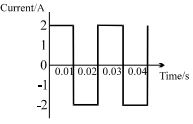
- A
$0$
- B
$\sqrt 2$
- ✓
$2$
- D
$2 \sqrt 2 $
View full question & answer→MCQ 361 Mark
The effective value of current $i = 2\, sin\, 100\, \pi\, t + 2 \,sin(100\, \pi \,t + 30^o)$ is :
View full question & answer→MCQ 371 Mark
If $I_1, I_2, I_3$ and $I_4$ are the respective $r.m.s$. values of the time varying currents as shown in the four cases $I, II, III$ and $IV$. Then identify the correct relations.

- A
$I_1 = I_2 = I_3 = I_4$
- ✓
$I_3 > I_1 = I_2 > I_4$
- C
$I_3 > I_4 > I_2 = I_1$
- D
$I_3 > I_2 > I_1 > I_4$
AnswerCorrect option: B. $I_3 > I_1 = I_2 > I_4$
View full question & answer→MCQ 381 Mark
In the circuit show below, the key $K$ is closed at $t = 0$ . The current through the battery is
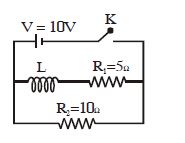
- A
$5\ A$ at $t = 0$ and $7\ A$ at $t$ = $\infty $
- B
$3\ A$ at $t = 0$ and $1\ A$ at $t$ = $\infty $
- ✓
$1\ A$ at $t = 0$ and $3\ A$ at $t$ = $\infty $
- D
$2\ A$ at $t = 0$ and $6\ A$ at $t$ = $\infty $
AnswerCorrect option: C. $1\ A$ at $t = 0$ and $3\ A$ at $t$ = $\infty $
c
at $t = 0$ $'L'$ behaves as open circuit and at $t$ = $\infty $ as short circuit
View full question & answer→MCQ 391 Mark
In an $ac$ circuit, the instantaneous voltage $e(t)$ and current $I(t)$ are given by $e(t)$ = $5[cos\ \omega t + \sqrt 3\ sin\ \omega t]\ volt$ $i (t)$ = $5[sin(\omega t +\frac {\pi}{4})]\ amp$ then
- A
Current leads voltage by $\frac {\pi}{4}$
- B
Voltage leads current by $\frac {\pi}{3}$
- C
Voltage leads current by $\frac {\pi}{6}$
- ✓
Current leads voltage by $\frac {\pi}{12}$
AnswerCorrect option: D. Current leads voltage by $\frac {\pi}{12}$
d
$\mathrm{v}=10\left[\sin \left(\omega \mathrm{t}+\frac{\pi}{6}\right)\right]$
$\mathrm{i}=5 \sin \left(\omega \mathrm{t}+\frac{\pi}{4}\right)$
$\Delta p=\frac{\pi}{4}-\frac{\pi}{6}=\frac{3 \pi-2 \pi}{12}=\frac{\pi}{12}$
View full question & answer→MCQ 401 Mark
A periodic voltage $V$ varies with time $t$ as shown in the figure. $T$ is the time period. The $r.m.s$. value of the voltage is :-
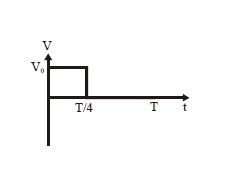
- A
$\frac{{{V_0}}}{8}$
- ✓
$\frac{{{V_0}}}{2}$
- C
${V_0}$
- D
$\frac{{{V_0}}}{4}$
AnswerCorrect option: B. $\frac{{{V_0}}}{2}$
b
Root mean square value
$ < {\rm{V}} > = \sqrt {\frac{{\int_0^{{\rm{T}}/4} {{\rm{V}}_0^2} {\rm{dt}} + \int_{{\rm{T}}/4}^{\rm{T}} {(0)} {\rm{dt}}}}{{\int_0^{\rm{T}} {dt} }}} $
$=\sqrt{\frac{V_{0}^{2}\left(\frac{T}{4}\right)}{T}}=\sqrt{\frac{V_{0}^{2}}{4}}=\frac{V_{0}}{2}$
View full question & answer→MCQ 411 Mark
For the $RC$ circuit shown, the resistance is $R = 10.0\ W$, the capacitance is $C = 5.0\ F$ and the battery has voltage $\xi= 12$ volts . The capacitor is initially uncharged when the switch $S$ is closed at time $t = 0$. At some time later, the current in the circuit is $0.50\ A$. What is the magnitude of the charge across the capacitor at that moment?.......$µC$
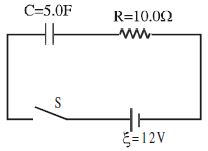
Answerd
$\mathrm{V}_{\mathrm{R}}+\mathrm{V}_{\mathrm{C}}=\xi$
$0.5 \times 10+V_{C}=12$
$\mathrm{q}=\mathrm{CV}_{\mathrm{C}}=5 \times 7=35\, \mu \mathrm{C}$
View full question & answer→MCQ 421 Mark
An alternating voltage $V = 300\sqrt 2 sin(100t)$ is connected to a $1\ \mu F$ capacitor through an $AC$ ammeter. The reading of the ammeter will be.....$mA$
- A
$10$
- ✓
$30$
- C
$30\sqrt 2$
- D
$20\sqrt 2$
Answerb
$\mathrm{i}_{0}=\frac{\mathrm{V}_{0}}{\mathrm{X}_{\mathrm{C}}}=300 \sqrt{2} \times 100 \times 10^{-6}=30 \sqrt{2} \mathrm{\,mA}$
$\mathrm{i}_{\mathrm{rms}}=\frac{i_{0}}{\sqrt{2}}$
$\mathrm{i}_{\mathrm{rms}}=30 \mathrm{\,mA}$
View full question & answer→MCQ 431 Mark
The $r.m.s.$ voltage of the wave form shown is
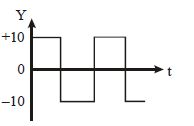
Answera
$V_{r m s}=\sqrt{\frac{1}{T} \int_{0}^{T} 10^{2} d t}=10 V$
View full question & answer→MCQ 441 Mark
The voltage of $AC$ source varies with time according to the equation, $V = 100\, \sin 100\, \pi \, t \, \cos \,100\, \pi \,t$. Where $t$ is in second and $V$ is in volt. Then:-
- A
The peak voltage of the source is $100\, volt$
- B
The peak voltage of the sourece is $(100/ \sqrt 2 )\, volt$
- ✓
the peak voltage of the source is $50\, volt$
- D
The frequency of the source is $50\, Hz$
AnswerCorrect option: C. the peak voltage of the source is $50\, volt$
c
${\rm{V}} = 100\,\,\sin 100\,\pi \,{\rm{t}}\cos 100\,\pi \,{\rm{t}}$
${\rm{V}} = 50\sin 200\,\pi \,{\rm{t}}$
Here $\mathrm{V}_{0}=50 \quad $ and $\omega = 200\,\pi \,{\rm{f}} = 100\,{\mkern 1mu} {\rm{Hz}}$
View full question & answer→MCQ 451 Mark
An alternating voltage is given by : $e = e_1\, \sin \omega t + e_2\, \cos \omega t$. Then the root mean square value of voltage is given by :-
AnswerCorrect option: D. $\sqrt {\frac{e_1^2 + e_2^2}{2}}$
d
$\mathrm{V}_{\mathrm{rms}}^{2} =\int_{0}^{\mathrm{T}} \frac{\left(\mathrm{e}_{1} \sin \omega \mathrm{t}+\mathrm{e}_{2} \cos \omega \mathrm{t}\right)^{2} \mathrm{dt}}{\mathrm{T}}$
$=\sqrt{\frac{\mathrm{e}_{1}^{2}+\mathrm{e}_{2}^{2}}{2}}$
where $\omega=\frac{2 \pi}{\mathrm{T}}$
View full question & answer→MCQ 461 Mark
In a circuit, current varies with time as $i = 2\sqrt t $ . Root mean square value of current for interval $t = 2\,s$ to $t = 4\,s$ is
AnswerCorrect option: B. $2\sqrt 3 A$
b
$\mathrm{I}^{2}=4 \mathrm{t}$
$<\mathrm{I}^{2}>=\int_{2}^{4} \mathrm{I}^{2} \mathrm{dt}=\int_{2}^{4} 4 \mathrm{t} \mathrm{dt}=\frac{4\left(4^{2}-2^{2}\right)}{2 \times 2}=12$
$\mathrm{I}_{\mathrm{rms}}=\sqrt{<\mathrm{I}^{2}>}=\sqrt{12}=2 \sqrt{3} \mathrm{\,A}$
View full question & answer→MCQ 471 Mark
The voltage of an $ac$ source varies with time according to the equation $V = 100\sin \,\left( {100\pi t} \right)\cos \,\left( {100\pi t} \right)$ where $t$ is in seconds and $V$ is in volts. Then
- A
The peak voltage of the source is $100\,volts$
- ✓
The peak voltage of the source is $50\,volts$
- C
The peak voltage of the source is $100/\sqrt 2\,volts$
- D
The frequency of the source is $50\,Hz$
AnswerCorrect option: B. The peak voltage of the source is $50\,volts$
b
$\mathrm{V}=50 \times 2 \sin (100 \pi \mathrm{t}) \cos (100 \pi \mathrm{t})$
$=50 \sin (200 \pi \mathrm{t})$
$\mathrm{V}_{\mathrm{O}}=50$ and $\omega=200 \pi$
$\mathrm{f}=\frac{\omega}{2 \pi}=\frac{200 \pi}{2 \pi}=100 \mathrm{\,Hz}$
View full question & answer→MCQ 481 Mark
The charge in an $LC$ circuit with negligible resistance oscillates as given by equation $\frac{{{d^2}q}}{{d{t^2}}} + 16{\pi ^2}q = 0$. If the charge is maxiumum equal to $24\,\mu C$ at $t = 0$, find the charge at $t = \frac{1}{{12}}\,s$............$\,\mu C$
- A
$2$
- ✓
$12$
- C
$12\sqrt 3$
- D
$0$
Answerb
From equation $\omega^{2}=16 \pi^{2} \quad \rightarrow \omega=4 \pi$
$\therefore \mathrm{q}=\mathrm{q}_{\mathrm{o}} \cos (\omega \mathrm{t})$
$=24 \cos \left(4 \pi \times \frac{1}{12}\right)$
$=24 \cos \left(\frac{\pi}{3}\right)$
$=24 \times \frac{1}{2}=12$
View full question & answer→MCQ 491 Mark
Find the effective value of current $i = 2\, sin\, 100\pi t + 2cos\,(100\pi t + 30^o)$
- A
$2\,A$
- B
$2\sqrt 2\,A$
- ✓
$\sqrt 2\,A$
- D
$4\,A$
AnswerCorrect option: C. $\sqrt 2\,A$
c
Analytically
$\mathrm{i}=2 \sin 100 \pi \mathrm{t}+2 \cos \left(100 \pi \mathrm{t}+30^{\circ}\right)$
$\Rightarrow \mathrm{i}=2 \sin 100 \pi \mathrm{t}+2 \cos 100 \pi \mathrm{tcos} 30^{\circ}$
$-2 \sin 100 \pi \operatorname{tsin} 30^{\circ}$
$\Rightarrow \mathrm{i}=\sin 100 \pi \mathrm{t}+\sqrt{3} \cos 100 \pi \mathrm{t}$
$\Rightarrow \mathrm{i}=\mathrm{I}_{\mathrm{m}} \sin (100 \pi \mathrm{t}+\phi)$
Where $I_{\operatorname{m}}=\sqrt{1+(\sqrt{3})^{2}}=2 A$
$I_{\operatorname{rms}}=\frac{I_{m}}{\sqrt{2}}=\frac{2}{\sqrt{2}}=\sqrt{2} A$
View full question & answer→MCQ 501 Mark
When a $DC$ voltage of $200\, V$ is applied to a coil of self inductance $\frac{{2\sqrt 3 }}{\pi }\,H$, a current of $1\, A$ flows through it. But by replacing $DC$ source with $AC$ source of $200\, V$, the current in the coil is reduced to $0.5\, A$. Then, the frequency of $AC$ supply is......$Hz$
Answerd
${{\rm{R}} = \frac{{\rm{V}}}{{{{\rm{I}}_1}}}}$ (for $DC$)
${{\rm{Z}} = \frac{{\rm{V}}}{{{{\rm{I}}_2}}}}$ (for $AC$)
$Z=\sqrt{R^{2}+X_{L}^{2}}$
$\mathrm{X}_{\mathrm{L}}=\omega \mathrm{L}=2 \pi \mathrm{fL}$
View full question & answer→