Question 14 Marks
Write the equation of average power for $L - C - R$ series $AC$ circuit and discuss its special cases.
Answer
View full question & answer→$\rightarrow$ Average power for $L - C - R$ series $AC$ circuit,
$P = VI \cos \phi$
$\therefore P =\frac{v_m i_m}{2} \cos \phi$
$•$ Special Cases :
$(i)$ Case $I$ : Resistive Circtuit :
$\rightarrow$ For an $AC$ circuit containing only resistance $($i.e. for purely resistive circuits$),$ so $\phi=0$
$\therefore \quad$ Average power dissipation,
$P = VI \cos \phi$
$\therefore P = VI \cos 0$
$\therefore P = VI \text { (Maximum) }$
$\rightarrow$ Thus, in the $AC$ circuit having only resistance, power dissipation is maximum.
$(ii)$ Case $II$ : Purely Inductive Or Purely Capacitive Circuit :
$\rightarrow$ If the circuit is purely inductive or purely capacitive, phase difference between voltage and current is $\frac{\pi}{2}$.
$\rightarrow$ Therefore, average power dissipated in circuit is :
$P = VI \cos \phi$
$\therefore P = VI \cos \frac{\pi}{2}$
$\therefore P =0$
$\rightarrow$ Thus, eventhough a current is flowing in the circuit, power dissipated is zero.
$\rightarrow$ Such a current is referred to as Wattless Current .
$(iii)$ Case $IIII: L - C - R$ Series Circuit:
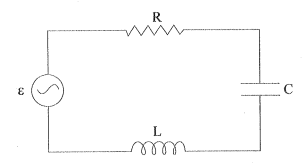
$\rightarrow$ In an $L - C - R$ series circuit, power dissipated is as per,
$P = VI \cos \phi$
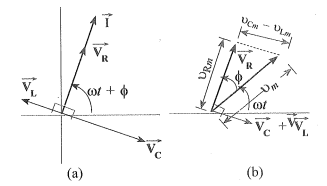
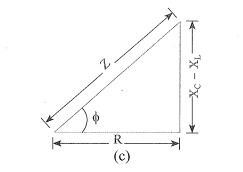
Where, $\phi=\tan ^{-1}\left(\frac{ X _{ C }- X _{ L }}{ R }\right)$
$\rightarrow$ So, $\phi$ may be non zero in a $RL$ or $RC$ or $\text{RCL}$ circuit, Even in such cases, power is dissipated only in the resistor.
$(iv)$ Case $IV$ : Power dissipated at Resonance in $L-C-R$ Circuit :
$\rightarrow$ At resonance, $X _{ C }= X _{ L }$ and $\phi=0$ so $\cos \phi=1$
$\rightarrow$ Therefore, power dissipated in circuit.
$P = VI \cos \phi$
$P = VI \text { (Maximum) }$
$\rightarrow$ Thus, maximum power is dissipated in a circuit $($through $R)$ at Resonance.
$P = VI \cos \phi$
$\therefore P =\frac{v_m i_m}{2} \cos \phi$
$•$ Special Cases :
$(i)$ Case $I$ : Resistive Circtuit :
$\rightarrow$ For an $AC$ circuit containing only resistance $($i.e. for purely resistive circuits$),$ so $\phi=0$
$\therefore \quad$ Average power dissipation,
$P = VI \cos \phi$
$\therefore P = VI \cos 0$
$\therefore P = VI \text { (Maximum) }$
$\rightarrow$ Thus, in the $AC$ circuit having only resistance, power dissipation is maximum.
$(ii)$ Case $II$ : Purely Inductive Or Purely Capacitive Circuit :
$\rightarrow$ If the circuit is purely inductive or purely capacitive, phase difference between voltage and current is $\frac{\pi}{2}$.
$\rightarrow$ Therefore, average power dissipated in circuit is :
$P = VI \cos \phi$
$\therefore P = VI \cos \frac{\pi}{2}$
$\therefore P =0$
$\rightarrow$ Thus, eventhough a current is flowing in the circuit, power dissipated is zero.
$\rightarrow$ Such a current is referred to as Wattless Current .
$(iii)$ Case $IIII: L - C - R$ Series Circuit:
$\rightarrow$ In an $L - C - R$ series circuit, power dissipated is as per,
$P = VI \cos \phi$
Where, $\phi=\tan ^{-1}\left(\frac{ X _{ C }- X _{ L }}{ R }\right)$
$\rightarrow$ So, $\phi$ may be non zero in a $RL$ or $RC$ or $\text{RCL}$ circuit, Even in such cases, power is dissipated only in the resistor.
$(iv)$ Case $IV$ : Power dissipated at Resonance in $L-C-R$ Circuit :
$\rightarrow$ At resonance, $X _{ C }= X _{ L }$ and $\phi=0$ so $\cos \phi=1$
$\rightarrow$ Therefore, power dissipated in circuit.
$P = VI \cos \phi$
$P = VI \text { (Maximum) }$
$\rightarrow$ Thus, maximum power is dissipated in a circuit $($through $R)$ at Resonance.