Questions

3 Marks Question

🎯

Test yourself on this topic

13 questions · timed · auto-graded

Question 13 Marks
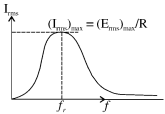
Draw a graph showing change of alternating current with frequency in LCR series resonant circuit and obtain expression for bandwidth.
Answer
Graph
Image
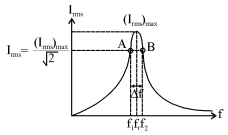
Half Power Points or Frequencies : In the graph drawn between $I_{r m s}$ and frequency in a series $R-L-C$ circuit, two frequencies $f_1$ and $f_2$ are obtained on either side of the resonant frequency $f$ such that the value of current at these two frequencies is $\frac{1}{\sqrt{2}}$ times of its maximum value or power dissipation is half of its resonance value. These frequencies are known as half power frequencies and the points A and B corresponding to these frequencies are known as half power points.
Image
Bandwidth : $\beta=\Delta f$ The difference of the frequencies corresponding to points A and B is known as bandwidth of series resonant circuit.
Bandwidth $\beta=\Delta f=f_2-f_1$.
View full question & answer
Question 23 Marks
Why alternating current of 220 V is more dangerous than direct current of 220 V ?
Answer
Generally, in our house holds alternating current flows at 220 V . It means that root mean square value of the voltage is 220 V .
Hence, its peak value will be
$E _0=\sqrt{2} \times E _{ rmf }$
$=\sqrt{2} \times 220=1.414 \times 220$
or $E_0=311 V$
It can be said that voltage of ac flowing in our houses changes from +311 volts to -311 volts in one cycle.
Maximum change in alternating voltage in one complete cycle is 622 V . This is the reason that ac of 220 V is more dangerous than the dc of 220 V .
View full question & answer
Question 33 Marks
State difference between the working and non-working current.
Answer
When an alternating potential is applied to an impedance circuit, then there is phase difference between alternating current passing through the circuit and alternating voltage applied on the circuit. If root mean square value of the current is $I _{ rms }$ and the phase dfference between potential and current is $\phi$, then there are two components of current along the direction of potential and perpendicular to the direction of potential $I _{ rma } \cos \phi$ and $I _{ rms } \sin \phi$ respectively. The component of alternating current which is in the direction of alternating potential that is $I _{ rms } \cos \phi$, which does the wrok of passing through the circuit is known as working current.
The component of alternating current which is perpendicular to the applied alternating voltage that is $I _{ rms } \sin \phi$, does not do any work while passing through the circuit and this component is known as workless current.
View full question & answer
Question 43 Marks
Write the difference between alternating current and voltage.
Answer
When a coil is rotated rapidly in a strong magnetic field, then there is continuous change in the flux linked with the coil due to which an emf is induced in the coil and induced current flows. Direction and magnitude of both emf and current changes with rotation of the coil and these types of voltage and current is known as alternating voltage and alternating current.
Instantaneous values of alternating voltage is given by the expressions
$E = E _0 \sin (\omega t+\phi)$
or $E = E _0 \cos (\omega t+\phi)$
Here E is instantaneous value, $E _0$ is peak value $=$ $NB \omega A$ and $(\omega t+\phi)$ is the phase.
In the same way, instantaneous values of alternating current is given by the expressions
$I=I_0 \sin (\omega t+\phi)$
or $I = I _0 \cos (\omega t +\phi)$
$I = instantaneous$ value, $I _0=$ peak value and its value is $\frac{ N \omega BA }{ R }$.
Where R is the resistance of the coil.
View full question & answer
Question 53 Marks
Potential at an instant $t$ in an ac circuit is $E=200 \sin 157 t . \cos 157 t$ volts and current is $I=\sin \left(314 t+\frac{\pi}{3}\right) \quad$ Amperes. In this condition calculate :
(a) frequency
(b) root mean square value of voltage
(c) impedance of the circuit
(d) power factor.
Answer
Given that,
$E =200 \sin 157 t \cdot \cos 157 t$
$E =100 \times 2 \sin 157 t \cdot \cos 157 t$
$E =100 \sin 2 \times 157 t$
$E =100 \sin 314 t$ volts
(a) Frequency, $f=\frac{\omega}{2 \pi}=\frac{314}{2 \times 3.14}$
$f=50 Hertz$
(a) $\quad E _{\text {r.m.s. }}=\frac{ E _0}{\sqrt{2}}=0.707 \times 100=70.7 V$
$\begin{aligned} I_{\text {r.m.s. }} & =\frac{I_0}{\sqrt{2}}=0.707 \times 1 \\ & =0.707 A\end{aligned}$
(c) Impedance of the circuit
$Z=\frac{E_{r . m s}}{I_{r, m} . s .}=\frac{70.7}{0.707}$
$=\frac{707 \times 1000}{707 \times 10}$
$Z =100 ohm$
(d) Power factor $=\cos \phi$
$=\cos 60^{\circ}=\frac{1}{2}=0.5 \quad$
View full question & answer
Question 63 Marks
Power factor of a coil in an ac circuit at 60 hertz frequency is 0.707 . If frequency of ac source becomes 120 hertz, then what will be power factor?
Answer
We know that,
$\cos \phi=\frac{ R }{ Z }=\frac{ R }{\sqrt{ R ^2+ X _{ L }^2}}$
On squaring both sides,
$\cos ^2 \phi=\frac{ R ^2}{ R ^2+ X _{ L }^2}$
Again, $\quad \cos \phi=0.707$
$\therefore \quad(0.707)^2=\frac{ R ^2}{ R ^2+ X _{ L }^2}$
$0.5=\frac{ R ^2}{ R ^2+ X _{ L }^2}$
$\Rightarrow \quad 0.5 R ^2+0.5 X _{ L }^2= R ^2$
$\Rightarrow \quad 0.5 R ^2=0.5 X _{ L }^2$
$\therefore \quad R ^2= X _{ L }{ }^2 \quad \therefore R = X _{ L }$
Again, $\quad \cos \phi^{\prime}=\frac{ R }{\sqrt{ R ^2+\left( X _{ L }{ }^{\prime}\right)^2}}$
But given $\quad X_L{ }^{\prime}=2 R$
$\because$ Now value of frequency becomes double.
$X _{ L }{ }^{\prime}=2 R$
$\therefore \quad \cos \phi^{\prime}=\frac{ R }{\sqrt{( R )^2+(2 R )^2}}=\frac{ R }{\sqrt{5 R ^2}}$
$\cos \phi^{\prime}=\frac{1}{\sqrt{5}}=\frac{\sqrt{5}}{5}$
$\cos \phi^{\prime}=0.447$
$\therefore$ Power factor $\cos \phi^{\prime}=0.447$
View full question & answer
Question 73 Marks
At what time $t$ will the magnitude of sinusoidal alternating current will be (i) $1 / 2$ (ii) $\frac{1}{\sqrt{2}}$ times of its peak value?
Answer
Let at time $t _1$ magnitude of sinusoidal alternating current be half of its peak value
$I =\frac{ I _0}{2}= I _0 \sin \omega t_1$
or $\frac{1}{2}=\sin \omega t_1 \Rightarrow \sin \frac{\pi}{6}=\sin \omega t_1$
or $\omega t_1=\frac{\pi}{6} \quad \Rightarrow \quad t_1=\frac{\pi}{6 \omega}$
$t_1=\frac{\pi}{2 \pi f \times 6}=\frac{ T }{12}$ second
In the same way, let at time magnitude of sinusoidal alternating current be $I=\frac{I_0}{\sqrt{2}}$ of its peak value.
$\frac{ I _0}{\sqrt{2}}= I _0 \sin \omega t_2$
or $\frac{1}{\sqrt{2}}=\sin \omega t_2 \quad \Rightarrow \sin \omega t_2=\sin \frac{\pi}{4}$
or $\omega t_2=\frac{\pi}{4}$ or $t_2=\frac{\pi}{40}$
$t_2=\frac{\pi}{4 \times 2 \pi f}=\frac{ T }{8} \sec . \quad \because \frac{1}{f}= T$.
View full question & answer
Question 83 Marks
An electric bulb is marked $220 V, 100 W$. Calculate : (i) resistance of the bulb (ii) peak voltage of the source (iii) rms current flowing through the bulb.
Answer
Given : $E=220 V $ , $P =100 W$
Resistance of the bulb $\quad R=$ ?
Peak voltage $E _0=$ ?
r.m.s. current $I _{ rms }=$ ?
(a) $P=E \times I=E \times \frac{E}{R}=\frac{E^2}{R} $
$\therefore \quad R =\frac{ E ^2}{ P }=\frac{220 \times 220}{100}$
$R =484 \Omega$
(b) Peak voltage of the source
$E _0=\sqrt{2} E =1.414 \times 220$
$\cong 311.08$ V $\cong 311$ V
(c) $\quad \because I$ or $I _{ mms }=\frac{ P }{ E }$
$I =\frac{100}{220}=0.455 A$
View full question & answer
Question 93 Marks
A capacitor and a resistor are joined in series with an ac source. If voltage across the ends of $C$ and $R$ be 120 V and 90 V respectively and root mean square value of current is 3 A , then calculate (i) impedance (ii) power factor of the circuit.
Answer
(i) Given: $V _{ C }=120 V, V _{ R }=90 V$.
$I _{ rms }=3 A$
(i) $\quad V _{ rns }=\sqrt{ V _{ R }^2+ V _{ C }^2}$
$=\sqrt{(120)^2+(90)^2}$
$=\sqrt{14400+8100}=\sqrt{22500}$
$=150 V$
$V _{ rms }=150 V$ or $E _{ rms }=150 V$
$\therefore \quad Z=\frac{E_{r m s}}{I_{ rms }}=\frac{150}{3}=50 \Omega$
(ii) Power factor $\cos \phi=\frac{ V _{ R }}{ V _{ rms }}=\frac{90}{150}=0.6$
View full question & answer
Question 103 Marks
An ac circuit is made from series combination of components of circuits X and Y . Current is ahead of voltage by $\frac{\pi}{4}$. If component $X$ is pure resistor whose value is $100 \Omega$ then (i) what is the name of component $Y$ ? (ii) If root mean square value of voltage is 141 V , then find the root mean square value of the current.
Answer
(i) In series combination of $X - Y , X$ is a pure resistor and current is ahead of voltage by a phase difference of $\frac{\pi}{4}$, then circuit $Y$ is a capacitor.
(ii) $\quad \cos \phi=\frac{ R }{ Z } \Rightarrow Z=\frac{ R }{\cos \phi}$
Impedance, $Z=\frac{100}{\cos \frac{\pi}{4}}=\frac{100}{\frac{1}{\sqrt{2}}}=100 \sqrt{2}$ ohm
then $\quad I _{ rms }=\frac{ E _{ mss }}{ Z }=\frac{141}{100 \sqrt{2}}$
$=\frac{141}{100 \times 1.414} \simeq 1$ Amp.
View full question & answer
Question 113 Marks
An ac genrator is made from area of cross section $3 m^2$ and a coil of 100 turns which is rotated by a constant angular velocity of $60 rad / s$ in a magnetic field of 0.04 T . Resistance of the coil is $500 \Omega$ Calculate: (i) maxumum current obtained from the generator and (ii) maximum power dissipated in the coil.
Answer
$A=3 m^2, N=100 $
$B=0.04 T, \omega=60 rad / s$
$R =500 ohm$
(i) Maximum current obtained from the generator
$I_0=\frac{E_0}{R}=\frac{N B A \omega}{R}$
$=\left(\frac{100 \times 0.04 \times 3 \times 60}{500}\right)$ ampere
= 1.44 ampere
(ii) Maximum power dissipated
$\overline{ P }= E _{ rms } I _{ rms } \cos \phi$
$(\overline{ P })_{\max }= E _{ rms } I _{ rms } \quad($ when $\cos \phi=1)$
$\therefore \quad(\overline{ P })_{\max }= E _{ rms } \times I _{ rms }=\frac{ E _0}{\sqrt{2}} \times \frac{ I _0}{\sqrt{2}}$
$=\frac{ I _0 R \times I _0}{2}=\frac{1}{2} I _0^2 R$
Hence, $\quad\left(\overline{ P }_{\max }=\frac{(1.44)^2 \times 500}{2} W\right.$
$=518.4 W$ 
View full question & answer
Question 123 Marks
A resistor of $12 \Omega$, a capacitor of $14 \Omega$ reactance and a pure inductor of inductance 0.1 H are joined in series and an alternating current of 200 V, 50 Hz is joined with them. Compute: (i) current in the circuit and (ii) phase angle between current and the voltage (Take $\pi=3$ ).
Answer
Given : $R =12 \Omega, X _{ C }=14 \Omega, L=0.1$ henry
$E _{ rms }=200 volt$
$f=50 Hz$
$\therefore \quad X _{ L }=2 \pi / L =2 \times 3 \times 50 \times 0.1$ $=30 \Omega$
$\therefore$ Impedance, Z of the circuit
$Z =\sqrt{ R ^2+\left( X _{ L }- X _{ C }\right)^2}$
$Z=\sqrt{(12)^2+(30-14)^2}$
$=\sqrt{144+256}=\sqrt{400}=20 \Omega$
(i) Current in the circuit,
$I_{\text {rms }}=\frac{E_{\text {mus }}}{Z}=\frac{200}{20}$ $=10 A$
(ii) $\quad \tan \phi=\frac{ X _{ L }- X _{ C }}{ R }=\frac{30-14}{12}=\frac{16}{12}$
$\phi=\tan ^{-1}\left(\frac{4}{3}\right)$
Resultant voltage will be ahead of current by an angle of $\tan ^{-1}\left(\frac{4}{3}\right)$.
View full question & answer
Question 133 Marks
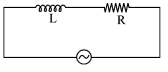
In the given figure, voltage across the ends of inductor ( L ) and resistor ( R ) is 120 V and 90 V respectively. The root mean square value of the current is 3 A. Calculate :
(i) impedance of the circuit and (ii) phase difference between voltage and current.
Image
Answer
(i) Given :
$V=\sqrt{V_R^2+V_L^2}$
$=\sqrt{(90)^2+(120)^2}$
$=\sqrt{8100+14400}$
$=\sqrt{22500}$ $=150 Volt$
$V _{ L }=120$ volt, $V _{ R }=90 volt$
and current $I=3$ , Impedance $Z =$ ? , Phase difference $\phi=$ ?
$\therefore$ Impedance of the circuit,
$Z=\frac{V}{I}=\frac{150}{3}=50$ ohm
(ii) If phase difference between voltage and current is $\phi$, then
$\tan \phi=\frac{ V _{ L }}{ V _{ R }}=\frac{120}{90}=\frac{4}{3}$
$\phi=\tan ^{-1}\left(\frac{4}{3}\right) \cdot$ 
View full question & answer
3 Marks Question - Physics STD 12 Science Questions - Vidyadip