MCQ 11 Mark
A photodetector is made from a semiconductor In$ 0.53$ $Ga$ $0.47$ As with $E_g = 0.73 \,eV$. What is the maximum wavelength, which it can detect.........$nm$
- A
$1000$
- ✓
$1703$
- C
$500$
- D
$173$
AnswerCorrect option: B. $1703$
b
(b) Limiting value of hv is $Eg$ , such that $h\nu = \frac{{hc}}{\lambda } = {E_g}$
or $\lambda = \frac{{hc}}{{{E_g}}}$
$ = \frac{{6.63 \times {{10}^{ - 34}}J{\rm{ - }}s \times 3 \times {{10}^8}m{s^{ - 1}}}}{{0.73 \times 1.6 \times {{10}^{ - 19}}J}}$
$= 1703\, nm$
View full question & answer→MCQ 21 Mark
A transmitter supplies $9 \,kW$ to the aerial when unmodulated. The power radiated when modulated to $40\%$ is........$kW$
AnswerCorrect option: B. $9.72$
b
(b) ${P_t} = {P_c}\,\left[ {1 + \frac{{{m^2}}}{2}} \right] = 9\,\left[ {1 + \frac{{{{(0.4)}^2}}}{2}} \right]$
$= 9\,\left[ {1 + \frac{{0.16}}{2}} \right]$ $( m = 40\% = 0.4)$
$= 9 (1.08) = 9.72\, kW$
View full question & answer→MCQ 31 Mark
The total power content of an $AM$ wave is $1500\, W.$ For $100\%$ modulation, the power transmitted by the carrier is........$W$
- A
$500$
- B
$700$
- C
$750$
- ✓
$1000$
AnswerCorrect option: D. $1000$
d
(d) $\frac{{{P_t}}}{{{P_c}}} = 1 + \frac{{{m^2}}}{2}$ or ${P_c} = {P_t}\left[ {\frac{2}{{2 + {m^2}}}} \right]$
$\therefore {P_c} = 1500\,\left[ {\frac{2}{{2 + 1}}} \right]$ $m = 100\% = 1$
$= 1000 \,W$
View full question & answer→MCQ 41 Mark
The total power content of an $AM$ wave is $ 900\, W$. For $100\%$ modulation, the power transmitted by each side band is......$W$
Answerc
(c) ${P_c} = {P_t}\,\left[ {\frac{2}{{2 + {m^2}}}} \right] = 900\,\left[ {\frac{2}{{2 + 1}}} \right] = 600\,W$
Now, ${P_{LSB}} = \frac{{{m^2}}}{4} \times {P_c} = \frac{1}{4} \times 600 = 150\,W$
View full question & answer→MCQ 51 Mark
The modulation index of an $FM$ carrier having a carrier swing of $200\, kHz$ and a modulating signal $10\, kHz$ is
Answerb
(b) $CS = 2×\Delta$ or $\Delta$ $f = CS/2$
$\therefore \Delta f = \frac{{200}}{2} = 100\,kHz$
Now ${m_f} = \frac{{\Delta f}}{{{f_m}}} = \frac{{100}}{{10}} = 10$
View full question & answer→MCQ 61 Mark
A $500\, Hz$ modulating voltage fed into an $FM$ generator produces a frequency deviation of $2.25 \,kHz$. If amplitude of the voltage is kept constant but frequency is raised to $6\, kHz$ then the new deviation will be.......$kHz$
Answerb
(b) ${m_f} = \frac{\delta }{{{f_m}}} = \frac{{2250}}{{500}} = 4.5$
$\therefore$ New deviation $ = 2({m_f}\,{f_m}) = 2 \times 4.5 \times 6 = 54\,kHz.$
View full question & answer→MCQ 71 Mark
The bit rate for a signal, which has a sampling rate of $8 \,kHz$ and where $16 $ quantisation levels have been used is.........$bits/sec$
- ✓
$32000 $
- B
$16000$
- C
$64000$
- D
$72000$
AnswerCorrect option: A. $32000 $
a
(a) If n is the number of bits per sample, then number of quantisation level $= 2n$
Since the number of quantisation level is $16$
$⇒ 2n = 16 ⇒ n = 4$
$\therefore$ bit rate = sampling rate $×$ no. of bits per sample
$= 8000 × 4 = 32,000\, bits/sec.$
View full question & answer→MCQ 81 Mark
In $AM$ , the centpercent modulation is achieved when
- ✓
Carrier amplitude $=$ signal amplitude
- B
Carrier amplitude $\neq$ signal amplitude
- C
Carrier frequency $=$ signal frequency
- D
Carrier frequency $\neq$ signal frequency
AnswerCorrect option: A. Carrier amplitude $=$ signal amplitude
a
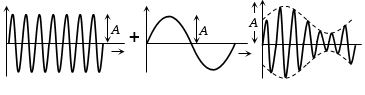
(a) When signal amplitude is equal to the carrier amplitude, the amplitude of carrier wave varies between $2A$ and zero.
${m_a} = \frac{{{\rm{Amplitude \,charge\, of\, carrier}}}}{{{\rm{Amplitude\, of \,normal \,carrier}}}} = \frac{{2A - A}}{A} \times 100 = 100\% $
View full question & answer→MCQ 91 Mark
A ground receiver station is receiving a signal at $(i)$ $5\, MHz$ and transmitted from a ground transmitter at a height of $300\, m$, located at a distance of $100\, km$ from the receiver station. The signal is coming via. Radius of earth $= 6.4 \times 10^6\, m$. Nmax of isosphere = $10^{12} m_3$
Answerb
(b) Maximum distance covered by space wave communication $\sqrt {2Rh} = 62\,km$
Critical frequency =${f_c} = 9{({N_{\max }})^{1/2}}\tilde --9\,MHz$
$5\, MHz < fc$, sky wave propagation (ionospheric propagation)
View full question & answer→MCQ 101 Mark
In the given detector circuit, the suitable value of carrier frequency is
- ✓
$<< 109\, Hz$
- B
$<< 105\, Hz$
- C
$>> 109\, Hz$
- D
AnswerCorrect option: A. $<< 109\, Hz$
a
(a) Using $\frac{1}{{{f_{carrier}}}} < < RC$
We get time constant, $RC = 1000 \times {10^{ - 12}} = {10^{ - 9}}s$
Now $\nu = \frac{1}{T} = \frac{1}{{{{10}^{ - 9}}}} = {10^9}Hz$
Thus the value of carrier frequency should be much less than ${10^9}Hz,$ say $100 \,kHz$.
View full question & answer→MCQ 111 Mark
An optical fibre communication system works on a wavelength of $1.3 \mu m$. The number of subscribers it can feed if a channel requires $20\, kHz$ are
- A
$2.3 \times 10^{10}$
- ✓
$1.15 \times 10^{10}$
- C
$1 \times 10^{5}$
- D
AnswerCorrect option: B. $1.15 \times 10^{10}$
b
(b) Optical source frequency $f = \frac{c}{\lambda } = \frac{{3 \times {{10}^8}}}{{1.3 \times {{10}^{ - 6}}}} = 2.3 \times {10^{14}}Hz$
$\therefore$ Number of channels or subscribers $ = \frac{{2.3 \times {{10}^{14}}}}{{20 \times {{10}^3}}}$
= $1.15 \times 10^{10}$
View full question & answer→MCQ 121 Mark
In a radio receiver, the short wave and medium wave stations are tuned by using the same capacitor but coils of different inductance $L_s$ and $L_m$ respectively then
- A
$L_s > L_m$
- ✓
$L_s < L_m$
- C
$L_s = L_m$
- D
AnswerCorrect option: B. $L_s < L_m$
b
(b) As $\nu = \frac{c}{\lambda }$ ==> ${\nu _m} = \frac{c}{{{\lambda _m}}}$ and ${\nu _s} = \frac{c}{{{\lambda _s}}}$
$\because$ ( ${\lambda _m} > {\lambda _s}$ ==> ${\nu _m} < {\nu _s}$
Also ${\nu _m} = \frac{1}{{2\pi \sqrt {{L_m}C} }}$ and ${\nu _s} = \frac{1}{{2\pi \sqrt {{L_s}C} }}$
==> $\frac{{{\nu _m}}}{{{\nu _s}}} = \sqrt {\frac{{{L_s}}}{{{L_m}}}} $ ==> $Ls < Lm.$
View full question & answer→MCQ 131 Mark
A transmitter transmits a power of $10\, kW$ when modulation is $50\%$. Power of carrier wave is.......$kW$
AnswerCorrect option: B. $8.89$
b
(b) ${P_c} = \frac{P}{{\left( {1 + \frac{{m_a^2}}{2}} \right)}} = \frac{{10000}}{{\left( {1 + \frac{{{{(0.5)}^2}}}{2}} \right)}} = \frac{{10000}}{{1.125}} = 8.89\,kW$
View full question & answer→MCQ 141 Mark
A telephone link operating at a central frequency of $10\, GHz$ is established. If $1\%$ of this is available then how many telephone channel can be simultaneously given when each telephone covering a band width of $5\, kHz$
- ✓
$2 \times 10^4$
- B
$2 \times 10^6$
- C
$5 \times 10^4$
- D
$5 \times 10^6$
AnswerCorrect option: A. $2 \times 10^4$
a
(a) $1\%$ of $10\, GHz$ = $10 \times {10^9} \times \frac{1}{{100}} = {10^8}Hz$
Number of channels $ = \frac{{{{10}^8}}}{{5 \times {{10}^3}}} = 2 \times {10^4}$
View full question & answer→MCQ 151 Mark
The velocity factor of a transmission line $x$ . If dielectric constant of the medium is $2.6$, the value of $x$ is
- A
$0.26$
- ✓
$0.62$
- C
$2.6$
- D
$6.2$
AnswerCorrect option: B. $0.62$
b
(b) $v.f. = \frac{1}{{\sqrt k }} = \frac{1}{{\sqrt {2.6} }} = 0.62$
View full question & answer→MCQ 161 Mark
A laser beam of pulse power $10^{12}$ watt is focussed on an object are $10^{-4} cm^2$. The energy flux in $ watt/ cm^{2}$ at the point of focus is
- A
$10^{20}$
- ✓
$10^{16}$
- C
$10^8$
- D
$10^4$
AnswerCorrect option: B. $10^{16}$
b
(b) The energy flux $\varphi = \frac{{{\rm{Pulse power }}}}{{{\rm{Area }}}} = \frac{{{{10}^{12}}}}{{{{10}^{ - 4}}}} = {10^{16}}\frac{W}{{c{m^2}}}$
View full question & answer→MCQ 171 Mark
The carrier frequency generated by a tank circuit containing $1 \,nF$ capacitor and $10 \mu H$ inductor is
- A
$1592 \,Hz$
- B
$1592\, MHz$
- ✓
$1592\, kHz$
- D
$159.2 \,Hz$
AnswerCorrect option: C. $1592\, kHz$
c
(c) $\nu = \frac{1}{{2\pi \sqrt {LC} }} = \frac{1}{{2 \times 3.14\sqrt {10 \times {{10}^{ - 6}} \times 1 \times {{10}^{ - 9}}} }}$
$= 1592 \,kHz$
View full question & answer→MCQ 181 Mark
Maximum useable frequency $(MUF)$ in $F$ -region layer is $x$ , when the critical frequency is $60 \,MHz$ and the angle of incidence is $70°$. Then $x$ is.......$MHz$
- A
$50 $
- B
$170$
- ✓
$175 $
- D
$190$
AnswerCorrect option: C. $175 $
c
(c) $MUF = \frac{{{f_c}}}{{\cos \theta }} = \frac{{60}}{{\cos 70^\circ }} = 175\,MHz$
View full question & answer→MCQ 191 Mark
An oscillator is producing $FM$ waves of frequency $2 kHz$ with a variation of $10 kHz$ . What is the modulating index
Answerb
(b) The formula for modulating index is given by
${m_f} = \frac{\delta }{{{\nu _m}}} = \frac{{{\rm{Frequency \,variation\, }}}}{{{\rm{Modulating \,frequency\,,}}}} = \frac{{10 \times {{10}^3}}}{{2 \times {{10}^3}}} = 5$
View full question & answer→MCQ 201 Mark
The maximum peak to peak voltage of an $AM$ wire is $24 \,mV$ and the minimum peak to peak voltage is $8\, mV$. The modulation factor is.....$\%$
Answerd
(d) Here, ${V_{\max }} = \frac{{24}}{2} = 12\,mV$ and ${V_{\min }} = \frac{8}{2} = 2\,mV$
Now, $m = \frac{{{V_{\max }} - {V_{\min }}}}{{{V_{\max }} + {V_{\min }}}} = \frac{{12 - 4}}{{12 + 4}} = \frac{8}{{16}} = \frac{1}{2} = 0.5 = 50\% $
View full question & answer→MCQ 211 Mark
Sinusoidal carrier voltage of frequency $1.5 \,MHz$ and amplitude $50\, V$ is amplitude modulated by sinusoidal voltage of frequency $10\, kHz$ producing $50\% $ modulation. The lower and upper side-band frequencies in $kHz$ are
- ✓
$1490, 1510$
- B
$1510, 1490$
- C
$\frac{1}{{1490}},\frac{1}{{1510}}$
- D
$\frac{1}{{1510}},\frac{1}{{1490}}$
AnswerCorrect option: A. $1490, 1510$
a
(a) Here, ${f_c} = 1.5\,MHz = 1500\,kHz,$${f_m} = = 10\,kHz$
Low side band frequency
$ = {f_c} - {f_m} = 1500\,kHz - 10\,kHz = 1490\,kHz$
Upper side band frequency
$ = {f_c} + {f_m} = 1500\,kHz + 10\,kHz = 1510\,kHz$
View full question & answer→MCQ 221 Mark
An $AM$ wave has $1800\, watt$ of total power content, For $100%$ modulation the carrier should have power content equal to......$watt$
- A
$1000$
- ✓
$1200$
- C
$1500$
- D
$1600$
AnswerCorrect option: B. $1200$
b
(b) ${P_t} = {P_c}\left( {1 + \frac{{m_a^2}}{2}} \right)\,;$ Here $m_a = 1$
==> $1800 = {P_c}\left( {1 + \frac{{{{(1)}^2}}}{2}} \right)$
==> ${P_c} = 1200W$
View full question & answer→MCQ 231 Mark
Advantage of optical fibre
- A
High bandwidth and $EM$ interference
- B
Low bandwidth and $EM$ interference
- C
High band width, low transmission capacity and no $EM$ interference
- ✓
High bandwidth, high data transmission capacity and no $EM$ interference
AnswerCorrect option: D. High bandwidth, high data transmission capacity and no $EM$ interference
d
(d) Few advantages of optical fibres are that the number of signals carried by optical fibres is much more than that carried by the Cu wire or radio waves. Optical fibres are practically free from electromagnetic interference and problem of cross talks whereas ordinary cables and microwave links suffer a lot from it.
View full question & answer→MCQ 241 Mark
Audio signal cannot be transmitted because
- A
The signal has more noise
- B
The signal cannot be amplified for distance communication
- C
The transmitting antenna length is very small to design
- ✓
The transmitting antenna length is very large and impracticable
AnswerCorrect option: D. The transmitting antenna length is very large and impracticable
d
(d) Following are the problems which are faced while transmitting audio signals directly.
$(i)$ These signals are relatively of short range.
$(ii)$ If every body started transmitting these low frequency signals directly, mutual interference will render all of them ineffective.
$(iii)$ Size of antenna required for their efficient radiation would be larger $i.e$. about $75 km.$
View full question & answer→MCQ 251 Mark
Consider telecommunication through optical fibres. Which of the following statements is $NOT$ true ?
- A
Optical fibres can be of graded refractive index
- ✓
Optical fibres are subjected to electromagnetic interference from outside
- C
Optical fibres have extremely low transmission loss
- D
Optical fibres may have homogeneous core with a suitable cladding
AnswerCorrect option: B. Optical fibres are subjected to electromagnetic interference from outside
b
Some of the characteristics of an optical fibre are as follows
$(i)$ This works on the principle of total internal reflection.
$(ii$) It consists of core made up of glass/silica/ plastic with refractive index $n_1$ , which is surrounded by a glass or plastic cladding with refractive index $n_2 (n_2 > n_1)$ . The refractive index of cladding can be either changing abruptly or gradually changing (graded index fibre).
$(ii$i) There is a very little transmission loss through optical fibres.
$(iv$) There is no interference from stray electric and magnetic field to the signals through optical fibres.
View full question & answer→MCQ 261 Mark
Choose the correct statement
- A
While watching television by means of an antenna, a passing nearby aeroplane can produce wavering ghost images in the television picture
- B
Solar cells are often coated with a transparent thin film, such as silicon monoxide $(SiO)$ to minimize reflective losses.
- C
Glass lenses used in cameras and other optical instruments are usually coated with a transparent thin film, such as magnesium fluoride $\left( MgF _2\right)$ to reduce or eliminate unwanted reflection
- ✓
View full question & answer→MCQ 271 Mark
Why a $DVD$ stores almost $30$ times more information than a $CD$?
- ✓
$DVD$ uses shorter - wavelength lasers of $6350 \,\mathring A$ but $CD$ uses an infrared laser of $7800 \,\mathring A$
- B
$CD$ uses shorter wavelength laser compared to a $DVD$
- C
$CD$ works on the principle of diffraction
- D
$DVD$ works on diffraction of light
AnswerCorrect option: A. $DVD$ uses shorter - wavelength lasers of $6350 \,\mathring A$ but $CD$ uses an infrared laser of $7800 \,\mathring A$
a
(a)
We know that two separate wave front originating from two whereas sources produce interference,Secondary wavelets originating from different parts of same wave front constitute diffraction. So given statement on option $(A)$ is valid.
View full question & answer→MCQ 281 Mark
The intensity of light from a continuously emitting laser source operating at $638 \,nm$ wavelength is modulated at $1 \,GHz$. The modulation is done by momentarily cutting the intensity off with a frequency of $1 \,GHz$. What is the farthest distance apart two detectors can be placed in the line of the laser light, so that they can see the portions of the same pulse simultaneously?
(Consider the speed of light in air $3 \times 10^{8} \,m / s$ )
- A
$30 \,\mu m$
- ✓
$30 \,cm$
- C
$3 \,m$
- D
$30 \,m$
AnswerCorrect option: B. $30 \,cm$
b
$(b)$ Given, $\lambda=638 \,nm$
$f=1 GHz =1 \times 10^{9} \,Hz$
and $c=3 \times 10^{8} \,m / s$
Distance travelled by laser between two detector,
$D =\frac{c}{f}=\frac{3 \times 10^{8}}{1 \times 10^{9}}=0.3 \,m =30 \,cm$
This is the farthest distance between two detector, so that they can see the same pulse simultaneously.
View full question & answer→MCQ 291 Mark
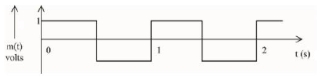
A modulating signal is a square wave, as shown in the figure.
If the carrier wave is given as $c ( t )=2 \sin (8 \pi t )$ volts, the modulation index is:
Answerd
Modulation index
$=\frac{\text { Amplitude of mod ulating signal }}{\text { Amplitude of carrier wave }}$
$\mu=\frac{1}{2}$
$=0.5$
View full question & answer→MCQ 301 Mark
Match List $I$ with List $II$
| LIST$-I$ |
LIST$-II$ |
| $A$ $AM$ Broadcast |
$I$ $88-108\,MHz$ |
| $B$ $FM$ Broadcast |
$II$ $540-1600\,kHz$ |
| $C$ Television |
$III$ $3.7-4.2\,GHz$ |
| $D$ Satellite Communication |
$IV$ $54\,MHz-590\,MHz$ |
Choose the correct answer from the options given below:
- ✓
$A-II, B-I, C-IV, D-III$
- B
$A-IV, B-III, C-I, D-II$
- C
$A-II, B-III, C-I, D-IV$
- D
$A-I, B-III, C-II, D-IV$
AnswerCorrect option: A. $A-II, B-I, C-IV, D-III$
a
$AM$ Broadast $\rightarrow 540-1600\,KHz$
$FM$ Broadcast $\rightarrow 88-108\,MHz$
Television $\rightarrow 54-890\,MHz$
Salellite communication $\rightarrow 3.7-4.2\,GHz$
$\therefore$ $A-II, B-I, C-IV, D-III$
View full question & answer→MCQ 311 Mark
A message signal of frequency $5\,kHz$ is used to modulate a carrier signal of frequency $2\,MHz$. The bandwidth for amplitude modulation is $..........\,kHz$
Answerc
Given
Signal frequency $f _{ m }=5\,kHz$
Carrier wave frequency $f_c=2\,MHz$
$f _{ c }=2000\,KHz$
The resultant signal will have band width of frequency given by
${\left[\left(f_c+f_m\right)-\left(f_c-f_m\right)\right]}$
$\Rightarrow[(2000+5)-(2000-5)]\,kHz$
$\Rightarrow 10\,kHz$
View full question & answer→MCQ 321 Mark
If the height of transmitting and receiving antennas are $80\,m$ each, the maximum line of sight distance will be $..............\,km$
Given : Earth's radius $=6.4 \times 10^6 m$.
Answerd
Maximum line of sight distance between two antennas, $d _{ M }=\sqrt{2 Rh _{ T }}+\sqrt{2 R \cdot h _{ R }}$
$d _{ M }=2 \times \sqrt{2 \times 6.4 \times 10^6 \times 80}=64\,km$
View full question & answer→MCQ 331 Mark
A sinusoidal carrier voltage is amplitude modulated. The resultant amplitude modulated wave has maximum and minimum amplitude of $120\,V$ and $80\,V$ respectively. The amplitude of each sideband is $..........V$
Answerb
$A _{ c }+ A _{ m }=120$
$A _{ c }- A _{ m }=80$
$\therefore A _{ c }=100$
$A _{ m }=20$
Modulation index $=\frac{20}{100}=\frac{1}{5}$
Amplitude of each sideband
$= A _{ c } \frac{( mod \text { ulation index) }}{2}$
$=100 \times \frac{1}{10}=10 \text { volt }$
View full question & answer→MCQ 341 Mark
Match List $I$ with List $II$ :
| List $I$ |
List $II$ |
| $A$ Attenuation |
$I$ Combination of a receiver and transmitter. |
| $B$ Transducer |
$II$ Process of retrieval of information from the carrier wave at received |
| $C$ Demodulation |
$III$ Converts one form of energy into another |
| $D$ Repeater |
$IV$ Loss of strength of a signal while propagating through a medium |
Choose the correct answer from the options given below:
- A
$A-I, B-II, C-III, D-IV$
- B
$A-II, B-III, C-IV, D-I$
- C
$A-IV, B-III, C-I, D-II$
- ✓
$A-IV, B-III, C-II, D-I$
AnswerCorrect option: D. $A-IV, B-III, C-II, D-I$
View full question & answer→MCQ 351 Mark
The amplitude of $15 \sin (1000 \pi t )$ is modulated by $10 \sin (4 \pi t )$ signal. The amplitude modulated signal contains frequency(ies) of
$(A)$ $500\ \,Hz$ $(B)$ $2\ \ ,Hz$ $(C)$ $250\ \,Hz$ $(D)$ $498\ \ ,Hz$ $(E)$ $502\ \ ,Hz$
Choose the correct answer from the options given below:
- A
$A$ only
- ✓
$A, D$ and $E$ only
- C
$B$ only
- D
$A$ and $B$ only
AnswerCorrect option: B. $A, D$ and $E$ only
b
Carrier wave frequency
$V _{ C }=\frac{100 \pi}{2 \pi}=500\,Hz$
Modulating wave frequency
$V _{ m }=\frac{4 \pi}{2 \pi}=2\,Hz$
$\therefore V_{ c }- V _{ m }, V _{ c }, V _{ c }+ V _{ m }$
$=498\,Hz,500\,Hz,502\,Hz$.
View full question & answer→MCQ 361 Mark
Given below are two statements
Statement $I:$ For transmitting a signal, size of antenna ( $l$ ) should be comparable to wavelength of signal (at least $l=\frac{\lambda}{4}$ in dimension).
Statement $II:$ In amplitude modulation, amplitude of carrier wave remains constant (unchanged).
In the light of the above statements, choose the most appropriate answer from the options given below.
- A
Both Statement $I$ and Statement $II$ are correct
- B
Both Statement $I$ and Statement $II$ are incorrect
- C
Statement $I$ is incorrect but Statement $II$ is correct
- ✓
Statement $I$ is correct but Statement $II$ is incorrect
AnswerCorrect option: D. Statement $I$ is correct but Statement $II$ is incorrect
View full question & answer→MCQ 371 Mark
In an amplitude modulation, a modulating signal having amplitude of $X$ Volt is superimposed with a carrier signal of amplitude $Y$ Volt in first case. Then, in second case, the same modulating signal is superimposed with different carrier signal of amplitude $2 Y$ Volt. The ratio of modulation index in the two case respectively will be:
Answerc
Modulating Index
$\mu=\frac{A_m}{A_c}$
$\mu_1=\frac{X}{Y}$
$\mu_2=\frac{X}{2 Y}$
$\frac{\mu_1}{\mu_2}=\frac{2}{1}$
View full question & answer→MCQ 381 Mark
By what percentage will the transmission range of a $TV$ tower be affected when the height of the tower is increased by $21 \%$ ?
Answerc
Range, $R =\sqrt{2 Rh }$
$R _1=\sqrt{2 Rh _1}$
$h _2= h _1+\left( h _1 \times \frac{21}{100}\right)=1.21 h _1$
$\therefore R _2=\sqrt{2 Rh _2}=\sqrt{2 R (1.21) h _1}=1.1 \sqrt{2 Rh _1}$
$\therefore R _2=1.1 R _1$
$\% \text { increase in range }$
$=\frac{ R _2- R _1}{ R _1} \times 100=\left(\frac{ R _2}{ R _1}-1\right) \times 100$
$=(1.1-1) \times 100=10 \%$
View full question & answer→MCQ 391 Mark
A TV transmitting antenna is $98\,m$ high and the receiving antenna is at the ground level. If the radius of the earth is $6400\,km$, the surface area covered by the transmitting antenna is approximately $.........\,km^2$
- A
$1240$
- ✓
$3942$
- C
$4868$
- D
$1549$
AnswerCorrect option: B. $3942$
b
$h _{ T }=98\,m , h _{ R }=0, R =6400\,km$
$d =\sqrt{2 h _{ T } \cdot R }+\sqrt{2 h _{ R } \cdot R }$
$=\sqrt{2 \times 98 \times 6400 \times 10^3}+0=\frac{112}{\sqrt{10}}\,km$
$\text { So area }=\pi d ^2$
$=3.14 \times \frac{112^2}{10}=3942\,km ^2$
View full question & answer→MCQ 401 Mark
A carrier wave of amplitude $15\,V$ is modulated by a simusoidal base band signal of amplitude $3\,V$. The ratio of maximum amplitude to minimum amplitude in an amplitude modulated wave is :
- A
$2$
- ✓
$\frac{3}{2}$
- C
$5$
- D
$1$
AnswerCorrect option: B. $\frac{3}{2}$
b
Given, $A_c=15\,V$
$A _{ m }=3\,V$
Maximum amplitude of modulated wave
$A _{\max }= A _{ c }+ A _{ m }=15+3=18\,V$
Minimum amplitude of modulated wave
$A _{\min }= A _c- A _{ m }=15-3=12\,V$
$\therefore \frac{ A _c+ A _{ m }}{ A _{ c }- A _{ m }}=\frac{18}{12}=\frac{3}{2}$
View full question & answer→MCQ 411 Mark
A transmitting antenna is kept on the surface of the earth. The minimum height of receiving antenna required to receive the signal in line of sight at $4\,km$ distance from it is $x \times 10^{-2}\,m$. The value of $x$ is (Let. radius of earth $R =6400\,km$)
- ✓
$125$
- B
$12.5$
- C
$1.25$
- D
$1250$
Answera
$d _{ r }=\sqrt{2 h _{ T } R } \therefore h _{ r }=\frac{ d _{ T }^2}{2 R }$
$=\frac{(4\,km )^2}{2(6400 km )}=\left(\frac{1}{800}\right)\,km =1.25\,m$
View full question & answer→MCQ 421 Mark
The amplitude of $15 \sin (1000 \pi t )$ is modulated by $10 \sin (4 \pi t)$ signal. The amplitude modulated signal contains frequencies of
$1.$ $500\,Hz$. $2.$ $2\,Hz$ $3.$ $250\,Hz$ $4.$ $498\,Hz$ $5.$ $502\,Hz$
Choose the correct answer from the options given below:
- A
$(1)$ and $(3)$ only
- B
$(1)$ and $(4)$ only
- C
$(1)$ and $(2)$ only
- ✓
$(1),(4)$ and $(5)$ only
AnswerCorrect option: D. $(1),(4)$ and $(5)$ only
d
Equation of Carrier wave
$c ( t )=15 \sin (1000 \pi t)$
$f _{ i }=\frac{\omega_{ c }}{2 \pi}=\frac{1000 \pi}{2 \pi}=500\,Hz$
Equation of modulated wave
$m(t)=10 \sin (4 \pi t)$
$f_m=\frac{\omega_m}{2 \pi}=\frac{4 \pi}{2 \pi}=2\,Hz$
Frequencies contained in resultant Amplitude modulated wave are $(500-2)\,Hz,500\,Hz$ and $(500+2)\,Hz$
View full question & answer→MCQ 431 Mark
The height of transmitting antenna is $180\,m$ and the height of the receiving antenna is $245\,m$. The maximum distance between them for satisfactory communication in line of sight will be .......... $km$ (given $R=6400\,km$ )
Answerd
$d _{\max }=\sqrt{2 Rh _{ t }}+\sqrt{2 Rh _{ r }}$
$=\sqrt{2 \times 64 \times 10^5 \times 180}+\sqrt{2 \times 64 \times 10^5 \times 245}$
$=\left\{\left(8 \times 6 \times 10^3\right)+\left(8 \times 7 \times 10^3\right)\right\} m$ $=(48+56)\,km$
$=104\,km$
View full question & answer→MCQ 441 Mark
The modulation index for an $A.M.$ wave having maximum and minimum peak to peak voltages of $14\,mV$ and $6\,mV$ respectively is :
Answerb
$\mu=\text { modulation index }=\frac{A_{\max }-A_{\min }}{A_{\max }+A_{\min }}$
$=\frac{14-6}{14+6}=0.4$
View full question & answer→MCQ 451 Mark
Which of the following frequencies does not belong to $FM$ broadcast
- A
$106\,MHz$
- ✓
$64\,MHz$
- C
$99\,MHz$
- D
$89\,MHz$
AnswerCorrect option: B. $64\,MHz$
b
FM broadcast range is $88\,MHz$ to $108\,MHz$
View full question & answer→MCQ 461 Mark
The power radiated from a linear antenna of length $l$ is proportional to
(Given, $\lambda=$ Wavelength of wave):
AnswerCorrect option: D. $\left(\frac{l}{\lambda}\right)^2$
d
Power radiated form a linear antenna of length $l \propto\left(\frac{l}{\lambda}\right)^2$
View full question & answer→MCQ 471 Mark
A message signal of frequency $3\,kHz$ is used to modulate a carrier signal of frequency $1.5\,MHz$. The bandwidth of the amplitude modulated wave is
- A
$3\,kHz$
- B
$6\,MHz$
- C
$3\,MHz$
- ✓
$6\,kHz$
AnswerCorrect option: D. $6\,kHz$
d
Bandwidth $=2 f _{ m }$
$=2 \times 3\,kHz$
$=6\,kHz$
View full question & answer→MCQ 481 Mark
In satellite communication, the uplink frequency band used is
- A
$3.7-4.2\,GHz$
- ✓
$5.925-6.425\,GHz$
- C
$76-88\,MHz$
- D
$420-890\,MHz$
AnswerCorrect option: B. $5.925-6.425\,GHz$
View full question & answer→MCQ 491 Mark
To radiate $EM$ signal of wavelength $\lambda$ with high efficiency, the antennas should have a minimum size equal to
- A
$\frac{\lambda}{2}$
- ✓
$\frac{\lambda}{4}$
- C
$2 \lambda$
- D
$\lambda$
AnswerCorrect option: B. $\frac{\lambda}{4}$
b
Minimum length of antenna should be $\frac{\lambda}{4}$.
View full question & answer→MCQ 501 Mark
For an amplitude modulated wave the minimum amplitude is $3\,V$, while the modulation index is $60 \%$. The maximum amplitude of the modulated wave is $......\,V$
- A
$15$ $V$
- ✓
$12$ $V$
- C
$10$ $V$
- D
$5$ $V$
AnswerCorrect option: B. $12$ $V$
b
Modulation index $=\frac{A_w}{A_c}=0.6$
Minimum amplitude of modulated wav $=A_c-A_w=3$
$\therefore A_c-0.6 A_c=3 \Rightarrow 0.4 A_c=3$
$A_c=\frac{3}{0.4}=\frac{15}{2}=7.5\,V$
$A_w=0.6 A_c=4.5\,V$
$\therefore$ Maximum amplitude $= A _{ c }+ A _{ m }$
$=7.5+4.5=12\,V$
View full question & answer→