MCQ 511 Mark
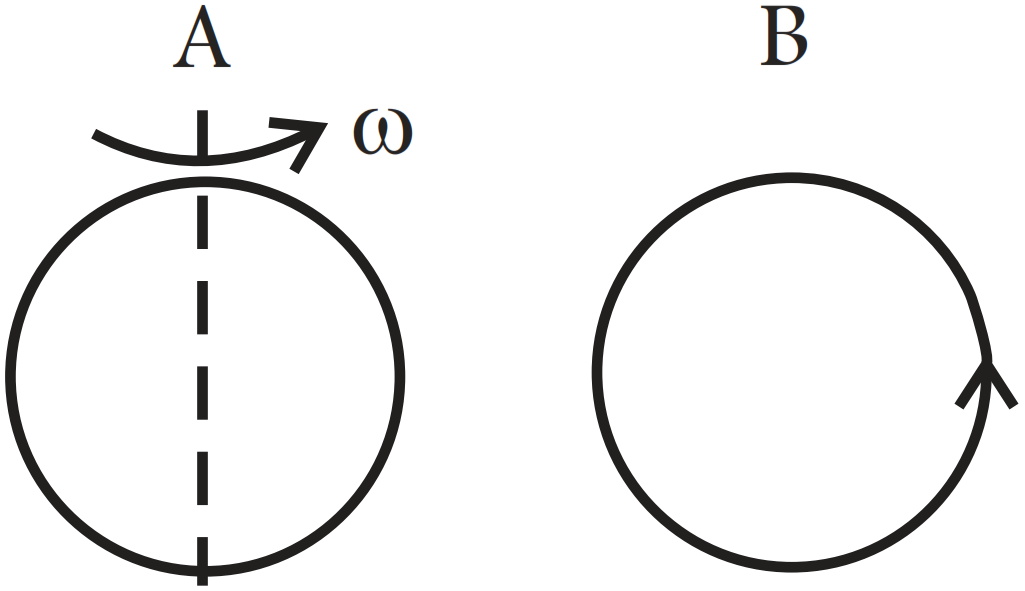
Same as problem $4$ except the coil A is made to rotate about a vertical axis $($Fig$)$. No current flows in $B$ if $A$ is at rest. The current in coil $A$, when the current in $B ($at $t = 0)$ is counterclockwise and the coil $A$ is as shown at this instant, $t = 0$, is:
- ✓
Constant current clockwise.
- B
Varying current clockwise.
- C
Varying current counterclockwise.
- D
Constant current counterclockwise.
AnswerCorrect option: A. Constant current clockwise.
Key concept: In this problem, the Lenz’s law is applicable so let us introduce Lenz’s law first.
Lenz's law gives the direction of induced emf$/$induced current. According to this law, the direction of induced emf or current in a circuit is such as to oppose the cause that produces it. This law is based upon law of conservation of energy.
When the current in coil $B ($at $t = 0)$ is counter-clockwise and the coil $A$ is considered above it. The counter clockwise flow of the current in coil $B$ is equivalent to north pole of magnet and magnetic field lines are eliminating upward to coil $A$. When coil A starts rotating at $t = 0$, the current in $A$ is constant along clockwise direction by Lenz's rule.
View full question & answer→MCQ 521 Mark
A wire loop is rotated in a magnetic field. The frequency of change of direction of the induced $e.m.f.$ is.
- A
- ✓
- C
Four times per revolution
- D
AnswerConsider the ring starting to rotate from its initial position where it is perpendicular to the magnetic field. Thus initially maximum flux is passing through the loop. When it rotates, the flux passing through the loop starts to decrease. When it becomes parallel to the magnetic field, the flux becomes zero and then starts to increase. Here the direction of the induced emf remains the same. Then as it rotates further, it keeps on increasing, reaches maximum. Here the direction of induced emf changes. According to lenz law, the induced emf tends to oppose the flux when it was increasing and now since it is decreasing, it tends to increase it. Similarly when it reaches its initial position it changes the direction.
View full question & answer→MCQ 531 Mark
A wire of fixed length is wound on a solenoid of length $l$ and radius $r$. Its self-inductance is found to be $L$. Now, if the same wire is wound on a solenoid of length $\frac{1}{2}$ and radius $\frac{\text{r}}{2},$ then the self$-$inductance will be
Answer$\text{L}=\frac{\mu_0\text{N}^2\pi\text{r}^2}{1}$
Length of wire $=\text{N}2\pi\text{r}=$ Constant$( = C,$ suppose$)$
$\therefore\text{L}=\mu_0\Big(\frac{\text{C}}{2\pi\text{r}}\Big)^2\frac{\pi\text{r}^2}{1}$
$\therefore\text{L}\propto\frac{1}{1}$
$\therefore\text{Self-inductance will become 2L.}$
View full question & answer→MCQ 541 Mark
The magnetic flux in a coil of $100$ turns increases by $12 \times 10^3$ Maxwell in $0.2$ second due to the motion of a magnet. The emf induced in the coil will be.
- A
$6 V$
- B
$0.6 V$
- ✓
$0.06 V$
- D
$60 V$
AnswerCorrect option: C. $0.06 V$
emf $=$ rate of change of flux $\times$ number of turns $=\frac{12\times10^3\times10^{-8}}{0.2}\times100=0.06\text{V}$
emf $=$ rate of change of flux $\times$ number of turns.
View full question & answer→MCQ 551 Mark
The area of the coil must be.$.......$
- A
$1.8\ m^2$
- ✓
$18\ m^2$
- C
$8\ m^2$
- D
AnswerCorrect option: B. $18\ m^2$
Flux through a circular coil $\phi=\text{NBA}\cos\omega\text{t}$
Voltage required $\in=\frac{-\text{d}\phi}{\text{dt}}$
$\Rightarrow9=\text{NBA}\omega\sin\omega\text{t}$
$9=\frac{8\times10^{-5}\times\text{A}\times30\times2\pi\times2000}{60}$
$\text{A}=\frac{9\times10^5}{50\times10^3}=18\text{m}^2$
View full question & answer→MCQ 561 Mark
Magnetic flux during time interval $\tau$ varies through a stationary loop of resistance $R$, as $\phi_\text{B}=\text{at}(\tau-\text{t})$ Find the amount of heat generated during that time. Neglect the inductance of the loop.
- A
$\frac{\text{a}^2\tau^3}{\text{R}}$
- B
$\frac{\text{a}^2\tau^3}{\text{2R}}$
- ✓
$\frac{\text{a}^2\tau^3}{\text{3R}}$
- D
$\frac{\text{a}^2\tau^3}{\text{4R}}$
AnswerCorrect option: C. $\frac{\text{a}^2\tau^3}{\text{3R}}$
View full question & answer→MCQ 571 Mark
Which of the following units denotes the dimensions $\frac{{\text{ML}}^2}{{\text{Q}}^2}$where $Q$ denotes the electric charge?
AnswerCorrect option: C. Henry $(H)$
Weber $= ML ^2 T^{-2} I ^{-1}$
$= ML ^2 T^{-2} Q ^{-1} T= ML ^2 T^{-1} Q ^{-1}\left(I= QT ^{-1}\right)$
Henry $H$ is $SI$ unit of inductance.
$H = ML ^2 T^{-2} I ^{-2}$
also $I = QT ^{-1}$
So $H = ML ^2 T^{-2} Q ^{-2} T^2= ML ^2 Q ^{-2}$
View full question & answer→MCQ 581 Mark
Study involving both electricity and magnetism is called $.......$.
AnswerStudy of phenomenon involving both electricity and magnetism is called electromagnetism.
View full question & answer→MCQ 591 Mark
The length of side of a square coil is $50\ cm$ and number of turns in it is $100$. If it is placed at right angles to a magnetic field which is changing at the rate of $4$ Tesla/ s, then induced emf in the coil will be:
- A
$0.1 V$
- B
$1.0 V$
- C
$10 V$
- ✓
$100 V$
AnswerCorrect option: D. $100 V$
View full question & answer→MCQ 601 Mark
A loop, made of straight edges has six corners at $\text{A(0, 0, 0), B(L, O, 0) C(L, L, 0), D(0, L, 0) E(0, L, L)}$ and $\text{F(0, 0, L). A}$ magnetic field $\text{B}=\text{B}_0(\hat{\text{I}}+\hat{\text{k}})\text{T}$ is present in the region. The flux passing through the loop $\text{ABCDEFA} ($in that order$)$ is:
AnswerCorrect option: B. $2 B_0 L^2 Wb$
The situation given in question is shown in the figure given below,
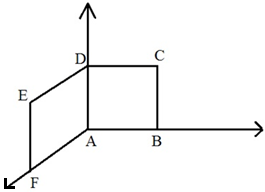
Clearly, loop $\text{ABCDA}$ lies in $x-y$ plane whose area vector $\vec{\text{A}_1}=\text{L}^2\hat{\text{K}}$ whereas lppo $\text{ADEFA}$ lies in $y-z$ plane whose area vector $\vec{\text{A}_2}=\text{L}^2\hat{\text{i}}$.
As, $\phi=\text{B.A}$
Now, $\text{B}=\text{B}_0(\hat{\text{i}}+\hat{\text{K}})\text{T}$ and $\text{A}=\text{A}_1+\text{A}_2=(\text{L}^2\hat{\text{K}}+\text{L}^2\hat{\text{i}})$
Therefore, $\phi=\text{B.A}=\big[\text{B}_0(\hat{\text{i}}+\hat{\text{K}})\big].\big[\text{L}^2\hat{\text{K}}+\text{L}^2\hat{\text{i}}\big]=2\text{B}_0\text{L}^2\text{Wb}$.
View full question & answer→MCQ 611 Mark
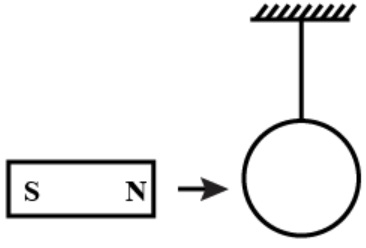
A copper ring is suspended by a thread in a vertical plane. If one end of a magnet is brought horizontally towards the ring in plane of ring as shown, the ring will.
- A
- ✓
- C
move away from the magnet.
- D
first move towards and then move away from the magne
AnswerThe magnetic flux is given by $\phi=\text{BA}\cos\theta$ where $\theta$ is angle between magnetic field and area of ring.
in this case the area vector is out of the plane,
Hence $\theta=90^\circ$
$\Rightarrow\phi=0$
The ring will not move from the magnet, as there is no change in flux through ring and current in it will be zero. Ring will not behave as a magnet.
View full question & answer→MCQ 621 Mark
If $‘N’$ is the number of turns in a coil, the value of self inductance varies as
- A
$N ^0$
- B
$N$
- ✓
$N ^2$
- D
$N^{-2}$
AnswerCorrect option: C. $N ^2$
Formula for self$-$inductance of a coil: $\text{L}=\frac{\mu_0\text{N}^2\text{A}}{1}$
Hence, it varies as $N^2$
View full question & answer→MCQ 631 Mark
$........$ gave the principle of Electromagnetic Induction.
View full question & answer→MCQ 641 Mark
An $AC$ generator is a device which converts:
- A
Electrical energy to mechanical energy.
- B
Heat energy to electrical energy.
- C
Heat energy to light energy.
- ✓
Mechanical energy to electrical energy.
AnswerCorrect option: D. Mechanical energy to electrical energy.
An $AC$ generator converts mechanical energy into electrical energy, while a motor does the opposite $-$ it converts electrical energy into mechanical energy. Both devices work because of electromagnetic induction, which is when a voltage is induced by a changing magnetic field.
View full question & answer→MCQ 651 Mark
A square of side $L$ meters lies in the $x-y$ plane in a region, where the magnetic field is given by $B=B_0(2 \hat{ i }+3 \hat{ j }+4 \hat{ k }) T$, where $B _0$ is constant. The magnitude of flux passing through the square is:
- A
$2 B_0 L^2 W b$
- B
$3 B_0 L^2 W b$.
- ✓
$4 B_0 L^2 Wb$
- D
$\sqrt{29} B_0 L^2 Wb$.
AnswerCorrect option: C. $4 B_0 L^2 Wb$
Key concept: Magnetic flux is defined as the total number of magnetic lines of force passing normally through an area placed in a magnetic field and is equal to the magnetic flux linked with that area.
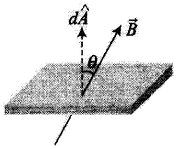
For elementary area $dA$ of a surface flux linked $\text{d}\phi=\text{BdA}\cos\theta \text{ or }\text{d}\phi=\vec{\text{B}}.\vec{\text{dA}}$
So, net flux through the surface $\phi=\oint=\vec{\text{B}}\times\vec{\text{dA}}=\text{BA}\cos\theta$
In this problem, $\text{A}=\text{L}^2\hat{\text{k}}$ and $\text{B}=\text{B}_0(2\hat{\text{i}}+3\hat{\text{j}}+4\hat{\text{k}})\text{T}$
$\phi=\vec{\text{B}}.\vec{\text{A}}=\text{B}_0(2\hat{\text{i}}+3\hat{\text{j}}+4\hat{\text{k}}).\text{L}^2\hat{\text{k}}=4\text{B}_0\text{L}^2\text{Wb}$ View full question & answer→MCQ 661 Mark
Check the incorrect statement: When a magnet is moved into a coil the strength of the current depends on:
- A
The number of turns in the coil
- B
The speed with which the magnet moves
- C
The resistance of the coil
- ✓
AnswerAccording to Faraday's Law when the magnetic flux linking a circuit changes, an electromotive force is induced in the circuit proportional to the rate of change of the flux linkage.
View full question & answer→MCQ 671 Mark
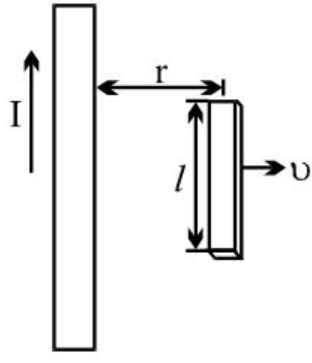
A long metal bar of $30 \ cm$ length is aligned along a north south line and moves eastward at a speed of $10 ms^{-1}$. A uniform magnetic field of $4.0 T$ points vertically downwards. If the south end of the bar has a potential of $0 V$ , the induced potential at the north end of the bar is:
- ✓
$+12V$
- B
$-12V$
- C
$0V$
- D
cannot be determined since there is not closed circuit
AnswerCorrect option: A. $+12V$
induced emf $= Blv = 12V$. It is induced in the northward direction by right hand rule $\big(\text{emf}=\overrightarrow{\text{V}}\times\overrightarrow{\text{B}}\big)$
therefore if south end of pole has potential of $0V$, north end will have a potential of $12V$
View full question & answer→MCQ 681 Mark
The rate of change of magnetic flux density through a circular coil of area $10 m$ and number of turns $100$ is $10^3 Wb$ / $m ^2 / s$. The value of induced emf will be.
- A
$10^{-2} V$
- B
$10^{-3} V$
- C
$10 V$
- ✓
$10^6 V$
AnswerCorrect option: D. $10^6 V$
emf $=$ rate of change of flux
$=$ area $\times$ number of turns $\times$ rate of change of flux density
$=10 \times 100 \times 1000=106 V$
View full question & answer→MCQ 691 Mark
Electric current produced by a moving straight wire in a magnetic field is?
AnswerElectric current produced by a moving straight wire in a magnetic field is Induced Current The current due to the emf induced due the change in magnetic flux of a coil when a magnet is inserted in it is induced current.When in a coil there is change in magnetic flux an emf is generated such that it opposes the change in magnetic flux. The current generated due to this emf is known as induced current.
View full question & answer→MCQ 701 Mark
AnswerInduced emf is potential difference only, hence its unit is volt only.
View full question & answer→MCQ 711 Mark
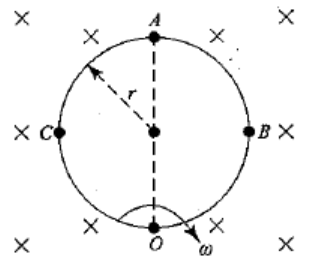
In figure, there is a conducting ring having resistance $R$ placed in the plane of paper in a uniform magnetic field $B_o$. If the ring is rotating in the plane of paper about an axis passing through point $O$ and perpendicular to the plane of paper with constant angular speed $\omega$ in clockwise direction, then.
- A
point $O$ will be at higher potential than $A$
- B
the potential of point $B$ and $C$ will different
- ✓
the current in the ring will be zero
- D
the current in the ring will be $\frac{2\text{B}_0\omega\text{r}^2}{\text{R}}$
AnswerCorrect option: C. the current in the ring will be zero
The ring can be seen as two rod $OCA$ and $OBA$ in parallel.
The motional emf will be induced between $O$ and $A =\frac{1}{2} B(2 r )^2 \omega=2 Br ^2 \omega$ with $A$ positibe wrt $O$
In both the paths from $O-C-A$; and from $O-B-A$, potential increases as one moves from point $O$ to point $A$.
Point $B$ and $C$ are at same potential due to symmetry.
As there is no return path, no current flows even though a potential is developed between points $O$ and $A$
View full question & answer→MCQ 721 Mark
A small, conducting circular loop is placed inside a long solenoid carrying a current. The plane of the loop contains the axis of the solenoid. If the current in the solenoid is varied, the current induced in the loop is:
- A
- B
- ✓
- D
Clockwise or anticlockwise depending on whether the resistance in increased or decreased.
AnswerThe angle between magnetic field and area vector is $90^{\circ}$, so the flux associated with coil is zero. Although magnetic field is changing but flux is remaining constant equal to zero, so emf induced and hence current in the loop is equal to zero.
View full question & answer→MCQ 731 Mark
A varying current in a coil change from $10A$ to 0 in $0.5 \sec$. If the average emf induced in the coil is $220V,$ the self inductance of the coil is:
Answer$\text{emf}=\text{L}\frac{\text{di}}{\text{dt}}$
$\text{L}=\frac{\text{emf}}{(\frac{\text{di}}{\text{dt}})}$
$\text{L}=\frac{220}{(\frac{10}{0.5})}$
$=11\text{H}$
View full question & answer→MCQ 741 Mark
A coil with $100$ turns has an inductance of $0.05H$ and $0.02A$ current is passed through it. Flux linked with the coil is
- A
$10^{-2} Wb$
- ✓
$10^{-3} Wb$
- C
$10^{-4} Wb$
- D
$10^{-5} Wb$
AnswerCorrect option: B. $10^{-3} Wb$
As we know that flux $=$ inductance $\times$ current
Hence,
Flux $\phi= Li$
$=0.05 \times 0.02$
$=10^{-3} Wb$
View full question & answer→MCQ 751 Mark
An average emf of $32V$ is induced in a coil in which the current drops from $10A$ to $2A $ in$ 0.1s$. The inductance of the coil is:
- A
$0.32H$
- ✓
$0.4H$
- C
$4H$
- D
$0.04H$
AnswerCorrect option: B. $0.4H$
$\text{emf}=\text{L}\frac{\text{di}}{\text{dt}}$
$\text{emf}=\text{L}\frac{\triangle\text{i}}{\triangle\text{i}}$
So, $\text{L}=\text{emf}\times\frac{\triangle\text{t}}{\triangle\text{i}}$
$=32\times\frac{0.1}{8}$
$=0.4\text{H}$
View full question & answer→MCQ 761 Mark
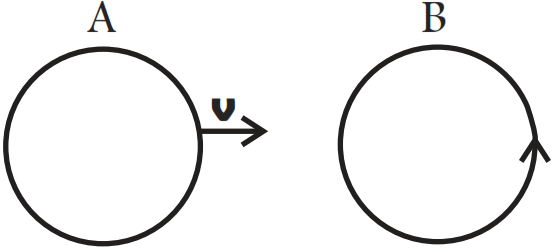
There are two coils $A$ and $B$ as shown in Fig. A current starts flowing in $B$ as shown, when $A$ is moved towards $B$ and stops when $A$ stops moving. The current in $A$ is counterclockwise. $B$ is kept stationary when $A$ moves. We can infer that:
- A
There is a constant current in the clockwise direction in $A.$
- B
There is a varying current in $A.$
- C
There is no current in $A.$
- ✓
There is a constant current in the counterclockwise direction in $A.$
AnswerCorrect option: D. There is a constant current in the counterclockwise direction in $A.$
Here, induced emf in $B$ is due to the variation of magnetic flux associated with it.
If the current in $A$ would be variable, there must be an induced emf $($current$)$ in $B$ even if the $A$ stops moving.
If the current in $A$ is constant and $A$ stops moving the current in $B$ becomes zero.
View full question & answer→MCQ 771 Mark
One conducting $U$ tube can slide inside another as shown in figure, maintaining electric contacts between the tubes. The magnetic field $B$ is perpendicular to the plane of the figure. If each tube moves towards the other at a constant speed $v$, then the emf induced in the circuit in terms of $B, l $ and $v$ where $l$ is the width of each tube, will be
AnswerCorrect option: C. $2 Blv$
Relative velocity $= v + v = 2v$
Therefore, emf $= Bl(2v)$
View full question & answer→MCQ 781 Mark
A conducting rod is moved with a constant velocity v in a magnetic field. A potential difference appears across the two ends:
- A
If $\vec{\text{v}}\parallel\vec{\text{l}}$
- B
If $\vec{\text{v}}\parallel\vec{\text{B}}$
- C
If $\vec{\text{l}}\parallel\vec{\text{B}}$
- ✓
AnswerPotential difference appears across the two ends $=\text{Bvl}$
$\text{v}^\hat{}\text{B}, \ \text{v}^\hat{}\text{I}, \ \text{I}^\hat{}\text{B}$
View full question & answer→MCQ 791 Mark
The current in a coil of $0.4\ mH$ coil increases by $250\ mA$ in $0.1$ seconds. The induced emf will be:-
- A
$+1V$
- B
$-1V$
- C
$+1mV$
- ✓
$-1mV$
AnswerCorrect option: D. $-1mV$
View full question & answer→MCQ 801 Mark
To measure the field $B$ between the poles of an electromagnet, a small test loop of area $1 \ cm^2$, resistance $10 \Omega$ and $20$ turns is pulled out of it. A galvanometer shows that a total charge of $2 \mu c$ passed through the loop. The value of $B$ is
- A
$0.001T$
- ✓
$0.01T$
- C
$0.1T$
- D
$1.0T$
AnswerCorrect option: B. $0.01T$
$\text{emf}=\frac{\text{BAn}}{\text{t}}$
$\text{i}=\frac{\text{emf}}{\text{R}}=\frac{\text{BAn}}{\text{tR}}$
$\text{q}=\text{it}=\frac{\text{emf}}{\text{tR}}=\frac{\text{BAn}}{\text{R}}$
$\therefore2\times10^{-6}=\frac{\text{B}\times10^{-4}\times20}{10}$
$B=10^{-2} T$
$B =0.01 T$
View full question & answer→MCQ 811 Mark
The distance between the ends of the wings of an airplane is $50 m$ . It is flying in a horizontal plane at a speed of $360 \ Km /$ hour. The vertical component of earth's magnetic field at that place is $2.0 \times 10^{-4} Wb / m ^2$, then the potential difference induced between the ends of the wings will be
- A
$0.1volt$
- ✓
$1.0volt$
- C
$0.2volt$
- D
$0.01volt$
AnswerCorrect option: B. $1.0volt$
emf $=$ Blv
$=2\times10^{-4}\times50\times360\frac{1000}{3600}=\text{1V}$
View full question & answer→MCQ 821 Mark
A circular coil of conducting wire has an area $A$ and number of turns $N$. It is lying in a vertical plane in a region where uniform magnetic field $B$ exist with field direction normal to the coil plane. If the coil is rotated about a vertical axis by an angle $π$ in $0.5$ seconds, then the value of the emf induced at the ends of the coil is.
- ✓
$4\text{NAB}$
- B
$4\pi\text{NAB}$
- C
$8\text{NAB}$
- D
$8\pi\text{NAB}$
AnswerCorrect option: A. $4\text{NAB}$
$AS$ the coil rotates by $\pi$ radians, $\triangle\phi=\text{NAB}-(-\text{NAB})=2\text{NAB}$
emf $=$ rate of change of flux
$=\frac{\triangle\phi}{\triangle\text{t}}=\frac{2\text{NAB}}{0.5}$
$=4\text{NAB}$
View full question & answer→MCQ 831 Mark
The coil is wound on an iron core and looped back on itself so that core has two sets of closely wound coils carrying current in opposite directions. The self inductance is.
- ✓
$0$
- B
$2L$
- C
$2L + M$
- D
$L + 2M$
AnswerLet the inductance due to first loop alone be $L.$
Then inductance due to second loop alone is also $L.$
The effective self inductance can be calculate by: $L_{\text {eff }}=L_1+L_2-2 M$
$=\text{L}+\text{L}-2\sqrt{\text{L.L}}=0$
View full question & answer→MCQ 841 Mark
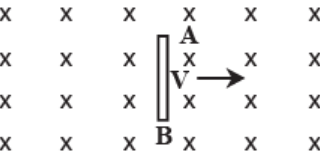
A rod AB moves with a uniform velocity v in a uniform magnetic field as shown in figure:
- A
The rod becomes electrically charged
- ✓
The end A becomes positively charged
- C
The end B becomes positively charged
- D
The rod becomes hot because of Joule heating
AnswerCorrect option: B. The end A becomes positively charged
Force on positive charges in the rod will be in direction given by $qv \times B$, i.e., towards $A.$
Hence force on electron will be in opposite direction i.e., towards $B$. So negative charge will move towards $ B.$
Therefore $B$ will be negatively charged and $A$ will be positively charged.
View full question & answer→MCQ 851 Mark
The magnetic flux linked with a coil is $\phi\leq8\text{t}^2+3\text{t}+5$ Weber. The induced emf in fourth second will be.
- A
$16V$
- B
$139V$
- ✓
$67V$
- D
$145V$
Answer$\text{emf(t)}=\frac{\text{d}\phi}{\text{dt}}=16\text{t}+3$
$\text{emf(4)}=16\times4+3=67\text{V}$
View full question & answer→MCQ 861 Mark
The time constant of an inductance coil is $2 \times 10^{-3} s$. When a $90 \Omega$ resistance is joined in series, the same constant becomes $0.5 \times 10^{-3} s$. The inductance and resistance of the coil are
- A
$30\text{mH};30\Omega$
- ✓
$60\text{mH};30\Omega$
- C
$30\text{mH};60\Omega$
- D
$60\text{mH};60\Omega$
AnswerCorrect option: B. $60\text{mH};30\Omega$
Initally the time constant can be representyed as:
$\frac{\text{L}}{\text{R}}=2\times10^{-3}...........(\text{i})$
When the resistance is increased, the new time constant is given as:
$\frac{\text{L}}{\text{R}+90}=0.5\times10^{-5}...........(\text{ii})$
From $(i)$ and $(ii) $, on solving , we get
$\text{L}=60\text{mH }\text{and } \text{R}=30\Omega$
View full question & answer→MCQ 871 Mark
Whenever the magnetic flux linked with a coil changes, an induced e.m.f. is produced in the circuit. The $e.m.f.$ lasts
- A
- B
- C
- ✓
so long as the change in flux takes place
AnswerCorrect option: D. so long as the change in flux takes place
The induced emf, $\text{E}=-\frac{\text{d}\phi}{\text{dt}}\text{where }\phi=\text{magnetic flux}$
Hence, emf will last as long as flux keeps changing.
View full question & answer→MCQ 881 Mark
When the current through the electromagnet of a relay reaches a particular value
- A
- B
It open the circuit by pulling in an iron contact
- C
It closes the circuit by pulling in an iron contact
- ✓
Both $A$ or $C$
AnswerCorrect option: D. Both $A$ or $C$
They are ways of switching using a low current to use an electromagnet to close or open a spring steel contact.They are often used to isolate a user from a high voltage that needs to be switched, using low current, low voltage to operate the relay, rather than having a user come in direct proximity to the higher voltage that needs to be switched.When the current through the electromagnet of a relay reaches a particular value it either breaks the circuit by repllening or closes the circuit by pulling in an iron contact.
View full question & answer→MCQ 891 Mark
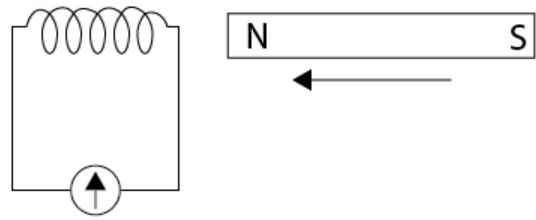
A magnet is moved into the coil of wire as shown, there is a small reading on the sensitive meter.
Which change would increase the size of the reading?
- A
- B
- ✓
Pushing the magnet in faster
- D
Unwinding some of the turns of wire
AnswerCorrect option: C. Pushing the magnet in faster
When a magnet is moved closer to the current carrying coil it will generate electricity as the coil moves through the magnetic field. As the magnet is moved, there will be an induced electro-motive force $\text{(EMF)}$ which can cause a current in the coil. Once the magnet stops moving, the current will go to zero.
Hence, when a galvanometer is connected to the circuit, there will be deflection due to the flow of electricity. As the magnet is moved toward the coil of wire, the needle of the galvanometer moves one direction. As the magnet is moved away from the coil of wire, the needle of the galvanometer moves the opposite direction. If the magnet is moved faster, the magnitude of the deflection increases.
View full question & answer→MCQ 901 Mark
When the current through the electromagnet of a relay reaches a particular value.
- A
- B
It open the circuit by pulling in an iron contact
- C
It closes the circuit by pulling in an iron contact
- ✓
Both $A$ or $C$
AnswerCorrect option: D. Both $A$ or $C$
They are ways of switching using a low current to use an electromagnet to close or open a spring steel contact.They are often used to isolate a user from a high voltage that needs to be switched, using low current, low voltage to operate the relay, rather than having a user come in direct proximity to the higher voltage that needs to be switched.When the current through the electromagnet of a relay reaches a particular value it either breaks the circuit by repllening or closes the circuit by pulling in an iron contact.
View full question & answer→MCQ 911 Mark
The length of a wire required to manufacture a solenoid of length $l$ and self$-$induction $L$ is$ ($cross$-$sectional area is negligible$)$
- A
$\sqrt\frac{{2\pi\text{LI}}}{\mu_0}$
- B
$\sqrt\frac{{\mu_0\text{LI}}}{4\pi}$
- ✓
$\sqrt\frac{{4\pi\text{LI}}}{\mu_0}$
- D
$\sqrt\frac{{\mu_0\text{LI}}}{2\pi}$
AnswerCorrect option: C. $\sqrt\frac{{4\pi\text{LI}}}{\mu_0}$
Use the formula of self$-$inductance of a solenoid.
Explanation for correct option:
Step $1:$ Find number of turns in the solenoid and area of cross section of solenoid
Let $x$ is the length of the wire, then the length of the solenoid is $\text{x}=2\pi\text{rN}$
$($Here $N ⇒$ number of turns$)$
$\Rightarrow\text{N}=\frac{\text{x}}{2\pi\text{r}}$
Since, the wire is in the shape of a cylinder, the area of cross section is
$\text{A}=\pi\text{r}^2$
Step $2:$ Find length of a wire required
The self$-$inductance of a solenoid is given by,
$\text{L}=\frac{\mu_0\text{N}^2\text{A}}{1}$ where $\mu_0$ is the magnetic permeability, $l$ is the length of the solenoid and $A$ is the area of each turn in the solenoid.
$\Rightarrow\text{L}=\frac{\mu_0\big(\frac{\text{x}}{2\pi\text{r}}\big)^2\pi\text{r}^2}{\text{I}}$
$\Rightarrow\text{x}=\sqrt\frac{4\pi\text{LI}}{\mu_0}$
View full question & answer→MCQ 921 Mark
A solenoid of inductance L carrying a certain current is linked with a total magnetic flux $\phi$. Now it is connected to a condenser with which it shares half of its initial energy. The total flux now linked with the solenoid is:
- A
$\frac{\phi}{2}$
- ✓
$\frac{\phi}{\sqrt2}$
- C
$\frac{\phi}{2\sqrt2}$
- D
$\frac{\phi}{4}$
AnswerCorrect option: B. $\frac{\phi}{\sqrt2}$
Energy in indicator $=\frac{1}{2}\text{Li}^2$
With Energy transfer, i becomes $\text{i}\sqrt{2}$
Now since $\phi=\frac{\text{Li}}{\sqrt{2}}=\frac{\phi}{\sqrt{2}}$
So, total flux will be $\frac{\phi}{\sqrt{2}}$
View full question & answer→MCQ 931 Mark
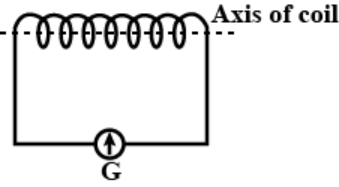
A student connects a coil of wire with a sensitive galvanometer as shown in figure. He will observe the deflection in the galvanometer if bar magnet is:
- A
one of the facts of the coil placed near and parallel to the axis of the coil
- B
placed near one of the facts of the coil and perpendicular to the axis of the coil
- C
- ✓
moved towards or away from the coil parallel to the axis of the coil
AnswerCorrect option: D. moved towards or away from the coil parallel to the axis of the coil
View full question & answer→MCQ 941 Mark
The coefficient of self inductance and the coefficient of mutual inductance have.
- A
same units but different dimensions
- B
different units but same dimensions
- C
different units and different dimensions
- ✓
same units and same dimensions
AnswerCorrect option: D. same units and same dimensions
$\text{emf}=-\text{L}\frac{\text{di}}{\text{dt}}$
$\phi=\text{Mi}$
$\text{Emf}\frac{\text{d}\phi}{\text{dt}}=-\text{M}\frac{\text{di}}{\text{dt}}$
So, units and dimension of coeffiecent of self inductance and coefficent of mutual inductance are same.
View full question & answer→MCQ 951 Mark
Complete the following sentence:
AnswerCorrect option: A. The current is induced in a closed circuit only if there is $.....$
The current is induced in a closed circuit only if there is a change in number of magnetic field lines in the circuit due to electromagnetic induction according to Faraday's law.
View full question & answer→MCQ 961 Mark
When the number of turns per unit length in a solenoid is doubled then its coefficient of self induction will become.
AnswerCoefficient of Self inductance is directly proportional to square of number of turns in coil, hence on doubling the number of turns. Coefficient of Self inductance becomes four times.
View full question & answer→MCQ 971 Mark
Change in number of magnetic field lines induces.
- A
- ✓
$\text{EMF}$ in the coil
- C
- D
both $A$ and $C$
AnswerCorrect option: B. $\text{EMF}$ in the coil
As per Faraday's law, the change in magnetic flux associated with coil produces an $\text{EMF}$ in the coil. Whenever there is a change in magnetic flux associated with a coil, an $\text{EMF}$ is induced in the coil. Magnetic flux is defined as the number of field lines passing normally through a given area. When magnetic flux changes, obviously, it means that, the number of magnetic field lines change.
View full question & answer→MCQ 981 Mark
In an $a.c.$ generator the speed at which the coil rotates is doubled. How would this affect the frequency of output voltage?
Answer$AC$ generators are made up of one or more magnetic pole pairs corresponding to their purposes.
The frequency of an $AC$ generator is dependent on the number of pairs of poles and the speed of the coil rotation. The frequency of the induced $AC$ current depends on therevolution
of the coil since, rate of revolution is Revolutions Per Minute $\text{(RPM)}$ and frequency is expressed as cycles per second, the frequency of the induced $AC$ current will be the rate of
revolution of the coil divided by 60 seconds.
That is, $F = RPM \times $ number of pole pairs $\div 60$
When the Revolutions per minute $\text{(RPM)}$ is doubled, then, obviously the frequency of the ac current will also be doubled as the $\text{RPM}$ is multiplied with the number of pole pairs.
View full question & answer→MCQ 991 Mark
If a spark is produced on removing the load from an $AC$ circuit then the element connected in the circuit is.
AnswerOn removal of load from the circuit, the circuit suddenly becomes an open circuit.
Thus $\frac{\text{di}}{\text{dt}}\rightarrow\infty$
For sparking, high voltage must appear across the open ends. This will happen only in case of an inductor as the voltage drop across the
inductor is $\text{L}\frac{\text{di}}{\text{dt}}$
Therefore, the circuit has high inductance.
View full question & answer→MCQ 1001 Mark
What is the unit for $\text{EMF?}$
Answer$\text{EMF}$ is defined as the voltage developed by the electrical energy source. For example : Battery Thus $\text{EMF}$ has the unit of volt denoted by $V$
View full question & answer→