Questions

3 Marks Question

🎯

Test yourself on this topic

5 questions · timed · auto-graded

Question 13 Marks
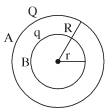
A small conducting sphere (radius r ) is placed concentrically inside a larger conducting hollow sphere of radius $R$. The big and small spheres are charged with $Q$ and $q(Q>q)$ respectively and kept separate from each other. Calculate the potential difference between the spheres.
Answer
Potential on the surface of A due to Q $ V=\frac{1}{4 \pi \epsilon_0} \times \frac{Q}{R} $
Potential on the surface of A due to $q$
Image
$ V=\frac{1}{4 \pi \epsilon_0} \times \frac{q}{R} $
Potential on the surface of $B$ due to $Q=\frac{1}{4 \pi \epsilon_0} \times \frac{Q}{R}$
Potential on the surface of B due to $q=\frac{1}{4 \pi \epsilon_0} \times \frac{q}{r}$
$\therefore$ Potential at $A , B _{s l}=\frac{1}{4 \pi \epsilon_0}\left(\frac{ Q }{ R }+\frac{q}{ R }\right)$
Potential at $B , V _{ B }=\frac{1}{4 \pi \epsilon_0}\left(\frac{ Q }{ R }+\frac{q}{r}\right)$
$\therefore \quad V _{ B }- V _{ A }=\frac{1}{4 \pi \epsilon_0}\left(\frac{q}{r}-\frac{q}{ R }\right)$
View full question & answer
Question 23 Marks
Write the product of equivalent capacitances when 10 capacitors, each having a capacitance of $10 \mu F$, are connected in series and then parallel connection.
Answer
Equivalent capacitance of series combination of $n$ capacitors will be
$ \frac{1}{C_{s}}=\frac{1}{C_1}+\frac{1}{C_2}+\frac{1}{C_3}+\ldots \ldots+\frac{1}{C_n} $
There are 10 capacitors each with a capacitance of $10 \mu F$.All of these are combined into series combinations. Therefore the value of equivalence will be $1 \mu F$.
All these have been combined in parallel combination after series combination.
Formula of equivalency for parallel combination :
$C _{ P }= C _1+ C _2+ C _3 \ldots \ldots C _n$
$\begin{array}{r}\therefore C _{ P }=10+10+10+10+10+10+10+10+ \\ 10+10=100 \mu F\end{array}$
The product of both the capacitances
$= C _{ S } \times C _{ P }=1 \mu F \times 100 \mu F$
$=1 \times 10^{-6} F \times 100 \times 10^{-6} F$
$=10^{-10} F=1 A F$ Ans.
View full question & answer
Question 33 Marks
A parallel plate capacitor is charged to a potential difference V from a direct current source, while there is air between the plates. Without separating the capacitor from the battery, a dielectric medium of dielectric constant K has been filled in place of air. Explain with reasons which of the following changes will occur? Also give explanation of the answers.(i) Potential difference (ii) Electric field between the plates (iii) Capacitance (iv) charge (v) energy.
Answer
(i) Since here the capacitor is connected to the battery, i.e. the electric potential difference V will remain unchanged.
(ii) Since both the potential difference and the distance between the plates are unchanged, the electric field $E=\frac{V}{D}$ will remain unchanged.
(iii) Capacitance will increase $\because C = KC _0$
(iv) Since V is constant and the capacitance becomes K times, the charge Q will also become K times.
(v) Initial energy $U_0=\frac{1}{2} C_0\left(V_0\right)^2$ and final energy $U =\frac{1}{2} K C _0\left(V_0\right)^2= K U _0$ i.e.,energy will also increase K times.
View full question & answer
Question 43 Marks
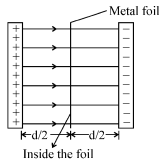
What will be the effect on placing a metal foil between the plates of a parallel plate capacitor on its capacitance?
Answer
When there is air between the plates of the capacitor, capacitance $ C_0=\frac{\epsilon_0 A}{d} . $
Image
By placing a metal foil between its plates $($Fig.$),$ this capacitor will be equivalent to a series combination of two parallel plate capacitors, in which the area of each plate is $A$ and the distance between the plates $=\frac{d}{2}$
Therefore, the capacitance of each of these is
$ C_1=\frac{E_0 A}{d / 2}=\frac{2 E_0 A}{d}$
$C_1=2 C_0 $
Therefore, the capacitance of their series combination
$ C=\frac{2 C_0 \times 2 C_0}{2 C_0+2 C_0}=C_0 $
Therefore, there will be no effect on the capacitance.
View full question & answer
Question 53 Marks
Define polarization.
Answer
The process of separating charges by pulling atoms in a dielectric in an induced electric field is called polarization. The pull of the atoms continues until the force exerted by the electric field on the charges becomes equal to the restoring force. Due to this stretching, the positive centre of gravity of the nucleus and the negative centre of gravity, which is formed due to the electrons, get separated from each other. And thus the atoms acquire dipole moment. That is, the dipole moment per unit volume of a substance is called its polarization and it is denoted by $\vec{p}$.
For linear isotropic dielectrics $ \vec{p}=\chi_0 E $
Here, $\chi_0$ is a constant characteristic of the dielectric which is called the electrical tendency of the dielectric medium.
View full question & answer