Question 14 Marks
The triboelectric series is a list that ranks materials according to their tendency to gain or lose electrons. The process of electron transfer as a result of two objects coming into contact with one another and then separating is called triboelectric charging. During such an interaction, one of the two objects will always gain electrons (becoming negatively charged) and the other object will lose electrons (becoming positively charged). The relative position of the two objects on the triboelectric series will define which object gains electrons and which object loses electrons.
In triboelectric series, materials are ranked from high to low in terms of the tendency for the material to lose electron. If an object high up on this list (Glass, for example) is rubbed with an object low down on the list (Teflon, for example), the glass will lose electrons to the teflon. The glass will, in this case, become positively charged and the teflon will become negatively charged. Materials in the middle of the list (steel and wood, for example) are items those do not have a strong tendency to give up or accept electrons.
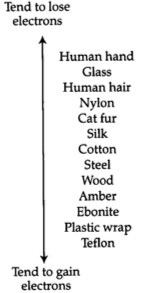
(i) Materials in the upper position have ________ tendency to become positively charged
(a) no (b) medium (c) high (d) low
(ii) Name two materials which do not have a strong tendency to give up or accept electrons.
(a) Steel, wood (b) Plastic wrap, Teflon (c) Ebonite, Nylon (d) Nylon, cat fur
(iii) if human hair is rubbed with amber, how those will be charged?
(a) Hair will be negatively charged, Amber will be positively charged.
(b) Both positive
(c) Hair will be positively charged, Amber will be negatively charged.
(d) Both negative
(iv) Triboelectric charging is the process of electron transfer between two objects
(a) By contact (b) Without contact (c) By anyone of these (d) By none of these
OR
The object which loses electron becomes ________ charged and the object gains electron becomes ________ charged.
(a) positively, positively
(b) negatively, positively
(c) negatively, negatively
(d) positively, negatively
In triboelectric series, materials are ranked from high to low in terms of the tendency for the material to lose electron. If an object high up on this list (Glass, for example) is rubbed with an object low down on the list (Teflon, for example), the glass will lose electrons to the teflon. The glass will, in this case, become positively charged and the teflon will become negatively charged. Materials in the middle of the list (steel and wood, for example) are items those do not have a strong tendency to give up or accept electrons.
(i) Materials in the upper position have ________ tendency to become positively charged
(a) no (b) medium (c) high (d) low
(ii) Name two materials which do not have a strong tendency to give up or accept electrons.
(a) Steel, wood (b) Plastic wrap, Teflon (c) Ebonite, Nylon (d) Nylon, cat fur
(iii) if human hair is rubbed with amber, how those will be charged?
(a) Hair will be negatively charged, Amber will be positively charged.
(b) Both positive
(c) Hair will be positively charged, Amber will be negatively charged.
(d) Both negative
(iv) Triboelectric charging is the process of electron transfer between two objects
(a) By contact (b) Without contact (c) By anyone of these (d) By none of these
OR
The object which loses electron becomes ________ charged and the object gains electron becomes ________ charged.
(a) positively, positively
(b) negatively, positively
(c) negatively, negatively
(d) positively, negatively
Answer
View full question & answer→The triboelectric series is a list that ranks materials according to their tendency to gain or lose electrons. The process of electron transfer as a result of two objects coming into contact with one another and then separating is called triboelectric charging. During such an interaction, one of the two objects will always gain electrons (becoming negatively charged) and the other object will lose electrons (becoming positively charged). The relative position of the two objects on the triboelectric series will define which object gains electrons and which object loses electrons.
In triboelectric series, materials are ranked from high to low in terms of the tendency for the material to lose electron. If an object high up on this list (Glass, for example) is rubbed with an object low down on the list (Teflon, for example), the glass will lose electrons to the teflon. The glass will, in this case, become positively charged and the teflon will become negatively charged. Materials in the middle of the list (steel and wood, for example) are items those do not have a strong tendency to give up or accept electrons.
(i) (c) high
Explanation: In triboelectric series, materials are ranked from high to low in terms of the tendency for the material to lose electron i.e., they are ranked high to low tendency of getting positively charged.
(ii) (a) steel, wood
Explanation: Materials in the middle of the list (steel and wood, for example) are items those do not have a strong tendency to give up or accept electrons.
(iii) (c) Hair will be positively charged, Amber will be negatively charged.
Explanation: Since, human hair is placed at the upper portion of the list, it will leave electron and will be positively charged. Since, amber is placed at the lower portion of the list, it will accept the electron and will be negatively charged.
OR
(a) By contact
Explanation: The process of electron transfer as a result of two objects corning into contact with one another and then separating is called triboelectric charging.
(iv) (d) positively, negatively
Explanation: During triboelectric charging, one of the two objects always gains electrons and become negatively charged. The other object loses electrons and become positively charged.
In triboelectric series, materials are ranked from high to low in terms of the tendency for the material to lose electron. If an object high up on this list (Glass, for example) is rubbed with an object low down on the list (Teflon, for example), the glass will lose electrons to the teflon. The glass will, in this case, become positively charged and the teflon will become negatively charged. Materials in the middle of the list (steel and wood, for example) are items those do not have a strong tendency to give up or accept electrons.
(i) (c) high
Explanation: In triboelectric series, materials are ranked from high to low in terms of the tendency for the material to lose electron i.e., they are ranked high to low tendency of getting positively charged.
(ii) (a) steel, wood
Explanation: Materials in the middle of the list (steel and wood, for example) are items those do not have a strong tendency to give up or accept electrons.
(iii) (c) Hair will be positively charged, Amber will be negatively charged.
Explanation: Since, human hair is placed at the upper portion of the list, it will leave electron and will be positively charged. Since, amber is placed at the lower portion of the list, it will accept the electron and will be negatively charged.
OR
(a) By contact
Explanation: The process of electron transfer as a result of two objects corning into contact with one another and then separating is called triboelectric charging.
(iv) (d) positively, negatively
Explanation: During triboelectric charging, one of the two objects always gains electrons and become negatively charged. The other object loses electrons and become positively charged.