Questions

M.C.Q (1 Marks)

🎯

Test yourself on this topic

12 questions · timed · auto-graded

MCQ 11 Mark
Green light of wavelength 5460 $\stackrel{\circ}{A}$ is incident on an air-glass interface. If the refractive index of glass is 1⋅ 5, the wavelength of light in glass would be (Given that the velocity of light in air, $c =3 \times 10^8 m s ^{-1}$ )
  • A
    6,731 $\stackrel{\circ}{A}$
  • B
    3,640 $\stackrel{\circ}{A}$
  • C
    5,446 $\stackrel{\circ}{A}$
  • D
    4,861 $\stackrel{\circ}{A}$
Answer
(b) : 3,640 $\stackrel{\circ}{A}$
Explanation: Now, $\lambda^{\prime}=\frac{\lambda}{\mu}=\frac{5460}{1.5}=$3,640 $\stackrel{\circ}{A}$
View full question & answer
MCQ 21 Mark
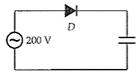
In the circuit given in the figure, an a.c. source of 200 V is connected through a diode D to a capacitor. The potential difference across the capacitor will be

Image
  • A
    283 V
  • B
    100 V
  • C
    310 V
  • D
    200 V
Answer
(a) : 283 V
Explanation: A diode conducts only during the positive half cycle of a.c. Accordingly, the capacitor charges and discharges. During charging, the p.d. across capacitor
$=200 \times \sqrt{2}=283 V$
View full question & answer
MCQ 31 Mark
If an electron is accelerated by $8.8 \times 10^{14} m / s ^2$ , then electric field required for acceleration is $($given specific charge of the electron $=1.76 \times 10^{11} Ckg ^{-1} )Z$
  • A
    $52 V cm ^{-1}$
  • $50 V cm ^{-1}$
  • C
    $54 V cm ^{-1}$
  • D
    $56 V cm ^{-1}$
Answer
Correct option: B.
$50 V cm ^{-1}$
$a=8.8 \times 10^{14} m / s ^2$
$\frac{e}{m}=1.76 \times 10^{11} C^{-1} \ kg^{-1}$
$a=\frac{F}{m}=\frac{e E}{m}=\left(\frac{e}{m}\right) E$
$8.8 \times 10^{14}=1.76 \times 10^{11} \times E$
$E=\frac{8.8 \times 10^{14}}{1.76 \times 10^{11}}$
$=5000 Vm ^{-1}$
$=50 Vcm ^{-1}$
View full question & answer
MCQ 41 Mark
The shape of the wavefront of the portion of the wavefront of light from a distant star intercepted by the earth is
  • A
    plane
  • B
    spherical
  • C
    conical
  • D
    hyperboloid
Answer
(a) : plane
Explanation: Stars are very far away from earth. Near the star the shape is spherical but by the time its light reaches earth, the portion of the wavefront is plane due to increase in radius.
View full question & answer
MCQ 51 Mark
An aeroplane having a wingspan of $35m$ files due north with the speed of $90 m/s,$ given $B=4 \times 10^{-5} T$ The potential difference between the tips of the wings will be
  • $0.126 V$
  • B
    $1.26 V$
  • C
    $0.013 V$
  • D
    $12.6 V$
Answer
Correct option: A.
$0.126 V$
$0.126 V$
Explanation:
$\varepsilon=B l v$
$=4 \times 10^{-5} \times 35 \times 90$
$=126 \times 10^{-3} V=0.126 V$
View full question & answer
MCQ 61 Mark
A pair of adjacent coils has a mutual inductance of 1.5 H. If the current in one coil changes from 0 to 20 A in 0.5 s, change of flux linkage with the other coil is
  • A
    45 Wb
  • B
    35 Wb
  • C
    30 Wb
  • D
    40 Wb
Answer
(c) : 30 Wb
Explanation: $\Delta \phi=M \Delta i=1.5 \times 20=30 Wb$
View full question & answer
MCQ 71 Mark
An electron is travelling along the X-direction. It encounters a magnetic field in the Y-direction. Its subsequent motion will be:
  • A
    a circle in the YZ-plane
  • B
    straight line along the X-direction
  • C
    a circle in the XZ-plane
  • D
    a circle in the XY-plane
Answer
(c) :a circle in the XZ-plane
Explanation: $\vec{F}=q(\vec{v} \times \vec{B})=-e(v \hat{i} \times B \hat{j})$
$=-e v B i \times \hat{j}=-e v B \hat{k}$
View full question & answer
MCQ 81 Mark
A parallel plate capacitor of plate area A has a charge Q. The force on each plate of the capacitor is
  • A
    $\frac{2 q^2}{\epsilon_o A}$
  • B
    zero
  • C
    $\frac{q^2}{\epsilon_o A}$
  • D
    $\frac{q^2}{2 \epsilon_o A}$
Answer
(d) : $\frac{q^2}{2 \epsilon_\sigma A}$
Explanation: Force between two plates of the capacitor
$F = u A$, where $u=\frac{1}{2} \varepsilon_0 E^2$ is the energy density and $A =$ Area of each plate Also the electric field, $E=\frac{\sigma}{\varepsilon_0}$ and the charge density, $\sigma=\frac{q}{A}$
Therefore, $F=\frac{1}{2} \varepsilon_0 E^2 A=\frac{1}{2} \varepsilon_0\left(\frac{\sigma}{\varepsilon_0}\right)^2 A=\frac{1}{2} \frac{\sigma^2 A}{\varepsilon_0}=\frac{1}{2}\left(\frac{q}{A}\right)^2 \frac{A}{\varepsilon_0}=\frac{q^2}{2 A \varepsilon_0}$
View full question & answer
MCQ 91 Mark
A magnet of magnetic moment M is suspended in a uniform magnetic field B. The maximum value of torque acting on the magnet is
  • A
    zero
  • B
    MB
  • C
    2MB
  • D
    $\frac{1}{2} M B$
Answer
(b) : MB
Explanation: $\tau=M B \sin \theta$
$\tau_{\max }=M B \sin 90^{\circ}=M B$
View full question & answer
MCQ 101 Mark
The focal length of a concave mirror is $f$. An object is placed at a distance $x$ from the focus. The magnification is
  • A
    $\frac{f}{(f+x)}$
  • B
    $\frac{(f+x)}{f}$
  • $\frac{f}{x}$
  • D
    $\frac{x}{f}$
Answer
Correct option: C.
$\frac{f}{x}$
Explanation:
$u = f + x$
Using mirror formula,
$\frac{1}{v}+\frac{1}{u}=\frac{1}{f}$
Or  $,\frac{1}{v}-\frac{1}{(f+x)}=-\frac{1}{f}$
$\therefore v=-\frac{f(f+x)}{x}$
So, the magnification $=| m |=\frac{v}{u}=\frac{f}{x}$
View full question & answer
MCQ 111 Mark
Current density of a conductor is
  • A
    Is always zero
  • B
    the net charge flowing through the area
  • C
    measure of the flow of electric charge in amperes per unit area of cross-section
  • D
    the net charge flowing through the area per unit time
Answer
(c) : measure of the flow of electric charge in amperes per unit area of cross-section
Explanation: Current density $J =\frac{I}{A}$
In electromagnetism, current density is the electric current per unit area of cross section. Or It is the measure of the flow of electric charge in amperes per unit area of cross-section .It is a vector and has a direction along the area vector.
View full question & answer
MCQ 121 Mark
The cations and anions are arranged in alternate form in
  • A
    ionic crystal
  • B
    semiconductor crystal
  • C
    covalent crystal
  • D
    metallic crystal
Answer
(a) : ionic crystal
Explanation: In an ionic crystal, cations and anions are arranged in alternate form.
View full question & answer