Question 15 Marks
$i$. What do you understand by the sharpness of resonance in a series $L-C-R$ circuit? Derive an expression for $Q$ factor of the circuit.
$ii$. Three electrical circuits having $AC$ sources of variable frequency are shown in the figures. Initially, the current flowing in each of these is same. If the frequency of the applied $AC$ source is increased, how will the current flowing in these circuits be affected? Give the reason for your answer.
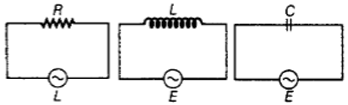
$ii$. Three electrical circuits having $AC$ sources of variable frequency are shown in the figures. Initially, the current flowing in each of these is same. If the frequency of the applied $AC$ source is increased, how will the current flowing in these circuits be affected? Give the reason for your answer.
Answer
View full question & answer→$i$. The sharpness of resonance in series $L-C-R$ circuit refers how quick fall of alternating current in circuit takes place when the frequency of alternating voltage shifts away from the resonant frequency. It is measured by the quality factor $(Q-$ factor$)$ of circuit.
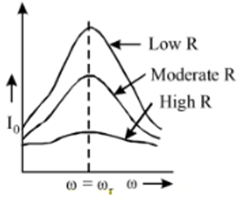
The $Q -$ factor of the series resonant circuit is defined as the ratio of the voltage developed across the capacitance or inductance at resonance to the impressed voltage which is the voltage applied.
$\text { i.e., quality factor }( Q )=\frac{\text { voltageacross } L \text { or } C}{\text { applied voltage }}$
$Q =\frac{\left(\omega_{ r } L\right) I}{R I}$
${[\because \text { applied voltage }=\text { voltage across R }]}$
$\text { or } Q =\frac{\omega_r L}{R} \text { or } Q =\frac{\left(1 / \omega_r C\right) I}{R I}=\frac{1}{R C \omega_r}$
$\therefore Q =\frac{L}{R C \cdot \frac{1}{\sqrt{L C}}} \text { [using } \omega_r=\frac{1}{\sqrt{L C}}$
$\text { Thus, } Q =\frac{1}{R} \sqrt{\frac{L}{C}}$
This is required expression.
$ii$. Let initially $I _{ r }$ current is flowing in all the three circuits.
If the frequency of applied $AC$ source is increased then, the change in current will occur in the following manner:
Circuit containing resistance $R$ only:
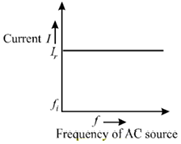
where, $f _{ i }=$ initial frequency of $AC$ source.
There is no effect on current with the increase in frequency.
$AC$ circuit containing inductance only:
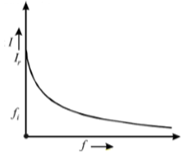
With the increase of frequency of $AC$ source, inductive reactance increase as
$I=\frac{V_\text{ rms }}{X_L}=\frac{V_\text{ mms }}{2 \pi f L}$
For given circuit $, I \propto \frac{1}{f}$
Current decreases with the increase of frequency.
$AC$ circuits containing capacitor only:
$ X _{ C }=\frac{1}{\omega C}=\frac{1}{2 \pi f C}$
$\text { Current, } I =\frac{V_{ mms }}{X_{ C }}=\frac{V_\text{ rms }}{\left(\frac{1}{2 \pi f C}\right)}$
$I =2 \pi f C V_\text{ rms }$
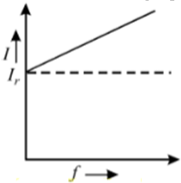
For given circuit, $I \propto f$
Current increases with the increase of frequency.
The $Q -$ factor of the series resonant circuit is defined as the ratio of the voltage developed across the capacitance or inductance at resonance to the impressed voltage which is the voltage applied.
$\text { i.e., quality factor }( Q )=\frac{\text { voltageacross } L \text { or } C}{\text { applied voltage }}$
$Q =\frac{\left(\omega_{ r } L\right) I}{R I}$
${[\because \text { applied voltage }=\text { voltage across R }]}$
$\text { or } Q =\frac{\omega_r L}{R} \text { or } Q =\frac{\left(1 / \omega_r C\right) I}{R I}=\frac{1}{R C \omega_r}$
$\therefore Q =\frac{L}{R C \cdot \frac{1}{\sqrt{L C}}} \text { [using } \omega_r=\frac{1}{\sqrt{L C}}$
$\text { Thus, } Q =\frac{1}{R} \sqrt{\frac{L}{C}}$
This is required expression.
$ii$. Let initially $I _{ r }$ current is flowing in all the three circuits.
If the frequency of applied $AC$ source is increased then, the change in current will occur in the following manner:
Circuit containing resistance $R$ only:
where, $f _{ i }=$ initial frequency of $AC$ source.
There is no effect on current with the increase in frequency.
$AC$ circuit containing inductance only:
With the increase of frequency of $AC$ source, inductive reactance increase as
$I=\frac{V_\text{ rms }}{X_L}=\frac{V_\text{ mms }}{2 \pi f L}$
For given circuit $, I \propto \frac{1}{f}$
Current decreases with the increase of frequency.
$AC$ circuits containing capacitor only:
$ X _{ C }=\frac{1}{\omega C}=\frac{1}{2 \pi f C}$
$\text { Current, } I =\frac{V_{ mms }}{X_{ C }}=\frac{V_\text{ rms }}{\left(\frac{1}{2 \pi f C}\right)}$
$I =2 \pi f C V_\text{ rms }$
For given circuit, $I \propto f$
Current increases with the increase of frequency.