Question 14 Marks
When electric dipole is placed in uniform electric field, its two charges experience equal and opposite forces, which cancel each other and hence net force on electric dipole in uniform electric field is zero. However these forces are not collinear, so they give rise to some torque on the dipole. Since net force on electric dipole in uniform electric field is zero. so no work is done in moving the electric dipole in uniform electric field. However some work is done in rotating the dipole against the torque acting on it.
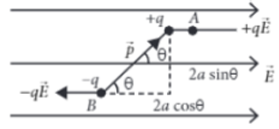
$(i)$ The dipole moment of a dipole in a uniform external field $\vec{E}$ is $\vec{P}$. Then the torque $\vec{\tau}$ acting on the dipole is
$(a) \ \vec{\tau}=2(\vec{P}+\vec{E})$
$(b) \ \vec{\tau}=\vec{P} \cdot \vec{E}$
$(c) \ \vec{\tau}=(\vec{P}+\vec{E})$
$(d) \ \vec{\tau}=\vec{P} \times \vec{E}$
$(ii)$ An electric dipole consists of two opposite charges, each of magnitude $1.0 \mu C$ separated by a distance of $2.0 \ cm$ . The dipole is placed in an external field of $10^5 NC ^{-1}$. The maximum torque on the dipole is
$(a) \ 4 \times 10^{-3} Nm$
$(b) \ 2 \times 10^{-3} Nm$
$(c) \ 1 \times 10^{-3} Nm$
$(d) \ 0.2 \times 10^{-3} Nm$
$(iii)$ Torque on a dipole in uniform electric field is minimum when $\theta$ is equal to
$(a) \ 0^{\circ} \ (b) \ 90^{\circ}\ (c) \ 180^{\circ} \ (d)$ Both $0^{\circ}$ and $180^{\circ}$
$(iv)$ When an electric dipole is held at an angle in a uniform electric field, the net force $F$ and torque on the dipole are
$(a) \ F =0, \tau=0$
$(b) \ F \neq 0, \tau \neq 0$
$(c) \ F \neq 0, \tau=0$
$(d) \ F =0, \tau \neq 0$
OR
An electric dipole of moment $p$ is placed in an electric field of intensity $E$. The dipole acquires a position such that the axis of the dipole makes an angle $\theta$ with the direction of the field. Assuming that the potential energy of the dipole to be zero when $\theta=90^{\circ}$, the torque and the potential energy of the dipole will respectively be
$(a) \ pE \sin \theta,- pE \cos \theta$
$(b) \ pE \cos \theta,- pE \sin \theta$
$(c) \ pE \sin \theta, 2 pE \cos \theta$
$(d) \ pE \sin \theta,-2 pE \cos \theta$
$(i)$ The dipole moment of a dipole in a uniform external field $\vec{E}$ is $\vec{P}$. Then the torque $\vec{\tau}$ acting on the dipole is
$(a) \ \vec{\tau}=2(\vec{P}+\vec{E})$
$(b) \ \vec{\tau}=\vec{P} \cdot \vec{E}$
$(c) \ \vec{\tau}=(\vec{P}+\vec{E})$
$(d) \ \vec{\tau}=\vec{P} \times \vec{E}$
$(ii)$ An electric dipole consists of two opposite charges, each of magnitude $1.0 \mu C$ separated by a distance of $2.0 \ cm$ . The dipole is placed in an external field of $10^5 NC ^{-1}$. The maximum torque on the dipole is
$(a) \ 4 \times 10^{-3} Nm$
$(b) \ 2 \times 10^{-3} Nm$
$(c) \ 1 \times 10^{-3} Nm$
$(d) \ 0.2 \times 10^{-3} Nm$
$(iii)$ Torque on a dipole in uniform electric field is minimum when $\theta$ is equal to
$(a) \ 0^{\circ} \ (b) \ 90^{\circ}\ (c) \ 180^{\circ} \ (d)$ Both $0^{\circ}$ and $180^{\circ}$
$(iv)$ When an electric dipole is held at an angle in a uniform electric field, the net force $F$ and torque on the dipole are
$(a) \ F =0, \tau=0$
$(b) \ F \neq 0, \tau \neq 0$
$(c) \ F \neq 0, \tau=0$
$(d) \ F =0, \tau \neq 0$
OR
An electric dipole of moment $p$ is placed in an electric field of intensity $E$. The dipole acquires a position such that the axis of the dipole makes an angle $\theta$ with the direction of the field. Assuming that the potential energy of the dipole to be zero when $\theta=90^{\circ}$, the torque and the potential energy of the dipole will respectively be
$(a) \ pE \sin \theta,- pE \cos \theta$
$(b) \ pE \cos \theta,- pE \sin \theta$
$(c) \ pE \sin \theta, 2 pE \cos \theta$
$(d) \ pE \sin \theta,-2 pE \cos \theta$
Answer
View full question & answer→When electric dipole is placed in uniform electric field, its two charges experience equal and opposite forces, which cancel each other and hence net force on electric dipole in uniform electric field is zero. However these forces are not collinear, so they give rise to some torque on the dipole. Since net force on electric dipole in uniform electric field is zero. so no work is done in moving the electric dipole in uniform electric field. However some work is done in rotating the dipole against the torque acting on it.
$(i) \ (d) \vec{\tau}=\vec{P} \times \vec{E}$
Explanation: As $\tau=$ either force $\times$ perpendicular distance between the two forces
$= qaE \sin \theta \text { or } \tau= PE \sin \theta$
$\text { or } \vec{P} \times \vec{E}(\because qa = P )$
$(ii) \ (b) 2 \times 10^{-3} Nm$
Explanation: The maximum torque on the dipole in an external field is given by
$\tau= pE = q (2 a ) \times E$
$\text { Here, } q =1 \mu C =10^{-6} C , 2 a =2 \ cm=2 \times 10^{-2} m, E =10^5 NC ^{-1}, \tau=?$
$\therefore \tau=10^{-6} \times 2 \times 10^{-2} \times 10^5=2 \times 10^{-3} Nm $
$(iii) (d)$ Both $0^{\circ}$ and $180^{\circ}$
Explanation: When $\theta$ is $0$ or $180^{\circ}$, the $\tau$ is minimum, which means the dipole moment should be parallel to the direction of the uniform electric field.
$(iv) \ (d) F =0, \tau \neq 0$
Explanation: Net force is zero and torque acts on the dipole, trying to align $p$ with $E .$
OR
$(a) pE \sin \theta,- pE \cos \theta$
Explanation: Torque, $\tau= pE \sin \theta$ and potential energy
$U=-p E \cos \theta$
$(i) \ (d) \vec{\tau}=\vec{P} \times \vec{E}$
Explanation: As $\tau=$ either force $\times$ perpendicular distance between the two forces
$= qaE \sin \theta \text { or } \tau= PE \sin \theta$
$\text { or } \vec{P} \times \vec{E}(\because qa = P )$
$(ii) \ (b) 2 \times 10^{-3} Nm$
Explanation: The maximum torque on the dipole in an external field is given by
$\tau= pE = q (2 a ) \times E$
$\text { Here, } q =1 \mu C =10^{-6} C , 2 a =2 \ cm=2 \times 10^{-2} m, E =10^5 NC ^{-1}, \tau=?$
$\therefore \tau=10^{-6} \times 2 \times 10^{-2} \times 10^5=2 \times 10^{-3} Nm $
$(iii) (d)$ Both $0^{\circ}$ and $180^{\circ}$
Explanation: When $\theta$ is $0$ or $180^{\circ}$, the $\tau$ is minimum, which means the dipole moment should be parallel to the direction of the uniform electric field.
$(iv) \ (d) F =0, \tau \neq 0$
Explanation: Net force is zero and torque acts on the dipole, trying to align $p$ with $E .$
OR
$(a) pE \sin \theta,- pE \cos \theta$
Explanation: Torque, $\tau= pE \sin \theta$ and potential energy
$U=-p E \cos \theta$