Questions

Case study (4 Marks)

🎯

Test yourself on this topic

2 questions · timed · auto-graded

Question 14 Marks
A charge is a property associated with the matter due to which it experiences and produces an electric and magnetic field. Charges are scalar in nature and they add up like real numbers. Also, the total charge of an isolated system is always conserved. When the objects rub against each other charges acquired by them must be equal and opposite.
Image
(i) The cause of charging is:
(a) the actual transfer of atoms
(b) the actual transfer of protons
(c) the actual transfer of electrons
(d) the actual transfer of neutrons

(ii) Pick the correct statement.
i. The glass rod gives protons to silk when they are rubbed against each other.
ii. The glass rod gives electrons to silk when they are rubbed against each other.
iii. The glass rod gains protons from silk when they are rubbed against each other.
iv. The glass rod gains electrons when they are rubbed against each other.
(a) Option (i) (b) Option (iv) (c) Option (iii) (d) Option (ii)

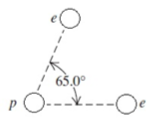
(iii) If two electrons are each $1.5 \times 10^{-10} m$ from a proton, as shown in Figure, magnitude of the net electric force they will exert on the proton is
Image

(a) $1.97 \times 10^{-8} N$
(b) $3.83 \times 10^{-8} N$
(c) $4.63 \times 10^{-8} N$
(d) $2.73 \times 10^{-8} N$

(iv) A charge is a property associated with the matter due to which it produces and experiences:
(a) electric effects only
(b) magnetic effects only
(c) both electric and magnetic effects
(d) non magnetic effects only

OR

The cause of quantization of electric charges is:
(a) transfer of an integral number of electrons
(b) transfer of an integral number of neutrons
(c) transfer of an integral number of protons
(d) transfer of an integral number of Atom
Answer
A charge is a property associated with the matter due to which it experiences and produces an electric and magnetic field. Charges are scalar in nature and they add up like real numbers. Also, the total charge of an isolated system is always conserved. When the objects rub against each other charges acquired by them must be equal and opposite.
Image
(i) (c) the actual transfer of electrons
Explanation: the actual transfer of electrons

(ii) (d) Option (ii)
Explanation: The glass rod gives electrons to silk when they are rubbed against each other.

(iii) (a) $1.97 \times 10^{-8} N$
Explanation: $1.97 \times 10^{-8} N$

(iv) (c) both electric and magnetic effects
Explanation: both electric and magnetic effects

OR

(a) transfer of an integral number of electrons
Explanation: transfer of an integral number of electrons
View full question & answer
Question 24 Marks
Answer
Electrons oscillating in a circuit give rise to radiowaves. A transmitting antenna radiates most effectively the radiowaves of wavelength equal to the size of the antenna. The infrared waves incident on a substance set into oscillation all its electrons, atoms and molecules. This increases the internal energy and hence the temperature of the substance.
(i). (d) $v_g=v_X=v_m$
Explanation: All electromagnetic waves travel in vacuum with the same speed.

(ii) (d) cathode rays
Explanation: Cathode rays (beam of electrons) get deflected in an electric field

(iii) (b) ionization chamber
Explanation: rays are detected by ionization chamber.

OR

(d) Option (i)
Explanation: Everybody at a temperature T > 0 K emits radiation in the infrared region.

(iv) (a) $10^{14} Hz$\
Explanation: Size of particle $=\lambda=\frac{c}{v}$
$\nu=\frac{c}{\lambda}=\frac{3 \times 10^{10} am s ^{-1}}{3 \times 10^{-4} cm^2}=3 \times 10^{14} Hz$
View full question & answer
Case study (4 Marks) - Physics STD 12 Science Questions - Vidyadip