Questions

2 Marks Questions

🎯

Test yourself on this topic

6 questions · timed · auto-graded

Question 12 Marks
A deuteron and an alpha particle having same momentum are in turn allowed to pass through a magnetic field $\vec{B}$, acting normal to the direction of motion of the particles. Calculate the ratio of the radii of the circular paths described by them.
Answer
$ R =\frac{m v}{q B}$
$R =\frac{m v}{q B}=\frac{\rho}{q B}$
Now, $\frac{q_d}{q_\alpha}=\frac{e}{2 e}=\frac{1}{2}$
$\therefore \frac{r_d}{r_\alpha}=\frac{q_a}{q_d}=\frac{2}{1}$
View full question & answer
Question 22 Marks
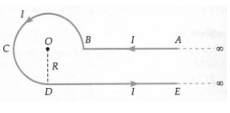
A current I is flowing in an infinitely long conductor bent into the shape shown in Fig. If the radius of the curved part is R, find the magnetic field at the centre O. 
Image
Answer
As the point O lies on the straight part AB, So 
$B _{ AB }=0$
$B_{B C D}=\frac{\mu_0 I}{4 \pi R} \cdot \frac{3 \pi}{2}$, acting normally outward
$B_{D E}=\frac{\mu_0 I}{4 \pi R}\left(\sin 90^{\circ}+\sin 0^{\circ}\right)=\frac{\mu_0 I}{4 \pi R}$, acting normally outward
Total magnetic field at the centre O 
$B = B _{ AB }+ B _{ BCD }+ B _{ DE }$
$=0+\frac{\mu_0 I}{4 \pi R} \cdot \frac{3 \pi}{2}+\frac{\mu_0 I}{4 \pi R}$
or $B=\frac{\mu_0 I}{4 \pi R}\left(\frac{3 \pi}{2}+1\right)$, acting normally outward.
View full question & answer
Question 32 Marks
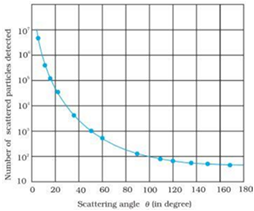
Briefly explain Geiger-Marsden experiment. Show the variation of the number of particles scattered (N) with scattering angle $(\theta)$ in this experiment. What is the main conclusion that can be inferred from this plot?
Answer
The alpha-particles emitted by a radioactive source were allowed to fall on a thin foil of gold. The scattered alpha-particles were observed through a rotatable detector consisting of zinc sulphide screen and a microscope. The scattered alpha-particles on striking the screen produced brief light flashes. 
Image

Conclusion: The existence of positively charged nucleus inside an atom and provide an upper limit to the size of the nucleus.
View full question & answer
Question 42 Marks
Explain the variation of resistivity with temperature in pure-semiconductors.
Answer
The resistivity of a semiconductor is given by 
$\rho=\frac{1}{\sigma}=\frac{1}{e\left(n_e \mu_e+n_h \mu_h\right)}$
As the temperature increases, the mobilities $\mu_e$ and $\mu_h$ of electrons and holes decrease due to the increase in their collision frequency. But due to the small energy gap of semiconductors, more and more electrons ( $n \propto e^{-E_g / k_B T}$ ) from the valence band cross over to the conduction band. The increase in carrier concentrations, $n _{ e }$ and $n _{ h }$ is so large that decrease in the values of $\mu_e$ and $\mu_h$ has no influence. The overall effect is that conductivity increases or resistivity decreases with the increase of temperature.
View full question & answer
Question 52 Marks
$a.$ Show that the time period $(T)$ of oscillations of a freely suspended magnetic dipole of magnetic moment $(m)$ in a uniform magnetic field $(B)$ is given by $T=2 \pi \sqrt{\frac{I}{m B}}$, where $I$ is a moment of inertia of the magnetic dipole.
$b.$ Identify the following magnetic materials:
$i.$ A material having susceptibility $\left(\chi_m\right)=-0.00015$.
$ii.$ A material having susceptibility $\left(\chi_m\right)=10^{-5}$.
Answer
$a.$ Let us consider a uniform magnetic field $\vec{B}$ exists in the region, in which a magnet of dipole moment $\vec{m}$ is placed.
The dipole is making small angle $\theta$ with the magnetic field.
The torque acts on the magnet is given by
$\vec{\tau}=\vec{m} \times \vec{B}$
$= mB \sin \theta$ In magnitude, $\tau= mB \sin \theta$
$=- mB \sin \theta(\because \theta \text { in small }) \ldots \text { (i) }$
Also the torque on dipole try to restore its initial position
i.e., along the direction of magnetic field. $(I =$ moment of inertia$)$ In equilibrium
$I \frac{d^2 \theta}{d t^2}=-m B \sin \theta \ldots( ii )$
Negative sign implies that restoring torque is in opposition to deflecting torque.
$\frac{d^2 \theta}{d t^2}=\frac{-m B}{I} \theta \ldots (iii)$
Comparing with equation of angular $\text{SHM}$
$\frac{d^2 \theta}{d t^2}=-\omega^2 \phi \ldots (iv)$
We have
$\omega^2=\frac{m B}{I}$
$\Rightarrow \omega=\sqrt{\frac{m B}{I}}$
$\Rightarrow \frac{2 \pi}{T}=\sqrt{\frac{m B}{I}}$
$\Rightarrow \frac{T}{2 \pi}=\sqrt{\frac{I}{m B}}$
$T=2 \pi \sqrt{\frac{I}{m B}}$
$b. i.$Diamagnetic substance.
$ii.$ Paramagnetic substance.
View full question & answer
Question 62 Marks
Which of the following electromagnetic waves has (a) minimum wavelength, and (b) minimum frequency? Write one use of each of these two waves.
Infrared waves, Microwaves, $\gamma$-rays and X-rays
Answer
The minimum wavelength or Maximum frequency has maximum energy and vice versa, $\gamma$ - Ray has maximum energy so it has a minimum wavelength and Microwaves have minimum energy so it has a maximum frequency.
Use of electromagnetic waves: 
Infrared waves:
Heat-sensitive thermal imaging cameras, Remote controls. 
Microwaves: microwave radio relay networks, radar, satellite, and spacecraft communication. 
$\gamma$-rays: Used as tracers in medicine, Astronomy.
X-rays: checking fracture
View full question & answer
2 Marks Questions - Physics STD 12 Science Questions - Vidyadip