Question 13 Marks
A rectangular loop of wire $\text{ABCD}$ is kept close to an infinitely long wire carrying a current $I ( t )= l _0\left(1-\frac{t}{T}\right)$ for $0 \leq t \leq T$ and $I (0)=0$ for $t > T ($Figure$)$. Find the total charge passing through a given point in the loop, in time $T$ . The resistance of the loop is $R$.
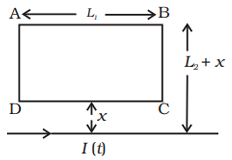
Answer
View full question & answer→To find the charge that passes through the circuit first we have to find the relation between instantaneous current and instantaneous magnetic flux linked with it. The emf induced can be obtained by differentiating the expression of magnetic flux linked $\text{w.r.t.}$ t and then applying Ohm's law, we get A rectangular loop of wire $\text{ABCD}$ is kept close to an infinitely long wire carrying a current
$I=\frac{E}{R}=\frac{1}{R} \frac{d \phi}{d t}$
According to the problem electric current is given as a function of time.
$I(t)=\frac{d Q}{d t}$ or $\frac{d Q}{d t}=\frac{1}{R} \frac{d \phi}{d t}$
Integrating the variable separately in the form of the differential equation for finding the charge $Q$ that passed in time $t$, we have
$Q\left(t_1\right)-Q\left(t_2\right)=\frac{1}{R}\left[\phi\left(t_1\right)-\phi\left(t_2\right)\right]$
$\phi\left(t_1\right)=L_1 \frac{\mu_0}{2 \pi} \int_x^{L_2+x} \frac{d x^2}{x^{\prime}} I\left(t_1\right)\left[\phi_m=\vec{B} \cdot \vec{A}=\frac{\mu_0 I}{2 \pi} l \int_{x_0}^x \frac{d r}{r}=\frac{\mu_0 I l}{2 \pi} \ln \frac{x}{x_0}\right]$
$=\frac{\mu_0 L_1}{2 \pi} I\left(t_1\right) \ln \frac{L_2+x}{x}$
Therefore the magnitude of charge is
$Q=\frac{1}{R}\left[\phi\left(T^{\prime}\right)-\phi(0)\right]$
$Q=\frac{\mu_0 L_1}{2 \pi} \ln \frac{L_2+x}{x}\left[I\left(T^{\prime}\right)-I(0)\right]$
Now $I(T)=I_1$ and $I(0)=0$
$\therefore Q=\frac{\mu_0 L_1}{2 \pi} I_1 \ln \left(\frac{L_2+x}{x}\right)$
This is the required expression.
$I=\frac{E}{R}=\frac{1}{R} \frac{d \phi}{d t}$
According to the problem electric current is given as a function of time.
$I(t)=\frac{d Q}{d t}$ or $\frac{d Q}{d t}=\frac{1}{R} \frac{d \phi}{d t}$
Integrating the variable separately in the form of the differential equation for finding the charge $Q$ that passed in time $t$, we have
$Q\left(t_1\right)-Q\left(t_2\right)=\frac{1}{R}\left[\phi\left(t_1\right)-\phi\left(t_2\right)\right]$
$\phi\left(t_1\right)=L_1 \frac{\mu_0}{2 \pi} \int_x^{L_2+x} \frac{d x^2}{x^{\prime}} I\left(t_1\right)\left[\phi_m=\vec{B} \cdot \vec{A}=\frac{\mu_0 I}{2 \pi} l \int_{x_0}^x \frac{d r}{r}=\frac{\mu_0 I l}{2 \pi} \ln \frac{x}{x_0}\right]$
$=\frac{\mu_0 L_1}{2 \pi} I\left(t_1\right) \ln \frac{L_2+x}{x}$
Therefore the magnitude of charge is
$Q=\frac{1}{R}\left[\phi\left(T^{\prime}\right)-\phi(0)\right]$
$Q=\frac{\mu_0 L_1}{2 \pi} \ln \frac{L_2+x}{x}\left[I\left(T^{\prime}\right)-I(0)\right]$
Now $I(T)=I_1$ and $I(0)=0$
$\therefore Q=\frac{\mu_0 L_1}{2 \pi} I_1 \ln \left(\frac{L_2+x}{x}\right)$
This is the required expression.