Question 14 Marks
Draw the graph of deviation angle $(\delta)$ versus incidence angle $(i)$ and derive the formula for refractive index $n_{21}=\frac{\sin \left(\frac{A+D_m}{2}\right)}{\sin \left(\frac{A}{2}\right)}$ for the material of prism.
Answer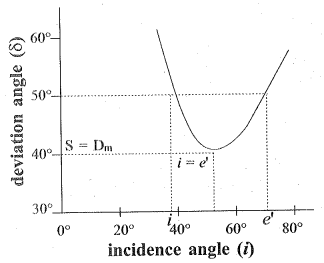
$\rightarrow$ The graph of deviation angle versus incidence angle is shown in figure.
$\rightarrow$ The graph shows that for a single value of deviation angle $(\delta)$ there are two values of incidence angle $i$ and hence also of $e$.
$\rightarrow$ From the symmetry it can be said that angle of deviation $\delta$ remains the same if angle of incidence $i$ and angle of emergent $e$ are interchanged.
Even if the path of ray can be traced back, resulting in the same angle of deviation.
$\rightarrow$ From the graph, for a particular value of $i=e$ the angle of incidence, a single value of deviation is obtained.
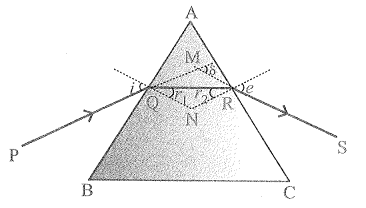
At the minimum deviation, $D _m,$ the refracted ray becomes parallel to its base.
$\rightarrow$ So when $\delta= D _m$ and $i=e$, then $r_1=r_2$.
$\rightarrow$ For prism, $ A =r_1+r_2$
$\therefore A =2 r_1$
$\therefore r_1 =\frac{ A }{2}......(1)$
$\rightarrow$ and from $\delta=i+e- A$,
$ D _m=2 i- A$
$2 i= D _m+ A$
$i=\frac{ A + D _m}{2}......(2)$
$\rightarrow$ Applying Snell's law at incident point $Q ,$
$n_1 \sin i=n_2 \sin r_1$
$\rightarrow$ Substituting value of $r_1$ and $i$ from equation $(1)$ and $(2),$
$\therefore n_1 \sin \left(\frac{ A + D _m}{2}\right)=n_2 \sin \left(\frac{ A }{2}\right)$
$\therefore \frac{n_2}{n_1}=\frac{\sin \left(\frac{ A + D _m}{2}\right)}{\sin \frac{ A }{2}}$
$\therefore n_{21}=\frac{\sin \left(\frac{ A + D _m}{2}\right)}{\sin \frac{ A }{2}}$
$\rightarrow$ which is the formula to find the refractive index of the material of the prism.
View full question & answer→$\rightarrow$ The graph of deviation angle versus incidence angle is shown in figure.
$\rightarrow$ The graph shows that for a single value of deviation angle $(\delta)$ there are two values of incidence angle $i$ and hence also of $e$.
$\rightarrow$ From the symmetry it can be said that angle of deviation $\delta$ remains the same if angle of incidence $i$ and angle of emergent $e$ are interchanged.
Even if the path of ray can be traced back, resulting in the same angle of deviation.
$\rightarrow$ From the graph, for a particular value of $i=e$ the angle of incidence, a single value of deviation is obtained.
At the minimum deviation, $D _m,$ the refracted ray becomes parallel to its base.
$\rightarrow$ So when $\delta= D _m$ and $i=e$, then $r_1=r_2$.
$\rightarrow$ For prism, $ A =r_1+r_2$
$\therefore A =2 r_1$
$\therefore r_1 =\frac{ A }{2}......(1)$
$\rightarrow$ and from $\delta=i+e- A$,
$ D _m=2 i- A$
$2 i= D _m+ A$
$i=\frac{ A + D _m}{2}......(2)$
$\rightarrow$ Applying Snell's law at incident point $Q ,$
$n_1 \sin i=n_2 \sin r_1$
$\rightarrow$ Substituting value of $r_1$ and $i$ from equation $(1)$ and $(2),$
$\therefore n_1 \sin \left(\frac{ A + D _m}{2}\right)=n_2 \sin \left(\frac{ A }{2}\right)$
$\therefore \frac{n_2}{n_1}=\frac{\sin \left(\frac{ A + D _m}{2}\right)}{\sin \frac{ A }{2}}$
$\therefore n_{21}=\frac{\sin \left(\frac{ A + D _m}{2}\right)}{\sin \frac{ A }{2}}$
$\rightarrow$ which is the formula to find the refractive index of the material of the prism.