Questions

3 Marks Question

🎯

Test yourself on this topic

7 questions · timed · auto-graded

Question 13 Marks
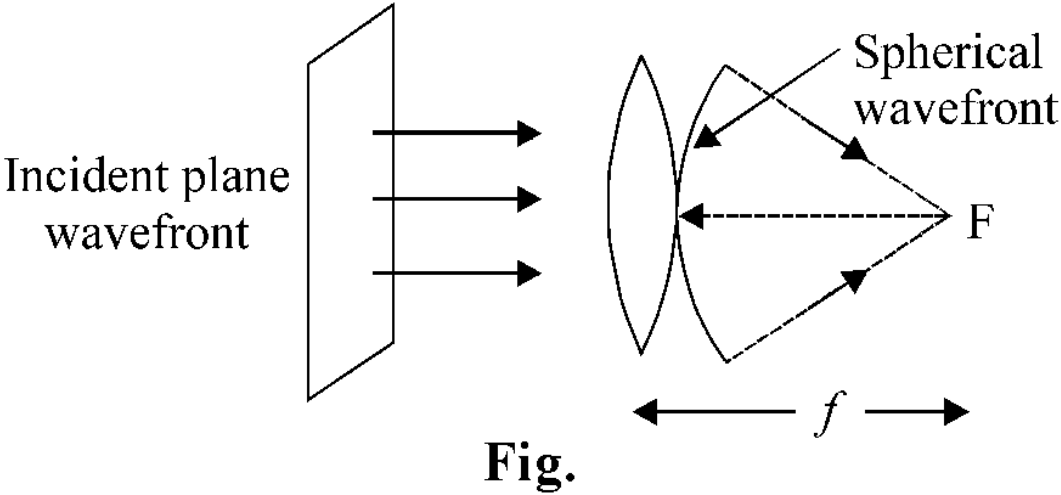
Write the definition of wavefront. Using Huygens' principle, draw the shape of a plane wave incident on a convex lens and the refracted wave body.
###
(a) When a wave propagates from a rarer medium to a denser medium, then which characteristic of that wave does not change and why?
(b) The refractive indices of two mediums are $\mu_1$ and $\mu_2$, what will be the ratio of velocities in the wave in them?
View full question & answer
Question 23 Marks
(a) When a telescope is turned upside down and looked at the objective, it appears very small, why?
(b) Why does this not happen in a microscope?
Answer
(a) In a telescope, the focal length $\left(f_o\right)$ of the objective lens is much more than the focal length $\left(f_e\right)$ of the eyepiece and its magnification power is $f_o / f_e$. On looking back, the magnification power will become $f_e / f_o$, because $f_o \ll f_e$ hence now the object will appear very small.
(b) The formula for the magnifying power of a compound microscope is $\frac{v_o}{u_o} \times \frac{ D }{f_e}$, because the value of $v _0$ is only slightly more than the focal length $f_o$ of the objective of the microscope, hence the magnification can be considered as $\frac{v_o}{f_o} \times \frac{ D }{f_e}$; because $f_o$ and $f_e$ both have low values. Therefore, even after turning the microscope, the magnification power remains almost unchanged due to there being no significant difference in the value of $v_0$.
View full question & answer
Question 33 Marks
(a) Stars located very far away, which cannot be seen with the eye, can be seen through a telescope. Why?
(b) The magnifying power of two telescopes is the same but the apertures of their objective lenses are different. What will be the change in the final images formed by them?
Answer
(a) The aperture of the lens of the eye is very small and the light coming from a star located very far away is very less and is unable to stimulate the retina of our eye. But the aperture of the telescope is much larger than that of the eye. Due to this, it can receive proper light from the distant star and forms a bright image of the star, which can be seen.
(b) The brightness of the images will varying; because it depends on the diameter of the aperture. The image formed by a telescope with an objective lens of a larger aperture will be brighter. Also, the resolving power $\left(\frac{ D }{1.22 \lambda}\right)$ of this telescope will also be higher than the smaller aperture of a telescope with an objective lens.
View full question & answer
Question 43 Marks
What is meant by pure and impure spectrum?
Answer
Pure spectrum : When rays of white light pass through a prism, each ray forms a spectrum on the screen. If each colour is seen separately in the spectrum, then this type of spectrum is called 'pure spectrum'. The following are the conditions for obtaining a pure spectrum :
(i) The line aperture should be narrow and located at the focus of the converging lens.
(ii) The prism should be in a position of minimum deviation.
(iii) Rays of the same colour emanating from the prism should be focused at one place by the converging lens.
(iv) The incident rays should be parallel.
Impure spectrum : When rays of white light pass through a prism then each ray produces a spectrum on the screen. Due to overlapping of different colors, these colours are not visible separately on the screen. This type of spectrum is called 'impure spectrum'.
View full question & answer
Question 63 Marks
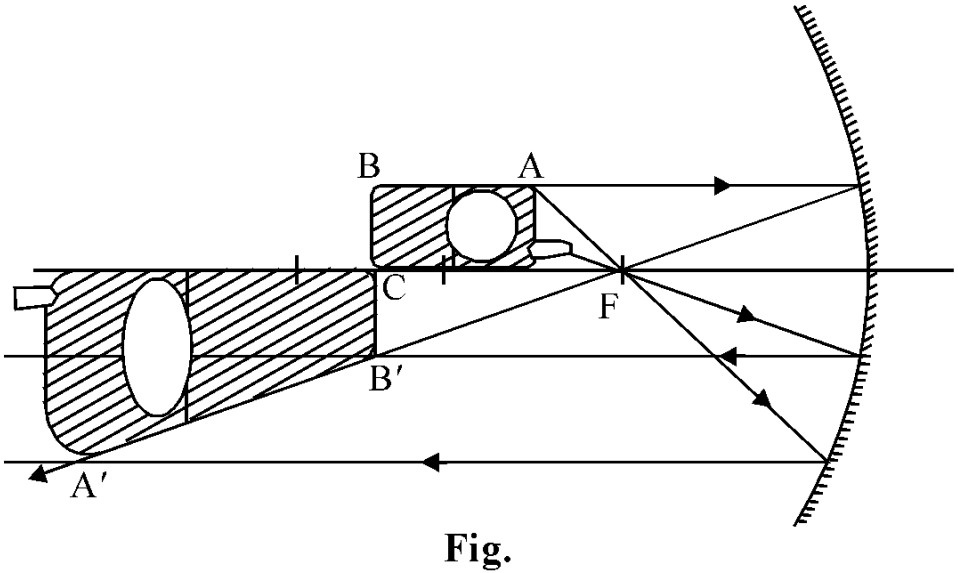
A mobile phone is placed on the principal axis of a concave mirror. Show the formation of the image with a suitable ray diagram. Explain why the magnification is not uniform. Does the distortion of the image depend on the position of the phone relative to the mirror?
View full question & answer
Question 73 Marks
Prove that $n_{12}=\frac{1}{\sin i_C}$ where $I_c$ is the critical angle.
Answer
The angle of incidence whose corresponding angle of refraction is $90^{\circ}$. It is called the critical angle $i_c$ for a given pair of mediums. From Snell's law $n_{21}=\frac{\sin i}{\sin r}$ we see that if the relative refractive index is less than one, then the maximum value of $\sin r$ is one. Therefore, there is an upper limit to the value of $\sin i$ up to which this rule can be applied.
This is $i=i_{ C }$, thus $\sin i_{ C }=n_{21}$
Snell's law of refraction cannot be applied to values of $i_c$ greater than $i$. Hence no refraction is possible. The refractive index of denser medium 2 will be relative to rarer medium 1.
$
n_{12}=\frac{1}{\sin i_C}
$
View full question & answer
3 Marks Question - Physics STD 12 Science Questions - Vidyadip