Questions · Page 5 of 5

M.C.Q (1 Marks)

MCQ 2011 Mark
In an $\text{LED}$ device, the intensity of emitted light:
  • A
    Increases continuously with the forward current of the diode.
  • Increases continuously with the forward current of the diode, reaches a maximum and then decreases.
  • C
    Decreases continuously with the forward current of the diode.
  • D
    Decreases continuously with the forward current of the diode, reaches a minimum and then increases.
Answer
Correct option: B.
Increases continuously with the forward current of the diode, reaches a maximum and then decreases.
The intensity of emitted light increase with the foreword current more the light intensity.
View full question & answer
MCQ 2021 Mark
The current flow in a Zener diode is mainly due to
  • A
    Thermally generated charge carriers
  • B
    Minority charge carriers
  • Collision generated charge carriers
  • D
    Ions
Answer
Correct option: C.
Collision generated charge carriers
When the reverse bias breakdown voltage is exceeded, a conventional diode is subject to high current due to avalanche breakdown.
Avalanche breakdown occurs in reverse bias when the applied voltage is high enough, the free electron may move fast enough to knock other electrons free, creating more free$-$electron$-$hole pairs $($i.e., more charge carriers$)$, increasing the current.
Thus, the current flow in a Zener diode is mainly due to collision generated charge carriers.
View full question & answer
MCQ 2031 Mark
On increasing the temperature of a semi$-$conductor material:
  • A
    Density of charge$-$carrier as well as their mobilities both increases.
  • Density of charge$-$carriers increases, but their mobilities decreases.
  • C
    Density of charge$-$carries decreases, but their mobilities increases.
  • D
    Both density of charge$-$carriers as well as their mobilities decreases.
Answer
Correct option: B.
Density of charge$-$carriers increases, but their mobilities decreases.
On increasing the temperature of a semi$-$conductor material, the density of charge increases which apparently increases the hinderance and thus decreases their mobility.
View full question & answer
MCQ 2041 Mark
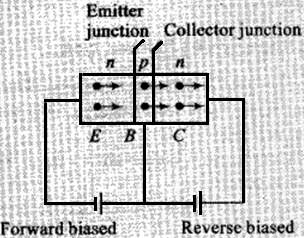
Consider an npn transitor with its base-emitter junction forward biased and collector base junction reverse biased. Which of the following statements are true?
  • A
    Electrons crossover from emitter to collector.
  • B
    Holes move from base to collector.
  • C
    Electrons move from emitter to base.
  • A and C both.
Answer
Correct option: D.
A and C both.
Solution:
Key concept: Transistor:
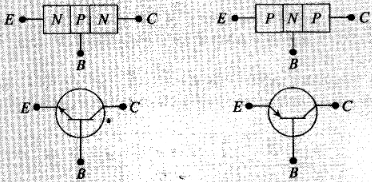
A junction transistor is formed by sandwiching a thin layer of P-type semiconductor between two N-type semiconductors or by sandwiching a thin layer of N-type semiconductor between two p-type semiconductors.

E - Emitter (emits majority charge carriers)
C - Collects majority charge carries
B - base (provide proper interaction between E and C)

In normal operation base-emitter is forward biased, i.e., the positive pole of emitter base battery is connected to base and its negative pole is connected to the emitter. And collector base junction is reverse biased, i.e., the positive pole of the collector base battery is connected to collector and negative pole to base. Thus, electron moves from emitter to base and crossover from emitter to collector.
View full question & answer
MCQ 2051 Mark
Zener breakdown takes place if:
  • A
    Doped impurity is low
  • Doped impurity is high
  • C
    Less impurity in $N-$part
  • D
    Less impurity in $P-$type
Answer
Correct option: B.
Doped impurity is high
Zener breakdown occurs due to heavily doped diodes.In this process electrons crosses the barrier from the valence band of the $p-$type to the conduction band of the lightly filled $n-$type material.
View full question & answer
MCQ 2061 Mark
If $‘p\ ’$ region of a semi conductor is connected to negative and $‘n\ ’$ region to positive pole, it is said to be :
  • A
    Directed biased
  • B
    Unbiased
  • C
    Forward biased
  • Reverse biased
Answer
Correct option: D.
Reverse biased
In reverse bias, $'p\ '$ region of a semi conductor is connected to negative pole and $'n\ '$ region to positive pole.
View full question & answer
MCQ 2071 Mark
In reverse biasing :
  • A
    Large amount of current flows.
  • Potential barrier across junction increases.
  • C
    Depletion layer resistance increases.
  • D
    No current flows.
Answer
Correct option: B.
Potential barrier across junction increases.
View full question & answer
MCQ 2081 Mark
In a semiconductor diode, the depletion region is removed when :
  • The diode is in its forward conducting state.
  • B
    The diode is in its reverse non$-$conducting state.
  • C
    There is no potential difference between the anode and cathode.
  • D
    None of these
Answer
Correct option: A.
The diode is in its forward conducting state.
In a semiconductor diode, when diode in its forward conducting state current starts in diode and depletion region starts to deformed. After sometime depletion region is removed.
View full question & answer
MCQ 2091 Mark
A transistor has three impurity regions. All the three regions have different doping levels. In order of increasing doping level, the regions are :
  • A
    Emitter, base and collector.
  • B
    Collector, base and emitter.
  • C
    Base, emitter and collector.
  • Base, collector and emitter.
Answer
Correct option: D.
Base, collector and emitter.
View full question & answer
MCQ 2101 Mark
Which of the following is$/$are optoelectronic devices?
  • A
    Photodiodes
  • B
    Solar cells
  • C
    Light emitting diodes
  • All of the above
Answer
Correct option: D.
All of the above
$P-n$ junctions are an integral part of several optoelectronic devices. These include photodiodes, solar cells light emitting diodes $\text{(LEDs)}$ and semiconductor lasers.
View full question & answer