Sample QuestionsCoordinate Geometry questions
One sample from each question group in this chapter. Select any group above to see the full set with answer keys.
The area of the triangle formed by the points $A(2, 0), B(6, 0)$ and $C(4, 6)$ is:
- A
$24$sq. unit
- ✓
$12$sq. unit
- C
$10$sq. unit
- D
Answer: B.
View full solution →A point whose abscissa is $-3$ and ordinate $2$ lies in:
Answer: B.
View full solution →A point whose abscissa and ordinate are $2$ and $-5$ respectively, lies in:
Answer: D.
View full solution →The ordinate of any point on $x$-axis is:
Answer: A.
View full solution →The abscissa of a point is positive in the:
- A
First and Second quadrant.
- B
Second and Third quadrant.
- C
Third and Fourth quadrant.
- ✓
Fourth and First quadrant.
Answer: D.
View full solution →Statement-1 $( A )$ : Points $(3,-3)$ and $(12,-4)$ lie in the same quadrant.
Statement-2 (R): Points $(-1,-1)$ and $(7,7)$ lie on the bisectors of third and first quadrant angles.
- A
Statement-1 is true, Statement-2 is true; Statement-2 is a correct explanation for Statement-1.
- ✓
Statement- 1 is true, Statement- 2 is true; Statement- 2 is not a correct explanation for Statement- 1.
- C
Statement-1 is true, Statement-2 is false.
- D
Statement- 1 is false, Statement-2 is true.
Answer: B.
View full solution →Statement-1 (A): The coordinates of a point whose ordinate is -2 and abscissa is 5 are $(-2,5)$.
Statement-2 $( R )$ : The coordinates of a point lying on positive $x$-axis at a distance of 9 units from the origin are $(9,0)$.
- A
Statement-1 is true, Statement-2 is true; Statement-2 is a correct explanation for Statement-1.
- B
Statement- 1 is true, Statement- 2 is true; Statement- 2 is not a correct explanation for Statement- 1.
- C
Statement-1 is true, Statement-2 is false.
- ✓
Statement- 1 is false, Statement-2 is true.
Answer: D.
View full solution →Statement-1 (A): The perpendicular distance of the point $(3,-7)$ from $x$-axis is 3 .
Statement-2 (R): The perpendicular distance of the point $(x, y)$ from $x$-axis $|y|$.
- A
Statement-1 is true, Statement-2 is true; Statement-2 is a correct explanation for Statement-1.
- B
Statement- 1 is true, Statement- 2 is true; Statement- 2 is not a correct explanation for Statement- 1.
- C
Statement-1 is true, Statement-2 is false.
- ✓
Statement- 1 is false, Statement-2 is true.
Answer: D.
View full solution →Statement-1 (A): The point $P(0,12)$ lies on $y$-axis.
Statement-2 (R): The abscissa of every point on $y$-axis is zero
- ✓
Statement-1 is true, Statement-2 is true; Statement-2 is a correct explanation for Statement-1.
- B
Statement- 1 is true, Statement- 2 is true; Statement- 2 is not a correct explanation for Statement- 1.
- C
Statement-1 is true, Statement-2 is false.
- D
Statement- 1 is false, Statement-2 is true.
Answer: A.
View full solution →Statement-1 (A): The point $P(-7,0)$ lies on $x$-axis.
Statement-2 (R): The ordinate of every point on $y$-axis is positive.
- A
Statement-1 is true, Statement-2 is true; Statement-2 is a correct explanation for Statement-1.
- B
Statement- 1 is true, Statement- 2 is true; Statement- 2 is not a correct explanation for Statement- 1.
- ✓
Statement-1 is true, Statement-2 is false.
- D
Statement- 1 is false, Statement-2 is true.
Answer: C.
View full solution →The points $O(0,0), A(6,0)$ and $B(0,4)$ form a _______________ triangle of area _______________ sq. units.
View full solution →The points $O(0,0), A(7,0)), B(7,4)$ and $C(0,4)$ form a _______________ .
View full solution →The points $O(0,0), A(5,0)$ and $B(0,5)$ are joined in order to form a/ an _______________ triangle.
View full solution →If $a>0$ and $b<0$, then the image of $(a, b)$ in $y$-axis lies in _______________ quadrant.
View full solution →The image of the point (-3,-2) in x-axis lies in _______________ quadrant.
For Maths integrated project, Sonia created a symmetrical design on Cartesian plain. She drew a fish in a rectangle ABCD in the 2nd quadrant as shown in figure.
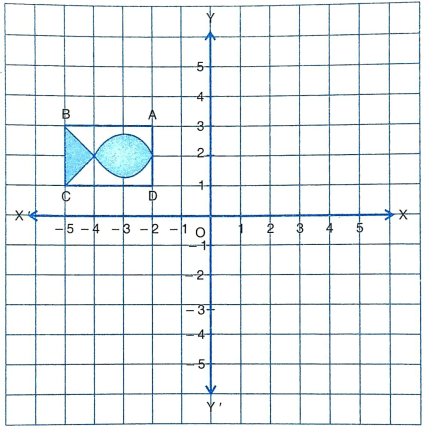
Based on the above information, answer the following questions:
(i) Find the sum of abscissa of points A and B.
(ii) Find the area of rectangle ABCD.
(iii) What will be the new coordinates of A, B, C and D to draw the reflection of fish in the $3^{\text {rd }}$ quadrant across $x$-axis.
(iv) What will be the new coordinates of A, B, C and D to draw the fish by shifting each vertex of the rectangle 5 units to the right. View full solution →Four persons John, Saurabh, Salim and Ratan are sitting in a courtyard at points A, B, C and D respectively as shown in Fig. The courtyard has been divided into small squares by drawing equally spaced horizontal and vertical lines. Taking OX and OY as the coordinates axes answer the following questions:
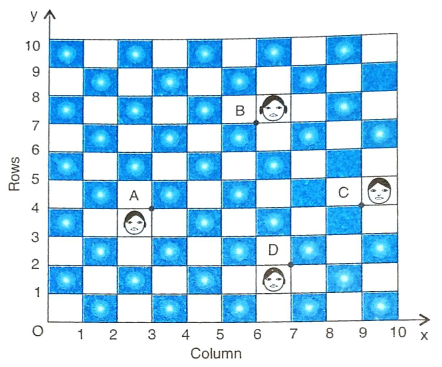
(i) The distance between John and Salim is
(a) 6 units $\quad$(b) 4 units $\quad$(c) 5 units $\quad$(d) 7 units
(ii) The distance between John and Saurabh is
(a) 6 units $\quad$(b) $3 \sqrt{2}$ units $\quad$(c) $6 \sqrt{2}$ units $\quad$(d) $2 \sqrt{2}$ units
(iii) The distance between John and Ratan is
(a) $2 \sqrt{5}$ units $\quad$(b) $2 \sqrt{10}$ units $\quad$(c) $\sqrt{5}$ units $\quad$(d) 20 units
(i) The coordinates of point A are
(a) $(4,3)$ $\quad$(b) $(3,4)$ $\quad$(c) $(3,3)$ $\quad$(d) $(4,4)$ View full solution →Four persons John, Saurabh, Salim and Ratan are sitting in a courtyard at points A, B, C and D respectively as shown in Fig. The courtyard has been divided into small squares by drawing equally spaced horizontal and vertical lines. Taking OX and OY as the coordinates axes answer the following questions:
(i) The coordinates of point A are
(a) $(4,3)$ $\quad$(b) $(3,4)$ $\quad$(c) $(3,3)$ $\quad$(d) $(4,4)$
(ii) The coordinates of point B are
(a) $(7,6)$ $\quad$(b) $(7,7)$ $\quad$(c) $(6,6)$ $\quad$(d) $(6,7)$
(iii) The coordinates of point C are
(a) $(9,3)$ $\quad$(b) $(9,4)$ $\quad$(c) $(4,9)$ $\quad$(d) $(10,4)$
(iv) The coordinates of point D are
(a) $(7,2)$ $\quad$(b) $(8,2)$ $\quad$(c) $(6,2)$ $\quad$(d) $(2,7)$ View full solution →Class IX students of a school in Moti Nagar, Delhi have been allotted a rectangular plot of land, adjacent to their school, for gardening activity. Saplings of Gulmohar are planted on the boundary at a distance of 1 m from each other. There is a triangular grassy lawn in the plot as shown in Fig. The students are to sow seeds of flowering plants on the remaining area of the plot. Considering A as origin, AD along $x$-axis and AB along $y$-axis, answer the following questions:
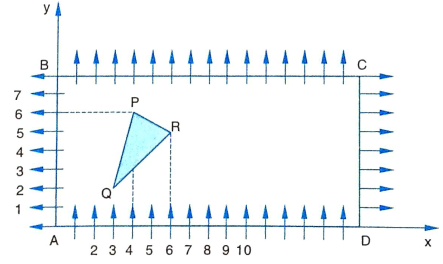
(i) The coordinates of A are
(a) $(0,1)$$\quad$(b) $(1,0)$$\quad$(c) $(0,0)$$\quad$(d) $(-1,-1)$
(ii) The coordinates of P are
(a) $(4,6)$$\quad$(b) $(6,4)$$\quad$(c) $(4,5)$$\quad$(d) $(5,4)$
(iii) The coordinates of R are
(a) $(6,5)$$\quad$(b) $(5,6)$$\quad$(c) $(6,0)$$\quad$(d) $(7,4)$
(iv) The coordinates of D are
(a) $(16,0)$$\quad$(b) $(6,0)$$\quad$(c) $(0,16)$$\quad$(d) $(16,1)$ View full solution →Floor of Jenny's study room is paved with square tiles. She observed that 4 ants $A, B, C$ and $D$ are moving on the floor following a straight lines path.
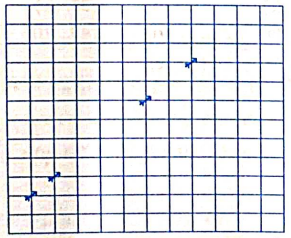
Study the location of ants on the floor as shown in the figure considering two perpendicular edges of the floor as axes; their meeting point as origin and the floor surface as the 1st quadrant.
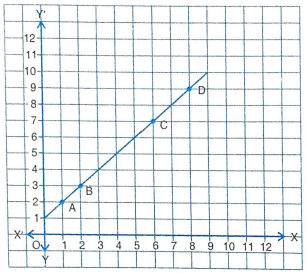
Choose the correct option in the following questions:
(i) Location of ants A, B, C and D in order are
(a) (1, 2), (2, 3), (6, 7), (8, 9)$\quad$(b) (2, 1), (3, 2), (7, 6), (9, 8)
(c) (8, 9), (6, 7), (2, 3), (1, 2)$\quad$(d) (9,8), (7,6), (3, 2), (2, 1)
(ii) Ants A, B, C and D are moving following the rule?
(a) x = y +1$\quad$(b) x + y = 1$\quad$(c) y = x + 1$\quad$(d) y = 2x
(iii) Which of the following ordered pair does not lie on the line?
(a) (4,5)$\quad$(b) (7,8)$\quad$(c) (9, 10)$\quad$(d) (8,7)
(iv) Which of the following is true?
(a) The line passes through the origin.$\quad$(b) The line meets x-axis at (0, 1).
(c) The line meets y-axis at (0, 1).$\quad$(d) None of these View full solution →Plot the following points on the graph paper: $(4, -3)$
View full solution →Plot the following points on the graph paper:$(0, 7)$
View full solution →Plot the following points on the graph paper:$(7, 0)$
View full solution →Plot the following points on the graph paper:$(0, 0)$
View full solution →Plot the following points on the graph paper$:(-3, 2)$
View full solution →