MCQ 11 Mark
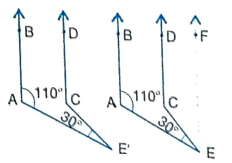
Statement-1 (A): In Fig., if $A B \| C D, \angle E A B=110^{\circ}$ and $\angle A E C=30^{\circ}$, then$\angle D C E=140^{\circ}$
Statement-2 (R): If two parallel lines are intersected by a tramsubersal, then each pair of alternate angles are equal.
Statement-2 (R): If two parallel lines are intersected by a tramsubersal, then each pair of alternate angles are equal.
- AStatement-1 and Statement-2 are true; Statement-2 is a correct explanation for Statement-4
- ✓Statement-1 and Statement-2 is true; Statement-2 is not a correct explanation for Statement-1.
- CStatement-1 is true, Statement-2 is false.
- DStatement-1 is false, Statement-2 is true.
Answer
View full question & answer→Correct option: B.
Statement-1 and Statement-2 is true; Statement-2 is not a correct explanation for Statement-1.
(b)
Statement-2 is true. From E draw EF parallel to AB or CD. Now, $E F \| C D$ and CE is the transversal intersecting CD and EF at C and E respectively.
$\therefore \quad \angle C E F+\angle D C E=180^{\circ}$$\quad$$[\because$ Co-interior angles are supplementary $]$
$\Rightarrow \quad \angle C E F=180^{\circ}-\angle D C E$$\quad$...(i)
Again $A B \| E F$ and transversal AE cuts them at A and E respectively.
$\therefore \quad \angle B A E+\angle A E F=180^{\circ}$$\quad$$[\because$ Co-interior angles are supplementary $]$
$\Rightarrow \quad 110^{\circ}+30^{\circ}+\angle C E F=180^{\circ} \Rightarrow \angle C E F=40^{\circ}$$\quad$...(ii)
From (i) and (ii), we obtain
$40^{\circ}=180^{\circ}-\angle D C E \Rightarrow \angle D C E=180^{\circ}-40^{\circ}=140^{\circ}$
Thus, both the statements are true but statement-2 is not a correct explanation for statement-1. Hence, option (b) is correct.
Statement-2 is true. From E draw EF parallel to AB or CD. Now, $E F \| C D$ and CE is the transversal intersecting CD and EF at C and E respectively.
$\therefore \quad \angle C E F+\angle D C E=180^{\circ}$$\quad$$[\because$ Co-interior angles are supplementary $]$
$\Rightarrow \quad \angle C E F=180^{\circ}-\angle D C E$$\quad$...(i)
Again $A B \| E F$ and transversal AE cuts them at A and E respectively.
$\therefore \quad \angle B A E+\angle A E F=180^{\circ}$$\quad$$[\because$ Co-interior angles are supplementary $]$
$\Rightarrow \quad 110^{\circ}+30^{\circ}+\angle C E F=180^{\circ} \Rightarrow \angle C E F=40^{\circ}$$\quad$...(ii)
From (i) and (ii), we obtain
$40^{\circ}=180^{\circ}-\angle D C E \Rightarrow \angle D C E=180^{\circ}-40^{\circ}=140^{\circ}$
Thus, both the statements are true but statement-2 is not a correct explanation for statement-1. Hence, option (b) is correct.