Questions

2 Marks Questions

🎯

Test yourself on this topic

7 questions · timed · auto-graded

Question 12 Marks
A team of $10$ interns and $1$ professor from zoological department visited a forest, where they set up a conical tent for their accommodation. There they perform activities like planting saplings, yoga, cleaning lakes, testing the water for contaminants and pollutant levels and desilt the lake bed and also using the silt to strengthen bunds. Find the radius and height of the tent if the base area of tent is $154 \ cm^2$ and curved surface area of the tent is $396 \ cm ^2$.
Answer
A tent is of conical shape Thus,
Base area $=\pi r^2=154 \ cm^2$
So, radius $r = 7 \ cm$
Curved surface area $=\pi r l=396 \ cm^2$
$396=3.14 \times 7 \times 1$
$\Rightarrow 1=18 \ cm$
Now, height $h=\sqrt{l^2-r^2}$
$=\sqrt{18^2-7^2}=16.5 \ cm$
View full question & answer
Question 22 Marks
If the volume of a right circular cone of height $9 \ cm$ is $48 \pi \ cm^3$, find the diameter of its base.
Answer
Let the radius of the base of the right circular cone be $r \ cm.$
$ h =9 \ cm,$ volume $=48 \pi \ cm^3$
$\Rightarrow \frac{1}{3} \pi r^2 h=48 \pi$
$\Rightarrow \frac{1}{3} r^2 h=48$
$\Rightarrow \frac{1}{3} \times r^2 \times 9=48$
$\Rightarrow r ^2=\frac{48 \times 3}{9}$
$\Rightarrow r ^2=16$
$\Rightarrow r =\sqrt{16}=4 \ cm$
$\Rightarrow 2 r =2(4)=8 \ cm .$
$\therefore$ the diameter of the base of the right circular cone is $8 \ cm .$
View full question & answer
Question 32 Marks
Express $0.35 \overline{7}$ in the form $\frac{p}{q}$, where $p$ and $q$ are integers and $q \neq 0$.
Answer
Let $x = 0 . 3 5 \overline{7}$.
Then,$x=0.35777 \ldots$
So, $100 x=35.777 \ldots . . . \text { (i) }$
$1000 x=357.777 \ldots \ldots \text {...(ii) }$
Subtracting $(i)$ from $(ii),$ we get
$1000 x-100 x=357.777 \ldots-35.777 \ldots$
$900 x=322$
$\Rightarrow x=\frac{822}{900}$
$\Rightarrow x=\frac{322}{900}=\frac{161}{450}$
View full question & answer
Question 42 Marks
Prove that: $\frac{a+b+c}{a^{-1} b^{-1}+b^{-1} c^{-1}+c^{-1} a^{-1}}= abc$
Answer
$\ce{LHS}$
$=\frac{a+b+c}{a^{-1} b^{-1}+b^{-1} c^{-1}+c^{-1} a^{-1}}$
$=\frac{a+b+c}{\frac{1}{a} \times \frac{1}{b}+\frac{1}{b} \times \frac{1}{c}+\frac{1}{c} \times \frac{1}{a}}$
$=\frac{a+b+c}{\frac{1}{ab}+\frac{1}{b c}+\frac{1}{ca}}$
$=\frac{\frac{a+b+c}{c+a+b}}{a b c}$
$=\frac{a b c(a+b+c)}{a+b+c}$
$=a b c$
$=\text { RHS }$
$\ce{LHS=RHS}$
Hence Proved
View full question & answer
Question 52 Marks
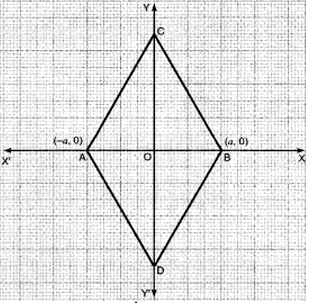
In Fig., if $\text{ABC}$ and $\text{ABD}$ are equilateral triangles then find the coordinates of $C$ and $D.$
Image
Answer
Here, $\text{AC} =2a$ and $\text{AO} =a$
By Pythagoras theorem
$\ce{OC^2 = AC^2 -  AO^2}=4 a^2-a^2=3 a^2$
$\text{OC} =a \sqrt{3}$
Therefore, coordinates of $C$ are $(0, a \sqrt{3})$
And the coordinates of $D$ are $(0,-a \sqrt{3})$.
View full question & answer
Question 62 Marks
Why is Axiom 5, in the list of Euclid's axioms, considered a universal truth?
Answer
Euclid's Axiom 5 states that "The whole is greater than the part. Since this is true for anything in any part of the world. So, this is a universal truth.
View full question & answer
2 Marks Questions - Maths STD 9 Questions - Vidyadip
