Questions

5 Marks Questions

🎯

Test yourself on this topic

6 questions · timed · auto-graded

Question 15 Marks
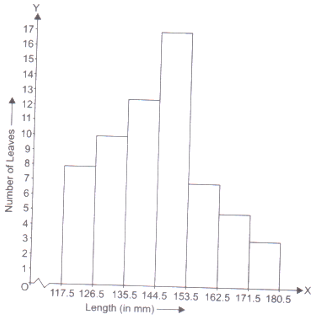
The lengths of 62 leaves of a plant are measured in millimetres and the data is represented in the following table:
Length (in mm)Number of leaves
118-1268
127-13510
136-14412
144-15317
154-1627
163-1715
172-1803
Number of leaves
View full question & answer
Question 25 Marks
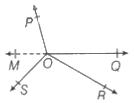
In the given figure, $O P, O Q, O R$ and $O S$ are four rays. Prove that $\angle POQ +\angle ROQ +\angle SOR +\angle POS =360^{\circ}$.
Image
Answer
Let us produce a ray $OQ$ backwards to a point $ M,$ then $\text{MOQ}$ is a straight line.
Now, $OP$ is a ray on the line $\text{MOQ}$. Then, by linear pair axiom, we have
Image
$\angle MOP +\angle POQ =180^{\circ} \ldots \ldots.(i)$
Similarly, $OS$ is a ray on the line $\text{MOQ}$.
Then, by linear pair axiom, we have
$\angle MOS+\angle SOQ=180^{\circ} \ldots$
Also, $\angle SOR$ and $\angle ROQ$ are adjacent angles.
$\therefore \angle SOQ=\angle SOR+\angle ROQ$
On putting the value of $\angle SOQ$ from Eq.$(iii)$ in Eq.$(ii),$ we get
$\angle MOS+\angle SOR+\angle ROQ=180^{\circ}$
Now, on adding Eqs.$(i)$ and $(iv),$ we get
$\angle MOP +\angle POQ +\angle MOS +\angle SOR +\angle ROQ =180^{\circ}+180^{\circ}$
$\Rightarrow \angle MOP +\angle MOS +\angle POQ +\angle SOR +\angle ROQ =360^{\circ} \ldots .( iv )$
But $\angle MOP +\angle MOS =\angle POS$
Then, from Eq.$(v),$ we get
$\angle POS+\angle POQ+\angle SOR+\angle ROQ=360^{\circ}$
View full question & answer
Question 35 Marks
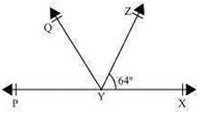
If is given that $\angle X Y Z=64^{\circ}$ and $X Y$ is produced to point $P.$ Draw a figure from the given information. If ray $YQ$ bisects $\angle ZYP$, find $\angle XYQ$ and reflex $\angle QYP$.
Answer
We are given that $\angle XYZ =64^{\circ}$, $XY$ is produced to $P$ and $YQ$ bisects $\angle ZYP$
We can conclude the given below figure for the given situation:
Image
We need to find $\angle XYQ$ and reflex $\angle QYP$
From the given figure,
we can conclude that $\angle XYZ$ and $\angle ZYP$ form a linear pair.
We know that sum of the angles of a linear pair is $180^{\circ}$.
$\angle XYZ+\angle ZYP=180^{\circ}$
But $\angle XYZ =64^{\circ}$
$\Rightarrow 64^{\circ}+\angle ZYP =180^{\circ}$
$\Rightarrow \angle ZYP =116^{\circ}$
Ray $YQ$ bisects $\angle ZYP , \text { or }$
$\angle QYZ =\angle QYP =\frac{11 \varphi^{\circ}}{2}=58^{\circ}$
$\angle XYQ =\angle QYZ +\angle XYZ$
$=58^{\circ}+64^{\circ}=122^{\circ} .$
Reflex $\angle QYP =360^{\circ}-\angle QYP$
$=360^{\circ}-58^{\circ}$
$=302^{\circ} .$
Therefore, we can conclude that $\angle XYQ =122^{\circ}$ and Reflex $\angle QYP =302^{\circ}$
View full question & answer
Question 45 Marks
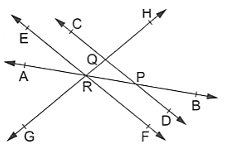
In the adjoining figure, name:
i. Two pairs of intersecting lines and their corresponding points of intersection
ii. Three concurrent lines and their points of intersection
iii. Three rays
iv. Two line segments
Image
Answer
i. $\overleftrightarrow{E F}, \overleftrightarrow{G H}$ and their corresponding point of intersection is R.
$\overleftrightarrow{A B}, \overleftrightarrow{C D}$ and their corresponding point of intersection is P .
ii. $\overleftrightarrow{A B}, \overleftrightarrow{E F}, \overleftrightarrow{G H}$ and their point of intersection is R .
iii. Three rays are: $\overrightarrow{ RB }, \overrightarrow{ RH }, \overrightarrow{ RG }$
iv. Two line segments are: $\overline{R Q}, \overline{R P}$.
View full question & answer
Question 55 Marks
Find the values of $a$ and $b$ if $\frac{7+3 \sqrt{5}}{3+\sqrt{5}}-\frac{7-3 \sqrt{5}}{3-\sqrt{5}}=a+b \sqrt{5}$.
Answer
$\ce{LHS}$
$=\frac{7+3 \sqrt{5}}{3+\sqrt{5}}-\frac{7-3 \sqrt{5}}{3-\sqrt{5}}$
$=\frac{7+3 \sqrt{5}}{3+\sqrt{5}} \times \frac{3-\sqrt{5}}{3-\sqrt{5}}-\frac{7-3 \sqrt{5}}{3-\sqrt{5}} \times \frac{3+\sqrt{5}}{3+\sqrt{5}}$
$=\frac{7 \times 3-7 \sqrt{5}+3 \sqrt{5} \times 3-3 \sqrt{5} \times \sqrt{5}}{3^2-\sqrt{5}^2}-\frac{7 \times 3+7 \sqrt{5}-3 \sqrt{5} \times 3-3 \sqrt{5} \times \sqrt{5}}{3^2-\sqrt{5}^2}$
$=\frac{21-7 \sqrt{5}+9 \sqrt{5}-15}{9-5}-\frac{21+7 \sqrt{5}-9 \sqrt{5}-15}{9-5}$
$=\frac{6+2 \sqrt{5}}{4}-\frac{6-2 \sqrt{5}}{4}$
$=\frac{6+2 \sqrt{5}-6+2 \sqrt{5}}{4}$
$=\frac{0+4 \sqrt{5}}{4}$
$=0+\sqrt{5}$
We know that,
$\frac{7+3 \sqrt{5}}{3+\sqrt{5}}-\frac{7-3 \sqrt{5}}{3-\sqrt{5}}=a+b \sqrt{5}$
$0+\sqrt{5}=a+b \sqrt{5}$
$a =0 \text { and } b =1$
View full question & answer
Question 65 Marks
If $p=\frac{3-\sqrt{5}}{3+\sqrt{5}}$ and $q=\frac{3+\sqrt{5}}{3-\sqrt{5}}$, find the value of $p ^2+ q ^2$.
Answer
$p=\frac{3-\sqrt{5}}{3+\sqrt{5}}$
$=\frac{3-\sqrt{5}}{3+\sqrt{5}} \times \frac{3-\sqrt{5}}{3-\sqrt{5}}$
$=\frac{(3-\sqrt{5})^2}{3^2-\sqrt{5^2}}$
$=\frac{9+5-6 \sqrt{5}}{9-5}$
$=\frac{14-6 \sqrt{5}}{4}$
$=\frac{7-3 \sqrt{5}}{2}$
$q=\frac{3+\sqrt{5}}{3-\sqrt{5}}$
$=\frac{3+\sqrt{5}}{3-\sqrt{5}} \times \frac{3+\sqrt{5}}{3+\sqrt{5}}$
$=\frac{(3+\sqrt{5})^2}{3^2-\sqrt{5}}$
$=\frac{9+5+6 \sqrt{5}}{9-5}$
$=\frac{14+6 \sqrt{5}}{4}$
$=\frac{7+3 \sqrt{5}}{2}$
$p^2+q^2$
$=\left(\frac{7-3 \sqrt{5}}{2}\right)^2+\left(\frac{7+3 \sqrt{5}}{2}\right)^2$
$=\frac{49+45-42 \sqrt{5}}{4}+\frac{49+45+42 \sqrt{5}}{4}$
$=\frac{94-42 \sqrt{5}}{4}+\frac{94+42 \sqrt{5}}{4}$
$=\frac{47-21 \sqrt{5}}{2}+\frac{47+21 \sqrt{5}}{2}$
$=\frac{47-21 \sqrt{5}+47+21 \sqrt{5}}{2}$
$=47$
View full question & answer