Questions · Page 1 of 2

Answer the questions.[Che-2M]

🎯

Test yourself on this topic

50 questions · timed · auto-graded

Question 12 Marks
Write two differences between isobars and isotopes. 
Answer
S.No
ISOTOPES
ISOBARS
1.
Atoms of same element but have different mass number.
1.
Atoms of different elements but having same mass number.
2.
They have same number of protons and electrons but different number of neutrons.
2.
They have same number of protons and neutrons but different atomic number.
3.
Example: Carbon- $_6^{12}\text{C}$ and $^{14}_6\text{C}$
3.
$^{40}_{18}\text{Ar}$ and $^{40}_{20}\text{Ca}.$
View full question & answer
Question 22 Marks
Write the electronic configuration of any one pair of isotopes and isobars.
Answer
Two isotopes of carbon are ${^{12}_{6}\text{C}}$ and ${^{14}_{6}\text{C}}$ .

The electronic configuration of ${^{12}_{6}\text{C}}$ is 2, 4.

The electronic configuration of ${^{14}_{6}\text{C}}$ is 2, 4.

[Isotopes have the same electronic configuration]

${^{40}_{20}\text{Ca}}$ and ${^{40}_{18}\text{Ar}}$ are a pair of isobars

The electronic configuration of ${^{40}_{20}\text{Ca}}$ is 2, 8, 8, 2.

The electronic configuration of ${^{40}_{18}\text{Ar}}$ is 2, 8, 8.

View full question & answer
Question 32 Marks
Write the distribution of electrons in carbon and sodium atoms.
Answer
Write the distribution of electrons in carbon and sodium atoms.

Carbon

Atomic number = 6

$\therefore$ 
No. of Protons = 6

and Number of Protons = Numberof electrons

$\therefore$ Distribution of electrons = KL

24

Sodium

Atomic number = 11

$\therefore$ No. of Protons = 11 = No. of electrons

$\therefore$ Distribution of electrons = K L M

2 8 1

View full question & answer
Question 42 Marks
Write any two uses of isotopes.
Answer
Uses of isotopes are as follows:
  1. Deuterium is used as a moderator in nuclear reactors to slow down the speed of fast-moving neutrons. 
  2. Deuterium and its compounds are used as a "tracer" in the study of mechanism of various chemical and metabolic reactions taking place in the body. 
  3. Tritium is used in nuclear fusion reactions. 
  4. Copper-64 is used to study genetic diseases affecting copper metabolism. 
  5. Iron-59 is used in studies of iron metabolism in the spleen.
View full question & answer
Question 52 Marks
Write any two observations which support the fact that atoms are divisible.
Answer
Discovery of electrons and discovery of protons support the fact that atoms are divisible. during a chemical reaction, there is an either transfer of electrons or sharing of electrons between different atoms which leads to the rearrangement of atoms.
View full question & answer
Question 62 Marks
With the help of Table 4.1, find out the mass number of oxygen and sulphur atom.
Answer
 Mass number of oxygen = Number of protons + Number of neutrons

= 8 + 8

= 16

Mass number of sulphur = Number of protons + Number of neutrons

= 16 + 16

= 32

View full question & answer
Question 72 Marks
Why is an atom neutral inspite of the presence of charged particles in it?
Answer
There are equal no. of positive and negative particles in an atom, so it is neutral as a whole.
View full question & answer
Question 82 Marks
Why helium and neon do not take part in chemical reactions?
Answer
These gases have completely filled outer most orbitals (octet configuration). Hence they are very stable and do not react with other elements and are considered chemically inert and they were discovered late. Hence they are called noble gases.
View full question & answer
Question 92 Marks
Why do helium, neon, and argon have zero valencies?
Answer
Valency,the combining capacity of an element is equal to the no. of electrons needed to be removed from the outer most shell of the atom of the element, to have a complete ‘octet’.
He(2)
Electronic configuration : 2
Complete octet.
Ne(10)
Electronic configuration :2, 8
Complete octet.
Ar(18)
Electronic configuration : 2, 8, 8
Complete octet.
Since the octet is complete so there is no need to remove any electron. So the valency is 0.
View full question & answer
Question 102 Marks
Why are atomic masses of most of the elements are fractional and not whole numbers?
Answer
The atomic masses of most elements are fractional because they exist as a mixture of isotopes of different masses.
Explanation: Most elements occur as a mixture of isotopes of different masses. The fractional atomic masses arise because of this mixture.
View full question & answer
Question 112 Marks
Which of the following pairs are isotopes? Give reasons for your choice:
  1. $^{58}_{26}\text{A},\ ^{58}_{28}\text{B}$
  2. $^{79}_{35}\text{X},\ ^{80}_{35}\text{Y}$
Answer
  1. Atoms of the same element can have different numbers of neutrons, the different possible versions of each element are called isotopes. ${^{58}\text{A}}_{26}\text{ and }^{58}\text{B}_{28}$ are not isotopes because they have different atomic numbers.

  2. ${^{79}\text{X}}_{26}\text{ and }^{80}\text{Y}_{35}$ are isotopes as they have same atomic number.

View full question & answer
Question 122 Marks
Which of the following pair is are isobars?
  1. $^{58}_{26}\text{A},\ ^{58}_{28}\text{B}$
  2. $^{79}_{35}\text{X},\ ^{80}_{35}\text{Y}$
Give reasons for your choice.
Answer
$^{58}_{26}\text{A}\text{ and }\ ^{58}_{28}\text{B}$ are isobars because they have same number of nucleons i.e., their mass numbers are same but atomic number is different.
View full question & answer
Question 132 Marks
Which of the above elements is most reactive and why?
Answer
Potassium is the most reactive because its valence electron is at farthest distance among the three and hence, attracted by the nucleus with a smaller force and thus, can be lost easily.
View full question & answer
Question 142 Marks
When we rub two object together they become electrically charged.
Where did this electric charge come from?
Answer
The Electric charge is generated from the molecules of the bodies. They experience Electrostatic force of attraction due to the rubbing.
For example: Rubbing of comb and then attraction of small pieces of paper to it.
View full question & answer
Question 152 Marks
What valencies will be shown by the elements A, B, C, D and E having atomic numbers 2, 4, 8, 10, and 13 respectively.
Answer
Valency shown by A(atomic no. 2) – 0
Valency shown by B(atomic no. 4) – 2
Valency shown by C(atomic no. 8) – 2
Valency shown by D(atomic no. 10) – 0
Valency shown by E(atomic no. 13) – 3
View full question & answer
Question 162 Marks
What is the valency of these elements and why?
Answer
Valency is the combining capacity of an element. For metals, it is equal to the number of electrons in the outermost shell of their atoms, and for nonmetals it is eight minus the number of electrons in the outermost shell. Transition metals like iron and copper show more than one valency in compound formation.
View full question & answer
Question 172 Marks
What is the relation between the valency of an element and the number of valence electrons in its atoms? Explain with examples.
Answer
The valency of an element is either equal to the number of valence electrons in its atom or equal to the number of electrons required to complete eight electrons in the valence shell.
Valency of metal = No. of valence electron in its atom
Valency of a non-metal = 8 - No. of valence electron in its atom
For example: Valency of sodium (metal) is 1 and that of chlorine (non-metal) is also 1.
View full question & answer
Question 182 Marks
What is the number of valence electrons in:
  1. Sodium ion, Na+
  2. Oxide ion, O2-
Answer
  1. Atomic number of sodium atom = 11

In Na+ ion, there are only 10 electrons. The electronic configuration is 2, 8.

Therefore, the number of valence electrons in sodium ion is 8.

  1. Atomic number of oxygen atom = 8

In O2- ion, there will be 10 electrons, as it has gained two electrons. The electronic configuration is 2, 8.

Therefore, the number of valence electrons in O2- is 8.

View full question & answer
Question 192 Marks
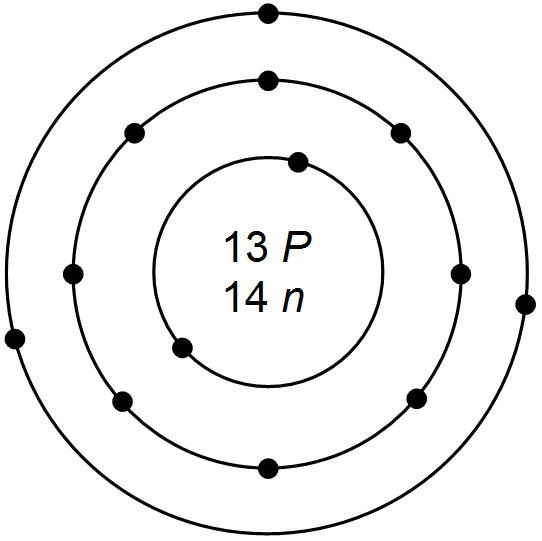
What is the atomic number and mass number of the element whose atomic structure is shown in below?


Answer
Atomic number that can be determined from the atomic structure is 13
Mass number is 13 + 14 = 27
View full question & answer
Question 202 Marks
What is meant by (i) atomic number, and (ii) mass number, of an element? Explain with the help of an example.
Answer
  1. Atomic no. is the number of protons in one atom of an element.
  2. Mass no. is the total number of protons and neutrons present in one atom of the element.

Example: The total no. of protons in a carbon atom is 6, so its atomic no. is 6.

Also, one atom of Na contains 11 protons and 12 neutrons, so its mass no. is 23.

View full question & answer
Question 212 Marks
What is a proton? State its relative mass and charge.
Answer
Protons are positively charged particle found in the atoms of all the elements.
Relative mass of proton is 1u.
Relative charge of proton is +1C.
View full question & answer
Question 222 Marks
What is an octet? How do elements reach an octet? 
Answer
Octet is an arrangement of 8 electrons in outermost shell to achieve nearest noble gas electronic configuration. Elements complete their octet by sharing, gaining or donating electrons to become stable.
View full question & answer
Question 232 Marks
What is an electron? State its relative mass and charge.
Answer
Electron is a negatively charged particle found in the atoms of all elements.
The relative mass of an electron is $\frac{1}{1840\text{u}}$
A charge of -1 is carried by an electron.
View full question & answer
Question 242 Marks
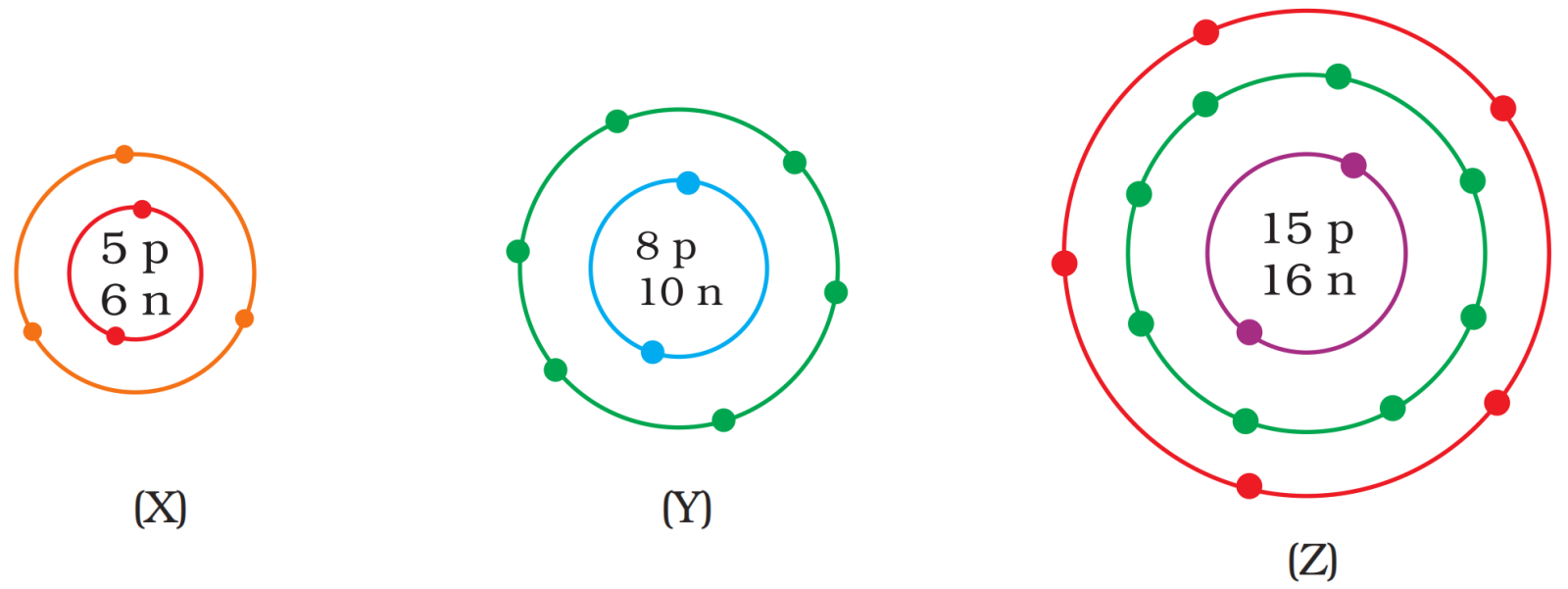
What information do you get from the Fig. about the atomic number, mass number and valency of atoms X, Y and Z? Give your answer in a tabular form.


Answer
Element
Atomic number
= {no. of (p + n)}
Mass number
= {no. of (p + n)}
Number of electrones
(= no. of p)
Electronic configuration
valancy
X
5
5 + 6 = 11
5
2, 3
3
Y
8
8 + 10 = 18
8
2, 6
2
Z
15
15 + 16 = 31
15
2, 8, 5
3, 5
View full question & answer
Question 252 Marks
What important information is furnished about the nucleus of an atom by the alpha particle scattering experiment of Rutherford?
Answer
Important information furnished about nucleus in Rutherford’s alpha-particle scattering experiment is:
  • Nucleus of an atom is positively charged.
  • Nucleus of an atom is very hard and dense.
  • Nucleus of an atom is very small as compared to the size of an atom as a whole.
View full question & answer
Question 262 Marks
What do you understand by the tern "electronic configuration" of an element? Write down the electronic configuration of oxygen (At. No. = 8).
Answer
The arrangement of electrons in various shells of an atom of the element is known as electronic configuration of the element. Electronic configuration of oxygen (atomic no. = 8) is (2, 6).
View full question & answer
Question 272 Marks
What do you think would be the observation if the α-particle scattering experiment is carried out using a foil of a metal other than gold?
Answer
When in the – particle scattering experiment, when any other metal foil is used instead of gold, the observation would remain the same. This is because the structure of an atom when considered individually remains the same.
View full question & answer
Question 282 Marks
What are the canal rays? State the nature of the constituents of canal rays. 
Answer
The positively charged rays created when passing through discharge tube is known as canal rays and anode rays.
The nature of constituents of canal rays are:
  1. Proton deflect towards negative feild in dicharged tube.
  2. Electron deflects towards the positive field in discharged tube.
  3. There is a single ray which pass out in a straight line.
View full question & answer
Question 292 Marks
What are radioactive isotopes? Give two examples of radioactive isotopes
Answer
The isotopes which are unstable due to presence of extra neutrons in their nuclei and emit various types of radiations, are called radioactive isotopes or radioisotopes.
For example: Carbon - 14 , Arsenic - 74
View full question & answer
Question 302 Marks
What are isobars? Give one example.
Answer
Isobars- are atoms of different element which have same mass number but different atomic number.
For eg. $^{40}\text{Ar}_{18},\ ^{40}\text{K}_{19}$ As they have different atomic number so properties are different because no. of valence electrons will be different.
View full question & answer
Question 312 Marks
What are inert elements? Why are they called so?
Answer
The noble gases are in Group 18 (8A). They are helium, neon, argon, krypton, xenon, and radon. They were once called inert gases because they were thought to be completely inert - unable to form compounds.
View full question & answer
Question 322 Marks
What are cathode rays? What is the nature of charge on cathode rays?
Answer
The stream of particles coming out from cathode (negative electrode) are called cathode rays. Cathode rays are negatively charged.
View full question & answer
Question 332 Marks
There are 15 protons and 16 neutrons in the nucleus of an element. Calculate its atomic number and mass number.
Answer
Atomic number of any element is the number of proton present in that atom.
Here, number of proton = 15 therefore atomic number is also 15. 
Mass number or atomic mass is the sum of proton and neutron. 
Therefore mass number = 15 + 16 = 31. 
View full question & answer
Question 342 Marks
The number of electrons in the outermost shell of chlorine is 7. What is its valency and why?
Answer
The number of electrons present in chlorine is 17. So by electronic configuration we get 2, 8, 7 so to make it self stable chlorine gain one electron and makes the octet complete. so the valency of chlorine is positive one.
View full question & answer
Question 352 Marks
The nucleus of an atom has 5 protons and 6 neutrons. What would be the:
  1. Atomic number.
  2. Mass number.
  3. The number of electrons.
  4. The number of valence electrons, per atom of this element?
Answer
  1. Atomic no. = 5
  2. Mass no. = 6 + 5 = 11
  3. No. of electrons = 5
  4. No. of valence electrons, per atom = 3
View full question & answer
Question 362 Marks
The mass number of an element is 23 and it contains 11 electrons. What is the number of protons and neutrons in it? What is the atomic number of the element?
Answer
Given,
Mass no. = 23
No. of electrons = 11
Then, no. of protons = 11
No. of neutrons = 23 - 11 = 12 
Atomic no. = 11
View full question & answer
Question 372 Marks
The mass number of an element is 18. It contains 7 electrons. What is the number of protons and neutrons in it?
Answer
When mass no. is 18 and no. of electrons is 7 then:
  • No. of protons = 7
  • No. of neutrons = 18 - 7 = 11
  • Atomic no. = 7
View full question & answer
Question 382 Marks
The electronic configurations of some elements are given below. Name the elements. 
  1. 2, 8, 5
  2. 2, 8, 8, 2
  3. 2, 8, 1
Answer
  1. The electronic configuration is given as 2, 8, 5.

= 2 + 8 + 5 = 15

  1. The electronic configuration is given as 2, 8, 8, 2.

= 2 + 8 + 8 + 2 = 20.

  1. He electronic configuration is given as 2, 8, 1.

= 2 + 8 + 1 = 11.

View full question & answer
Question 392 Marks
The composition of two atomic particles is given below:
X
Y
Protons
8
8
Neutrons
8
9
Electrons
8
8
  1. What is the mass number of X?
  2. What is the mass number of Y?
  3. What is the relation between X and Y?
  4. Which element/ elements do they represent?
Answer
  1. Mass number of X = 8 + 8 = 16
  2. Mass number of Y = 8 + 9 = 17
  3. X and Y are isotopes, as they have the same number of protons but different number of neutrons.
  4. X and Y represent the isotopes of oxygen.
View full question & answer
Question 402 Marks
The atomic species A and B have different number of protons but the same number of nucleons. On the other hand, the atomic species X and Y have the same number of protons but different number of nucleons. Which pair is an example of isobars? Why?
Answer
Atoms of different elements with different atomic numbers but same mass number are known as isobars. Here, A and B are the examples of isobars, as they have same number of nucleons.
View full question & answer
Question 412 Marks
The atomic number of an element X is 16.
What will be the valency of X?
Answer
Valency of X = 8 - no. of valence electrons
Valency of X = 8 - 6 = 2
View full question & answer
Question 422 Marks
The atomic number of Al and Cl are 13 and 17 respectively. What will be the number of electrons in Al3+ and Cl-?
Answer
Al3+

Electrons = 10(13 - 3)

Protons = 13

Neutrons = 14

Cl-

Elactrons = 18(17 + 1)

Protons = 17

Neutrons = 18

View full question & answer
Question 432 Marks
The atomic number and the mass number of certain elements are given below in the table.
ElementABCDEF
Atomic number13818201
Mass number271640404
  1. Select a pair of isobar and isotope from the above table.
  2. What would be the valency of elements B and E?
Answer
  1. Element D (Argon) and Element E (Calcium) are a pair of isobars.
  2. The valency of Element C (Nitrogen) is 1.
View full question & answer
Question 442 Marks
State two observations which show that atom is not indivisible.
Answer
Two observations which shows that atom is not indivisible are:
  1. In J. J. Thomson’s experiment, the stream of cathode rays in the gas discharge tube shows the presence of negatively charged subatomic particles called electrons.
  2. In Goldstein’s experiment, the faint red glow in the gas discharge tube shows the presence of positively charged subatomic particles called protons.
View full question & answer
Question 452 Marks
State the location of electrons, protons and neutrons in an atom.
Answer
Protons and neutrons are collectively present in the nucleus at the center while electrons revolve rapidly round the nucleus in fixed circular orbits called energy levels.
View full question & answer
Question 462 Marks

The ratio of the radii of hydrogen atom and its nucleus is ~ 10. Assuming the atom and the nucleus to be spherical,

what will be the ratio of their sizes?

Answer
Atomic size is represented in terms of atomic radius, $\frac{\text{r}_\text{H}}{\text{r}_\text{n}}=10^5$
As volume of sphere $=\frac{4}{3}\pi\text{r}^3,\ \therefore\text{v}_\text{H}=\frac{4}{3}\pi\text{r}^3_\text{H}\ \text{and}\ \text{V}_\text{n}=\frac{4}{3}\pi\text{r}_\text{n}^3$
Thus, the ratio of volume $\frac{\text{v}_\text{H}}{\text{v}_\text{n}}=\frac{\frac{4}{3}\pi\text{r}_\text{H}^3}{\frac{4}{3}\pi\text{r}_\text{n}^3}=\frac{\text{r}_\text{H}^3}{\text{r}_\text{n}^3}=\Big(\frac{\text{r}_\text{H}}{\text{r}_\text{n}}\Big)^3=(10^5)^3=10^{15}$
View full question & answer
Question 472 Marks

The atomic number of calcium and argon are 20 and 18 respectively, but the mass number of both these elements is 40. What is the name given to such a pair of elements?

Answer
Mass number of calcium 40 i.e, $^{40}_{20}\text{C}$
Mass number of argon 40 i.e, $^{40}_{18}\text{Ar}$
A pair of element having same mass number but different atomic number is called isobar.
View full question & answer
Question 482 Marks

Helium atom has 2 electrons in its valence shell but its valency is not 2, Explain.

Answer
Helium atom has 2 electrons in its outermost shell and its duplet is complete. Hence the valency of helium atom is zero. It has no propensity to give or take electrons.
View full question & answer
Question 492 Marks

Calculate the number of neutrons present in the nucleus of an element X which is represented as $^{31}_{15}\text{X}.$

Answer
Mass number (A) = No. of protons (Z) + No. of neutrons

But the mass number is given as 31 and the number of protons is 15.

$\therefore$ No. of protons (Z) + No. of neutrons = 31

$\therefore$ Number of neutrons = 31 - number of protons

$\therefore$ Number of neutrons = 31 - 15 = 16

16 neutrons are present in the nucleus of the element X.

View full question & answer
Question 502 Marks
On the basis of Thomson’s model of an atom, explain how the atom is neutral as a whole.
Answer
As per Thomson’s model of the atom, an atom consists both negative and positive charges which are equal in number and magnitude. So, they balance each other as a result of which atom as a whole is electrically neutral.
View full question & answer
Answer the questions.[Che-2M] - Science STD 9 Questions - Vidyadip