Questions · Page 1 of 3

Do as directed; [Bio-1 M]

🎯

Test yourself on this topic

50 questions · timed · auto-graded

Question 231 Mark
Which connective tissue connects bone to another bone?
Answer
Ligament connects two bones together at joints.
View full question & answer
Question 241 Mark
Which component of xylem is responsible for the transport of minerals?
Answer
The main components of xylem are:
  1. Xylem tracheids,
  2. Xylem vessels,
  3. Xylem parenchyma,
  4. Xylem fibres.
  1. Xylem tracheids and xylem vessels are responsible for the conduction of water and minerals because they are elongated tubular channels with wide lumen.
  2. Xylem tracheids possesses pits with pores and vessels possess perforated plates through which they are able to conduct water and minerals from one cell to the another.
View full question & answer
Question 251 Mark
Which chemical is deposited in the cell wall of sclerenchyma?
Answer
Lignin is deposited in the cell wall of sclerenchyma.
View full question & answer
Question 261 Mark
Which chemical is deposited at the corner of cells in collenchymas?
Answer
Collenchyma tissue is irregularly thickened at the corners due to the depositon of pectin and cellulose.
View full question & answer
Question 281 Mark
Where can one find meristematic tissues in plants?
Answer
Meristematic tissues are found in apical, intercalary and lateral positions in plants.
View full question & answer
Question 291 Mark
Where are the cardiac muscles present?
Answer
Cardiac muscle cells are located in the walls of the heart, appear striated, and are under involuntary control. Smooth muscle fibers are located in walls of hollow visceral organs, except the heart, appear spindle-shaped, and are also under involuntary control.
View full question & answer
Question 301 Mark
Where are smooth muscle tissues located in the body?
Answer
Smooth muscle is found in the walls of hollow organs throughout the body. Smooth muscle contractions are involuntary movements triggered by impulses that travel through the autonomic nervous system to the smooth muscle tissue. The arrangement of cells within smooth muscle tissue allows for contraction and relaxation with great elasticity. The smooth muscle in the walls of organs like the urinary bladder and the uterus allow those organs to expand and relax as needed. The smooth muscle of the alimentary canal (the digestive tract) facilitates the peristaltic waves that move swallowed food and nutrients. In the eye smooth muscle changes the shape of the lens to bring objects into focus. Artery walls include smooth muscle that relaxes and contracts to move blood through the body.
View full question & answer
Question 311 Mark
When does the tissue formation take place?
Answer
When many cells togetherly comes there the tissue forms.
View full question & answer
Question 321 Mark
What type of tissues are more abundant in plants?
Answer
 Parenchyma tissues are the most abundant tissues found in plants.
View full question & answer
Question 341 Mark
What is the name of bone cell?
Answer
The cells of bones are called osteocytes. Bone cells are embedded in a hard matrix that is composed of calcium and phosphorus compounds.
View full question & answer
Question 351 Mark
What is the main function of vascular tissues in plants?
Answer
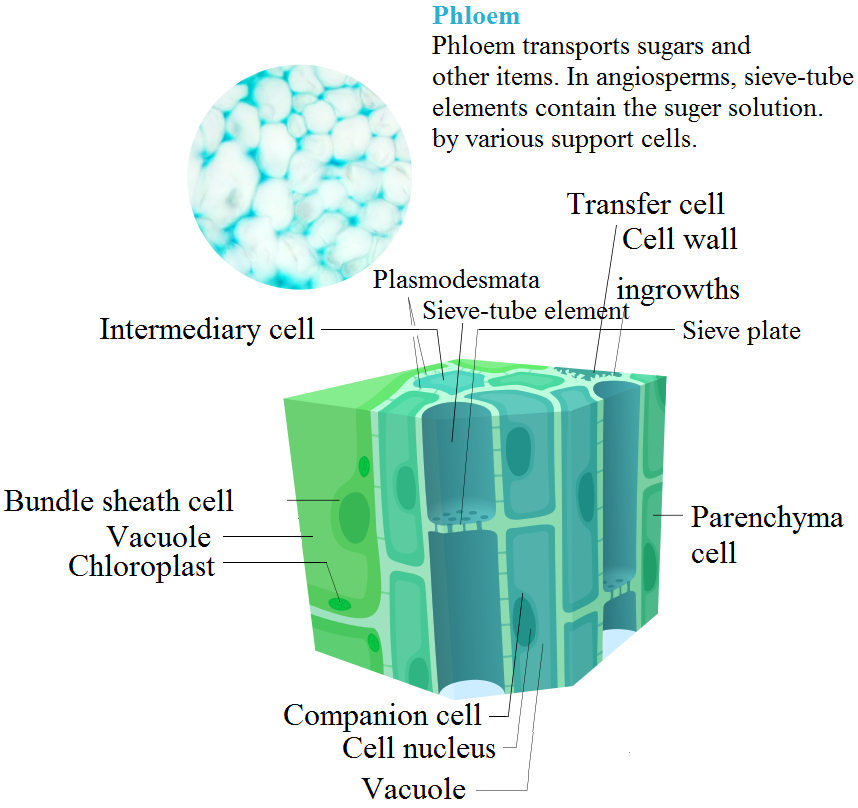
The main function of vascular tissues is to transport water and food in the plant. The Xylem is known to conduct water and Phloem conducts food in the form of sugars.
View full question & answer
Question 361 Mark
What is the main function of parenchyma?
Answer
The main function of parenchyma is to provide support to the plant and also store food.
View full question & answer
Question 381 Mark
What is the function of RBC?
Answer
RBC acts as a transportor of oxygen and carbon dioxide as it contains respiratory pigment called haemoglobin.
View full question & answer
Question 391 Mark
What is the function of companion cells?
View full question & answer
Question 401 Mark
What is the function of blood platelets?
Answer
Blood platelets help in clooting of blood at the site of injury.
View full question & answer
Question 411 Mark
What is stomata?
Answer
Stomata are tiny pores present on the leave’s surface which help in the exchange of gases and in transpiration.
View full question & answer
Question 421 Mark
What is s synapse? Explain.
Answer
Synapse is the junction between the terminal part of one axon and the dendrite of the adjacent neuron. Synapses helps in the transmission of impulses from one neuron to another.
View full question & answer
Question 431 Mark
What is permanent tissue?
Answer
A permanent tissue is a group of cells which temporarily or permanently cease to divide have assumed a definite form and size.
View full question & answer
Question 451 Mark
What is name of simple tissue that provides flexibility to soft aerial plant parts?
Answer
Collenchyma is the simple tissue that provides flexibility to soft aerial plant parts to withstand against winds.
View full question & answer
Question 461 Mark
What is mesophyll?
Answer
The tissue of a leaf that is found in between upper and lower epidermis is the mesophyll.
View full question & answer
Question 471 Mark
What is location and function of companion cells?
Answer
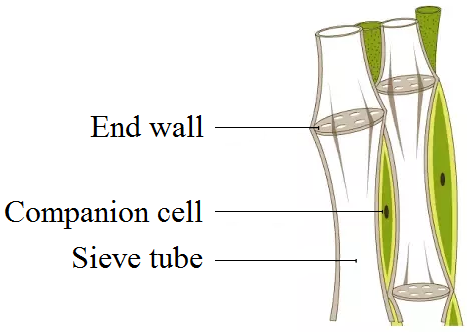
Companion cells are found associated with sieve tubes and helps in conduction of food.
View full question & answer
Question 481 Mark
What is goblet cell?
Answer
Goblet cell is a simple columnar epithelial cell which is modified to secrete mucus. It is seen in the intestine and other parts of the alimentary canal.
View full question & answer
Question 491 Mark
What is function of stomata?
Answer
Stomata are tiny pores present on the leave’s surface which help in the exchange of gases and in transpiration.
View full question & answer
Question 501 Mark
What is division of labour?
Answer
Division of labour is adaptation of different parts of an organism to carry out different functions.
View full question & answer
Do as directed; [Bio-1 M] - Science STD 9 Questions - Vidyadip