Sample QuestionsArithmetic Progressions questions
One sample from each question group in this chapter. Select any group above to see the full set with answer keys.
$11^{th}$ term of an AP: $– 3,$ $-\frac{1}{2}$ $, 2, . . .$ is $...........$
- A
$28$
- ✓
$22$
- C
$-38$
- D
$-48\frac{1}{2}$
Answer: B.
View full solution →$30^{th}$ term of an AP: $10, 7, 4, ......$ is $..............$
Answer: C.
View full solution →Sum of first three terms of AP is $51$ and product of first and third term is $240$ . Then the common difference of the following is ................ AP.
Answer: B.
View full solution →If $n^{\text {th }}$ term of an AP is $3 n+1$ then its $30^{\text {th }}$ term is ............. .
Answer: A.
View full solution →If $n^{\text {th }}$ term of an $AP$ is $2 n+1$ then its sum of $n$ terms is ............. .
- A
$n(n-2)$
- ✓
$n(n+2)$
- C
$n(n+1)$
- D
$n(n-1)$
Answer: B.
View full solution →The sum of $n$ terms of an AP is $2 n^2+5 n$ then its $4^{\text {th }}$ terms is $(19,20,21)$
View full solution →The sum of first $16$ terms of an AP $10,6,2 \ldots$ is ...... $(320,230,-320)$
View full solution →An AP whose first term is $-2$ and its common difference is $-2$ then its terms are is ............ $(-8,-6,-4,-2 ;-2,-4,-6,-8 ; 2,4,6,8)$
View full solution →If $\frac{1}{x+2}, \frac{1}{x+3}+\frac{1}{x+5}$ are the consecutive term of an AP then $x=$ ............ . $(-1,1,0)$
View full solution →$5,2,-1 \ldots-49$ is an arithmetic progression so it has ............. terms. $(19,20,21)$
View full solution →The arithmetic sum of first $n$ odd natural number is $n(n+1)$.
View full solution →$\sqrt{2}, \sqrt{8}, \sqrt{18}, \sqrt{32}, \ldots$ is an arithmetic progression.
View full solution →Sum of $₹ 10,000$ is deposited in bank at the rate of $8 \%$ per annual compound interest. Then amount deposited in each year in the account represent arithmetic progression.
View full solution →$3, 3, 3, 3, ............$ is an AP.
View full solution →If for an AP if common difference is negative then it is possible that sum of first $m$ terms and the sum of first $n$ terms will be same.
View full solution →In an AP:$ l = 28, S = 144$, and there are total $9$ terms. Find $n$
View full solution →Find the sum of the APs: $0.6, 1.7, 2.8,….,$ to $100$ terms.
View full solution →Find the sum of the APs: $–37, –33, –29, …,$ to $12$ terms.
View full solution →Find the sum of an $AP$ given as: $2, 7, 12,...$ upto $10$ terms.
View full solution →In the $AP 2, ? , 26,$ find the missing terms?
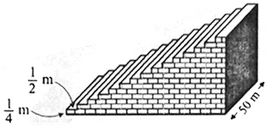
View full solution →A small terrace at a football ground comprises of $15$ steps each of which is $50\ m$ long and built of solid concrete.
Each step has a rise of $\frac{1}{4}$m and a tread of $\frac{1}{2}$m. (see figure). Calculate the total volume of concrete required to build the terrace.
$[$Hint: Volume of concrete required to build the first step = $\frac 14 \times \frac 12 \times 50\ m^3]$
View full solution →The houses of a row are numbered consecutively from $1$ to $49$. Show that there is a value of $x$ such that the sum of the numbers of the houses preceding the house numbered $x$ is equal to the sum of the numbers of the houses following it. Find this value of $x$.
$[$Hint: $S_{x-1}=S_{49}-S_x]$
View full solution →Which term of the AP: $121, 117, 113, .....$ is its first negative term?
$[$Hint: Find n for $a_n<0]$
View full solution →Find the sum of first 51 terms of an AP whose second and third terms are 14 and 18 respectively.
The first and the last terms of an $A.P$ are $17$ and $350$ respectively. If the common difference is $9$, how many terms are there and what is their sum?
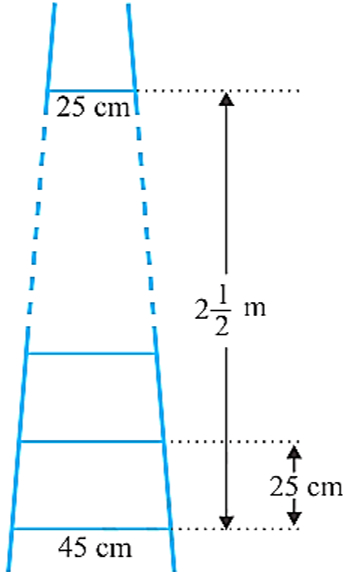
View full solution →A ladder has rungs $25 \ cm$ apart. The rungs decrease uniformly in length from $45 \ cm$ at the bottom to $25 \ cm$ at the top. If the top and bottom rungs are $2\frac 12$m apart, what is the length of the wood required for the rungs?
[Hint: Number of rungs = $\frac{250}{25} + 1$]
View full solution →The sum of the third and the seventh terms of an $AP$ is $6$ and their product is $8$. Find the sum of the first sixteen terms of the $AP.$
View full solution →If the sum of the first $7$ terms of an $A.P$. is $49$ and that of the first $17$ terms is $289$, find the sum of its first n terms.
View full solution →Find the sum of first $22$ terms of an $AP$ in which $d = 7$ and $22nd$ term is $149.$
View full solution →The first term of an $AP$ is $5,$ the last term is $45$ and the sum is $400.$ Find the number of terms and the common difference.
View full solution →
| $A$ |
$B$ |
| $Q.1.$ The sum of three consecutive terms of an $AP$ is $48.$ The product of first and last term is $252.$ Then the common difference $d = ..........$ |
$(a) ± 2$ |
| $Q.2.$ First two terms of an $AP$ are $-3$ and $4 .$ Find its $21^{\text {st }}$ term. |
$(b) ± 4$ |
| |
$(c) 137$ |
| $A$ |
$B$ |
| $Q.1.$ If $S _n=2 n^2+3 n$ then find $d$. |
$(a) 9$ |
| $Q.2.$ If First term of an $AP$ is $2$ and its last term is $200$ find the sum of its first $200$ terms |
$(b) 4$ |
| |
$(c) 2200$ |
| $A$ |
$B$ |
| $Q.1.$ If $a=2, d=4$ then $S _{20}=$ ? |
$(a) 47$ |
| $Q.2.$ If $n^{\text {th }}$ term of an $AP$ is $5 n-3$ then its $10^{\text {th }}$ term is $.......$ |
$(b) 53$ |
| |
$(c) 800$ |
| $A$ |
$B$ |
| $Q.1.$ For an $AP$ $a_{25}-a_{20}=15$ then $d=\ldots \ldots \ldots .$. |
$(a) 5$ |
| $Q.2.$ $10^{\text {th }}$ term of an $AP \sqrt{2}, \sqrt{8}, \sqrt{18} \ldots$ is $.......$ |
$(b) 3$ |
| |
$(c) \sqrt{200}$ |
| $A$ |
$B$ |
| $Q.1.$ The formula to find $n^{\text {th }}$ term of an $AP$ is $........$ |
$(a) 3.5, 5, 6.5, 8, ....$ |
| $Q.2.$ Out of the following which is an $AP ?$ |
$(b) a + (n – 1)d$ |
| |
$(c) 1, 4, 9, 16, ....$ |
The sum of the third and the seventh terms of an $AP$ is $6$ and their product is $8.$ Find the sum of the first sixteen terms of the $AP.$
View full solution →In an $AP: a_n= 4, d = 2, S_n= -14,$ find $n$ and $a.$
View full solution →In an $AP: a_3 = 15, S_{10} = 125,$ find $d$ and $a_{10}$.
View full solution →$200$ logs are stacked in the following manner: $20$ logs in the bottom row, $19$ in the next row, $18$ in the row next to it and so on $($see Fig.$)$. In how many rows are the $200$ logs placed and how many logs are in the top row$?$

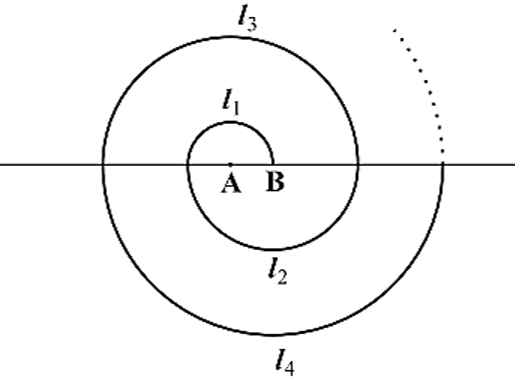
View full solution →A spiral is made up of successive semicircles, with centres alternately at $A$ and $B,$ starting with centre at $A,$ of radii $0.5\ cm, 1.0\ cm, 1.5\ cm, 2.0\ cm, ...$ as shown in Figure. What is the total length of such a spiral made up of thirteen consecutive semicircles? $(Take\; \pi = \frac { 22 } { 7 } )$
$[$Hint: Length of successive semicircles is $l_1, l_2, l_3, l_4, ...$ with centres at $A, B, A, B, ... $ respectively.$]$
View full solution →