Questions

4 Marks Questions

🎯

Test yourself on this topic

5 questions · timed · auto-graded

Question 14 Marks
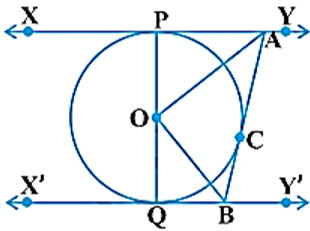
In Figure, $XY$ and $X'Y'$ are two parallel tangents to a circle with centre $O$ and another tangent $AB$ with point of contact $C$ intersects $XY$ at $A$ and $X'Y'$ at $B$. Prove that $\angle A O B = 90^\circ .$
Answer
According to the question, $XY$ and $X 'Y '$ are $x$ two parallel tangents to a circle with centre $O$ and another tangent $AB$ with point of contact $C$ intersects $XY$ at $A$ and $X 'Y '$ at $B.$
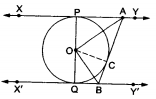
In quad. $APQB,$ we have
$\angle A P O =90^\circ $
and$ \angle B Q O = 90^\circ [ \because$ tangent at any point is perpendicular to the radius through the point of contact$]$
Now, $\angle A P O + \angle B Q O + \angle Q B C + \angle P A C = 360 ^ { \circ } $
$ \Rightarrow \angle P A C + \angle Q B C = 360 ^ { \circ } - ( \angle A P O + \angle B Q O ) = 180 ^ { \circ } ...(i)$
We have,
$\angle C A O = \frac { 1 } { 2 } \angle P A C$
and $\angle C B O = \frac { 1 } { 2 } \angle Q B C [ \because$ tangents from an external point are equally inclined to the line segment joining the centre to that point$]$
$\therefore \angle \mathrm { CAO } + \angle \mathrm { CBO } = \frac { 1 } { 2 } ( \angle P A C + \angle Q B C ) = \frac { 1 } { 2 } \times 180 ^ { \circ } = 90 ^ { \circ } .....(ii)$
In $\triangle A O B ,$ we have
$\angle C A O + \angle A O B + \angle C B O = 180 ^ { \circ } $
$ \Rightarrow 90 ^ { \circ }+\angle A O B = 180 ^ { \circ } $
$ \Rightarrow \quad \angle A O B = 90 ^ { \circ }$
View full question & answer
Question 24 Marks
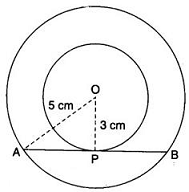
Two concentric circles are of radii $5\ cm$ and $3\ cm.$ Find the length of the chord of the larger circle which touches the smaller circle.
Answer
Let $O$ be the common centre of the two concentric circles.

Let $AB$ be a chord of the larger circle which touches the smaller circle at $P.$
Join $OP$ and $OA$
Then, $\angle OPA  = 90^\circ[ ∵$ The tangent at any point of a circle is perpendicular to th radius through the point of contact$]$
$\therefore OA^2= OP^2+ AP^2.......$ By Pythagoras theorem
$\Rightarrow (5)^2= (3)^2+ AP^2$
$\Rightarrow 25 = 9 + AP^2$
$\Rightarrow P^2= 25 - 9$
$\Rightarrow AP^2= 16$
$\Rightarrow  AP =  \sqrt{16} = 4\ cm$
SInce the perpendicular from the centre of a circle to a chord bisects the chord, therfore,
$AP = BP = 4\ cm$
$\therefore AB = AP + BP = AP + AP = 2AP = 2(4) = 8\ cm$
Hence, the required length is $8\ cm.$
View full question & answer
Question 34 Marks
Prove that opposite sides of a quadrilateral circumscribing a circle subtend supplementary angles at the centre of the circle.
Answer
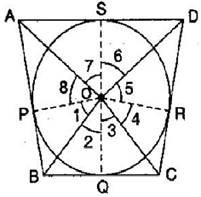
Given: $ABCD$ is a quadrilateral circumscribing a circle whose centre is $O.$
To prove:
  1. $\angle AOB + \angle COD = 180^\circ$
  2. $\angle BOC + \angle AOD = 180^\circ$
Construction: Join $OP, OQ, OR$ and $OS.$

Proof: Since tangents from an external point to a circle are equal.
$\therefore AP = AS,$
$BP = BQ ........ (i)$
$CQ = CR$
$DR = DS$
In $\triangle OBP$ and $\triangle OBQ,$
$OP = OQ [$Radii of the same circle$]$
$OB = OB [$Common$]$
$BP = BQ [$From eq. $(i)]$
$\therefore \triangle OPB \cong \triangle OBQ [$By $SSS$ congruence criterion$]$
$ \therefore \angle 1 = \angle 2 [$By $C.P.C.T.]$
Similarly, $\angle 3=\angle 4, \angle 5=\angle 6, \angle 7=\angle 8 $
Since, the sum of all the angles round a point is equal to $360^{\circ} .$
$ \therefore \angle 1+\angle 2+\angle 3+\angle 4+\angle 5+\angle 6+\angle 7+\angle 8=360^{\circ} $
$ \Rightarrow \angle 1+\angle 1+\angle 4+\angle 4+\angle 5+\angle 5+\angle 8+\angle 8=360^{\circ} $
$ \Rightarrow 2(\angle 1+\angle 4+\angle 5+\angle 8)=360^{\circ} $
$ \Rightarrow \angle 1+\angle 4+\angle 5+\angle 8=180^{\circ}$
$\Rightarrow(\angle 1+\angle 5)+(\angle 4+\angle 8)=180^{\circ} $
$ \Rightarrow \angle A O B+\angle C O D=180^{\circ}$
Similarly we can prove that
$\angle B O C+\angle A O D=180^{\circ}$
View full question & answer
Question 44 Marks
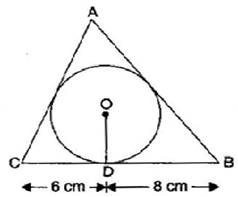
A triangle $ABC$ is drawn to circumscribe a circle of radius $4\ cm$ such that the segments $BD$ and $DC$ into which $BC$ is divided by the point of contact $D$ are of lengths $8\ cm$ and $6 \ cm$ respectively (see figure). Find the sides $AB$ and $AC$.
Answer
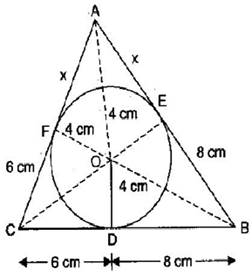
Join $OE$ and $OF.$ Also join $OA, OB$ and $OC.$​​​​​​​

Since $BD = 8\ cm$
$\therefore BE = 8\ cm$
$[$Tangents from an external point to a circle are equal$]$
Since $CD = 6 \ cm$
$\therefore CF = 6\ cm$
$[$Tangents from an external point to a circle are equal$]$
Let $AE = AF = x$
Since $OD = OE = OF = 4\ cm [$Radii of a circle are equal$]$
$\therefore$ Semi-perimeter of $\triangle ABC = \frac{(x\;+6)(x\;+8)\;+\;(6+8)}2 = \frac{(2x\;+28)}2= (x + 14)cm$
$\therefore$ Area of $\triangle ABC =\sqrt{s(s-a)(s-b)\;(s-c)}$
$= \sqrt{(x\;+14)(x\;+14\;-14)(x\;+14-\overline{x+8})(x\;+14-\overline{x+6})}$
$= \sqrt{(x\;+14)(x\;)(8)(6)}cm^2$
Now, Area of $ΔABC =$ Area of $\triangle OBC +$ Area of $\triangle OCA +$ Area of $\triangle OAB$
$\Rightarrow \sqrt{(x\;+14)(x\;)(8)(6)}=\frac{(6+8)4}2+\frac{\displaystyle(x+6)4}{\displaystyle2}+\frac{\displaystyle(x+8)4}{\displaystyle2}$
$\Rightarrow \sqrt{(x\;+14)(x\;)(8)(6)}= 28 + 2x + 12 + 2x + 16$
$\Rightarrow \sqrt{(x\;+14)(x\;)(8)(6)}= 4x + 56$
$\Rightarrow\sqrt{(x\;+14)(x\;)(8)(6)}=4(x + 14)$
Squaring both sides,
$(x + 14) (x) (6) (8) = 16(x + 14)^2$
$\Rightarrow 3x = x + 14$
$\Rightarrow 2x = 14$
$\Rightarrow x = 7$
$\therefore AB = x + 8 = 7 + 8 = 15\ cm$
And $AC = x + 6= 7 + 6 = 13\ cm$
View full question & answer
Question 54 Marks
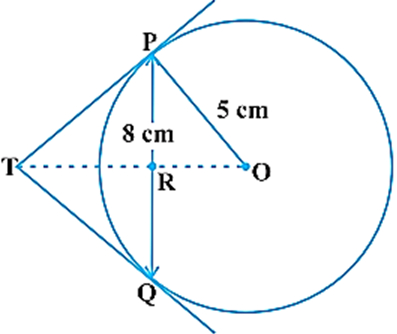
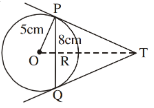
$PQ$ is a chord of length 8 cm of a circle of radius $5\ cm.$ The tangents at $P$ and $Q$ intersect at a point $T.$ Find the length $TP.$
Answer

Let $TR$ be $x\ cm$ and $TP$ be $y\ cm$
$OT$ is perpendicular bisector of $PQ$
So $PR = 4\ cm( PR = \frac {PQ} {2} = \frac {8 } {2 } )$
In $\triangle OPR,  OP^2= PR^2+ OR^2 ​​​​​​5^2= 4^2+ OR^2  OR =   \sqrt{25 - 16} $
$\therefore OR = 3\ cm$
In $\triangle PRT, PR^2+RT^2= PT^2$
$y^2= x^2+ 4^2.....(1)$
In $\triangle OPT,  OP^2+ PT^2= OT^2$
$(x + 3)^2= 5^2+ y^2( OT = OR + RT = 3 + x)$
$\therefore (x + 3)^2= 5^2+ x^2+ 16 [$using $(1)]$
Solving, we get $x = \frac{16}{3}\ cm$
From $(1), y^2= \frac{256}{9}  + 16 =  \frac{400}{9}$
So, $y = \frac{20}{3}\ cm = 6.667\ cm$
View full question & answer
4 Marks Questions - Maths STD 10 Questions - Vidyadip