Questions

3 Marks Question

🎯

Test yourself on this topic

10 questions · timed · auto-graded

Question 13 Marks
The length of a tangent from a point $A $at distance $5\ cm$ from the centre of the circle is $4\ cm.$ Find the radius of the circle.
Answer
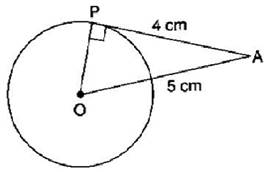
We know that the tangent at any point of a circle is $\perp$ to the radius through the point of contact.
$\therefore \angle O P A=90^{\circ}$
$\therefore O A^2=O P^2+A P^2[B y \text { Pythagoras theorem }]$
$\Rightarrow(5)^2=(O P)^2+(4)^2$
$\Rightarrow 25=(O P)^2+16$
$\Rightarrow O P^2=9$
$\Rightarrow O P=3 \mathrm{~cm}$
View full question & answer
Question 23 Marks
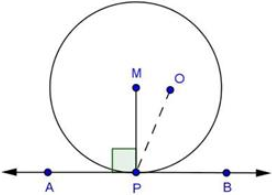
Prove that the perpendicular at the point of contact to the tangent to a circle passes through the centre of the circle.
Answer
Let $APB$ be the tangent and take $O$ as centre of the circle.

Let us suppose that $MP \bot AB$ does not pass through the centre.
Then,
$\angle OPA = 90^\circ [ \because$ Tangent is perpendicular to the radius of circle$]$
But $\angle MPA = 90^\circ [$Given$]$
$\therefore \angle OPA = \angle MPA$
This is only possible when point $O$ and point $M$ coincide with each other.
Hence, the perpendicular at the point of contact to the tangent to a circle passes through the centre of the circle.
View full question & answer
Question 33 Marks
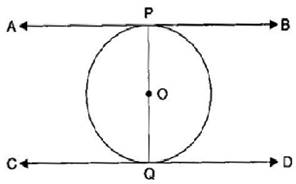
Prove that the tangents drawn at the ends of a diameter of a circle are parallel.
Answer

Given: $PQ$ is a diameter of a circle with centre $O.$
The lines $AB$ and $CD$ are the tangents at $P$ and $Q$ respectively.
To Prove: $AB \parallel CD$
Proof: Since $AB$ is a tangent to the circle at $P$ and $OP$ is the radius through the point of contact.
$\therefore \angle OPA = 90^\circ........ (i)$
$[$The tangent at any point of a circle is $\perp$ to the radius through the point of contact$]$
$\because CD$ is a tangent to the circle at $Q$ and $OQ$ is the radius through the point of contact.
$\therefore \angle  OQD = 90^\circ........ (ii)$
$[$The tangent at any point of a circle is $\perp$ to the radius through the point of contact$]$
From eq. $(i)$ and $(ii), \angle OPA = \angle OQD$
But these form a pair of equal alternate angles also,
$\therefore AB  \parallel CD$
View full question & answer
Question 43 Marks
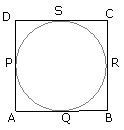
Prove that parallelogram circumscribing a circle is a rhombus.
Answer

Given $ABCD$ is a parallelogram in which all the sides touch a given circle
To prove:- $ABCD$ is a rhombus
Proof:-
$\because ABCD$ is a parallelogram
$\therefore AB = DC$ and $AD = BC$
Again $AP, AQ$ are tangents to the circle from the point $A$
$\therefore AP = AQ$
Similarly, $BR = BQ$
$CR = CS$
$DP = DS$
$\therefore(AP + DP) + (BR + CR) = AQ + DS + BQ + CS = (AQ + BQ) + (CS + DS)$
$\Rightarrow AD + BC = AB + DC$
$\Rightarrow  BC + BC = AB + AB [ \because AB = DC, AD = BC]$
$\Rightarrow 2BC = 2AB$
$\Rightarrow BC = AB$
Hence, parallelogram $ABCD$ is a rhombus
View full question & answer
Question 53 Marks
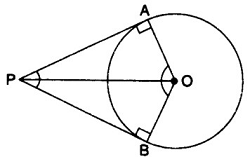
Prove that the angle between the two tangents drawn from an external point to a circle is supplementary to the angle subtended by the line-segment joining the points of contact at the centre.
Answer
$\angle O A P=90^{\circ}...........(1) [$Angle between tangent and radius through the point of contact is $90^{\circ}]$
$\angle O B P=90^{\circ}..........(2) [$Angle between tangent and radius through the point of contact is $90^{\circ}]$
$\therefore OAPB$ is quadrilateral

$ \therefore \angle A P B+\angle A O B+\angle O A P+\angle O B P=360^{\circ}[\text { Angle sum property of a quadrilateral }] $
$ \Rightarrow \angle A P B+\angle A O B+90^{\circ}+90^{\circ}=360^{\circ}[\text { From (1) and (2) }] $
$ \Rightarrow \angle A P B+\angle A O B=180^{\circ} $
$ \Rightarrow \angle A P B \text { and } \angle A O B \text { are supplementary }$
View full question & answer
Question 63 Marks
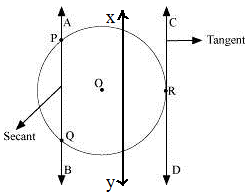
Draw a circle and two lines parallel to a given line such that one is a tangent and the other, a secant to the circle.
Answer

Steps of Construction:
  1. Draw a circle with any radius and center $O.$ Here $xy$ is given line.
  2. Choose any point $P$ on the circumference of the circle, and draw a line passing through $P,$ Let's name it $AB.$
  3.  Draw a line $AB$ parallel to $xy,$ such that $AB$ intersects the circle at two points $P$ and $A.$Here, $AB$ and $xy$ are two parallel lines. $AB$ intersects the circle at exactly two points, $P$ and $Q$. Therefore, line $AB$ is the secant of this circle.
  4. $CD$ intersects the circle at exactly one point, $R,$ line $CD$ is the tangent to the circle.
View full question & answer
Question 73 Marks
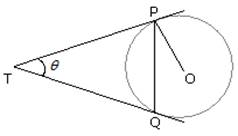
Two tangents $TP$ and $TQ$ are drawn to a circle with centre $O$ from an external point $T.$ Prove that ​$\angle ​PTQ = 2 \angle OPQ.$
Answer

Given $A$ circle with centre $O$ and an external point $T$ and two tangents $TP$ and $TQ$ to the circle, where $P, Q$ are the points of contact.
To Prove: $\angle PTQ = 2 \angle OPQ$
Proof: Let $\angle PTQ = \theta$
Since $TP, TQ$ are tangents drawn from point $T$ to the circle.
$TP = TQ$
$\therefore TPQ$ is an isoscles triangle
$\therefore \angle \mathrm{TPQ}=\angle \mathrm{TQP}=\frac{1}{2}\left(180^{\circ}-\theta\right)=90^{\circ}-\frac{\theta}{2}$
Since, $TP$ is a tangent to the circle at point of contact $P $
$ \therefore \angle \mathrm{OPT}=90^{\circ} $
$ \therefore \angle \mathrm{OPQ}=\angle \mathrm{OPT}-\angle \mathrm{TPQ}=90^{\circ}-\left(90^{\circ}-\frac{1}{2} \theta\right)=\frac{\theta}{2}=\frac{1}{2} \angle \mathrm{PTQ}$
Thus, $\angle \mathrm{PTQ}=2 \angle \mathrm{OPQ}$
View full question & answer
Question 83 Marks
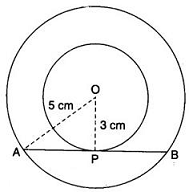
Two concentric circles are of radii $5 \ cm$ and $3 \ cm.$ Find the length of the chord of the larger circle which touches the smaller circle.
Answer
Let $O$ be the common centre of the two concentric circles.
 
Let $AB$ be a chord of the larger circle which touches the smaller circle at $P.$
Join $OP$ and $OA$
Then,$\angle OPA = 90^\circ [ \because$ The tangent at any point of a circle is perpendicular to th radius through the point of contact$]$
$\therefore  OA^2 = OP^2 + AP^2 .....$ By Pythagoras theorem
$\Rightarrow  (5)^2 = (3)^2 + AP^2$
$\Rightarrow  25 = 9 + AP^2$
$\Rightarrow  P^2 = 25 - 9$
$\Rightarrow  AP^2 = 16$
$\Rightarrow  AP =  \sqrt{16}  = 4 \ cm$
SInce the perpendicular from the centre of a circle to a chord bisects the chord, therfore,
$AP = BP = 4 \ cm$
$\therefore  AB = AP + BP = AP + AP = 2AP = 2(4) = 8 \ cm$
Hence, the required length is $8 \ cm.$
View full question & answer
Question 93 Marks
Prove that the lengths of tangents drawn from an external point to a circle are equal.
Answer
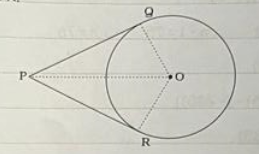
Given: P is a point lying in the exterior of a circle with centre of Tangents from to the circle touch the circle at Q and R
To prove PQ PR

Image

Proof: Join $O P, O Q$ and $O R$.
Then, according to theorem 10.1, $\angle P Q O$ and $\angle P R O$ are right angl being angles formed by tangents and radii through points af contact.
In $\triangle O Q P$ and $\triangle O R P$,
$O Q=O R$ (Radii of same circle)
$O P=O P \quad$ (Same segment)
$\angle P Q O=\angle P R O$ (Both right angles)
$\therefore$ By RHS critenon of congruence, $\triangle O Q P=\triangle O R P$
$\therefore P Q=P R$
View full question & answer
Question 103 Marks
Prove that: The tangent at any point of a circle is perpendicular to the radius through the point of contact.
Answer
Statement: The tangent at any point of a circle is perpendicular to the radius through the point of contact.
Given: A circle with centre O. AB is a tangent to the circle at point P. OP is the radius to the point of contact.
To Prove: $O P \perp A B$.
Construction
Take any point Q on the tangent AB, other than P. Join OQ.
Since Q is a point on the tangent AB (and not the point of contact P), Q must lie outside the circle.
If Q were inside the circle, the line AB would intersect the circle at two points and would not be a tangent.
Because Q lies outside the circle, the line segment OQ must be longer than the radius OP.
Therefore, OQ > OP.
This means that OP is the shortest of all the line segments that can be drawn from the centre O to any point on the line AB. We know that the shortest distance from a point to a line is the perpendicular distance.
Thus, OP is perpendicular to the tangent AB.
$O P \perp A B$
Hence, the theorem is proved.
View full question & answer