Questions

3 Marks Question

🎯

Test yourself on this topic

12 questions · timed · auto-graded

Question 13 Marks
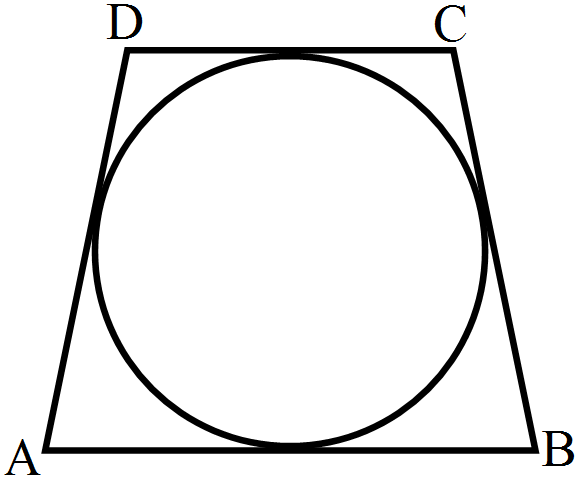
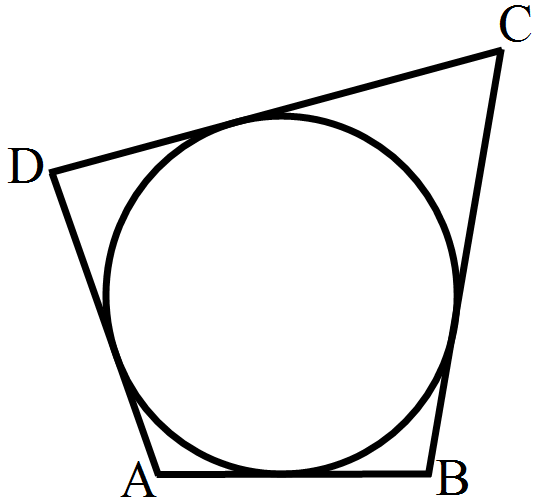
In the adjoining figure, a circle touches all the four sides of a quadrilateral $ABCD$ whose sides are $AB = 6\ cm, BC = 9\ cm$ and $CD = 8\ cm.$ Find the length of $AD.$
Answer
We know that when a quadrilateral circumscribes a circle then sum of opposites sides is equal to the sum of other opposite sides
$\therefore AB + CD = AD + BC$
$⇒ 6 + 8 = AD + 9$
$⇒ AD = 5\ cm$
View full question & answer
Question 23 Marks
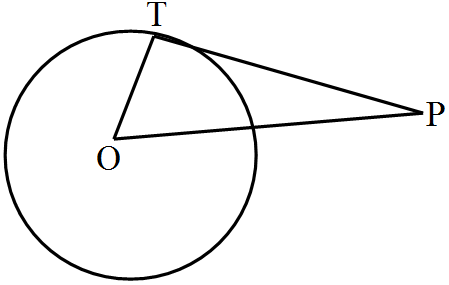
A point $P$ is $25\ cm$ away from the centre of a circle and the length of tangent drawn from $P$ to the circle is $24\ cm$. Find the radius of the circle.
Answer

Draw a circle and let $P$ be a point such that $OP = 25\ cm$
Let $TP$ be the tangent, so that $TP = 24\ cm$
Join $OT,$ where $OT$ is radius.
Now, tangent drawn from an external point is perpendicular to the radius at the point of contact.
$\therefore\text{OT}\perp\text{PT}$
In the right $\triangle\text{OTP},$ we have:
$\text{OP}^2=\text{OT}^2+\text{TP}^2$ [By Pythagoras' theorem]
$\text{OT}^2=\sqrt{\text{OP}^2-\text{TP}^2}$
$=\sqrt{25^2-24^2}$
$=\sqrt{625-576}$
$=\sqrt{49}$
$=7\text{cm}$
$\therefore$ The length of the radius is $7\ cm.$
View full question & answer
Question 33 Marks
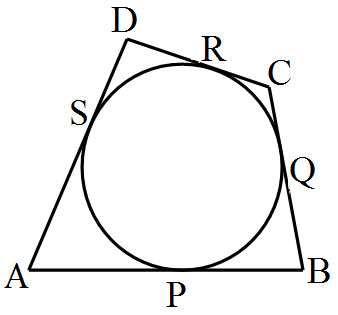
In the given figure, a circle touches all the four sides of a quadrilateral $ABCD$ whose three sides are $AB = 6\ cm, BC = 7\ cm$ and $CD = 4\ cm.$ Find $AD.$
Answer

Let the circle touch the sides of the quadrilateral $AB, BC, CD$ and $DA$ at $P, Q, R$ and $S$ respectively.
Given, $AB = 6\ cm, BC = 7\ cm$ and $CD = 4\ cm.$
Tangents drawn from an external point are equal.
$\therefore\text{AP}=\text{AS},\text{BP}=\text{BQ},\text{CR}=\text{CQ}$ and $\text{DR}=\text{DS}$
Now, $\text{AB}+\text{CD}=(\text{AP}+\text{BP})+(\text{CR}+\text{DR})$
$=>\text{AB}+\text{CD}=(\text{AS}+\text{BQ})+(\text{CQ}+\text{DS})$
$=>\text{AB}+\text{CD}=(\text{AS}+\text{DS})+(\text{CQ}+\text{CQ})$
$=>\text{AB}+\text{CD}=\text{AD}+\text{BC}$
$=>\text{AD}=(\text{AB}+\text{CD})-\text{BC}$
$=>\text{AD}=(6+4)-7$
$=>\text{AD}=3\text{cm}$
$\therefore$ The length of $AD$ is $3\ cm.$
View full question & answer
Question 43 Marks
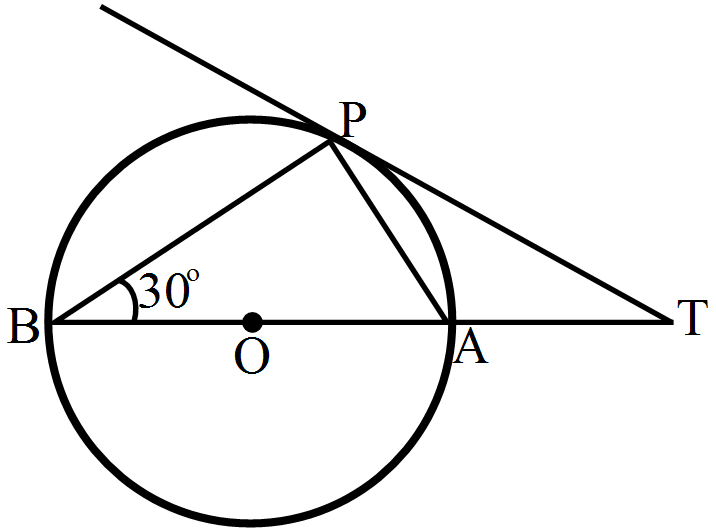
In the given figure, $O$ is the centre of the circle and $TP$ is the tangent to the circle from an external point $T.$ If $\angle\text{PBT} = 30^\circ,$prove that
$BA : AT = 2 : 1.$
Answer
$AB$ is the chord passing through the centre
So, $AB$ is the diameter
Since, angle in a semi circle is a right angle
$\therefore\angle\text{APB} = 90^\circ$
By using alternate segment theorem
We have $\angle\text{APB} = \angle\text{PAT} = 30^\circ $
Now, in $\triangle\text{APB}$
$\angle\text{BAP} + \angle\text{APB} + \angle\text{BAP} = 180^\circ $ (Angle sum property of triangle)
$\Rightarrow\angle\text{BAP} = 180^\circ − 90^\circ − 30^\circ = 60^\circ$
Now, $\angle\text{BAP}=\angle\text{APT}+\angle\text{PTA}$ (Exterior angle property)
$\Rightarrow 60^\circ = 30^\circ + \angle\text{PTA}$
$\Rightarrow \angle\text{PTA}=60^\circ - 30^\circ =30^\circ $
We know that sides opposite to equal angles are equal.
$\therefore\text{ AP} = \text{AT}$
In right triangle $ABP$
$\sin\angle\text{ABP}=\frac{\text{AP}}{\text{BA}}$
$\Rightarrow\sin30^\circ=\frac{\text{AT}}{\text{BA}}$
$\Rightarrow\frac{1}{2}=\frac{\text{AT}}{\text{BA}}$
$\therefore\text{BA}:\text{AT}=2:1$
View full question & answer
Question 53 Marks
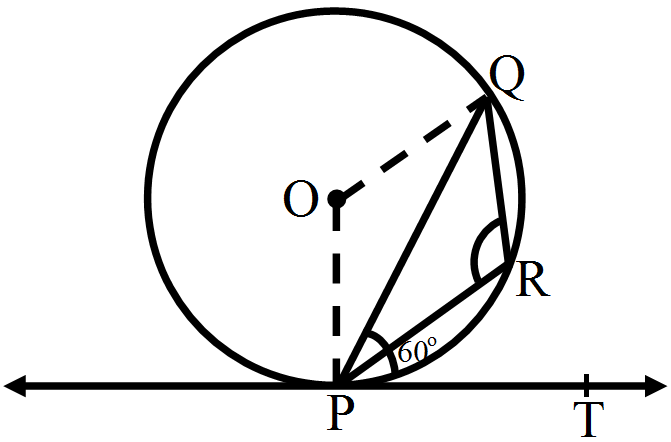
In the given figure, $PQ$ is a chord of a circle with centre $O$ and $PT$ is a tangent. If $\angle\text{QPT} = 60^\circ ,$ find $\angle\text{PRQ}.$
Answer
We know that the radius and tangent are perperpendular at their point of contact.
$\therefore\angle\text{OPT}=90^\circ$
Now, $\angle\text{OPT}=\angle\text{OPT}-\angle\text{OPT}=90^\circ-60^\circ=30^\circ$
Since, $OP = OQ$ as both are radius
$\therefore\angle\text{OPQ}=\angle\text{OQP}=30^\circ$(Angles opposite to equal sides are equal)
Now, In isosceles $\triangle\text{POQ}$
$\angle\text{POQ}+\angle\text{OPQ}+\angle\text{OQP}=180^\circ$(Angle sum property of a triangle)
$\Rightarrow\angle\text{POQ}=180^\circ-30^\circ-30^\circ=120^\circ$
Now, $ \angle\text{POQ}+\text{reflex }\angle\text{POQ}=360^\circ$(Complete angle)
$\Rightarrow\text{reflex }\angle\text{POQ}=360^\circ-120^\circ=240^\circ$
We know that the angle subtended by an arc at the centre is double the angle subtended by the arc at any point on the remaining part of the circle.
$\therefore\angle\text{PRQ}=\frac{1}{2}(\text{reflex }\angle\text{POQ})=120^\circ.$
View full question & answer
Question 63 Marks
A point $P$ is at a distance of $29\ cm$ from the center of a circle of radius $20\ cm$. Find the length of the tangent drawn from $P$ to the circle.
Answer
Since tangent is always perpendicular to the radius, so a right triangle will be formed...
$ \text { So, }(29)^2=(20)^2+x^2 $
$ 841=400+x^2 $
$ x^2=441 $
$ x=21 \mathrm{~cm}$
Hence, Length of the tangent is $21cm.$
View full question & answer
Question 73 Marks
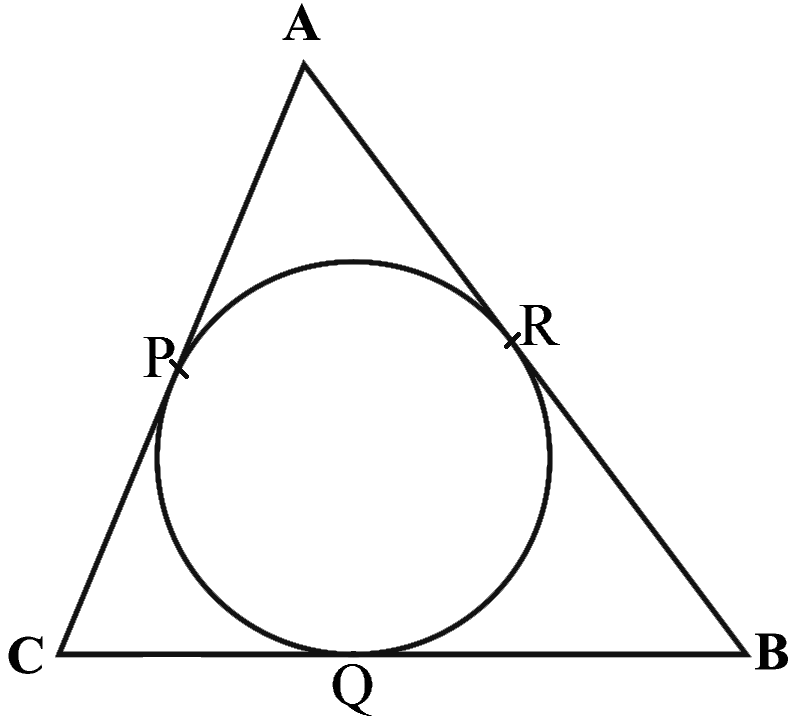
A circle is inscribed in a $\triangle\text{ABC}$ touching $AB, BC$ and $AC$ at $P, Q$ and $R$ respectively. If $AB = 10\ cm, AR = 7\ cm$ and $CR = 5\ cm,$ find the length of $BC.$
Answer
Given, a circle inscribed in triangle $ABC$, such that the circle touches the sides of the triangle at $P, Q, R.$
Tangent drawn to a circle from an external point are equal.
$\therefore\text{AP}=\text{AR}=7\text{cm},\text{CQ}=\text{CR}=5\text{cm}.$
Now, $\text{BP}=(\text{BP}-\text{BP})=(10-7)=3\text{cm}$
$\therefore\text{BP}=\text{BQ}=3\text{cm}$
$\therefore\text{BC}=(\text{BQ}+\text{QC})$
$=>\text{BC}=3+5$
$=>\text{BC}=8$
$\therefore$ The length of $BC$ is $8\ cm.$
View full question & answer
Question 83 Marks
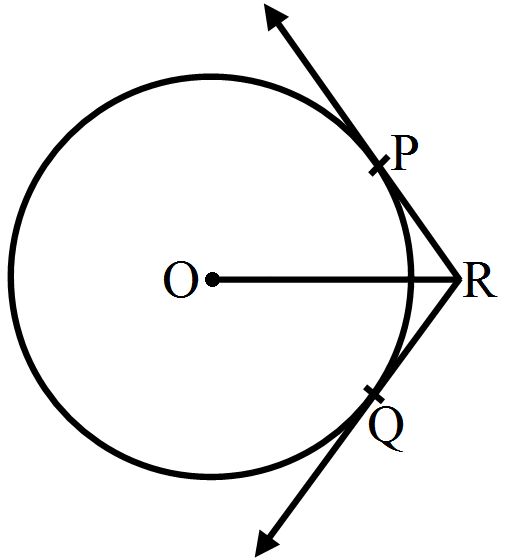
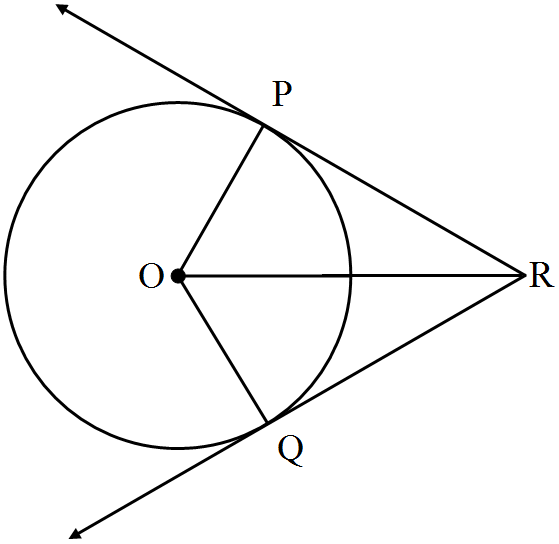
In the given figure, two tangents $RQ$ and $RP$ are drawn from an external point $R$ to the circle with centre $O$. If $\angle\text{PRQ} = 120^\circ$ then prove that $OR = PR + RQ.$
Answer

Construction: Join $PO$ and $OQ$
In $\triangle\text{POR}$ and $\triangle\text{QOR}$
$OP = OQ ($Radii$)$
$RP = RQ ($Tangents from the external point are congruent$)$
$OR = OR ($Common$)$
By $SSS$ congruency, $\triangle\text{POR}\cong\triangle\text{QOR}$
$\angle\text{PRO}=\angle\text{QRO} (C.P.C.T)$
Now, $\angle\text{PRO}+\angle\text{QRO}=\angle\text{PRQ}$
$\Rightarrow2\angle\text{PRO}=120^\circ$
$\Rightarrow\angle\text{PRO}=60^\circ$
Now In $\triangle\text{POR}$
$\cos60^\circ=\frac{\text{PR}}{\text{OR}}$
$\Rightarrow\text{OR}=2\text{PR}$
$\Rightarrow\text{OR}=\text{PR}+\text{PR}$
$\Rightarrow\text{OR}=\text{PR}+\text{RQ}$
View full question & answer
Question 93 Marks
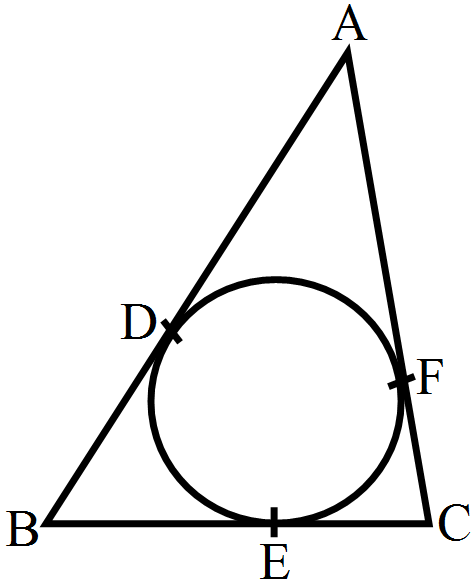
In the given figure, a circle inscribed in a triangle $ABC$ touches the sides $AB, BC$ and $CA$ at points $D, E$ and $F$ respectively. If $AB = 14\ cm, BC = 8\ cm$ and $CA = 12\ cm.$ Find the lengths $AD, BE$ and $CF.$
Answer
We know that tangent segments to a circle from the same external point are congruent.
Now, we have,
$AD = AF, BD = BE$ and $CE = CF$
Now, $AD + BD = 14\ cm ....(1)$
$AF + FC = 12\ cm$
$⇒ AD + FC = 12\ cm ....(2)$
$BE + EC = 8cm$
$⇒ BD + FC = 8\ cm ....(3)$
Adding all these we get
$AD + BD + AD + FC + BD + FC = 34$
$⇒ 2(AD + BD + FC) = 34$
$⇒ AD + BD + FC = 17\ cm .....(4)$
Solving $(1)$ and $(4),$ we get
$FC = 3\ cm$
Solving $(2)$ and $(4)$, we get
$BD = 5\ cm = BE$
Solving $(3)$ and $(4),$ we get
and $AD = 9\ cm.$
View full question & answer
Question 103 Marks
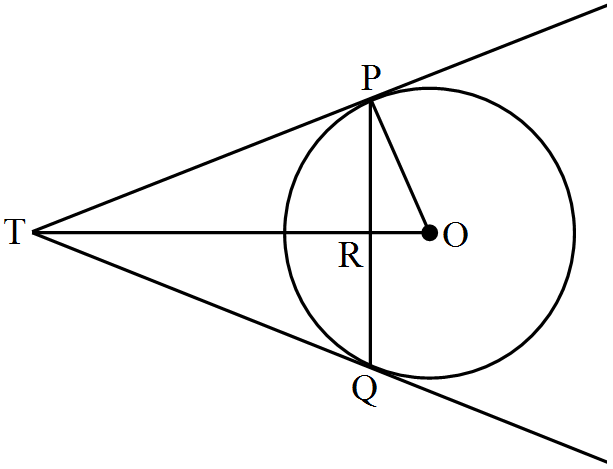
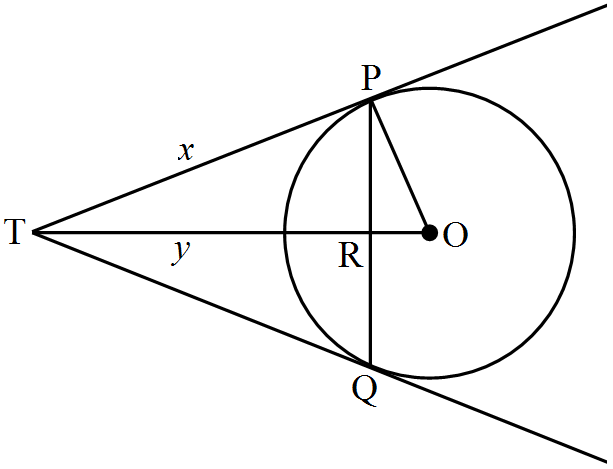
$PQ$ is a chord of length $4.8\ cm$ of a circle of radius $3\ cm$. The tangent at $P$ and $Q$ intersect at a point $T$ as shown in the figure. Find the length of $TP.$
Answer

Let $TR = y$ and $TP = x$
We know that the perpendicular drawn from the centre to the chord bisects
$\therefore PR = RQ$
Now, $PR + RQ = 4.8$
$⇒ PR + PR = 4.8$
$⇒ PR = 2.4$
Now, in right triangle $POR$
By Using Pyhthagoras theorem, we have
$P O^2=O R^2+P R^2 $
$ \Rightarrow 3^2=O R^2+(2.4)^2 $
$ \Rightarrow O R^2=3.24 $
$ \Rightarrow O R=1.8$
Now, in right triangle $TPR$
By Using Pyhthagoras theorem, we have
$ T P^2=T R^2+P R^2 $
$ \Rightarrow x^2=y^2+(2.4)^2 $
$ \Rightarrow x^2=y^2+5.76 \ldots(1)$
Again, in right triangle $TPQ$
By Using Pyhthagoras theorem, we have
$ \mathrm{TO}^2=\mathrm{TP}^2+P \mathrm{O}^2 $
$ \Rightarrow(\mathrm{y}+1.8)^2=\mathrm{x}^2+3^2 $
$ \Rightarrow \mathrm{y}^2+3.6 \mathrm{y}+3.24=\mathrm{x}^2+9 $
$ \Rightarrow \mathrm{y}^2+3.6 \mathrm{y}=\mathrm{x}^2+5.76 \ldots . . \text { (2) }$
Solving $(1)$ and $(2),$ we get
$x = 4\ cm$ and $y = 3.2\ cm$
$\therefore TP = 4\ cm$
View full question & answer
Question 113 Marks
If the angle between two tangents drawn from an external point $P$ to a circle of radius a and centre $O,$ is $60^\circ $ then find the length of $OP.$
Answer
We know that tangent is always perpendicular to the radius at the point of contact.
So, $\angle\text{OAP}=90^\circ$
We know that if $2$ tangents are drawn from an external point, then they are equally inclined to the line segment joining the centre to that point.
So, $\angle\text{OPA}=12\angle\text{APB}=12\times60^\circ=30^\circ$
According to the angle sum property of triangle
In $\triangle\text{AOP}\angle\text{AOP}+\angle\text{OAP}+\angle\text{OPA}=180^\circ$
$\Rightarrow\angle\text{AOP}+90^\circ+30^\circ=180^\circ$
$\Rightarrow\angle\text{AOP}=60^\circ$
So, in triangle AOP
tan angle $\text{AOP}=\frac{\text{AP}}{\text{OA}}$
$\sqrt{3}=\frac{\text{AP}}{\text{a}}$
Therefore, $\text{AP}=\sqrt{3\text{a}}$
Hence, proved.
View full question & answer
Question 123 Marks
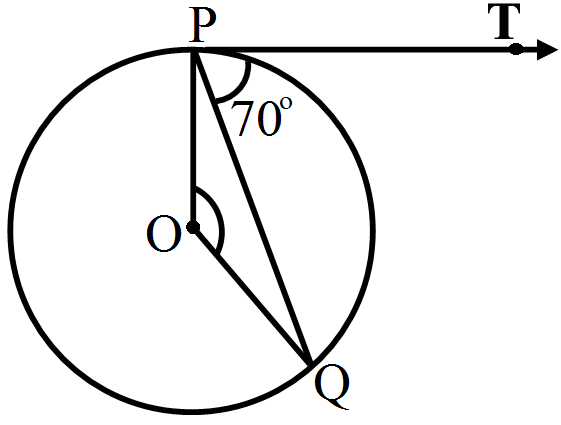
If $PT$ is a tangent to a circle with centre $O$ and $PQ$ is a chord of the circle such that $\angle\text{QPT} = 70^\circ$ then find the measure of $\angle\text{POQ}.$
Answer
We know that the radius and tangent are perperpendular at their point of contact.
$\therefore\angle\text{OPT} = 90^\circ$
Now, $\angle\text{OPQ}=\angle\text{OPT}-\angle\text{TPQ}=90^\circ-70^\circ=20^\circ$
Since, $OP = OQ$ as both are radius
$\therefore\angle\text{OPQ}=\angle\text{OQP}=20^\circ($Angles opposite to equal sides are equal$)$
Now, In isosceles $ \triangle\text{POQ}$
$\angle\text{POQ}+\angle\text{OPQ}+\angle\text{OQP}=180^\circ ($Angle sum property of a triangle$)$
$\Rightarrow\angle\text{POQ} = 180^\circ − 20^\circ − 20^\circ = 140^\circ$
View full question & answer
3 Marks Question - Maths STD 10 Questions - Vidyadip