Sample QuestionsCoordinate Geometry questions
One sample from each question group in this chapter. Select any group above to see the full set with answer keys.
$A (1,2) B (2,3) C (3,4)$ are given points. Out of the following which is true ?
Answer: B.
View full solution →If the coordinates of the midpoint $P$ of the line segment joining $x$ and $y$ is $(-2,3)$ then which is true ?
- A
$x(-4,3), y(2,2)$
- B
$x(0,2), y(-2,2)$
- ✓
$x(-6,2), y(2,4)$
- D
$x(-4,-2), y(0,4)$
Answer: C.
View full solution →For $\square A B C D$, which group is true? | 1 | ◻ ABCD is a rhombus | (a) | AC and BD bisect |
| 2 | ◻ ABCD is a parallelogram | (b) | AC and BD bisect at right angle. |
| 3 | ◻ ABCD is a rectangle | (c) | AC and BD are congruent and bisect at right angle. |
| 4 | ◻ ABCD is a square | (d) | AC and BD are congruent and bisect at right angle. |
- A
$(1-c),(2-d)(3-a)(4-b)$
- ✓
$(1- b ),(2- a )(3- d )(4- c )$
- C
$(1- b ),(2- c )(3- d )(4- a )$
- D
$(1- d ),(2- a )(3- b )(4- c )$
Answer: B.
View full solution →The perimeter of the triangle with vertices $(0,4)(0,0)$ and $(3,0)$ is __________ units. $(8, 12, 15)$
View full solution →The point which divides the line segment joining the points $A(4,-1)$ and $B(-2,-3)$ in the ratio $1: 2$ lies in __________ quadrant (first, third, fourth)
View full solution →The centroid of the triangle with vertices $(3,2)(7,5)$ and $(2,1)$ is __________ $\left(\left(2, \frac{8}{3}\right),\left(3, \frac{8}{3}\right),\left(4, \frac{8}{3}\right)\right)$
View full solution →The distance between the points $(-5,8)$ and $(-2,-6)$ is __________ $(\sqrt{205}, \sqrt{502}, \sqrt{42})$
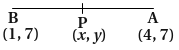
View full solution →$A (0,0), B (0,0)$ and $C (5,0)$ are given points. Then $BC =$ __________ $(5,25, \sqrt{5})$
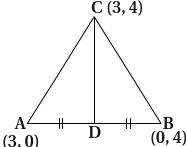
View full solution →The circumcenter of a right angle triangle is the midpoint of the hypotenuse.
The coordinates of the origin is $(0,0)$
View full solution →The distance between the points $(2,3)$ and $(4,1)$ is $2 \sqrt{2}$.
View full solution →The midpoint of the line segment joining $A (8,-3), B (-3,5)$ is $(5,4)$.
View full solution →$A = B$ if and only if $d( A , B )=0$.
View full solution →Find the ratio in which the line segment joining the points $(-3, 10)$ and $(6, -8)$ is divided by $(-1, 6).$
View full solution →Find the area of the rhombus if its vertices are $(3, 0), (4, 5), (-1, 4)$ and $(-2, -1)$ taken in order.
[Hint: Area of a rhombus $=\frac{1}{2}$ (product of its diagonals)]
View full solution →Find the coordinates of the point which divides the join of $(-1, 7)$ and $(4, -3)$ in the ratio $2 : 3$.
View full solution →Find the distance between the pair of points $(a, b), (-a, -b)$
View full solution →Find the distance between the pair of points $(-5, 7), (-1, 3)$
View full solution →If $A$ and $B$ are $(-2, -2)$ and $(2, -4)$ respectively, find the coordinates of $P$ such that $AP =$ $\frac{3}{7}$ $AB$ and $P$ lies on the line segment $AB$.
View full solution →Find the coordinates of a point $A$, where $AB$ is the diameter of a circle whose centre is $(2, -3)$ and $B$ is $(1, 4)$.
View full solution →If $(1, 2), (4, y), (x, 6)$ and $(3, 5)$ are the vertices of a parallelogram taken in order, find $x$ and $y$.
View full solution →Find the ratio in which the segment joining $A(1, -5)$ and $B(-4, 5)$ is divided by the $x$-axis. Also find the coordinates of the point of division.
View full solution →If $Q(0, 1)$ is equidistant from $P(5, -3)$ and $R(x, 6)$, find the values of $x$. Also find the distances $QR$ and $PR$.
View full solution →Find the point on the x-axis which is equidistant from $(2, -5)$ and $(-2, 9).$
View full solution →Name the type of quadrilateral formed, if any, by the points $(4,5),(7,6),(4,3),(1,2)$, and give a reason for your answer.
View full solution →Name the type of quadrilateral formed, if any, by the points $(-3,5),(3,1),(0,3),(-1,-4)$, and give a reason for your answer.
View full solution →Name the type of quadrilateral formed, if any, by the points $(-1,-2),(1,0),(-1,2),(-3,0)$, and give a reason for your answer.
View full solution →Find the distance between the points $(0,0)$ and $(36,15)$. Can you now find the distance between the two towns $A$ and $B$ discussed in Section $7.2.$
View full solution →