Questions

4 Marks Questions

🎯

Test yourself on this topic

4 questions · timed · auto-graded

Question 14 Marks
Find the coordinates of the points which divide the line segment joining $A(-2, 2)$ and $B(2, 8)$ into four equal parts.
Answer
Let $P\left(x_1, y_1\right) Q\left(x_2, y_2\right)$ and $R\left(x_3, y_3\right)$ be the points which divide the line segment $AB$ into four equal parts.

Then, $P$ divides $AB$ in the ratio $1 : 3$ internally.
$x=\frac{mx_2+nx_1}{m+n}$
$\therefore x _ { 1 } = \frac { ( 1 ) ( 2 ) + ( 3 ) ( - 2 ) } { 1 + 3 }$
$= \frac { 2 - 6 } { 4 } = - \frac { 4 } { 4 } = - 1$
$y=\frac{my_2+ny_1}{m+n}$
$y _ { 1 } = \frac { ( 1 ) ( 8 ) + ( 3 ) ( 2 ) } { 1 + 3 }$
$= \frac { 8 + 6 } { 4 } = \frac { 14 } { 4 } = \frac { 7 } { 2 }$
So, $\mathrm { P } \rightarrow \left( - 1 , \frac { 7 } { 2 } \right)$
Also, $Q$ divides $AB$ in the ratio $1 : 1$ i.e.
$Q$ is the mid point of $AB$
$x _ { 2 } = \frac { - 2 + 2 } { 2 } = 0$
$y _ { 2 } = \frac { 2 + 8 } { 2 } = \frac { 10 } { 2 } = 5$
So, $Q \rightarrow ( 0,5 )$
and, $R$ divides $AB$ in the ratio $3 : 1$
$\therefore x _ { 2 } = \frac { ( 3 ) ( 2 ) + ( 1 ) ( - 2 ) } { 3 + 1 }$
$= \frac { 6 - 2 } { 4 } = \frac { 4 } { 4 } = 1$
$y _ { 3 } = \frac { ( 3 ) ( 8 ) + ( 1 ) ( 2 ) } { 3 + 1 }$
$= \frac { 24 + 2 } { 4 } = \frac { 26 } { 4 } = \frac { 13 } { 2 }$
So, $\mathrm { R } \rightarrow \left( 1 , \frac { 13 } { 2 } \right)$
View full question & answer
Question 24 Marks
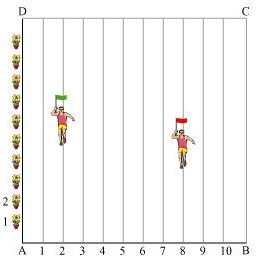
To conduct Sports Day activities, in your rectangular-shaped school ground $ABCD,$ lines have been drawn with chalk powder at a distance of $1m$ each. $100$ flower pots have been placed at a distance of $1m$ from each other along $AD,$ as shown in Figure. Niharika runs $\frac{1}{4}$th the distance $AD$ on the $2nd$ line and posts a green flag. Preet runs $\frac{1}{5}$th the distance $AD$ on the eighth line and posts a red flag. What is the distance between both the flags$?$ If Rashmi has to post a blue flag exactly halfway between the line segment joining the two flags, where should she post her flag$?$
Answer
It can be observed that Niharika posted the green flag at $\frac{1}{4}$th of the distance $AD$ i.e., $\frac{1}{4} \times 100 = 25m$ from the starting point of $2^{nd}$ line. Therefore, the coordinates of this point $G$ is $(2, 25)$
Similarly, Preet posted a red flag at $\frac{1}{5}$th of the distance $AD$ i.e., $\frac{1}{5} \times 100 = 20m$ from the starting point of $8^{th}$ line. Therefore, the coordinates of this point $R$ are $(8, 20)$
Now we have the positions of posts by Preet and Niharika
According to distance formula, the distance between points $A(x_1, y_1)$ and $B(x_2, y_2)$ is given by
$D=\sqrt{\left(x_{2}-x_{1}\right)^{2}+\left(y_{2}-y_{1}\right)^{2}}$
Distance between these flags by using distance formula,
$D=\sqrt{\left(8-2_{}\right)^{2}+\left(25_{}-{20}\right)^{2}}$
$=\sqrt{36+25} \mathrm {m}$
$=\sqrt{61} \mathrm{m}$
The point at which Rashmi should post her blue flag is the mid-point of the line joining these points. Let this point be $A (X,Y)$
Now by midpoint formula,
$(X, Y)=\left(\frac{x_{1}+x_{2}}{2}, \frac{y_{1}+y_{2}}{2}\right)$
$X=\left(\frac{2+8}{2}\right)=5$
$Y=\left(\frac{25+20}{2}\right)=22.5$
Hence,$ A (X,Y) = (5, 22.5)$
Therefore, Rashmi should post her blue flag at $22.5m$ on the $5^{th}$ line.
View full question & answer
Question 34 Marks
Find the coordinates of the points of trisection of the line segment joining $(4, –1)$ and $(–2, –3)$.
Answer

The points of trisection means that the points which divide the line into three equal parts. From the figure, it is clear that $C,$ and $D$ are these two points. Let $C\left(x_1, y_1\right)$ and $D\left(x_2, y_2\right)$ are the points of trisection of the line segment joining the given points i.e., $BC = CD = DA$
Let $BC = CD = DA = k,$ Point $C$ divides $BC$ and $CA$ as: $BC = kCA = CD + DA = k + k = 2k$
Hence the ratio between $BC$ and $CA$ is: $\frac{B C}{C A}=\frac{k}{2 k}=\frac{1}{2}$
Therefore, point $C$ divides $BA$ internally in the ratio $1:2$ then by section formula we have that if a point $P(x, y)$ divides two points $P\left(x_1, y_1\right)$ and $Q\left(x_2, y_2\right)$ in the ratio $m:n$ then, the point $(x, y)$ is given by $(\mathrm{x}, \mathrm{y})=\left(\frac{\mathrm{mx}_{2}+\mathrm{nx}_{1}}{\mathrm{m}+\mathrm{n}}, \frac{\mathrm{my}_{2}+\mathrm{ny}_{1}}{\mathrm{m}+\mathrm{n}}\right)$
Therefore $C(x, y)$ divides $B(–2, –3)$ and $A(4,–1)$ in the ratio $1:2,$ then
$C(x, y)=\left(\frac{(1 \times 4)+(2 \times-2)}{1+2}, \frac{(1 \times-1)+(2 \times-3)}{1+2}\right)$
$C(x, y)=\left(\frac{4-4}{1+2}, \frac{-1-6}{1+2}\right)$
$C(x, y)=\left(0, \frac{-7}{3}\right)$
Point $D$ divides the $BD$ and $DA$ as:$DA = kBD = BC + CD = k + k = 2k$
Hence the ratio between $BD$ and $DA$ is: $\frac{B D}{D A}=\frac{2 k}{k}=\frac{2}{1}$
The point $D$ divides the line $BA$ in the ratio $2:1$
So now applying section formula again we get,
$D(x, y)=\left(\frac{(2 \times 4)+(1 \times-2)}{2+1}, \frac{(2 \times-1)+(1 \times-3)}{2+1}\right)$
$D(x, y)=\left(\frac{8-2}{3}, \frac{-2-3}{3}\right)$
$D(x, y)=\left(\frac{6}{3}, \frac{-5}{3}\right)$
$D(x, y)=\left(2, \frac{-5}{3}\right)$
View full question & answer
Question 44 Marks
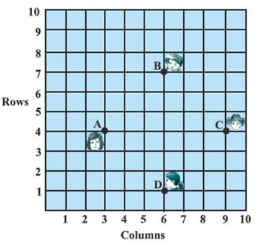
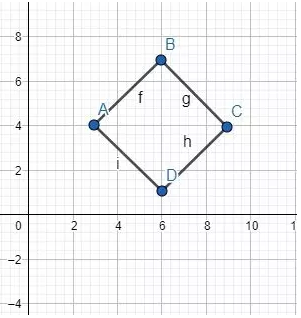
In a classroom, $4$ friends are seated at the four points $A, B, C$ and $D$ as shown in Fig. Champa and Chameli walk into the class and after observing for a few minutes Champa asks Chameli, Don’t you think $ABCD$ is a square$?$ Chameli disagrees. Using distance formula, find which of them is correct.
Answer
It can be seen that $A (3, 4), B (6, 7), C (9, 4),$ and $D (6, 1)$ are the positions of $4$ friends

Distance between two points $A(x_1,y_1)$ and $B(x_2, y_2)$ is given by
$D=\sqrt{\left( x_{2} - x_{1}\right)^{2}+\left(y_{2}-y_{1}\right)^{2}}$
Hence,
$ A B=\left[(3-6)^2+(4-7)^2\right]^{1 / 2}$
$ =\sqrt{9+9}=\sqrt{18}$
$ =3 \sqrt{2}$
$ B C=\left[(6-9)^2+(7-4)^2\right]^{1 / 2}$
$ =\sqrt{9+9}=\sqrt{18}$
$ =3 \sqrt{2}$
$ C D=\left[(9-6)^2+(4-1)^2\right]^{1 / 2}$
$ =\sqrt{9+9}=\sqrt{18}$
$ =3 \sqrt{2}$
$ A D=\left[(3-6)^2+(4-1)^2\right]^{1 / 2}$
$ =\sqrt{9+9}=\sqrt{18}$
$ =3 \sqrt{2}$
$ \text { Diagonal AC }=\left[(3-9)^2+(4-4)^2\right]^{1 / 2}$
$ =\sqrt{36+0}=6$
$ \text { Diagonal } B D=\left[(6-6)^2+(7-1)^2\right]^{1 / 2} \\
=\sqrt{36+0}=6$
It can be seen that all sides of quadrilateral $ABCD$ are of the same length and diagonals are of the same length
Therefore, $ABCD$ is a square and hence, Champa was correct.
View full question & answer
4 Marks Questions - Maths STD 10 Questions - Vidyadip