MCQ 11 Mark
$A (1,2) B (2,3) C (3,4)$ are given points. Out of the following which is true ?
AnswerCorrect option: B. $AB + BC = AC$
$AB + BC = AC$
View full question & answer→MCQ 21 Mark
If the coordinates of the midpoint $P$ of the line segment joining $X$ and $Y$ is $(-2,3)$ then which is true ?
Note :The coordinates of the midpoint $=\left(\frac{x_1+x_2}{2^1} \frac{y_1+y_2}{2}\right)$
- A
$X (-4,3), Y (2,2)$
- B
$X (0,2), Y (-2,2)$
- ✓
$X (-6,2), Y (2,4)$
- D
$X (-4,-2), Y (0,4)$
AnswerCorrect option: C. $X (-6,2), Y (2,4)$
$X (-6,2), Y (2,4)$
View full question & answer→MCQ 31 Mark
For $\square$ $ABCD$, which group is true ?
| 1 |
$\square$ $ABCD$ is a rhombus |
(a) |
$AC$ and $BD$ bisect |
| 2 |
$\square$ $ABCD$ is a parallelogram |
(b) |
$AC$ and $BD$ bisect at right angle. |
| 3 |
$\square$ $ABCD$ is a rectangle |
(c) |
$AC$ and $BD$ are congruent and bisect at right angle. |
| 4 |
$\square$ $ABCD$ is a square |
(d) |
$AC$ and $BD$ are congruent and bisect at right angle. |
- A
$(1 – c), (2 – d) (3 – a) (4 - b)$
- ✓
$(1 – b), (2 – a) (3 – d) (4 - c)$
- C
$(1 – b), (2 – c) (3 – d) (4 - a)$
- D
$(1 – d), (2 – a) (3 – b) (4 - c)$
AnswerCorrect option: B. $(1 – b), (2 – a) (3 – d) (4 - c)$
$(1 – b), (2 – a) (3 – d) (4 - c)$
View full question & answer→MCQ 41 Mark
Distance is _______ of point $(x, y)$ to origin.
- ✓
$\sqrt{x^2+y^2}$
- B
$\sqrt{x^2-y^2}$
- C
$x^2+y^2$
- D
$x^2-y^2$
AnswerCorrect option: A. $\sqrt{x^2+y^2}$
$\sqrt{x^2+y^2}$
View full question & answer→MCQ 51 Mark
Perpendicular distance from $X$ - axis point $(-5,7)$ is _______
View full question & answer→MCQ 61 Mark
Distance from point $(-6,8)$ to origin is _______ unit.
View full question & answer→MCQ 71 Mark
Distance from point $(x, y)$ to origin is _______ .
- ✓
$\sqrt{x^2+y^2}$
- B
$\sqrt{x^2-y^2}$
- C
$x^2-y^2$
- D
$x^2+y^2$
AnswerCorrect option: A. $\sqrt{x^2+y^2}$
$\sqrt{x^2+y^2}$
View full question & answer→MCQ 81 Mark
Distance between point $(3,4)$ and origin is _______ .
View full question & answer→MCQ 91 Mark
The distance of point (a, b) from the origin is..........
- A
$\sqrt{a^2-b^2}$
- ✓
$\sqrt{a^2+b^2}$
- C
$a^2-b^2$
- D
$a^2+b^2$
AnswerCorrect option: B. $\sqrt{a^2+b^2}$
$\sqrt{a^2+b^2}$
View full question & answer→MCQ 101 Mark
The distance of the point $(5,-4)$ from $x$-axis is
Answer(b) : Distance of the point $(5,-4)$ from $x$-axis $=\mid y$-coordinate of the point $(5,-4) \mid=4$ units
View full question & answer→MCQ 111 Mark
The distance of the point $(3,5)$ from the $x$-axis is
Answer(b) : Distance of the point $(3,5)$ from $x$-axis $=5$ units.
View full question & answer→MCQ 121 Mark
The distance of the point $(-3,-4)$ from origin is
Answer(c) : Let the points be $A(-3,-4)$ and $B(0,0)$
$
\therefore A B=\sqrt{(-3-0)^2+(-4-0)^2}=5 \text { units }
$
View full question & answer→MCQ 131 Mark
Find the value of $k$, if the distance between $A(k, 3)$ and $B(2,3)$ is 5 units.
Answer(c) : Given, $A B=\sqrt{(k-2)^2+(3-3)^2}=5$
$
\Rightarrow \sqrt{(k-2)^2}=5
$
Squaring both sides, we have $(k-2)^2=25$
$
\Rightarrow k-2= \pm 5 \Rightarrow k=2 \pm 5 \Rightarrow k=7 \text { or }-3
$
View full question & answer→MCQ 141 Mark
If the points $A(4,3)$ and $B(x, 5)$ are on the circle with centre $O(2,3)$, then the value of $x$ is
AnswerSince $A$ and $B$ lie on the circle having centre $O$.
$\therefore O A=O B$
$\Rightarrow \sqrt{(4-2)^2+(3-3)^2}=\sqrt{(x-2)^2+(5-3)^2}$
$\Rightarrow 2=\sqrt{(x-2)^2+4} $
$\Rightarrow 4=(x-2)^2+4$
$\Rightarrow(x-2)^2=0 $
$\Rightarrow x-2=0 $
$\Rightarrow x=2 [$Each equal to radius$]$
View full question & answer→MCQ 151 Mark
If points $A(5, p), B(1,5), C(2,1)$ and $D(6,2)$ form a square $\text{ABCD}$, then $p=$
AnswerSince $\text{ABCD}$ is a square.
$\therefore A B=A D $
$\Rightarrow A B^2=A D^2$
$\Rightarrow(1-5)^2+(5-p)^2=(6-5)^2+(2-p)^2$
$\Rightarrow 16+25-10 p+p^2=1+4-4 p+p^2$
$\Rightarrow 6 p=36 $
$\Rightarrow p=6$
View full question & answer→MCQ 161 Mark
The perimeter of the triangle formed by the points $(0,0),(2,0)$ and $(0,2)$ is
- A
$1-2 \sqrt{2}$
- B
$2 \sqrt{2}+1$
- C
$4+\sqrt{2}$
- ✓
$4+2 \sqrt{2}$
AnswerCorrect option: D. $4+2 \sqrt{2}$
(d) : Let $A(0,0), B(2,0)$ and $C(0,2)$ be the vertices of $\triangle A B C$.
$
\begin{aligned}
\therefore \quad A B & =\sqrt{(2-0)^2+(0-0)^2}=2 \\
B C & =\sqrt{(0-2)^2+(2-0)^2}=2 \sqrt{2} \\
C A & =\sqrt{(0-0)^2+(0-2)^2}=2
\end{aligned}
$
$\therefore$ Required perimeter $=2+2 \sqrt{2}+2=4+2 \sqrt{2}$
View full question & answer→MCQ 171 Mark
If $A(4,2), B(6,5)$ and $C(1,4)$ be the vertices of $\triangle A B C$ and $A D$ is the median, then the coordinates of $D$ are
- A
$\left(\frac{5}{2}, 3\right)$
- B
$\left(5, \frac{7}{2}\right)$
- ✓
$\left(\frac{7}{2}, \frac{9}{2}\right)$
- D
AnswerCorrect option: C. $\left(\frac{7}{2}, \frac{9}{2}\right)$
(c) : Since $A D$ is the median, so $D$ is the mid point of $B C$.
$\therefore \quad$ Coordinates of $D=\left(\frac{6+1}{2}, \frac{5+4}{2}\right)$ i.e., $\left(\frac{7}{2}, \frac{9}{2}\right)$
View full question & answer→MCQ 181 Mark
If $(-2,-1),(a, 0),(4, b)$ and $(1,2)$ are the vertices of a parallelogram, then the values of $a$ and $b$ are respectively
Answer(a): The given points are $A(-2,-1), B(a, 0)$, $C(4, b)$ and $D(1,2)$. Since the diagonals of a parallelogram bisect each other.
$\therefore \quad$ Coordinates of $P$ are
$X=\frac{-2+4}{2}=\frac{1+a}{2} \Rightarrow a=1$
and $Y=\frac{-1+b}{2}=\frac{0+2}{2} \Rightarrow b=3$
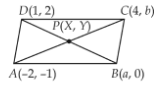
View full question & answer→MCQ 191 Mark
If $P(-1,1)$ is the mid point of the line segment joining $A(-3, b)$ and $B(1, b+4)$, then $b=$
Answer(b) : Since $P(-1,1)$ is the mid point of line segment joining $A(-3, b)$ and $B(1, b+4)$.
$
\therefore \quad(-1,1)=\left(\frac{-3+1}{2}, \frac{b+b+4}{2}\right) \Rightarrow b+2=1 \Rightarrow b=-1
$
View full question & answer→MCQ 201 Mark
In what ratio, does the point $P(3,4)$ divides the line segment joining the points $A(1,2)$ and $B(6,7)$ ?
- A
$1: 2$
- ✓
$2: 3$
- C
$3: 4$
- D
$1: 1$
AnswerCorrect option: B. $2: 3$
(b) : Let $P(3,4)$ divides the join of $A(1,2)$ and $B(6,7)$ in the ratio $k: 1$.
$\therefore$ Coordinates of $p$ are $\frac{6 k+1}{k+1}=3 \Rightarrow k=\frac{2}{3}$ and $\frac{7 k+2}{k+1}=4 \Rightarrow k=\frac{2}{3}$
$\therefore \quad$ The required ratio is $\frac{2}{3}: 1$ i.e., $2: 3$.
View full question & answer→MCQ 211 Mark
The coordinates of the mid point of the line segment joining $(-8,13)$ and $(x, 7)$ is $(4,10)$. Then the value of $x$ is
Answer(a) : Since, $(4,10)$ is the mid point of the line segment joining $(-8,13)$ and $(x, 7)$.
$
\therefore \quad \frac{-8+x}{2}=4 \Rightarrow x=16
$
View full question & answer→MCQ 221 Mark
The ratio in which the $x-$axis divides the line segment joining $A(3,6)$ and $B(12,-3)$ is
- ✓
$2: 1$
- B
$1: 2$
- C
$-2: 1$
- D
$1:-2$
AnswerCorrect option: A. $2: 1$
Let the $x-$axis divides the join of $A(3,6)$ and $B(12,-3)$ in the ratio $k: 1$.
$\therefore \frac{-3 k+6}{k+1}=0 [\because$ At $x-$axis, ordinate must be $0]$
$\Rightarrow k=\frac{-6}{-3}$
$\Rightarrow k=\frac{2}{1}$
i.e., $2: 1$
View full question & answer→MCQ 231 Mark
The coordinates of the fourth vertex $C$ of the rectangle $A B C D$ formed by the points $A(0,0), B(2,0)$ and $D(0,3)$ are
- A
$(3,0)$
- B
$(0,2)$
- ✓
$(2,3)$
- D
$(3,2)$
AnswerCorrect option: C. $(2,3)$
(c) : Let coordinates of $C \equiv(a, b)$.
$\because \quad A B C D$ is a rectangle
$\therefore \quad$ Mid-point of $A C=$ Mid-point of $B D$
$\Rightarrow\left(\frac{0+a}{2}, \frac{0+b}{2}\right)=\left(\frac{2+0}{2}, \frac{0+3}{2}\right)$
$\Rightarrow \frac{a}{2}=1$ and $\frac{b}{2}=\frac{3}{2} \Rightarrow a=2$ and $b=3$
Hence, the coordinates of fourth vertex $C$ are $(2,3)$.
View full question & answer→MCQ 241 Mark
The coordinates of the point, dividing the join of the points $(5,0)$ and $(0,4)$ in the ratio $2: 3$ internally, are
- ✓
$\left(3, \frac{8}{5}\right)$
- B
$\left(1, \frac{4}{5}\right)$
- C
$\left(\frac{5}{2}, \frac{3}{4}\right)$
- D
$\left(2, \frac{12}{5}\right)$
AnswerCorrect option: A. $\left(3, \frac{8}{5}\right)$
(a): Let the point $P(x, y)$ divides the join of $A(5,0)$ and $B(0,4)$ in the ratio $2: 3$ internally.
$
\therefore \quad x=\frac{2(0)+3(5)}{2+3}=3 \text { and } y=\frac{2(4)+3(0)}{2+3}=\frac{8}{5}
$
View full question & answer→MCQ 251 Mark
If the coordinates of one end of a diameter of a circle are $(2,3)$ and the coordinates of its centre are $(-2,5)$, then the coordinates of the other end of the diameter are
- ✓
$(-6,7)$
- B
$(6,-7)$
- C
$(6,7)$
- D
$(-6,-7)$
AnswerCorrect option: A. $(-6,7)$
(a) : Let $A(x, y)$ and $B(2,3)$ be the end points of the diameter and $C(-2,5)$ be the centre of the circle. Coordinate Geometry
Since, centre of the circle is mid point of diameter.
$
\therefore \quad \frac{2+x}{2}=-2 \Rightarrow x=-6
$
and $\frac{3+y}{2}=5 \Rightarrow y=7$
Hence, the coordinates of the other end of the diameter are $(-6,7)$.
View full question & answer→MCQ 261 Mark
The distance of the point $P(2,3)$ from the $x$-axis is
Answer(b) : Distance of the point $P(2,3)$ from the $x$-axis $=$ Ordinate of the point $P(2,3)=3$ units
View full question & answer→MCQ 271 Mark
The distance between the points $A(0,6)$ and $B(0,-2)$ is
Answer(b) : Distance between $A(0,6)$ and $B(0,-2)$ is, $A B=\sqrt{(0-0)^2+(-2-6)^2}=\sqrt{0+(-8)^2}=\sqrt{8^2}=8$ units
View full question & answer→MCQ 281 Mark
The distance of the point $P(-6,8)$ from the origin is
Answer(c) : Distance between $P(-6,8)$ and origin i.e., $O(0,0)$ is,
$
\begin{aligned}
P O & =\sqrt{[0-(-6)]^2+(0-8)^2} \\
& =\sqrt{(6)^2+(-8)^2}=\sqrt{36+64}=\sqrt{100}=10 \text { units }
\end{aligned}
$
View full question & answer→MCQ 291 Mark
The distance between the points $(0,5)$ and $(-5,0)$ is
- A
- ✓
$5 \sqrt{2}$ units
- C
$2 \sqrt{5}$ units
- D
AnswerCorrect option: B. $5 \sqrt{2}$ units
(b) : Distance between $A(0,5)$ and $B(-5,0)$, is $A B=\sqrt{(-5-0)^2+(0-5)^2}=\sqrt{25+25}=\sqrt{50}=5 \sqrt{2}$ units
View full question & answer→MCQ 301 Mark
$A O B C$ is a rectangle whose three vertices are $A(0,3), O(0,0)$ and $B(5,0)$. The length of its diagonal is
AnswerCorrect option: C. $\sqrt{34}$ units
(c): Length of the diagonal $A B=$ Distance between the points $A(0,3)$ and $B(5,0)$.
$
\therefore \quad A B=\sqrt{(5-0)^2+(0-3)^2}=\sqrt{25+9}=\sqrt{34}
$
Hence, the required length of its diagonal is $\sqrt{34}$ units.
View full question & answer→MCQ 311 Mark
The perimeter of a triangle with vertices $A(0,4), O(0,0)$ and $B(3,0)$ is
- A
$5$ units
- ✓
$12$ units
- C
$11$ units
- D
$(7+\sqrt{5})$ units
AnswerCorrect option: B. $12$ units
Perimeter of $\triangle A B C=A O+O B+A B$
$=\sqrt{(0-0)^2+(0-4)^2}+\sqrt{(3-0)^2+(0-0)^2} +\sqrt{(3-0)^2+(0-4)^2}$
$=\sqrt{0+16}+\sqrt{9+0}+\sqrt{(3)^2+(4)^2}$
$=4+3+5$
$=12$ units
View full question & answer→MCQ 321 Mark
If the distance between the points $(4, p)$ and $(1,0)$ is 5 units, then the value of $p$ is
AnswerCorrect option: B. $\pm 4$
(b): The distance between the points $(4, p)$ and $(1,0)=5$ i.e., $\sqrt{(1-4)^2+(0-p)^2}=5$
On squaring both the sides, we get, $9+p^2=25$
$
\Rightarrow p^2=16 \Rightarrow p= \pm 4
$
View full question & answer→MCQ 331 Mark
Find the value of $a$, so that the point $(4, a)$ lies on the line represented by $2 x-3 y=5$.
Answer(b) : Since point $(4, a)$ lies on the line $2 x-3 y=5$
$
\therefore 2 \times 4-3 a=5 \Rightarrow 8-5=3 a \Rightarrow a=\frac{3}{3}=1
$
View full question & answer→MCQ 341 Mark
Find the distance between the points $A(2 a, 6 a)$ and $B(2 a+\sqrt{3} a, 5 a)$.
AnswerRequired distance $=A B$
$=\sqrt{(2 a+\sqrt{3} a-2 a)^2+(5 a-6 a)^2}$
$=\sqrt{3 a^2+a^2}$
$=\sqrt{4 a^2}$
$=2 a$
View full question & answer→MCQ 351 Mark
Find the coordinates of the point which divides the line segment joining the points $(3,-3)$ and $(8,4)$ in the ratio $2: 1$ internally.
- A
$(-1,2)$
- B
$(3,-6)$
- C
$(-2,1)$
- ✓
Answer(d) : Let $R(x, y)$ divides the join of $P(3,-3)$ and $Q(8,4)$ in the ratio $2: 1$ internally.
$
\therefore \quad x=\frac{2(8)+1(3)}{2+1}=\frac{16+3}{3}=\frac{19}{3}
$
and $y=\frac{2(4)+1(-3)}{2+1}=\frac{8-3}{3}=\frac{5}{3}$
Thus, the coordinates of $R$ are $\left(\frac{19}{3}, \frac{5}{3}\right)$.
View full question & answer→MCQ 361 Mark
Find the abscissa of the point which divides the join of $(-1,7)$ and $(4,-3)$ in the ratio $2: 3$.
Answer(a) : Let $C(x, y)$ divides the join of $A(-1,7)$ and $B(4,-3)$ in the ratio $2: 3$.Then, by section formula, abscissa $x$ is given by
$
x=\frac{(2)(4)+(3)(-1)}{2+3}=\frac{8-3}{5}=\frac{5}{5}=1
$Hence, the required abscissa is 1 .
View full question & answer→MCQ 371 Mark
If the mid point of the line segment joining $A(x, y+1)$ and $B(x+1, y+2)$ is $C(3 / 2,5 / 2)$, then $x$ and $y$ respectively are
- A
$1,-1$
- B
$-1,1$
- ✓
$1,1$
- D
$-1,-1$
AnswerSince $C\left(\frac{3}{2}, \frac{5}{2}\right)$ is the mid point of the line segment joining $A(x, y+1)$ and $B(x+1, y+2)$.
$\therefore\left(\frac{x+x+1}{2}, \frac{y+1+y+2}{2}\right)=\left(\frac{3}{2}, \frac{5}{2}\right)$
$\Rightarrow \frac{2 x+1}{2}=\frac{3}{2} $
$\Rightarrow x=1 $ and $ \frac{2 y+3}{2}=\frac{5}{2}$
$ \Rightarrow y=1$
View full question & answer→MCQ 381 Mark
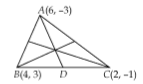
Find the length of the median $A D$ of a $\triangle A B C$ whose vertices are $A(6,-3), B(4,3)$ and $C(2,-1)$.
Answer(c) : Since, $A D$ is the median. So, $D$ is the mid point of the side $B C$. Thus, coordinates of $D$ are $\left(\frac{4+2}{2}, \frac{3-1}{2}\right)=(3,1)$
$
\begin{aligned}
\therefore A D & =\sqrt{(6-3)^2+(-3-1)^2} \\
& =\sqrt{9+16}=\sqrt{25}=5 \text { units }
\end{aligned}
$
View full question & answer→MCQ 391 Mark
If $P(b,-4)$ is the midpoint of the line segment joining $A(6,6)$ and $B(-2,3)$, then $b=$
Answer(c) : Since $P(b,-4)$ is the mid point of line joining $A(6,6)$ and $B(-2,3)$.
$
\therefore \quad \frac{6+(-2)}{2}=b \Rightarrow b=2
$
View full question & answer→MCQ 401 Mark
$C$ is the mid-point of $P Q$, if $P$ is $(4, x), C$ is $(y,-1)$ and $Q$ is $(-2,4)$, then $x$ and $y$ respectively are
Answer(a) : Since $C(y,-1)$ is mid-point of the join of $P(4, x)$ and $Q(-2,4)$.
So $\frac{4-2}{2}=y$ and $\frac{4+x}{2}=-1$
$\Rightarrow y=1$ and $x=-6$
View full question & answer→MCQ 411 Mark
The line represented by $4 x-3 y=9$ intersects the $y$-axis at
- ✓
$(0,-3)$
- B
$\left(\frac{9}{4}, 0\right)$
- C
$(-3,0)$
- D
$\left(0, \frac{9}{4}\right)$
AnswerCorrect option: A. $(0,-3)$
(a) : Given, the equation of line is $4 x-3 y=9$.
Putting $x=0$, we get $4 \times 0-3 y=9 \Rightarrow y=-3$
So, the line $4 x-3 y=9$ intersects the $y$-axis at $(0,-3)$.
View full question & answer→MCQ 421 Mark
$y$-axis divides the join of $P(-4,2)$ and $Q(8,3)$ in the ratio
- A
$3: 1$
- B
$1: 3$
- C
$2: 1$
- ✓
$1: 2$
AnswerCorrect option: D. $1: 2$
(d) : We know that on $y$-axis, $x$-coordinate is 0 .
Let this point divides the given line in the ratio $k: 1$.
Then, $0=\frac{8 k-4}{k+1} \Rightarrow 0=8 k-4$
$\Rightarrow 8 k=4 \Rightarrow k=\frac{1}{2} \therefore$ Required ratio $=1: 2$.
View full question & answer→MCQ 431 Mark
The equation of the perpendicular bisector of line segment joining points $A(4,5)$ and $B(-2,3)$ is
- A
$2 x-y+7=0$
- B
$3 x+2 y-7=0$
- C
$3 x-y-7=0$
- ✓
$3 x+y-7=0$
AnswerCorrect option: D. $3 x+y-7=0$
Any point $P(x, y)$ of perpendicular bisector will be equidistant from $A$ and $B$.
and $y=\frac{2(4)+1(-3)}{2+1}=\frac{8-3}{3}=\frac{5}{3}$
$\therefore \sqrt{(x-4)^2+(y-5)^2}$
$=\sqrt{(x+2)^2+(y-3)^2}$
$\Rightarrow x^2+16-8 x+y^2+25-10 y$
$=x^2+4+4 x+y^2+9-6 y$
$\Rightarrow-12 x-4 y+28=0$
$\Rightarrow 3 x+y-7=0$
View full question & answer→MCQ 441 Mark
If the mid-point of the line joining $(3,4)$ and $(k, 7)$ is $(x, y)$, which satisfies $2 x+2 y+1=0$. Find the value of $k$.
Answer(b) : Since $(x, y)$ is mid-point of line segment joining $(3,4)$ and $(k, 7)$
$\therefore x=\frac{3+k}{2}$ and $y=\frac{4+7}{2}=\frac{11}{2}$
Also $2 x+2 y+1=0$. So, on putting values, we get $3+k+11+1=0 \Rightarrow k+15=0 \Rightarrow k=-15$
View full question & answer→MCQ 451 Mark
Find the coordinates of point $A$, where $A B$ is the diameter of a circle whose centre is $O(2,-3)$ and $B$ is $(1,4)$.
- A
$(2,10)$
- ✓
$(3,-10)$
- C
$(3,-1)$
- D
$(1,-7)$
AnswerCorrect option: B. $(3,-10)$
Let coordinates of $A$ be $(a, b)$ and $C$ is the midpoint of $A B$. ( $\because$ Centre is mid$-$point of diameter$)$
$\therefore C \equiv\left(\frac{a+1}{2}, \frac{b+4}{2}\right)=(2,-3)$
$\Rightarrow \frac{a+1}{2}=2$ and $ \frac{b+4}{2}=-3$
$\Rightarrow a+1=4$ and $b+4=-6 $
$\Rightarrow a=3 $ and $ b=-10$
Hence, coordinates of point $A$ are $(3,-10)$.
View full question & answer→MCQ 461 Mark
If $A$ is a point on $y$-axis, whose ordinate is 3 and $B$ is a point $(-5,2)$, then the distance $A B$ is
- ✓
$\sqrt{26}$ units
- B
$\sqrt{24}$ units
- C
- D
$\sqrt{65}$ units
AnswerCorrect option: A. $\sqrt{26}$ units
(a) : Since, the point $A$ has ordinate 3 , so we take the point on $y$-axis as $A(0,3)$.
Now, $A B=\sqrt{(-5-0)^2+(2-3)^2}=\sqrt{25+1}=\sqrt{26}$ units
View full question & answer→MCQ 471 Mark
Find the values of $k$ for which the distance between the points $A(k,-5)$ and $B(2,7)$ is $13$ units.
- A
$7,3$
- B
$-7,3$
- ✓
$7,-3$
- D
$-7,-3$
AnswerCorrect option: C. $7,-3$
The given points are $A(k,-5)$ and $B(2,7)$
Now, $A B=13 $
$\Rightarrow A B^2=169$
$\Rightarrow(2-k)^2+(7+5)^2=169 $
$\Rightarrow k^2-4 k+4+144=169$
$\Rightarrow k^2-4 k-21=0 $
$\Rightarrow k^2-7 k+3 k-21=0$
$\Rightarrow k(k-7)+3(k-7)=0 $
$\Rightarrow(k-7)(k+3)=0$
$\Rightarrow k=7$ or $k=-3$
View full question & answer→MCQ 481 Mark
For what positive value of $x$, the distance between the points $(-2,5)$ and $(x, 19)$ be $\sqrt{205}$ units?
AnswerWe have $(x+2)^2+(19-5)^2=205$
$\Rightarrow x^2+4 x+4+196=205$
$\Rightarrow x^2+4 x-5=0 $
$\Rightarrow(x+5)(x-1)=0$
$\therefore x=-5 $ or $ x=1$
$\therefore $ Required positive value is $1 .$
View full question & answer→MCQ 491 Mark
The point $P(x, y)$ divides the join of the points $A(4,-2)$ and $B(-1,3)$ in the ratio $1: 4$, then $x+y=$
Answer(b): We have, $x=\frac{1(-1)+4 \times 4}{1+4}=3$,
$
\begin{aligned}
& y=\frac{1(3)+4(-2)}{1+4}=-1 \\
\therefore \quad & x+y=3-1=2
\end{aligned}
$
View full question & answer→MCQ 501 Mark
The distance between the points (2,-1) and (-1,-5) is ___________units.