Question 14 Marks
Solve the pairs of linear equation by the elimination method and the substitution method:$\frac{x}{2} + \frac{{2y}}{3} = - 1\,and\,x - \frac{y}{3} = 3$
Answer
- By Elimination method
The given system of equation is
$\frac { x } { 2 } + \frac { 2 y } { 3 } = - 1...............(1)$
$x - \frac { y } { 3 } = 3....................(2)$
Multiplying equation $(2)$ by $2,$ we get
$2 x - \frac { 2 y } { 3 } = 6......................(3)$
Adding equation$(1)$ and equation $(2),$ we get
$\frac { 5 } { 2 } x = 5 \Rightarrow x = \frac { 5 \times 2 } { 5 } \Rightarrow \quad x = 2$
Substituting this value of $x$ in equation$(2),$ we get
$2 - \frac { y } { 3 } = 3 \Rightarrow \frac { y } { 3 } = 2 - 3 = - 1 \Rightarrow \quad y = - 3$
So, the solution of the given system of equation is
$x = 2, y = -3$
- By substitution method
The given system of equation is
$\frac { x } { 2 } + \frac { 2 y } { 3 } = - 1...............(1)$
$x - \frac { y } { 3 } = 3....................(2)$
From equation $(2),$
$x = \frac { y } { 3 } + 3....................(3)$
Substituting this value of $x$ in $(1),$
$\frac { 1 } { 2 } \left( \frac { y } { 3 } + 3 \right) + \frac { 2 y } { 3 } = - 1$
$\Rightarrow \quad \frac { y } { 6 } + \frac { 3 } { 2 } + \frac { 2 y } { 3 } = - 1 \Rightarrow \quad \frac { 5 y } { 6 } = - 1 - \frac { 3 } { 2 }$
$\Rightarrow \quad \frac { 5 y } { 6 } - - \frac { 5 } { 2 } \Rightarrow y = - 3$
Substituting this value of y in equation $(3)$, we get
$x = - \frac { 3 } { 3 } + 3 = - 1 + 3 - 2$
So, the solution of the given system of equations is $x = 2, y = -3$
Verification: Substituting $x = 2, y = -3,$ we find that both the equation $(1)$ and $(2)$ are satisfied as shown below:
$\frac { x } { 2 } + \frac { 2 y } { 3 } = \frac { 2 } { 2 } + \frac { 2 ( - 3 ) } { 3 } = 1 - 2 = - 1$
View full question & answer→Question 24 Marks
Solve the given pair of linear equation by the elimination method and the substitution method: $3x – 5y – 4 = 0$ and $9x = 2y + 7$
Answer
- By Elimination method,
The given system of equations is :
$3 x - 5 y - 4 = 0............(1)$
$9 x = 2 y + 7$
$9 x - 2 y - 7 = 0.............(2)$
Multiplying equation $(1)$ by $3,$ we get
$9 x - 15 y - 12 = 0.............(3)$
Subtracting equation $(3)$ from equation $(2) ,$ we get
$13 y + 5 = 0$
$\Rightarrow \quad 13 y = - 5 \Rightarrow y = \frac { - 5 } { 13 }$
Substituting this value of $y$ in equation $(1),$ we get
$3 x - 5 \left( \frac { - 5 } { 13 } \right) - 4 = 0$
$\Rightarrow \quad 3 x + \frac { 25 } { 13 } - 4 = 0 \Rightarrow 3 x - \frac { 27 } { 13 } = 0$
$\Rightarrow \quad 3 x = \frac { 27 } { 13 } \Rightarrow x = \frac { 9 } { 13 }$
So, the solution of the given system of equation is
$x = \frac { 9 } { 13 } , y = \frac { - 5 } { 13 }$
- By Substitution method:
The given system of equation is:
$3 x - 5 y - 4 = 0.............(1)$
$9 x = 2 y + 7...................(2)$
From equation $(2),$
$x = \frac { 2 y + 7 } { 9 }..................(3)$
Substituting this value of $x$ in equation$(1),$ we get
$3 \left( \frac { 2 y + 7 } { 9 } \right) - 5 y - 4 = 0$
$\Rightarrow \quad \frac { 2 y + 7 } { 3 } - 5 y - 4 = 0$
$\Rightarrow \quad 2 y + 7 - 15 y - 12 = 0$
$\Rightarrow -13y - 5 = 0$
$\Rightarrow 13y = -5$
$\Rightarrow \quad y = \frac { - 5 } { 13 }$
Substituting this value of $y$ in equation$(3),$ we get
$x = \frac { 2 \left( \frac { - 5 } { 13 } \right) + 7 } { 9 } = \frac { - \frac { 10 } { 13 } + 7 } { 9 } = \frac { - 10 + 91 } { 117 } = \frac { 81 } { 117 } = \frac { 9 } { 13 }$
View full question & answer→Question 34 Marks
Solve the given pair of linear equation by the elimination method and the substitution method: $3x + 4y = 10$ and $2x – 2y = 2$
Answer
- By Elimination method,
The given system of equation is :
$3 x + 4 y = 10 ...................(1)$
$2 x - 2 y = 2 ...................(2)$
Multiplying equation$(2)$ by $2,$ we get
$4 x - 4 y = 4 ...................(2)$
Adding equation $(1)$ and equation $(3),$ we get
$7 x = 14$
$\therefore \quad x = \frac { 14 } { 7 } = 2$
Substituting this value of $x$ in equation $(2),$ we get
$2(2) - 2y = 2$
$\Rightarrow \quad 4 - 2 y = 2$
$\Rightarrow \quad 2 y = 4 - 2$
$\Rightarrow \quad 2 y = 2$
$\Rightarrow \quad y =\frac22=1$
So, the solution of the given system of equation is
$x = 2, y = 1$
- By Substitution method,
The given system of equation is:
$3 x + 4 y = 10.................(1)$
$2 x - 2 y = 2....................(2)$
From equation$(1)$
$3 x=10-4 y$
$x=\left(\frac{10-4 y}{3}\right)$
Put value of x in equation $(2),$
$2 x-2 y=2$
$2\left(\frac{10-4 y}{3}\right)-2 y=2$
$\frac{2(10-4 y)-2 y(3)}{3}=2$
$20-8 y-6 y=6$
$-14 y=-14$
$y = 1$
Putting value of $y = 1$ in equation $(2)$
$2x - 2 = 2$
$x = 2$
Therefore, $x = 2, y = 1$ is the solution.
Verification: Substituting $x = 2, y = 1,$ we find that both the
equation$(1)$ and $(2)$ are satisfied shown below:
$3 x + 4 y = 3 ( 2 ) + 4 ( 1 ) = 6 + 4 = 10$
$2 x - 2 y = 2 ( 2 ) - 2 ( 1 ) = 4 - 2 = 2$
Hence, the solution is correct.
View full question & answer→Question 44 Marks
Solve the given pair of linear equation by the elimination method and the substitution method: $x + y = 5$ and $2x - 3y = 4$
Answer$y = 5 .......... (1)$
$2x - 3y=4 ............. (2)$
- Elimination method:
Multiplying equation $(1)$ by $2,$ we get equation $(3)$
$2x +2y =10 ............. (3)$
$2x−3y =4 ........... (2)$
Subtracting equation $(2)$ from $(3),$ we get
$5y =6 ⇒ y = \frac{6}{5}$
Putting value of $y$ in $(1),$ we get
$x + \frac{6}{5}=5$
$⇒ x =5− \frac{6}{5}= \frac{{19}}{5}$
Therefore,$ x = \frac{{19}}{5}$ and $y = \frac{6}{5}$
- Substitution method:
$x +y =5 .......................... (1)$
$2x−3y =4 ......................... (2)$
From equation $(1),$ we get,
$x =5−y$
Putting this in equation $(2),$ we get
$2(5−y )−3y =4$
$⇒ 10−2y−3y =4$
$⇒ 5y =6$
$⇒ y = \frac{6}{5}$
Putting value of $y$ in $(1),$ we get
$x =5−\frac{6}{5}$=$\frac{{19}}{5}$
Therefore, $x = \frac{{19}}{5}$ and $y = \frac{6}{5}$
View full question & answer→Question 54 Marks
A fraction becomes $\frac { 9 } { 11 }$ if $2$ is added to both numerator and denominator. If $3$ is added to both numerator and denominator it becomes $ \frac { 5 } { 6 }$. Find the fraction by substitution method.
AnswerLet the numerator be $x$ and denominator be y if $2$ is added to both numerator and denominator,
the fraction becomes $\frac { 9 } { 11 }$ $\frac { x + 2 } { y + 2 } = \frac { 9 } { 11 }$
$11(x + 2) = 9( y + 2) = 11x + 22 = 9y + 18$ or,
$11x + 22 - 9y - 18 = 0$ or,
$ 11 x - 9 y + 4 = 0 ........(i)$
If 3 is added to both numerator and denominator the fraction becomes $\frac { 5 } { 6 }$ and $\frac { x + 3 } { y + 3 } = \frac { 5 } { 6 }$
$ 6(x+3) = 5(y+3)
6x +18 = 5y + 15$ or,
$6x + 18 - 5y - 15 = 0$ or,
$6x -5y + 3 = 0 ...(ii)$
On comparing with ax + by + c = 0 we get $a _ { 1 } = 11 , b _ { 1 } = -9 , c _ { 1 } = 4$
$a _ { 2 } = 6 , b _ { 2 } = - 5 \text { and } c _ { 2 } = 3$
Now, $\frac { x } { b _ { 1 } c _ { 2 } - b _ { 2 } c _ { 1 } } = \frac { y } { c _ { 1 } a _ { 2 } - c _ { 2 } a _ { 1 } } = \frac { 1 } { a _ { 1 } b _ { 2 } - a _ { 2 } b _ { 1 } }$
$\frac { x } { (-9 ) ( 3 ) - ( - 5 ) ( 4 ) } = \frac { y } { ( 4 ) ( 6 ) - ( 3 ) ( 11 ) } =\frac{1}{(11)(-5)-(6)-(9)}$
$\frac { x } { - 27 + 20 } = \frac { y } { 24 - 33 } = \frac { 1 } { - 55 + 54 }$
$\Rightarrow \quad \frac { x } { - 7 } = \frac { y } { - 9 } = \frac { 1 } { - 1 }$
$\Rightarrow \quad \frac { x } { - 7 } = -1$ or, $x = 7$
Hence, $x=7, y=9$
$\therefore$ Fraction $=\frac { 7 } { 9 }$
View full question & answer→Question 64 Marks
The taxi charges in a city consist of a fixed charge together with the charge for the distance covered. For a distance of $10\ km,$ the charge paid is $₹\ 105$ and for a journey of $15\ km$ the charge paid is $₹\ 155$. What are the fixed charges and the charge per $km?$ How much does a person have to pay for travelling a distance of $25\ km?$ Find them by substitution method.
AnswerLet fixed charge be $₹x$ and the charge per km be $₹y.$
For a distance of $10\ km,$ the charge paid is $₹\ 105 .$
$x + 10y = 105 ....(i)$
For a journey of $15\ km$ the charge paid is $₹\ 155$
$x + 15y = 155 .... (ii)$
From eqn. $(i), x = 105 -10y ...(iii)$
On substituting $x$ from eqn. $(iii)$ in eqn. $(ii),$
$105 - 10y + 15y = 155$
$\Rightarrow 5y = 155 - 105$
$\Rightarrow 5y = 50$
$\Rightarrow y = 10$
Put $y = 10$ in $(iii)$
$x = 105 - 10(10)$
$\Rightarrow x = 105 - 100$
$\therefore x = 5$
Hence, fixed charges $= ₹\ 5$
Rate per $km = ₹\ 10$
Amount to be paid for travelling $25\ km$
$= ₹\ 5 + ₹\ 10 \times 25$
$= ₹\ 5 + ₹\ 250$
$= ₹\ 255$
View full question & answer→Question 74 Marks
The coach of a cricket team buys $7$ bats and $6$ balls for $₹\ 3800.$ later, she buys $3$ bats and $5$ balls for $₹\ 1750.$ Find the cost of each bat and each ball by substitution method.
AnswerLet the cost of each bat and each ball be $Rs.x$ and $Rs. y$ respectively. Then, according to the equation, The pair of linear equations formed is
$7x + 6y = 3800 ....... (1)$
$3x + 5y = 1750 ...... (2)$
From equation $(2), 5y = 1750 - 3x$
$y = \frac { 1750 - 3 x } { 5 } ......... (3)$
Substitute this value of $y$ in equation $(1),$ we get
$7 x + 6 \left( \frac { 1750 - 3 x } { 5 } \right) = 3800$
$ \Rightarrow \quad 35 x + 10500 - 18 x = 19000$
$\Rightarrow \quad 17 x + 10500 = 19000$
$\Rightarrow \quad 17 x = 19000 - 10500$
$\Rightarrow \quad 17 x = 8500$
$\Rightarrow \quad x = \frac { 8500 } { 17 } = 500$ Substituting this value of $x$ in equation $(3),$ we get
$y = \frac { 1750 - 3 ( 500 ) } { 5 } = \frac { 1750 - 1500 } { 5 } = \frac { 250 } { 5 } = 50$
Hence, the cost of each bat and each ball is $Rs.500$ and $Rs.50$ respectively.
Verification,
Substituting $x = 500$ and $y = 50,$ we find that both the equations $(1)$ and $(2)$ are satisfied as shown below:
$7 x + 6 y = 7 ( 500 ) + 6 ( 50 )$
$= 3500 + 300 = 3800$
$3 x + 5 y = 3 ( 500 ) + 5 ( 50 )$
$= 1500 + 250 = 1750.$ This verifies the solution.
View full question & answer→Question 84 Marks
Solve $2x + 3y = 11$ and $2x – 4y = –24$ and hence find the value of m for which $y = mx + 3.$
AnswerThe given pair of linear equations
$2x + 3y = 11 ...... (1)$
$2x - 4y = -24 ....... (2)$
From equation $(1), 3y = 11 - 2x$
$\Rightarrow \quad y = \frac { 11 - 2 x } { 3 }$
Substituting this value of $y$ in equation $(2),$ we get
$2 x - 4 \left( \frac { 11 - 2 x } { 3 } \right) = - 24$
$\Rightarrow 6 x - 44 + 8 x = - 72$
$\Rightarrow 14 x - 44 = - 72$
$\Rightarrow 14 x = 44 - 72$
$\Rightarrow 14 x = - 28$
$\Rightarrow x = - \frac { 28 } { 14 } = - 2$
Substituting this value of $x$ in equation $(3),$ we get
$y = \frac { 11 - 2 ( - 2 ) } { 3 } = \frac { 11 + 4 } { 3 } = \frac { 15 } { 3 } = 5$ Verification,
Substituting $x = -2$ and $y = 5,$ we find that both the equations $(1)$ and $(2)$ are satisfied as shown below:
$2 x + 3 y = 2 ( - 2 ) + 3 ( 5 ) = - 4 + 15 = 11$
$2 x - 4 y = 2 ( - 2 ) - 4 ( 5 ) = - 4 - 20 = - 24$
This verifies the solution,
Now, $y = axe + 3$
$\Rightarrow 5 = m ( - 2 ) + 3$
$\Rightarrow - 2 m = 5 - 3$
$\Rightarrow - 2 m = 2$
$\Rightarrow \mathrm { m } = \frac { 2 } { - 2 } = - 1$
View full question & answer→Question 94 Marks
Solve the pair of linear equations by substitution method: $\frac { 3 x } { 2 } - \frac { 5 y } { 3 } = - 2$; $\frac { x } { 3 } + \frac { y } { 2 } = \frac { 13 } { 6 }$
Answer$\frac { 3 x } { 2 } - \frac { 5 y } { 3 } = - 2 ; \frac { x } { 3 } + \frac { y } { 2 } = \frac { 13 } { 6 }$
The given system of linear equation is
$\frac { 3 x } { 2 } - \frac { 5 y } { 3 } = - 2 \quad \dots \ldots \ldots \ldots ( 1 )$
$\frac { x } { 3 } + \frac { y } { 2 } = \frac { 13 } { 6 }....... (2)$
$\Rightarrow \quad 9 x - 10 y = - 12........ (3)$
$2x + 3y = 13 ...... (4)$
From equation $(3)$
$9x - 10y = -12$
$9x = 10y - 12$
$x = \frac { 10 y - 12 } { 9 }$
Substituting the value of $y$ in equation $(4),$ we get
$2 \left( \frac { 10 y - 12 } { 9 } \right) + 3 y = 13$
$20 y - 24 + 27 y = 117$
$47 y = 117 + 24$
$y = \frac { 141 } { 47 }$
$y = 3$
Substituting the value of $y$ in equation $(4),$ we get
$2 x + 3 \times 3 = 13$
$2 x + 9 = 13$
$2 x = 13 - 9$
$x = \frac { 4 } { 2 } = 2$
Therefore, the solution is
$x = 2, y = 3$
Verification, Substituting $x = 2$ and $y = 3,$ we find that both the equations $(1)$ and $(2)$ are satisfied as shown below:
$\frac { 3 } { 2 } x - \frac { 5 y } { 3 } = \frac { 3 } { 2 } ( 2 ) - \frac { 5 } { 3 } ( 3 ) = 3 - 5 = - 2$
$\frac { x } { 3 } + \frac { y } { 2 } = \frac { 2 } { 3 } + \frac { 3 } { 2 } = \frac { 13 } { 6 }$
This verifies the solution.
View full question & answer→Question 104 Marks
Draw the graphs of the equations $x – y + 1 = 0$ and $3x + 2y – 12 = 0.$ Determine the coordinates of the vertices of the triangle formed by these lines and the $x-$axis, and shade the triangular region.
AnswerThe given equations are
$x - y + 1 = 0 ...(1)$
$3x + 2y - 12 = 0 ...(2)$
Let us draw the graphs of equations $(1)$ and $(2)$ by finding two solutions for each of these equations. These two solutions of these equations $(1)$ and $(2)$ are given below in table $1$ and table $2$ respectively.
For equation $(1) x - y + 1 = 0$
$\Rightarrow y = x + 1$
Table 1 of solutions
For equation $(2) 3x + 2y - 12 = 0 \Rightarrow y = \frac{{12 - 3x}}{2}$
Table 2 of solutions
We plot the points $A(0, 1)$ and $B(-1, 0)$ on a graph paper and join these points to form the line $AB$ representing the equation $(1)$ as shown in the figure. Also, we plot the points $C(4, 0)$ and $D(0, 6)$ on the same graph paper and join these points to form the line $CD$ representing the equation $(2)$ and shown in the same figure.
In the figure, we observe that the coordinates of the vertices of the triangle formed by these given lines and the $x-$axis are $E(2, 3 ), B(-1, 0)$ and $C(4, 0)$
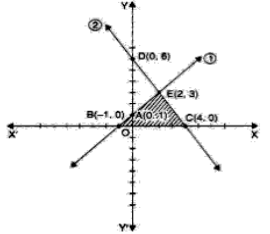
The triangular region $EBC$ has been shaded and the area of triangular region $EBC = \frac12 (5)(3)=\frac{15}{2}$ View full question & answer→Question 114 Marks
Half the perimeter of a rectangular garden, whose length is $4\ m$ more than its width, is $36\ m$. find the dimensions of the garden.
AnswerLet the dimensions (i.e., length and width) of the garden be $x$ and $y\ m$ respectively.
Then, $x = y + 4$ and $\frac{1}{2}(2x + 2y) = 36$
$\Rightarrow x - y = 4 ...(1)$
$x + y = 36 ...(2)$
Let us draw the graphs of equations $(1)$ and $(2)$ by finding two solutions for each of the equations. These two solution of the equations $(1)$ and $(2)$ are given below in table $1$ and table $2$ respectively.
For equation $(1)$
$x - y = 4$
$\Rightarrow y = x - 4$
Table $1$ of solutions
For equation $(2) x + y = 36$
$\Rightarrow y = 36 - x$
Table $2$ of solutions
| $x$ |
$20$ |
$16$ |
| $y$ |
$16$ |
$20$ |
We plot the points $A(4, 0)$ and $B(2, -2)$ on a graph paper and join these points to form the line $AB$ representing. The equation $(1)$ as shown in the figure.
Also, we plot the points $C(20, 16)$ and $D(16, 20)$ on the same graph paper and join these points to form the line $CD$ representing the equation $(2)$ as shown in the same figure.
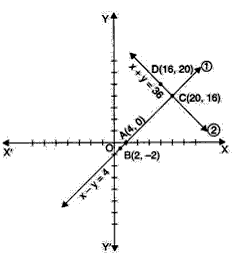
In the figure, we observe that the two lines intersect at the point $C(20, 16)$ So $x = 20, y = 16$ is the required solution of the pair of linear equations formed. i.e., the dimensions of the garden are $20\ m$ and $16\ m.$
Verification : substituting $x = 20$ and $y = 16$ in $(1)$ and $(2),$ we find that both the equations are satisfied as shown below:
$20 - 16 = 4$
$20 + 16 = 36$
This verifies the solution. View full question & answer→Question 124 Marks
Is the pair of linear equation consistent/inconsistent$?$ If consistent, obtain the solution graphically: $2x + y - 6 = 0; 4x - 2y - 4 = 0$
Answer$2x + y - 6 = 0 ...(1)$
$4x - 2y - 4 = 0 ...(2)$
$ \text { Here, } a_1=2, b_1=1, c_1=-6 $
$ a_2=4, b_2=-2, c_2=-4$
We see that $\frac{{{a_1}}}{{{a_2}}} \ne \frac{{{b_1}}}{{{b_2}}}$
Hence, the lines represented by the equations $(1)$ and $(2)$ are intersecting.
Therefore equation $(1)$ and $(2)$ have exactly one $($unique$)$ solution i.e., the given pair of linear equation is consistent. Graphical representation. We draw the graphs of the equations $(1)$ and $(2)$ by finding two solutions for each of the equations.
These two solution of the equations $(1)$ and $(2)$ given below in table $1$ and $2$ respectively.
For equation $(1)$
$2x + y - 6 = 0$
$\Rightarrow y = -2x + 6$
Table $1$ of solutions
For equation $(2)$
$4x - 2y - 4 = 0$
$\Rightarrow 2y = 4x - 4$
$\Rightarrow y = \frac{{4x - 4}}{2} \Rightarrow y = 2x - 2$
Table $2$ of solutions
We plots the points $A(0, 6)$ and $B(3, 0)$ on a graph paper and join these points to form the line $AB$ representing the equation $(1)$ as shown in the figure.
Also. we plot the points $C(0, -2)$ and $D(1, 0)$ on the same graph paper and join these points to form the line $CD$ representing the equation $(2)$ as shown in the same figure. In the figure, we observe that the same lines intersect
at the point $P(2, 1).$ So $x = 2$ and $y = 1$ is the required unique solution of the pair of linear equations formed.
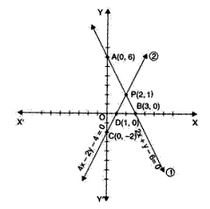
Verification : substituting $x = 2$ and $y = 1$ in $(1)$ and $(2)$ we find that both the equations are satisfied as shown below:
$2x + y - 6 = 2(2) + 2 = 6$
$4x - 2y - 4 = 4(2) - 2(2) - 4 = 0$
This verifies the solution. View full question & answer→Question 134 Marks
Is the pair of linear equation consistent/inconsistent$?$ If consistent, obtain the solution graphically: $x + y = 5, 2x + 2y = 10$
Answer$x + y = 5 ...(1)$
$2x + 2y = 10 ...(2)$
$ \text { Here, } a_1=1, b_1=1, c_1=-5 $
$ a_2=2, b_2=2, c_2=-10$
We see that $\frac{{{a_1}}}{{{a_2}}} = \frac{{{b_1}}}{{{b_2}}} = \frac{{{c_1}}}{{{c_2}}}$
Hence, the lines represented by the equations $(1)$ and $(2)$ are coincident.
Therefore, equations $(1)$ and $(2)$ have infinitely many common solutions, i.e., the given pair of linear equations is consistent.
Graphical Representation, we draw the graphs of the equations $(1)$ and $(2)$ by finding two solutions for each if the equations. These two solutions of the equations $(1)$ and $(2)$ are given below in table $1$ and table $2$ respectively.
For equation $(1) x + y = 5$
$\Rightarrow y = 5 - x$
Table $1$ of solutions
For equations $(2) x + 2y = 10$
$\Rightarrow 2y = 10 - 2x$
$\Rightarrow y = \frac{{10 - 2x}}{2} $
$\Rightarrow y = 5 - x$
Table $2$ of solutions
We plot the points $A(0, 5)$ and $B(5, 0)$ on a graph paper and join these points to form the line $AB$ representing the equation $(1)$ as shown in the figure, Also, we plot the points $C(1, 4)$ and $D (2, 3)$ on the same graph paper and join these points to form the line $CD$ representing the equation $(2)$ as shown in the same figure.
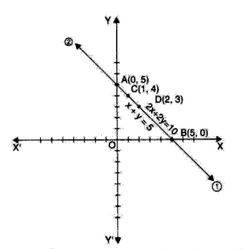
In the figure we observe that the two lines $AB$ and $CD$ coincide. View full question & answer→Question 144 Marks
Form the pair of linear equations in the problem, and find it's solution graphically.
$10$ students of class $X$ took part in Mathematics quiz. If the number of girls is $4$ more than the number of boys, find the number of boys and girls who took part in the quiz.
AnswerFormulation: Let the number of girls be $x$ and the number of boys be $y$.
It is given that total ten students took part in the quiz.
$\therefore$ Number of girls$+$ Number of boys $= 10$
i.e. $x + y =10$
It is also given that the number of girls is $4$ more than the number of boys.
$\therefore$ Number of girls$=$ Number of boys $+ 4$
i.e. $x = y+4$
or, $x-y = 4$
Thus, the algebraic representation of the given situation is
$x + y=10 ........(i)$
$x - y =4 ..........(ii)$
Add $(i)$ and $(ii)$ we get
$x + y + x - y = 10 + 4$
$2x = 14$
$x = 7$
Put $x = 7$ in $(i)$
$x + y = 10$
$7 + y = 10$
$y = 10 -7$
$y = 3$
So, value of $x = 7$ and $y = 3$
Graphical Representation: Now putting $y = 0$ in $x + y = 10,$ we get
$x = 10.$ Similarly, by putting $x = 0$ in $x + y = 10,$ we get $y = 10.$
Thus, two solution of equation $(i)$ are:
| $x$ |
$10$ |
$0$ |
| $y$ |
$0$ |
$10$ |
Similarly, two solutions of equation $(ii)$ are:
putting $y = 0$ in $x - y = 4,$ we get
$x = 4.$ Similarly, by putting $x = 0$ in $x + y = 10,$ we get $y = -4.$
Now, we plot the points $A (10, 0), B (0, 10), P (4, 0)$ and $Q (0, -4)$ corresponding to these solutions on the graph paper and draw the lines $AB$ and $PQ$ representing the equations $x + y = 10$ and $x - y - 4$ as shown in Fig. 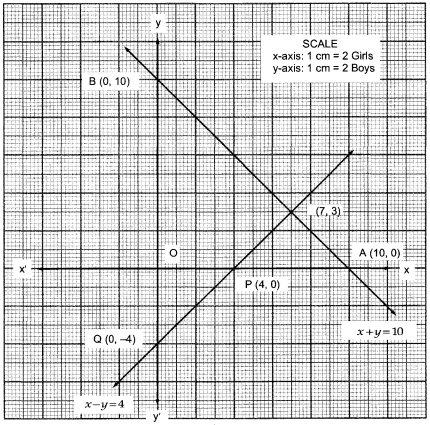
We observe that the two lines representing the two equations are intersecting at the point $(7, 3).$ View full question & answer→Question 154 Marks
The sum of a two-digit number and the number obtained by reversing the digits is $66.$ If the digits of the number differ by $2,$ find the number. How many such numbers are there$?$
AnswerSuppose, the digit at units and tens place of the given number be $x$ and $y$ respectively.
$\therefore$ the number is $10y + x$
After interchanging the digits, the number becomes $10x + y$
Given: The sum of the numbers obtained by interchanging the digits and the original number is $66.$
Thus, $(10x + y) + (10y + x) =66$
$\Rightarrow$ $10x + y + 10y + x = 66$
$\Rightarrow$ $11x +11y =66$
$\Rightarrow$ $11(x + y) = 66$
$\Rightarrow x + y = \frac{{66}}{{11}}$
$\Rightarrow$ $x + y = 6 .....(i)$
Also given, the two digits of the number are differing by $2.$
$\therefore$ we have $x - y = ±2....(ii)$
So, we have two systems of simultaneous equations,
$x - y = 2, \;x + y = 6$
$x - y = -2, \;x + y = 6$
Here x and y are unknowns. We have to solve the above systems of equations for $x$ and $y.$
- First, we solve the system
$x - y = 2$
$x + y = 6$
Adding the two equations,
$\Rightarrow(x - y) + (x + y) = 2 + 6$
$\Rightarrow x - y + x + y = 8$
$\Rightarrow 2x = 8$
$\Rightarrow x = \frac{8}{2} $
$\Rightarrow x = 4$
Substituting the value of $x$ in the first equation, we have
$4 - y = 2$
$\Rightarrow y = 4 - 2$
$\Rightarrow y = 2$
Hence, the number is $10 \times 2 + 4 = 24$
- Now, we solve the system
$x - y= -2$
$x + y = 6$
Adding the two equations, we have
$(x - y) + (x + y) = -2 + 6$
$\Rightarrow$ $x - y + x + y = 4$
$\Rightarrow$ $2x = 4$
$\Rightarrow x = \frac{4}{2} $
$\Rightarrow x = 2$
Substituting the value of x in the first equation,
$\Rightarrow 2 - y = -2$
$\Rightarrow y = 2 + 2$
$\Rightarrow y = 4$
Hence, the number is $10 \times 4 + 2 = 42$
Thus, the two numbers are $24$ and $42.$
View full question & answer→Question 164 Marks
Nihan hires a taxi to visit his uncle's house. The taxi charges in a city consist of a fixed charge together with the charge for the distance covered. His uncle's house is 10 km from his house and for that he pays ₹105. From there he goes to his grandfather's house. His grandfather's house is 15 km from his uncle's house. He pays ₹155 for this travel. What are the fixed charges and the charge per km? Nihan returns to his house from his grandfather's house. His house is 25 grandfather's house. How much taxi fare will he pay?
AnswerLet's assume the fixed charge is $₹ x$ and the charge per km is ₹ $y$. The total fare is calculated using the formula: Total Fare $=x+($ distance $\times y)$.
Based on the information given, we can form a pair of linear equations:
For the 10 km trip:$x+10 y=105$ ...(1)
For the 15 km trip: $x+15 y=155$ ...(2)
Subtracting equation (1) from equation (2) to solve for $y$ :
$\begin{array}{l}(x+15 y)-(x+10 y)=155-105 \\ 5 y=50 \\ y=10\end{array}$
Now, substitute $y=10$ into equation (1) to solve for $x:$
$\begin{array}{l}x+10(10)=105 \\ x+100=105 \\ x=5\end{array}$
The fixed charges are $₹ 5$ and the charge per km is ₹10.
The return trip is 25 km. Using the values of the fixed charge and charge per km, we can calculate the fare.
Fare = Fixed Charge + (Distance × Charge per km)
Fare =5+(25×10)
Fare = 5+250
Fare = ₹255
Nihan will have to pay ₹255 for the 25 km return journey.
View full question & answer→