Questions

2 Marks Questions

🎯

Test yourself on this topic

17 questions · timed · auto-graded

Question 12 Marks
Is it possible to design a rectangular park of perimeter $80\ m$ and area $400\ m^2?$ If so, find its length and breadth.
Answer
Let the length and breadth of the park be $l$ and $b$.
Perimeter = $2(l+ b) = 80$
$l + b = 40 ~or,~ b = 40 - l$
Area = $ l \times b = l(40 - l)$
$= 40l - l^{2} = 400$ Given
$l^{2}-40l+400=0$
Comparing this equation with $al^2+ bl + c = 0,$ we obtain
$a = 1, b = -40, c = 400$
Discriminant $D = b^2- 4ac = (-40)^2- 4(1) (400) = 1600 - 1600 = 0$
As $b^2- 4ac = 0$
Therefore, this equation has equal real roots and hence, this situation is possible.
Root of this equation,
$l=-\frac{b}{2 a}$
$l=-\frac{(-40)}{2(1)}=\frac{40}{2}=20$
Therefore, length of park, $l= 20m$
And breadth of park, $b = 40 - l = 40 - 20 = 20m$
View full question & answer
Question 22 Marks
Is the following situation possible? If so, determine their present ages. The sum of the ages of two friends is $20$ years. Four years ago, the product of their ages in years was $48$.
Answer
Let the present age of one friend be $x$ years. Also, sum of ages of both friends $= 20$ years hence age of 2nd friend will be $(20 - x)$ years. $4$ years ago, age of $1$st friend $= (x - 4 )$ years.
age of $2$nd friend$= (20-x)- 4 = (16-x)$ years. According to the question;
$(x - 4 )( 1 6 - x ) = 48 \Rightarrow x^2- 20x + 112 = 0$
Let D be the discriminant of this quadratic. Then,
D =$b^2-4ac$ $= 400 - 448 = -48 < 0$. $($here, $a=1 b=-20, c=112)$
So, above equation does not have real roots. Hence, the given situation is not possible.
View full question & answer
Question 32 Marks
Find the value of $k$ for the quadratic equation $kx(x − 2) + 6 = 0$, so that they have two equal roots.
Answer
$\Rightarrow \mathrm{kx}^2-2 \mathrm{kx}+6=0$
Comparing quadratic equation $\mathrm{kx}^2-2 \mathrm{kx}+6=0$ with general form $\mathrm{ax}^2+\mathrm{bx}+\mathrm{c}=0$, we get $\mathrm{a}=\mathrm{k}, \mathrm{b}=-2 \mathrm{k}$ and $\mathrm{c}=6$
$\text { Discriminant }=\mathrm{b}^2-4 \mathrm{ac}=(-2 \mathrm{k})^2-4(\mathrm{k})(6)=4 \mathrm{k}^2-24 \mathrm{k}$
We know that two roots of quadratic equation are equal only if discriminant is equal to zero.
Putting discriminant equal to zero
$ 4 k^2-24 k=0 $
$ \Rightarrow 4 k(k-6) \Rightarrow k=0,6$
The basic definition of quadratic equation says that quadratic equation is the equation of the form $\mathrm{ax}^2+\mathrm{bx}+\mathrm{c}=0$, where $a \neq 0$ Therefore, in equation $\mathrm{kx}^2-2 \mathrm{kx}+6=0$, we cannot have $\mathrm{k}=0$.
Therefore, we discard $\mathrm{k}=0$.
Hence the answer is $\mathrm{k}=6$.
View full question & answer
Question 42 Marks
Find the value of $k$ for the quadratic equation $2x^2+ kx + 3 = 0,$ so that they have two real equal roots.
Answer
The given quadratic equation is
$2 x^2+k x+3=0$
Here, $a=2, b=k, c=3$
Therefore, discriminant $=b^2-4 a c$
$=(k)^2-4(2)(3)=k^2-24$
If the given quadratic equation has two equal real roots, then
$b^2-4 a c=0$
$\Rightarrow \mathrm { k } ^ { 2 } - 24 = 0 \Rightarrow \mathrm { k } ^ { 2 } = 24$
$\Rightarrow \mathrm { k } = \pm \sqrt { 24 } \Rightarrow \mathrm { k } \pm 2 \sqrt { 6 }$
Hence, the required values of k are $\pm 2 \sqrt { 6 }$ .
i.e., $2 \sqrt { 6 } \text { and } - 2 \sqrt { 6 }$
View full question & answer
Question 52 Marks
Find the nature of the roots of the quadratic equation $2x^2- 6x + 3= 0.$  If the real roots exist. Find it.
Answer
The given quadratic equation is
$2x^2- 6x + 3= 0$
Here, $a = 2, b = -6, c = 3$
Therefore, discriminant $= b^2- 4ac$
$= ( - 6 ) ^ { 2 } - 4 ( 2 ) ( 3 ) = 36 - 24$
$= 12 > 0$
So, the given quadratic equation has two distinct real roots
Solving the quadratic equation $2 x ^ { 2 } - 6 x + 3 = 0$ , by the quadratic formula, $x = \frac { - b \pm \sqrt { b ^ { 2 } - 4 a c } } { 2 a }$
we get $= \frac { - ( - 6 ) \pm \sqrt { 12 } } { 2 ( 2 ) } = \frac { 6 \pm 2 \sqrt { 3 } } { 4 } = \frac { 3 \pm \sqrt { 3 } } { 2 }$
Therefore, the roots are $\frac { 3 \pm \sqrt { 3 } } { 2 } , \text { i.e. } \frac { 3 + \sqrt { 3 } } { 2 } \text { and } \frac { 3 - \sqrt { 3 } } { 2 }$​​​​​​
View full question & answer
Question 62 Marks
A cottage industry produces a certain number of pottery articles in a day. It was observed on a particular day that cost of production of each article (in rupees) was $3$ more than twice the number of articles produced on that day. If, the total cost of production on that day was $₹ 90$, find the number of articles produced and the cost of each article.
Answer
Let cost of production of each article be $Rs\ x$
We are given total cost of production on that particular day $= Rs\  90$
Therefore, total number of articles produced that day $= 90/x$
According to the given conditions,
$ x = 2 \left( \frac { 90 } { x } \right) + 3$
$\Rightarrow x = \frac { 180 } { x } + 3$
$\Rightarrow x = \frac { 180 + 3 x } { x }$
$\Rightarrow x ^ { 2 } = 180 + 3 x$
$\Rightarrow x ^ { 2 } - 3 x - 180 = 0$
$\Rightarrow x ^ { 2 } - 15 x + 12 x - 180 = 0$
$\Rightarrow x (x − 15) + 12 (x − 15) = 0$
$\Rightarrow (x − 15) (x + 12) = 0$
$ \Rightarrow x = 15, −12$
Cost cannot be in negative, therefore, we discard $x = − 12$
Therefore, $x = Rs\ 15$ which is the cost of production of each article.
Number of articles produced on that particular day = $ \frac { 90 } { 15 }$ $= 6$
View full question & answer
Question 72 Marks
The altitude of a right triangle is $7\ cm$ less than its base. If the hypotenuse is $13\ cm$, find the other two sides.
Answer
Let the base of the right triangle be $x\ cm$.
Then altitude $= (x - 7) cm$
Hypotenuse $= 13\ cm$ By Pythagoras theorem $\mathrm{(Base)^2+ (Altitude)^2= (Hypotenuse)^2}$
$\implies x^2+ (x-7)^2= (13)^2$
$\implies x^2+ x^2 -14x + 49 = 169$
$\implies 2x^2-14x -120 = 0$
$\implies 2(x^2- 7x -60) = 0$ or $x^2- 7x -60 = 0$
$\implies x^2- 12x + 5x -60 = 0$
$\implies x ( x - 12) +5 ( x - 12) = 0$
$\implies (x + 5) (x - 12) = 0$
Either $x + 5 = 0$ or $x -12 = 0$
$\implies x = -5, 12$
Since side of the triangle cannot be negative.
So, $x =12\ cm$ and $x = - 5$ is rejected.
Hence, length of the other two sides are $12cm, (12 - 7) = 5cm.$
View full question & answer
Question 82 Marks
Find two consecutive positive integers, sum of whose squares is $365.$
Answer
Let the two consecutive positive integers be $x$ and $x+1$
According to the question $x^2+ (x+1)^2= 365$
$\implies x^2+ x^2+ 2x + 1 = 365$
$\implies 2x^2+ 2x - 364 = 0$
$\implies 2(x^2+ x - 182) = 0$ or $x^2+ x - 182 = 0$
$\implies x^2+ 14x -13x -182 = 0$
$\implies x (x+14) -13 (x+14) = 0$
$\implies(x -13) (x+14) = 0$
Either $x-13 = 0$ or $x + 14 = 0$
$\implies x = 13, -14$
Since the numbers are positive. so $x = - 14$ is rejected.
Hence the required consecutive positive integers are $13, 13+1 =14.$
View full question & answer
Question 92 Marks
A cottage industry produces a certain number of toys in a day. The cost of production of each toy (in rupees) was found to be $55$ minus the number of toys produced in a day. On a particular day, the total cost of production was $₹ 750$. We would like to find out the number of toys produced on that day. Represent the situations mathematically (quadratic equation).
Answer
Let the number of toys produced be $x$.
$\therefore$ Cost of production of each toy $= Rs (55 − x)$
It is given that, total production of the toys $= Rs 750$
$\therefore x(55 – x) = 750$
$\Rightarrow x^2– 55x + 750 = 0$
Now to factorize this equation we have to find two numbers such that their product is 750 and sum is 55
$\Rightarrow x^2– 25x – 30x + 750 = 0$
$\Rightarrow x(x – 25 ) – 30(x – 25 ) = 0$
$\Rightarrow (x – 25)(x – 30) = 0$
Either $x – 25 = 0$ or $x − 30 = 0$
i.e., $x = 25 $ or $x = 30 $
Hence, the number of toys will be either $25$ or $30$.
View full question & answer
Question 102 Marks
Represent the situation in the form of the quadratic equation:
A train travels a distance of $480\ km$ at a uniform speed. If the speed had been $8\ km/hr$ less, then it would have taken $3$ hours more to cover the same distance. We need to find the speed of the train.
Answer
Distance travelled by the train $= 480\ km$
Let the speed of the train be $x\ kmph$
Time taken for the journey = $\frac { 480 } { x }$
Given speed is decreased by $8\ kmph$
Hence the new speed of train$ = (x – 8)\  kmph$
Time taken for the journey = $\frac { 480 } { x - 8 }$
$\frac { 480 } { x - 8 } = \frac { 480 } { x } + 3$
$\Rightarrow$ $\frac { 480 } { x - 8 } - \frac { 480 } { x } = 3$
$\Rightarrow \frac { 480 ( x - x + 8 ) } { x ( x - 8 ) } = 3$
$\Rightarrow \frac { 480 \times 8 } { x ( x - 8 ) } = 3$
$\Rightarrow 3 x ( x - 8 ) = 480 \times 8$
$\Rightarrow x(x - 8 ) = 160\times 8 \\ \Rightarrow   x^2 - 8x - 1280 = 0$
View full question & answer
Question 112 Marks
Represent the situation in the form of the quadratic equation:
The product of two consecutive positive integers is 306. Form the quadratic equation to find the integers.
Answer
Let the required consecutive positive integers be $x$ and $(x + 1)$.
Then, we have
$x(x + 1) = 306$
$\Rightarrow$ $x^2 + x - 306 = 0$
$\Rightarrow$ $x^2 + 18x - 17x  - 306 = 0$
$\Rightarrow$ $x(x + 18) - 17(x + 18) = 0$
$\Rightarrow$ $x + 18 = 0$ or $x - 17 = 0$
$\Rightarrow$ x = -18 or x = 17
Since $x$ is a positive integer, x $\neq$ -18.
$\Rightarrow$ $x = 17$
$\Rightarrow$ $x + 1 = 17 + 1 = 18$
Hence, the required positive intergers are $17$ and $18$.
View full question & answer
Question 122 Marks
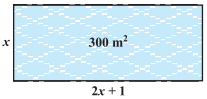
Find the dimensions of the prayer hall given in the below figure.
Answer
In the figure we found that if the breadth of the hall is x m, then x satisfies the equation $2x^2+ x – 300 = 0$
Applying the factorisation method, we write this equation as
$2x^2– 24x + 25x – 300 = 0$
$2x (x – 12) + 25 (x – 12) = 0$
$i.e., (x – 12)(2x + 25) = 0$
So, the roots of the given equation are $x = 12$ or $ x = – 12.5.$
Since x is the breadth of the hall, it cannot be negative.
Thus, the breadth of the hall is $12\ m$ and its length $= 2x + 1 = 25 m$
View full question & answer
Question 132 Marks
Find the roots of equation:$\frac { 1 } { x } - \frac { 1 } { ( x - 2 ) } = 3 , x \neq 0,2$
Answer
The given equation may be written as
$\frac { ( x - 2 ) - x } { x ( x - 2 ) } = 3$
 $ \Rightarrow$$3x(x - 2) = -2$
$\Rightarrow$ $3x^2 - 6x + 2 = 0$$..(i)$
This equation is of the form $ax^2 + bx + c = 0$, where $a = 3,\ b = -6\ and\ c = 2$.
$\therefore$ $D = (b^2 - 4ac) = (-6)^2 - 4$ $\times$ 3 $\times$ $2 = 36 - 24 = 12 > 0.$
So, the given equation has real roots.
Now, $\sqrt { D } = \sqrt { 12 } = 2 \sqrt { 3 }$
$\therefore \quad \alpha = \frac { - b + \sqrt { D } } { 2 a } = \frac { 6 + 2 \sqrt { 3 } } { 2 \times 3 } = \frac { 6 + 2 \sqrt { 3 } } { 6 } = \frac { 3 + \sqrt { 3 } } { 3 }$
$\beta = \frac { - b - \sqrt { D } } { 2 a } = \frac { 6 - 2 \sqrt { 3 } } { 2 \times 3 } = \frac { 6 - 2 \sqrt { 3 } } { 6 } = \frac { 3 - \sqrt { 3 } } { 3 }$
Hence, the required values of $x$ are $\frac { ( 3 + \sqrt { 3 } ) } { 3 }$ and $\frac { ( 3 - \sqrt { 3 } ) } { 3 }$
View full question & answer
Question 142 Marks
Find the roots of the quadratic equation $3 x^{2}-2 \sqrt{6} x+2=0$.
Answer
We have $3 x^{2}-2 \sqrt{6} x+2$ it can be factorise as:
$3 x^{2}-2 \sqrt{6} x+2=3 x^{2}-\sqrt{6} x-\sqrt{6} x+2$
$=\sqrt{3} x(\sqrt{3} x-\sqrt{2})-\sqrt{2}(\sqrt{3} x-\sqrt{2})$
$=(\sqrt{3} x-\sqrt{2})(\sqrt{3} x-\sqrt{2})$
So, the roots of the equation are the values of $x$ for which
$(\sqrt{3} x-\sqrt{2})(\sqrt{3} x-\sqrt{2})=0$
Now, $\sqrt{3} x-\sqrt{2}=0 \text { for } x=\sqrt{\frac{2}{3}}$
So, this root is repeated twice, one for each repeated factor $\sqrt{3} x-\sqrt{2}$
Therefore, the roots of $3x^{2}-2 \sqrt{6} x+2=0$ are $\sqrt{\frac{2}{3}}, \sqrt{\frac{2}{3}}$
View full question & answer
Question 152 Marks
Find the roots of the quadratic equation $2x^2– 5x + 3 = 0$ by factorisation.
Answer
Let us first split the middle term $-5 x$ as $-2 x,-3 x$ [because $(-2 x) \times(-3 x)=6 x^2=\left(2 x^2\right) \times 3$ ]
So, $2 x^2-5 x+3=2 x^2-2 x-3 x+3=2 x(x-1)-3(x-1)=(2 x-3)(x-1)$
Now, $2 x^2-5 x+3=0$ can be rewritten as $(2 x-3)(x-1)=0$
So, the values of x for which $2x^2– 5x + 3 = 0$ are the same for which $(2x – 3)(x – 1) = 0$
i.e., either $2x – 3 = 0$ or $x – 1 = 0.$
Now, $2x – 3 = 0$ gives $x=\frac{3}{2}$ and $x – 1 = 0$ gives $x = 1.$
So, $x=\frac{3}{2}$ and $x = 1$ are the roots of the given quadratic equation.
View full question & answer
Question 162 Marks
John and Jivanti together have $45$ marbles. Both of them lost $5$ marbles each, and the product of the number of marbles they now have is $124$. We would like to find out how many marbles they had to start with. Represent situation mathematically (quadratic equation).
Answer
Let the number of John’s marbles be $x.$
Therefore, number of Jivanti’s marble $= 45 − x$
After losing $5$ marbles,
Number of John’s marbles $= x − 5$
Number of Jivanti’s marbles $= 45 − x − 5 = 40 − x$
Given that the product of their marbles is $124$.
$\therefore (x – 5) (40 – x) = 124$
$\Rightarrow x^2– 45x +324 = 0$
View full question & answer
Question 172 Marks
Find two numbers whose sum is 27 and product is 182.
Answer
Let the two numbers be x, 27 - x. According to the question x (27 - x) =182 $\implies$27x - x2 -182 = 0 $\implies$x2 - 27x + 182 = 0 $\implies$ x2 - 13x -14x + 182 = 0 $\implies$x (x-13) - 14 (x-13) = 0 $\implies$(x-13) (x-14) = 0 Either x-13 = 0 or x - 14 = 0 $\implies$x = 13, 14 Hence, the required numbers are 13, 14
View full question & answer