MCQ 11 Mark
The discriminant of equation $5 x^2-6 x=1 ; b^2-4 a c=$ _______
- ✓
$16$
- B
$\sqrt{56}$
- C
$4$
- D
$56$
View full question & answer→MCQ 21 Mark
The discriminant is _______ of quadratic equation. $3 x^2-7 x+2=0$.
View full question & answer→MCQ 31 Mark
The equation of discriminant is _______ of quadratic equation $a x^2+b x+c=0$.
- A
$b^2+4 a c$
- ✓
$b^2-4 a c$
- C
$b^2-a c$
- D
$b-4 a c$
AnswerCorrect option: B. $b^2-4 a c$
$b^2-4 a c$
View full question & answer→MCQ 41 Mark
The Discriminant of quadratic Equation $2 x^2-3 x+5$ $=0$ is _______ .
View full question & answer→MCQ 51 Mark
The quadratic equation $a x^2-4 a x+2 a+1=0$ has repeated roots, if $a=$
AnswerCorrect option: B. $1 / 2$
The roots are said to be repeated, if
$B^2-4 \ A C=0 $
$\Rightarrow(-4 a)^2-4 \times a \times(2 a+1)=0$
$\Rightarrow 16 a^2-4 a(2 a+1)-0 $
$\Rightarrow 16 a^2-8 a^2-4 a-0$
$\Rightarrow 8 a^2-4 a=0 $
$\Rightarrow a(8 a-4)=0 $
$\Rightarrow a=0$ or $8 a-4=0$
$\therefore a=1 / 2 \ (\because a \neq 0)$
View full question & answer→MCQ 61 Mark
The roots of the equation $2 x-\frac{3}{x}=1 \ (x \neq 0)$ are
- A
$\frac{1}{2},-1$
- B
$\frac{3}{2}, 1$
- ✓
$\frac{3}{2},-1$
- D
AnswerCorrect option: C. $\frac{3}{2},-1$
$\text {(c) : } 2 x-\frac{3}{x}=1 $
$\Rightarrow 2 x^2-3=x$
$\Rightarrow 2 x^2-x-3=0 $
$\Rightarrow 2 x^2-3 x+2 x-3=0$
$\Rightarrow x(2 x-3)+1(2 x-3)=0$
$\Rightarrow(2 x-3)(x+1)=0 $
$\Rightarrow x=-1,3 / 2$
View full question & answer→MCQ 71 Mark
If roots of the quadratic equation
$3 a x^2+2 b x+c=0$ are in the ratio $2: 3$, then
Ram and Shyam said the following :
Ram $: 8 a c=25 b$
Shyam : $8 b^2=9 a c$
Which of them is/are correct?
AnswerLet $\alpha$ and $\beta$ be the roots of $3 a x^2+2 b x+c=0$.
Then, $\alpha+\beta=\frac{-2 b}{3 a}, \alpha \beta=\frac{c}{3 a}$.
Given$, \frac{\alpha}{\beta}=\frac{2}{3} $
$\Rightarrow \alpha=\frac{2}{3} \beta$
$\therefore \frac{2}{3} \beta+\beta=-\frac{2 b}{3 a} $
$\Rightarrow \frac{5 \beta}{3}=\frac{-2 b}{3 a} $
$\Rightarrow \beta=\frac{-2 b}{5 a}$
$\therefore \alpha=\frac{2}{3} \times \frac{-2 b}{5 a}=\frac{-4 b}{15 a}$
Now, $\alpha \beta=\frac{c}{3 a} $
$\Rightarrow\left(\frac{-4 b}{15 a}\right) \times\left(\frac{-2 b}{5 a}\right)=\frac{c}{3 a} $
$\Rightarrow 8 b^2=25 a c$
View full question & answer→MCQ 81 Mark
A rope of $16 m$ is divided into two parts such that twice the square of the greater part exceeds the square of the smaller part by $164$ . Then greater and smaller parts are respectively
- A
$11 m , 5 m$
- B
$9 m , 7 m$
- C
$12 m , 4 m$
- ✓
$10 m , 6 m$
AnswerCorrect option: D. $10 m , 6 m$
Let the greater part be $x m$.
$\therefore$ Smaller part will be $(16-x) m$.
According to the question, $2 x^2=(16-x)^2+164$
$\Rightarrow 2 x^2=256+x^2-32 x+164 $
$\Rightarrow x^2+32 x-420=0$
$\Rightarrow x^2+42 x-10 x-420=0$
$\Rightarrow x(x+42)-10(x+42)=0$
$\Rightarrow(x+42)(x-10)=0$
$\Rightarrow x=10,-42 $
$\therefore x=10$
$($Neglecting $x=-42$ as length can not be negative$)$
$\therefore $ Two parts are of length $10 m$ and $(16-10) m =6 m$.
View full question & answer→MCQ 91 Mark
The two roots of a quadratic equation are $2$ and $-1$ . The equation is
- A
$x^2+2 x-2=0$
- B
$x^2+x+2=0$
- C
$x^2-2 x+2=0$
- ✓
$x^2-x-2=0$
AnswerCorrect option: D. $x^2-x-2=0$
Putting $x=2,-1$ in $x^2-x-2$, we get
$(2)^2-2-2=4-2-2=0$ and $(-1)^2-(-1)-2=1+1-2=0$
So$, 2$ and $-1$ are the roots of the equation $x^2-x-2=0$.
View full question & answer→MCQ 101 Mark
The roots of the equation $x^2+5 x+5=0$ are
- ✓
$\frac{-5+\sqrt{5}}{2}, \frac{-5-\sqrt{5}}{2}$
- B
$\frac{5-\sqrt{5}}{2}, \frac{5+\sqrt{5}}{2}$
- C
$\frac{-3+\sqrt{5}}{2}, \frac{-3-\sqrt{5}}{2}$
- D
$\frac{3-\sqrt{5}}{2}, \frac{3+\sqrt{5}}{2}$
AnswerCorrect option: A. $\frac{-5+\sqrt{5}}{2}, \frac{-5-\sqrt{5}}{2}$
(a) : The given equation is $x^2+5 x+5=0$.
Here, $a=1, b=5$ and $c=5$
$\therefore D=b^2-4 a c=25-4 \times 1 \times 5=5$
The roots are given by $\alpha=\frac{-b+\sqrt{D}}{2 a}=\frac{-5+\sqrt{5}}{2}$ and
$\beta=\frac{-b-\sqrt{D}}{2 a}=\frac{-5-\sqrt{5}}{2}$
View full question & answer→MCQ 111 Mark
$a x^2+b x+c=0, a>0, b=0, c>0$ has
Answer$D=b^2-4 a c=(0)^2-4 a c\ \left[{[\because b=0}\right]$
$=-4 a c<0$
$\therefore a x^2+b x+c=0$ has no real roots.
View full question & answer→MCQ 121 Mark
The roots of the quadratic equation $\frac{11}{3+x}=4(3-x)$ are
- A
$\pm \frac{1}{5}$
- ✓
$\pm \frac{5}{2}$
- C
$\pm 2$
- D
$\pm 5$
AnswerCorrect option: B. $\pm \frac{5}{2}$
We have$, \frac{11}{3+x}=4(3-x)$
$\Rightarrow 4(3+x)(3-x)=11 $
$\Rightarrow 4\left(9-x^2\right)=11$
$\Rightarrow 36-4 x^2=11 $
$\Rightarrow 4 x^2=25$
$\Rightarrow x^2=\frac{25}{4}=\left(\frac{5}{2}\right)^2$
$\therefore x= \pm \frac{5}{2}$
View full question & answer→MCQ 131 Mark
Which of the following equations has two distinct real roots?
AnswerCorrect option: B. $x^2+x-5=0$
(b) : To have two distinct real roots, discriminant $\left(D=b^2-4 a c\right)$ must be $>0$.
(a) $D=(-3 \sqrt{2})^2-4(2) \times\left(\frac{9}{4}\right)=18-18=0$
(b) $D=(1)^2-4(1)(-5)=1+20=21>0$
(c) $D=(3)^2-4(1)(2 \sqrt{2})=9-8 \sqrt{2}<0$
(d) $D=(-3)^2-4(5)(1)=9-20=-11<0$
View full question & answer→MCQ 141 Mark
The necessary condition for $a x^2+b x+c=0$ to be quadratic is
- ✓
$a \neq 0$
- B
$a=0$
- C
$c \neq 0$
- D
AnswerCorrect option: A. $a \neq 0$
(a): The necessary condition for $a x^2+b x+c=0$ to be quadratic is $a \neq 0$.
View full question & answer→MCQ 151 Mark
Find the positive value of $k$ for which quadratic equations $x^2+k x+64=0$ and $x^2-8 x+k=0$ will have real roots.
Answer(a): We have, $x^2+k x+64=0$
Since, roots are real. $\therefore b^2-4 a c \geq 0$
$\Rightarrow k^2-4(1)(64) \geq 0 \Rightarrow k^2 \geq 256\ldots(i)$
Also, $x^2-8 x+k=0$ has real roots.
$\Rightarrow 64-4 k \geq 0 \Rightarrow 64 \geq 4 k \Rightarrow k \leq 16\ldots(ii)$
From (i) and (ii), we get $k=16$.
View full question & answer→MCQ 161 Mark
Find the roots of quadratic equation $2 x^2+x-300=0$
- A
$30, \frac{2}{15}$
- B
$60, \frac{-2}{5}$
- ✓
$12, \frac{-25}{2}$
- D
AnswerCorrect option: C. $12, \frac{-25}{2}$
We have$, 2 x^2+x-300=0$
$\Rightarrow 2 x^2-24 x+25 x-300=0$
$\Rightarrow (x-12)(2 x+25)=0$
$\Rightarrow x=12, \frac{-25}{2}$
View full question & answer→MCQ 171 Mark
Which of the following equations has no real roots?
- A
$x^2=10 x-2$
- B
$x^2-12 x=16$
- C
$7 x^2-1=-8 x$
- ✓
$2 x^2+5 x+5=0$
AnswerCorrect option: D. $2 x^2+5 x+5=0$
(d) : To have no real roots, discriminant $\left(D=b^2-4 a c\right)$ must be $<0$.
(a) $D=(-10)^2-4(1)(2)=100-8=92>0$
(b) $D=(-12)^2-4(1)(-16)=144+64=208>0$
(c) $D=(8)^2-4(7)(-1)=64+28=92>0$
(d) $D=(5)^2-4(2)(5)=25-40=-15<0$
View full question & answer→MCQ 181 Mark
If $x=k$ be a solution of the quadratic equation $x^2+4 x+3=0$, then the possible values of $k$ will be
- A
$-1,2$
- ✓
$-1,-3$
- C
$-1,3$
- D
$-1,-2$
AnswerCorrect option: B. $-1,-3$
We have, $k^2+4 k+3=0 $
$\Rightarrow k^2+3 k+k+3=0$
$\Rightarrow k(k+3)+1(k+3)=0 $
$\Rightarrow(k+3)(k+1)=0$
$\Rightarrow k=-1,-3$
View full question & answer→MCQ 191 Mark
Two equations are given below :
(i) $(x+1)(x+3)-x+7=0$
(ii) $x^2+2 x+\frac{1}{x}=0 ; x \neq 0$
Rohit and Mohit said the following :
Rohit : Equation (i) is quadratic.
Mohit : Equation (ii) is quadratic.
Which of them is/are correct ?
Answer(a) : (i) $(x+1)(x+3)-x+7=0$
$\Rightarrow x^2+4 x+3-x+7=0$
$\Rightarrow x^2+3 x+10=0$, which is a quadratic equation.
(ii) $x^2+2 x+\frac{1}{x}=0$
$\Rightarrow x^3+2 x^2+1=0$ which is a cubic equation.
View full question & answer→MCQ 201 Mark
In the Maths test two representatives, while solving a quadratic equation, committed the following mistakes:
(i) One of them made a mistake in the constant term and got the roots as 5 and 9 .
(ii) Another one committed an error in the coefficient of $x$ and got the roots as 12 and 4 .
But in the meantime, they realised that they are wrong and they managed to get it right jointly. Find the correct quadratic equation.
- A
$x^2+4 x+14=0$
- B
$2 x^2+7 x-24=0$
- ✓
$x^2-14 x+48=0$
- D
$3 x^2-17 x+52=0$
AnswerCorrect option: C. $x^2-14 x+48=0$
(c) : Since, $1^{\text {st }}$ person made a mistake in constant term. Therefore, sum of roots $=14$ and $2^{\text {nd }}$ person made a mistake in coefficient of $x$
$\therefore \quad$ Product of roots $=48$
$\Rightarrow$ Required quadratic equation is
$x^2-14 x+48=0$
View full question & answer→MCQ 211 Mark
The integral value of $k$ for which the equation $(k-12) x^2+2(k-12) x+2=0$ possesses no real solutions, is
Answer(b): We have, $(k-12) x^2+2(k-12) x+2=0$
For no real solution, $D<0$ i.e., $b^2-4 a c<0$
$\begin{aligned} & \Rightarrow \quad[2(k-12)]^2-4(k-12) \times 2<0
\\ & \Rightarrow \quad 2(k-12)[2(k-12)-4]<0
\\ & \Rightarrow \quad(k-12)[2 k-24-4]<0
\\ & \Rightarrow \quad(k-12)(2 k-28)<0 \Rightarrow 12
View full question & answer→MCQ 221 Mark
The roots of the equation $x^2+x-p(p+1)=0$, where $p$ is a constant, are
- A
$p, p+2$
- B
$-p, p-1$
- ✓
$p,-(p+1)$
- D
$-p,-(p+1)$
AnswerCorrect option: C. $p,-(p+1)$
(c): Given equation is $x^2+x-p(p+1)=0$
Using quadratic formula,
$\begin{aligned}
x= & \frac{-1 \pm \sqrt{1-(4)\left(-p^2-p\right)}}{2} \\
& =\frac{-1 \pm \sqrt{(2 p+1)^2}}{2}=\frac{-1 \pm(2 p+1)}{2} \\
\therefore \quad x & =\frac{-1+(2 p+1)}{2} \text { or } x=\frac{-1-(2 p+1)}{2} \\
\Rightarrow & x=\frac{2 p}{2}=p \text { or } x=\frac{-2-2 p}{2}=-(p+1)
\end{aligned}$
View full question & answer→MCQ 231 Mark
The value(s) of $k$ for which the quadratic equation $2 x^2+k x+2=0$ has equal roots, is
AnswerCorrect option: B. $\pm 4$
(b) : Given quadratic equation is
$2 x^2+k x+2=0$
Since the equation has equal roots.
$\begin{array}{ll}
\therefore & \text { Discriminant }=0 \\
\Rightarrow & k^2-4 \times 2 \times 2=0 \\
\Rightarrow & k^2-16=0 \\
\Rightarrow & k^2=16 \Rightarrow k= \pm 4
\end{array}$
View full question & answer→MCQ 241 Mark
The roots of the quadratic equation $2 x^2-x-6=0$ are
- A
$-2,3 / 2$
- ✓
$2,-3 / 2$
- C
$-2,-3 / 2$
- D
$2,3 / 2$
AnswerCorrect option: B. $2,-3 / 2$
We have, $2 x^2-x-6=0$
$\Rightarrow 2 x^2-4 x+3 x-6=0$
$\Rightarrow 2 x(x-2)+3(x-2)=0 $
$\Rightarrow(x-2)(2 x+3)=0$
$\Rightarrow x-2=0$ or $ 2 x+3=0$
$\Rightarrow x=2$ or $ x=-\frac{3}{2}$
View full question & answer→MCQ 251 Mark
Which of the following equations has the sum of its roots as 3?
AnswerCorrect option: B. $-x^2+3 x-3=0$
(b) : Consider, $-x^2+3 x-3=0$
On comparing with $a x^2+b x+c=0$, we get
$a=-1, b=3 \text { and } c=-3$
$\therefore$ Sum of the roots $=-\frac{b}{a}=-\frac{3}{-1}=3$
Therefore, sum of the roots of the quadratic equation $-x^2+3 x-3=0$ is 3 .
View full question & answer→MCQ 261 Mark
If $(x+4)(x-4)=9$, then the values of $x$ are
AnswerCorrect option: A. $\pm 5$
(a): We have, $(x+4)(x-4)=9$
$\Rightarrow x^2-16=9 \Rightarrow x^2=25 \Rightarrow x= \pm 5$
View full question & answer→MCQ 271 Mark
The sum of the squares of two consecutive natural numbers is $41$ . Represent this situation in the form of a quadratic equation.
- ✓
$x^2+x-20=0$
- B
$x^2-x-20=0$
- C
$x^2+x+20=0$
- D
$x^2-x+20=0$
AnswerCorrect option: A. $x^2+x-20=0$
Let the two consecutive natural numbers be $x$ and $x+1$.
Then, their squares are $x^2$ and $(x+1)^2$ respectively.
$\therefore$ The required equation is, $x^2+(x+1)^2=41$
$\Rightarrow x^2+x^2+1+2 x=41$
$\Rightarrow 2 x^2+2 x-40=0$
$\Rightarrow x^2+x-20=0$
View full question & answer→MCQ 281 Mark
The roots of the equation $x^2-2 x-\left(r^2-1\right)=0$ are
- A
$1-r,-r-1$
- ✓
$1-r, r+1$
- C
$1, r$
- D
$1-r, r$
AnswerCorrect option: B. $1-r, r+1$
We have, $x^2-2 x-\left(r^2-1\right)=0$
$\Rightarrow x^2-2 x+1=r^2 $
$\Rightarrow(x-1)^2=r^2$
$\Rightarrow(x-1)= \pm r $
$\Rightarrow x=1 \pm r$
View full question & answer→MCQ 291 Mark
If $\frac{1}{3}$ is a root of the equation $x^2+k x-\frac{5}{9}=0$, then find the value of $k$.
- A
$\frac{3}{4}$
- ✓
$\frac{4}{3}$
- C
$\frac{2}{3}$
- D
$\frac{3}{2}$
AnswerCorrect option: B. $\frac{4}{3}$
(b) : Since $\frac{1}{3}$ is a root of the equation, $x^2+k x-\frac{5}{9}=0$
$\therefore \quad\left(\frac{1}{3}\right)^2+k\left(\frac{1}{3}\right)-\frac{5}{9}=0$
$\Rightarrow \quad \frac{1}{3} k=\frac{5}{9}-\frac{1}{9}=\frac{4}{9} \Rightarrow k=\frac{4}{9} \times 3=\frac{4}{3}$
View full question & answer→MCQ 301 Mark
If $-2$ is a root of the quadratic equation $3 x^2+p x-8=0$ and the quadratic equation $4 x^2-2 p x+k=0$ has equal roots, then find the value of $k$.
AnswerSince $-2$ is a root of equation $3 x^2+p x-8=0$
$\therefore 3(-2)^2+p(-2)-8=0$
$\Rightarrow 12-2 p-8=0 $
$\Rightarrow 2 p=4 $
$\Rightarrow p=2$
Now, the equation $4 x^2-2 p x+k=0$ has equal roots.
$\therefore D=0 $
$\Rightarrow(-2 p)^2-4(4)(k)=0$
$\Rightarrow (-2 \times 2)^2-16 k=0 $
$\Rightarrow k=1$
View full question & answer→MCQ 311 Mark
The roots of the quadratic equation $2 x^2-3 x-5=0$ are
Answer(c) : We have, $2 x^2-3 x-5=0$
Here, $a=2, b=-3$ and $c=-5$.
$\therefore \quad D=b^2-4 a c=(-3)^2-4(2)(-5)$
$=9+40=49>0$ and 49 is a perfect square also.
Thus, given equation has rational and unequal roots.
View full question & answer→MCQ 321 Mark
Which of the following is a root of the quadratic equation $\sqrt{3} x^2+10 x+7 \sqrt{3}=0 ?$
- ✓
$-\sqrt{3}$
- B
$\sqrt{3}$
- C
$7 \sqrt{3}$
- D
$-7 \sqrt{3}$
AnswerCorrect option: A. $-\sqrt{3}$
We have, $\sqrt{3} x^2+10 x+7 \sqrt{3}=0$
$\Rightarrow \sqrt{3} x^2+7 x+3 x+7 \sqrt{3}=0$
$\Rightarrow x(\sqrt{3} x+7)+\sqrt{3}(\sqrt{3} x+7)=0$
$\Rightarrow (\sqrt{3} x+7)(x+\sqrt{3})=0$
$\Rightarrow x=\frac{-7}{\sqrt{3}} \text { or } x=-\sqrt{3}$
View full question & answer→MCQ 331 Mark
The discriminant of the equation $x^2+9 x-13=0$ is
AnswerWe have, $x^2+9 x-13=0$
Here, $a=1, b=9$ and $c=-13$.
$\therefore$ Discriminant$, D=b^2-4 a c=(9)^2-4(1)(-13)$
$=81+52=133$
View full question & answer→MCQ 341 Mark
The number of real roots of the equation $(x-1)^2+(x-2)^2+(x-3)^2=0$ is
AnswerWe have$, (x-1)^2+(x-2)^2+(x-3)^2=0$
$\Rightarrow x^2+1-2 x+x^2+4-4 x+x^2+9-6 x=0$
$\Rightarrow 3 x^2-12 x+14=0\ldots(i)$
For real roots, $D=b^2-4 a c \geq 0$
$\Rightarrow D=144-4(3)(14)$
$=144-168=-24<0$
$\therefore$ Equation $(i)$ has no real root.
View full question & answer→MCQ 351 Mark
Find the roots of the quadratic equation $x^2-3 \sqrt{5} x+10=0$.
- A
$-2 \sqrt{5}, \sqrt{5}$
- ✓
$2 \sqrt{5}, \sqrt{5}$
- C
$-2 \sqrt{5},-\sqrt{5}$
- D
$2 \sqrt{5},-\sqrt{5}$
AnswerCorrect option: B. $2 \sqrt{5}, \sqrt{5}$
Given, $x^2-3 \sqrt{5} x+10=0$
Using quadratic formula,
$x=\frac{3 \sqrt{5} \pm \sqrt{(-3 \sqrt{5})^2-4(1)(10)}}{2(1)}$
$=\frac{3 \sqrt{5} \pm \sqrt{5}}{2}$
$\Rightarrow x=\frac{4 \sqrt{5}}{2}$ or $ x=\frac{2 \sqrt{5}}{2}$
$\Rightarrow x=2 \sqrt{5}$ or $x=\sqrt{5}$
View full question & answer→MCQ 361 Mark
Solve the following quadratic equation for $x$ : $4 \sqrt{3} x^2+5 x-2 \sqrt{3}=0$
- ✓
$\frac{\sqrt{3}}{4}, \frac{-2}{\sqrt{3}}$
- B
$\frac{-\sqrt{3}}{4}, \frac{-2}{\sqrt{3}}$
- C
$\frac{\sqrt{3}}{4}, \frac{2}{\sqrt{3}}$
- D
$\frac{-\sqrt{3}}{4}, \frac{2}{\sqrt{3}}$
AnswerCorrect option: A. $\frac{\sqrt{3}}{4}, \frac{-2}{\sqrt{3}}$
We have, $4 \sqrt{3} x^2+5 x-2 \sqrt{3}=0$
$\Rightarrow 4 \sqrt{3} x^2+8 x-3 x-2 \sqrt{3}=0$
$\Rightarrow 4 x(\sqrt{3} x+2)-\sqrt{3}(\sqrt{3} x+2)=0$
$\Rightarrow(4 x-\sqrt{3})(\sqrt{3} x+2)=0$
$\therefore x=\frac{\sqrt{3}}{4}$ or $ x=-\frac{2}{\sqrt{3}}$
View full question & answer→MCQ 371 Mark
If $x=\sqrt{2+\sqrt{2+\sqrt{2+\ldots \infty}}}$ and $x$ is a natural number, then
- A
$x^2+x-2=0$
- B
$x^2+2 x+2=0$
- ✓
$x^2-x-2=0$
- D
$x^2-x+2=0$
AnswerCorrect option: C. $x^2-x-2=0$
(c) : We have, $x=\sqrt{2+\sqrt{2+\sqrt{2+\ldots \infty}}}$
$
\Rightarrow x=\sqrt{2+x} \quad[\because x=\sqrt{2+\sqrt{2+\sqrt{2+\ldots \infty}}}]
$
On squaring both sides, we get
$
x^2=2+x \Rightarrow x^2-x-2=0
$
View full question & answer→MCQ 381 Mark
Find the roots of quadratic equation $6 x^2-13 x+5=0$
- A
$2, \frac{3}{5}$
- B
$-2, \frac{-5}{3}$
- C
$\frac{1}{2}, \frac{-3}{5}$
- ✓
$\frac{1}{2}, \frac{5}{3}$
AnswerCorrect option: D. $\frac{1}{2}, \frac{5}{3}$
We have$, 6 x^2-13 x+5=0$
$\Rightarrow 6 x^2-3 x-10 x+5=0$
$\Rightarrow (2 x-1)(3 x-5)=0$
$\Rightarrow x=\frac{1}{2}, \frac{5}{3}$
View full question & answer→MCQ 391 Mark
For what value of $t, x=\frac{2}{3}$ is a root of $7 x^2+t x-3=0$ ?
- A
$\frac{1}{6}$
- ✓
$-\frac{1}{6}$
- C
$\frac{1}{5}$
- D
$\frac{1}{8}$
AnswerCorrect option: B. $-\frac{1}{6}$
Since $x=\frac{2}{3}$ is a root of $7 x^2+t x-3=0$
$\therefore 7\left(\frac{2}{3}\right)^2+t\left(\frac{2}{3}\right)-3=0 $
$\Rightarrow \frac{28}{9}+\frac{2 t}{3}-3=0$
$\Rightarrow \frac{2 t}{3}+\frac{1}{9}=0 $
$\Rightarrow t=\frac{-1}{9} \times \frac{3}{2}=-\frac{1}{6}$
View full question & answer→MCQ 401 Mark
The solution of the quadratic equation $\frac{x^2-8}{x^2+20}=\frac{1}{2}$ is shown below :
We have, $\frac{x^2-8}{x^2+20}=\frac{1}{2}$
$\Rightarrow 2 x^2-16=x^2+20($ step 1$)$
$\Rightarrow x^2=36$ (step 2)
$\Rightarrow x= \pm 5$ (step 3$)$
In which step is there an error in solving ?
Answer(c) : As $x^2=36 \Rightarrow x= \pm 6$
View full question & answer→MCQ 411 Mark
Find the roots of the following quadratic equation $2 \sqrt{3} x^2-5 x+\sqrt{3}=0$.
- A
$\frac{-\sqrt{3}}{2}, \frac{1}{\sqrt{3}}$
- B
$\frac{\sqrt{3}}{2}, \frac{-1}{\sqrt{3}}$
- ✓
$\frac{\sqrt{3}}{2}, \frac{1}{\sqrt{3}}$
- D
$\frac{-\sqrt{3}}{2}, \frac{-1}{\sqrt{3}}$
AnswerCorrect option: C. $\frac{\sqrt{3}}{2}, \frac{1}{\sqrt{3}}$
(c) : We have, $2 \sqrt{3} x^2-5 x+\sqrt{3}=0$
Discriminant, $D=25-4 \times 2 \sqrt{3} \times \sqrt{3}=25-24=1$
Using quadratic formula,
$
\begin{aligned}
x & =\frac{5 \pm \sqrt{1}}{2 \times 2 \sqrt{3}}=\frac{5 \pm 1}{4 \sqrt{3}} \\
\Rightarrow x & =\frac{6}{4 \sqrt{3}}=\frac{\sqrt{3}}{2} \quad \text { or } x=\frac{4}{4 \sqrt{3}}=\frac{1}{\sqrt{3}}
\end{aligned}
$
View full question & answer→MCQ 421 Mark
The roots of the equation $\sqrt{x^2+15}=8$ are
- A
$x=7$
- ✓
$x= \pm 7$
- C
$x=-7$
- D
$x=0$
AnswerCorrect option: B. $x= \pm 7$
We have, $\sqrt{x^2+15}=8$
$\Rightarrow x^2+15=64 \ [$Squaring both sides$]$
$\Rightarrow x^2=49 $
$\Rightarrow x= \pm 7$
View full question & answer→MCQ 431 Mark
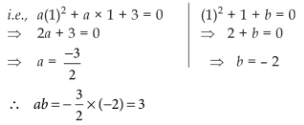
If 1 is a root of the equations $a y^2+a y+3=0$ and $y^2+y+b=0$, then find the value of $a b$.
Answer(a) : Given, 1 is the root of $a y^2+a y+3=0$ and $y^2+y+b=0$
$\therefore \quad y=1$ will satisfy these equations.
View full question & answer→MCQ 441 Mark
If the quadratic equation $m x^2+2 x+m=0$ has two equal roots, then find the values of $m$.
AnswerCorrect option: C. $\pm 1$
For roots of $m x^2+2 x+m=0$ to be equal, Discriminant, $D=0$
$\therefore (2)^2-4(m)(m)=0$
$\Rightarrow 4-4 m^2=0 $
$\Rightarrow m^2=1 $
$\Rightarrow m= \pm 1 .$
View full question & answer→MCQ 451 Mark
The roots of the quadratic equation $100 x^2-20 x+1=0$ are
- ✓
$\frac{1}{10}, \frac{1}{10}$
- B
$-10,-10$
- C
$-10, \frac{1}{10}$
- D
$\frac{-1}{10}, \frac{-1}{10}$
AnswerCorrect option: A. $\frac{1}{10}, \frac{1}{10}$
(a): We have, $100 x^2-20 x+1=0$
$
\Rightarrow \quad(10 x-1)^2=0 \quad \Rightarrow \quad x=\frac{1}{10}, \frac{1}{10}
$
View full question & answer→MCQ 461 Mark
The roots of the equation $8 x^2-22 x-21=0$ are
- ✓
$\frac{7}{2},-\frac{3}{4}$
- B
$-\frac{7}{2}, \frac{3}{4}$
- C
$\frac{3}{2},-\frac{7}{4}$
- D
$\frac{5}{2}, \frac{3}{4}$
AnswerCorrect option: A. $\frac{7}{2},-\frac{3}{4}$
We have, $8 x^2-22 x-21=0$
$\Rightarrow 8 x^2-28 x+6 x-21=0$
$\Rightarrow 4 x(2 x-7)+3(2 x-7)=0$
$\Rightarrow (2 x-7)(4 x+3)=0 $
$\Rightarrow 2 x-7=0$ or $4 x+3=0$
$\Rightarrow x=\frac{7}{2}$ or $ x=-\frac{3}{4}$
Hence, $\frac{7}{2}$ and $-\frac{3}{4}$ are the roots of the given equation.
View full question & answer→MCQ 471 Mark
$x=\ldots .$. is known as golden number.
- A
- ✓
$\frac{1+\sqrt{5}}{2}$
- C
$0$
- D
$\frac{1+\sqrt{2}}{2}$
AnswerCorrect option: B. $\frac{1+\sqrt{5}}{2}$
$\frac{1+\sqrt{5}}{2}$
View full question & answer→MCQ 481 Mark
Price of one pen is $₹ 15$. In its price if $₹ x$ decrease then number of pen obtained in $₹ 600$ are ......
- A
$\frac{15+x}{600}$
- B
$\frac{600}{15-x}$
- C
$\frac{15 x}{600}$
- ✓
$\frac{600}{15-x}$
AnswerCorrect option: D. $\frac{600}{15-x}$
$\frac{600}{15-x}$
View full question & answer→MCQ 491 Mark
If two roots of the equation $6 x^2-13 x+m=0$ one reciprocal of each other then value at $m$ is ......
- A
$\frac{13}{6}$
- B
$-\frac{13}{6}$
- C
- ✓
View full question & answer→MCQ 501 Mark
If ........ is then quadratic equation has no real roots.
- A
$D =0$
- B
$D >0$
- C
D $<0$
- D
$D \geq 0$
View full question & answer→