Question 14 Marks
Find the value of p for which quadratic equation $(p+1) x^2-6(p+1) x+3(p+9)=0$, $\text{p}\neq-1$ has equal roots. Hence, find the roots of the equation.
AnswerThe given quadratic equation $(p+1) x^2-6(p+1) x+3(p+9)=0$, has equal roots.
Here, $a=p+1, b=-6 p-6$ and $c=3 p+27$
As know that $D=b^2-4 a c$
Putting the value of $a=p+1, b=-6 p-6$ and $c=3 p+27$
$ \Rightarrow D=[-6(p+1)]^2-4(p+1)[3(p+9)] $
$ \Rightarrow D=36\left(p^2+2 p+1\right)-12\left(p^2+10 p+9\right) $
$ \Rightarrow D=36 p^2-12 p^2+72 p-120 p+36-108 $
$ \Rightarrow D=24 p^2-48 p-72$
The given equation will have real and equal roots, if $D=0$
Thus, $24 p^2-48 p-72=0$
The given equation will have real and equal roots, if $D=0$
$ \text { Thus, } 24 p^2-48 p-72=0 $
$ \Rightarrow p^2-2 p-3=0 $
$ \Rightarrow p^2-3 p+p-3=0 $
$ \Rightarrow p(p-3)+1(p-3)=0 $
$ \Rightarrow p+1=0 \text { or } p-3=0 $
$ \Rightarrow p=-1 \text { or } p=3$
Therefore, the value of p is -1, 3
It is given that $\text{p}\neq-1,$ thus p = 3 only.
Now the equation becomes,
$ 4 x^2-24 x+36=0 $
$ \Rightarrow x^2-6 x+9=0 $
$ \Rightarrow x^2-3 x-3 x+9=0 $
$ \Rightarrow x(x-3)-3(x-3)=0 $
$ \Rightarrow(x-3)^2=0 $
$ \Rightarrow x=3,3$
Hence, the root of the equation is 3
View full question & answer→Question 24 Marks
Some students planned a picnic. The budget for food was Rs. $480$. But eight of these failed to go and thus the cost of food for each member increased by Rs. $10$. How many students attended the picnic?
AnswerLet x students planned a picnic.
Then, the share of each student $=\frac{480}{\text{x}}$
According to question, $8$ students fail to go picnic, then remaining students $= (x - 8)$
Therefore, new share of each student $=\frac{480}{\text{x}-8}$
It is given that
$\frac{480}{\text{x}-8}-\frac{480}{\text{x}}=10$
$\frac{480\text{x}-480(\text{x}-8)}{(\text{x}-8)\text{x}}=10$
$\frac{480\text{x}+3840-480\text{x}}{(\text{x}-8)\text{x}}=10$
$\frac{3840}{(\text{x}-8)\text{x}}=10$
$ 10\left(x^2-8 x\right)=3840 $
$ \left(x^2-8 x\right)=384 $
$ x^2-8 x-384=0 $
$ x^2+16 x-24 x-384=0 $
$ x(x+16)-24(x+16)=0 $
$ (x+16)(x-24)=0 $
$ (x+16)=0 \text { or }(x-24)=0 $
$ x=-16 x=24$
Because x cannot be negative.
Thus, the total numbers of students attend a picnic
$= x - 8$
$= 24 - 8$
$= 164
Therefore, the total numbers of students attend a picnic be $x = 16.$
View full question & answer→Question 34 Marks
Solve the following quadratic equations by factorization:
$\frac{2\text{x}}{\text{x}-4}+\frac{2\text{x}-5}{\text{x}-3}=\frac{25}{3}$
Answer$\frac{2\text{x}}{\text{x}-4}+\frac{2\text{x}-5}{\text{x}-3}=\frac{25}{3}$
$\Rightarrow\frac{2\text{x}(\text{x}-3)+(2\text{x}-5)(\text{x}-4)}{(\text{x}-4)(\text{x}-3)}=\frac{25}{3}$
$\Rightarrow\frac{2\text{x}^2-6\text{x}+2\text{x}^2-8\text{x}-5\text{x}+20}{\text{x}^2-3\text{x}-4\text{x}+12}=\frac{25}{3}$
$\Rightarrow\frac{4\text{x}^2-19\text{x}+20}{\text{x}^2-7\text{x}+12}=\frac{25}{3}$
$ \Rightarrow 25 x^2-175 x+300=12 x^2-57 x+60 $
$\Rightarrow 25 x^2-175 x+300-12 x^2+57 x-60=0 $
$ \Rightarrow 13 x^2-118 x+240=0 $
$ \Rightarrow 13 x^2-78 x-40 x+240=0$
$\begin{cases}\because40\times13=3120\\\therefore3120=-78\times(-40)\\-118=-78-40\end{cases}$
$⇒ 13x(x - 6) - 40(x - 6) = 0$
$⇒ (x - 6)(13x - 40) = 0$
Either $x - 6 = 0,$ then $x = 6$
or $13x - 40 = 0$, then $13x = 40$
$\Rightarrow\text{x}=\frac{40}{13}$
$\therefore$ Roots are 6, $\frac{40}{13}$
View full question & answer→Question 44 Marks
Out of a group of swans, $\frac{7}{2}$ times the square root of the total number are playing on the share of a pond. The two remaining ones are swinging in water. Find the total number of swans.
AnswerLet the total number of swans be $x.$
Then, total number of swans are playing on the share of a pond $=\frac{7}{2}\sqrt{\text{x}}$
It is given that,
$\frac{7}{2}\sqrt{\text{x}}+2=\text{x}$
Let $x = y^2$, then $\frac{7}{2}{\text{y}}+2=\text{y}^2$
$\frac{7\text{y}+4}{2}={\text{y}^2}$
$ 2 y^2=7 y+4 $
$ 2 y^2-7 y-4=0 $
$ 2 y^2+8 y-y-4=0 $
$ 2 y(y+4)-1(y+4)=0 $
$ (y+4)(2 y-1)=0$
$ (y+4)=0 \text { or }(2 y-1)=0$
$y = -4$ or $\text{y}=\frac{1}{2}$
Beceuse $\text{y}=\frac{1}{2}$ is not correct.
Thus, $y = -4$ is correct. Putting the value of y
$y = -4$
$\sqrt{\text{x}}=-4$
Square root both sides, we get
$(\sqrt{\text{x}})^2=(-4)^2$
$x = 16$
Therefore, the total number of swans be $x = 16$
View full question & answer→Question 54 Marks
Prove that both the roots of the equation $(x - a)(x - b) + (x - b)(x - c) + (x - c)(x - a) = 0$ are real but they are equal only when $a = b = c.$
AnswerThe quadric equation is $(x-a)(x-b)+(x-b)(x-c)+(x-c)(x-a)=0$
Here, After simplifying the equation,
$ x^2-(a+b) x+a b+x^2-(b+c) x+b c+x^2-(c+a) x+c a=0 $
$ 3 x^2-2(a+b+c) x+(a b+b c+c a)=0 $
$ a=3, b=-2(a+b+c) \text { and } c=(a b+b c+c a)$
As we know that $D=b^2-4 a c$
Putting the value of $a=3, b=2(a+b+c)$ and $c=(a b+b c+c a)$
$\Rightarrow D=\{2(a+b+c)\}^2-4 \times 3 \times(a b+b c+c a) $
$ \Rightarrow D=4\left(a^2+b^2+c^2+2 a b+2 b c+2 c a\right)-12(a b+b c+c a) $
$ \Rightarrow D=4 a^2+4 b^2+4 c^2+8 a b+8 b c+8 c a-12 a b-12 b c-12 c a $
$ \Rightarrow D=4 a^2+4 b^2+4 c^2-4 a b-4 b c-4 c a $
$ \Rightarrow D=4\left(a^2+b^2+c^2-a b-b c-c a\right) $
$ \Rightarrow D=2\left[2 a^2+2 b^2+2 c^2-2 a b-2 a c-2 b c\right] $
$ \Rightarrow D=2\left[(a-b)^2+(b-c)^2+(c-a)^2\right]$
Since, $D>0$. So the solutions are real Let $a=b=c$
Then, $D=4\left(a^2+b^2+c^2-a b-b c-c a\right)$
$ \Rightarrow D=4\left(a^2+b^2+c^2-a a-b b-c c\right) $
$ \Rightarrow D=\left(a^2+b^2+c^2-a^2-b^2-c^2\right) $
$ \Rightarrow D=4 \times 0$
Thus, the value of $D = 0$
Therefore, the roots of the given equation are and but they are equal only when $a = b = c.$
Hence proved.
View full question & answer→Question 64 Marks
In a class test, the sum of Shefali's marks in Mathematics and English is $30$. Had she got $2$ marks more in mathematics and $3$ marks less in English, the product of her marks would have been $210$. Find her marks in two subjects.
AnswerLet marks of shefali in Mathematics and English be $x$ and respectively.
Given that sum of these two is $30$
$\Rightarrow x + y = 30$
$\Rightarrow x = 30 - y$
Given that if x becomes $(x + 2)$ i.e. marks in mathematics is increasedd by $2$
and y becomes $(y - 3)$ i.e. marks in English is decreased by $3,$
The product at these two becomes $210$
$ \text { i.e. }(x+2)(y-3)=210 $
$ \Rightarrow(30-y+2)(y-3)=210[\because x=30-y] $
$ \Rightarrow(32-y+2)(y-3)=210 $
$ \Rightarrow(32-y)(y-3)=210 $
$ \Rightarrow 32 y-32 \times 3-y \times y+3 \times y=210 $
$ \Rightarrow 35 y-96-y 2=210 $
$ \Rightarrow y^2-35 y+210+96=0 $
$ \Rightarrow y^2-35 y+306=0 $
$ \Rightarrow y^2-17 y-18 y+(-17 \times-18)=0[\because 306=17 \times 18=-17 \times-18] $
$ \Rightarrow y(y-17)-18(y-17)=0 $
$ \Rightarrow(y-17)(y-18)=0 $
$ \Rightarrow y-17=0 \text { or } y-18=0 $
$ \Rightarrow y=17 \text { or } y=18$
We have,
$\Rightarrow x + y = 30$
if $y = 17 \Rightarrow x = 30 - y = 30 - 17 = 13$ and
if $y = 18 \Rightarrow x = 30 - y = 30 - 18 = 18$
Marks in Mathematics $= 13$ and marks in English $= 17$ or
Marks in Mathematics $= 12$ and marks in English $= 18$.
View full question & answer→Question 74 Marks
Solve the following quadratic equations by factorization:
$\frac{\text{m}}{\text{n}}\text{x}^2+\frac{\text{n}}{\text{m}}=1-2\text{x}$
AnswerWe have been given
$\Rightarrow\frac{\text{m}}{\text{n}}\text{x}^2+\frac{\text{n}}{\text{m}}=1-2\text{x}$
$\Rightarrow\frac{\text{m}^2\text{x}^2+\text{n}^2}{\text{mn}}=1-2\text{x}$
$\Rightarrow\text{m}^2\text{x}^2+2\text{mnx}+(\text{n}^2-\text{mn})=0$
$\Rightarrow\text{m}^2\text{x}^2+\text{mnx}+\text{mnx}+\big[\text{n}^2-(\sqrt{\text{mn}})^2\big]=0$
$\Rightarrow\text{m}^2\text{x}^2+\text{mnx}+\text{mnx}+(\text{n}+\sqrt{\text{mn}})(\text{n}-\sqrt{\text{mn}})\\+(\text{m}\sqrt{\text{mnx}}-\text{m}\sqrt{\text{mnx}})=0$
$\Rightarrow\big[\text{m}^2\text{x}^2+\text{mnx}+\text{m}\sqrt{\text{mnx}}\big]+\big[\text{mnx}-\text{m}\sqrt{\text{mnx}}\\+(\text{n}+\sqrt{\text{mn}})(\text{n}-\sqrt{\text{mn}})\big]=0$
$\Rightarrow\big[\text{m}^2\text{x}^2+\text{mnx}+\text{m}\sqrt{\text{mnx}}\big]+\big[(\text{mx}(\text{n}-\sqrt{\text{mn}})\\+(\text{n}+\sqrt{\text{mn}})(\text{n}-\sqrt{\text{mn}})\big]=0$
$\Rightarrow(\text{mx})\big(\text{mx}+\text{n}+\sqrt{\text{mn}}\big)+\big(\text{n}-\sqrt{\text{mn}}\big)\\\big(\text{mx}+\text{n}+\sqrt{\text{mn}}\big)=0$
$\Rightarrow\big(\text{mx}+\text{n}+\sqrt{\text{mn}})\big(\text{mx}+\text{n}-\sqrt{\text{mn}}\big)=0$
Therefore,
$\Rightarrow\text{mx}+\text{n}+\sqrt{\text{mn}}=0$
$\Rightarrow\text{mx}=-\text{n}-\sqrt{\text{mn}}$
$\Rightarrow\text{x}=\frac{-\text{n}-\sqrt{\text{mn}}}{\text{m}}$
or, $\text{mx}+\text{n}-\sqrt{\text{mn}}=0$
$\Rightarrow\text{mx}=-\text{n}+\sqrt{\text{mn}}$
$\Rightarrow\text{x}=\frac{-\text{n}+\sqrt{\text{mn}}}{\text{m}}$
Hence, $\text{x}=\frac{-\text{n}-\sqrt{\text{mn}}}{\text{m}}$ or $\text{x}=\frac{-\text{n}+\sqrt{\text{mn}}}{\text{m}}$
View full question & answer→Question 84 Marks
Solve the following quadratic equations by factorization:
$\frac{\text{x}-\text{a}}{\text{x}-\text{b}}+\frac{\text{x}-\text{b}}{\text{x}-\text{a}}=\frac{\text{a}}{\text{b}}+\frac{\text{b}}{\text{a}}$
Answer$\frac{\text{x}-\text{a}}{\text{x}-\text{b}}+\frac{\text{x}-\text{b}}{\text{x}-\text{a}}=\frac{\text{a}}{\text{b}}+\frac{\text{b}}{\text{a}}$
$\Rightarrow\frac{\text{x}-\text{a}}{\text{x}-\text{b}}-\frac{\text{a}}{\text{b}}=\frac{\text{b}}{\text{a}}-\frac{\text{x}-\text{b}}{\text{x}-\text{a}}$
$\Rightarrow\frac{\text{bx}-\text{ab}-\text{ax}+\text{ab}}{\text{b}(\text{x}-\text{b})}=\frac{\text{bx}-\text{ab}-\text{ax}+\text{ab}}{\text{a}(\text{x}-\text{a})}$
$\Rightarrow\frac{\text{bx}-\text{ax}}{\text{b}(\text{x}-\text{b})}=\frac{\text{bx}-\text{ax}}{\text{a}(\text{x}-\text{a})}$
$\Rightarrow\frac{\text{bx}-\text{ax}}{\text{b}(\text{x}-\text{b})}-\frac{\text{bx}-\text{ax}}{\text{a}(\text{x}-\text{a})}=0$
$\Rightarrow(\text{bx}-\text{ax})\bigg(\frac{1}{\text{b}(\text{x}-\text{b})}-\frac{1}{\text{a}(\text{x}-\text{a})}\bigg)=0$
$\Rightarrow(\text{b}\text{x}-\text{ax})\bigg(\frac{\text{a}(\text{x}-\text{a})-\text{b}(\text{x}-\text{b})}{\text{a}\text{b}(\text{x}-\text{a})(\text{x}-\text{b})}\bigg)=0$
$\Rightarrow\frac{\text{x}(\text{b}-\text{a})(\text{ax}-\text{bx}-\text{a}^2+\text{b}^2)}{\text{ab}(\text{x}-\text{a})(\text{x}-\text{b})}=0$
$\because\text{x}\neq\text{a},\text{x}\neq\text{b}$
(Division by Zero is not possible)
$\therefore\text{x}(\text{ax}-\text{bx}-\text{a}^2+\text{b}^2)=0$
Either $\text{x}=0$
or $\text{ax}-\text{bx}=\text{a}^2-\text{b}^2$
$\Rightarrow(\text{a}-\text{b})\text{x}=(\text{a}+\text{b})(\text{a}-\text{b})$
$\Rightarrow\text{x}=\frac{(\text{a}+\text{b})(\text{a}-\text{b})}{\text{a}-\text{b}}=\text{a}+\text{b}$
Hence, $\text{x}=0,\text{a}+\text{b}$
View full question & answer→Question 94 Marks
Two water taps together can fill a tank in $9\frac{3}{8}$ hours. The of larger diameter takes $10$ hours less than the smaller one to fill the tank separately. Find the time in which each tap can separately fill the tank.
AnswerLet the first water tape takes x hours to fill the tank. Then the second water tape will takes $= (x + 10)$
Since, the faster water tape takes x hours to fill the tank.
Therefore, portion of the tank filled by the faster water tape in hour $=\frac{1}{\text{x}}$
So, portion of the tank filled by the faster water tape in $9\frac{3}{8}$ hours $=\frac{75}{8\text{x}}$
Similarly,
Portion of the tank filled by the slower water tape in $9\frac{3}{8}$ hours $=\frac{75}{8(\text{x}+10)}$
It is given that the tank is filled in $9\frac{3}{8}$ hours.
So, $\frac{75}{8\text{x}}+\frac{75}{8(\text{x}+10)}=1$
$\frac{75(\text{x}+10)+75\text{x}}{8\text{x}(\text{x}+10)}=1$
$ 75 x+750+75 x=8 x^2+80 x $
$ 8 x^2-70 x-750=0 $
$ 4 x^2-35 x-375=0 $
$ 4 x^2-60 x+25 x-375=0 $
$ 4 x(x-15)+25(x-15)=0 $
$ (x-15)(4 x+25)=0 $
$ (x-15)=0 \text { or }(4 x+25)=0$
$x = 15$ or $\text{x}=\frac{-25}{4}$
But, x cannot be negative.
Therefore, when x = 15 then
$(x + 10) = 5 + 10$
$(x + 10) = 25$
Hence, the first water tape will takes 15 hours to fill the tank, and the second water tape will takes $25$ hourse to fill the tank.
View full question & answer→Question 104 Marks
Find the roots of the following quadratic equation (if they exist) by the method of completing the square.
$\sqrt{3}\text{x}^2+10\text{x}+7\sqrt{3}=0$
AnswerWe have
$\sqrt{3}\text{x}^2+10\text{x}+7\sqrt{3}=0$
$\Rightarrow\text{x}^2+\frac{10}{\sqrt{3}}\text{x}+\frac{7\sqrt{3}}{\sqrt{3}}=0$
$\Rightarrow\text{x}^2+2\times\frac{1}{2}\times\frac{10}{\sqrt{3}}\text{x}+7=0$
$\Rightarrow\text{x}^2+2\times\frac{5}{\sqrt{3}}\times\text{x}+\Big(\frac{5}{\sqrt{3}}\Big)^2-\Big(\frac{5}{\sqrt{3}}\Big)^2+7=0$
$\Rightarrow\Big(\text{x}+\frac{5}{\sqrt{3}}\Big)^2=\frac{25}{3}-7$
$\Rightarrow\Big(\text{x}+\frac{5}{\sqrt{3}}\Big)^2=\frac{25-21}{3}$
$\Rightarrow\Big(\text{x}+\frac{5}{\sqrt{3}}\Big)^2=\frac{4}{3}$
$\Rightarrow\text{x}+\frac{5}{\sqrt{3}}=\pm\sqrt{\frac{4}{3}}$
$\Rightarrow\text{x}+\frac{5}{\sqrt{3}}=\frac{2}{\sqrt{3}}$ or $\text{x}+\frac{5}{\sqrt{3}}=\frac{-2}{\sqrt{3}}$
$\Rightarrow\text{x}=\frac{-3}{\sqrt{3}}$ or $\text{x}=-\frac{7}{\sqrt{3}}$
$\Rightarrow\text{x}=-\sqrt{3}$ or $\text{x}=-\frac{7}{\sqrt{3}}$
$\therefore\text{x}=-\sqrt{3}$ and $\text{x}=-\frac{7}{\sqrt{3}}$ are the roots of the given equation.
View full question & answer→Question 114 Marks
Find the roots of the following quadratic equation (if they exist) by the method of completing the square.
$\text{x}^2-(\sqrt{2}+1)\text{x}+\sqrt{2}=0$
AnswerWe have
$\text{x}^2-(\sqrt{2}+1)\text{x}+\sqrt{2}=0$
$\Rightarrow\text{x}^2-2\times\frac{1}{2}(\sqrt{2}+1)\text{x}+\sqrt{2}=0$
$\Rightarrow\text{x}^2-2\times\frac{\sqrt{2}+1}{2}\text{x}+\Big(\frac{\sqrt{2}-1}{2}\Big)^2-\Big(\frac{\sqrt{2}+1}{2}\Big)^2+\sqrt{2}=0$
$\Rightarrow\Big(\text{x}-\frac{\sqrt{2}+1}{2}\Big)^2=\Big(\frac{\sqrt{2}+1}{2}\Big)^2-\sqrt{2}$
$\Rightarrow\Big(\text{x}-\frac{\sqrt{2}+1}{2}\Big)^2=\frac{3+2\sqrt{2}-4\sqrt{2}}{4}$
$\Rightarrow\Big(\text{x}-\frac{\sqrt{2}+1}{2}\Big)^2=\frac{3-2\sqrt{2}}{4}$
$\Rightarrow\Big(\text{x}-\frac{\sqrt{2}+1}{2}\Big)^2=\frac{2+1-2\sqrt{2}}{4}$
$\Rightarrow\Big(\text{x}-\frac{\sqrt{2}+1}{2}\Big)^2=\frac{(\sqrt{2})^2-2\sqrt{2}+1}{2^2}$
$\Rightarrow\Big(\text{x}-\frac{\sqrt{2}+1}{2}\Big)^2=\frac{(\sqrt{2}-1)^2}{2^2}$
$\Rightarrow\Big(\text{x}-\frac{\sqrt{2}+1}{2}\Big)^2=\Big(\frac{\sqrt{2}-1}{2}\Big)^2$
$\Rightarrow\text{x}-\frac{\sqrt{2}+1}{2}=\pm\Big(\frac{\sqrt{2}-1}{2}\Big)$
$\Rightarrow\text{x}-\frac{\sqrt{2}+1}{2}=\frac{\sqrt{2}-1}{2}$ or $\text{x}-\frac{\sqrt{2}+1}{2}=-\frac{\sqrt{2}-1}{2}$
$\Rightarrow\text{x}=\frac{\sqrt{2}-1}{2}+\frac{\sqrt{2}+1}{2}$ or $\text{x}=-\frac{\sqrt{2}-1}{2}+\frac{\sqrt{2}+1}{2}$
$\Rightarrow\text{x}=\frac{\sqrt{2}-1+\sqrt{2}+1}{2}$ or $\text{x}=\frac{-\sqrt{2}+1+\sqrt{2}+1}{2}$
$\Rightarrow\text{x}=\frac{2\sqrt{2}}{2}$ or $\text{x}=\frac{2}{2}$
$\Rightarrow\text{x}=\sqrt{2}$ or $\text{x}=1$
$\therefore\text{x}=\sqrt{2}$ and $\text{x}=1$ are the roots of the given equation.
View full question & answer→Question 124 Marks
Find the value of p for which the quadratic equation $(2 p+1) x^2-(7 p+2) x+(7 p-3)=0$ has equal roots. Also, find these roots.
AnswerThe given quadric equation is $(2 p+1) x^2-(7 p+2) x+(7 p-3)=0$, and roots real and equal.
Then, find the value of $p$.
Here, $a=2 p+1, b=-7 p-2$ and $c=7 p-3$
As we know that $D=b^2-4 a c$
Putting the value of $a=2 p+1, b=-7 p-2$ and $c=7 p-3$
$ \Rightarrow D=[-(7 p+2)]^2-4(2 p+1)(7 p-3) $
$ \Rightarrow D=\left(49 p^2+28 p+4\right)-4\left(14 p^2-6 p+7 p-3\right) $
$ \Rightarrow D=49 p^2+28 p+4-56 p^2-4 p+12 $
$ \Rightarrow D=-7 p^2+24 p+16$
The given equation will have real and equal roots, if $D=0$
$\text { Thus, }-7 p^2+24 p+16=0 $
$ \Rightarrow 7 p^2-24 p-16=0 $
$ \Rightarrow 7 p^2-28 p+4 p-16=0 $
$ \Rightarrow 7 p(p-4)+4(p-4)=0 $
$ \Rightarrow(7 p+4)(p-4)=0 $
$ \Rightarrow 7 p+4=0 \text { or } p-4=0 $
$ \Rightarrow p=-\frac{4}{7} \text { or } p=4$
Therefore, the value of p is $4$ or $-\frac{4}{7}$
Now, for $p = 4$, the equation becomes,
$ 9 x^2-30 x+25=0 $
$ \Rightarrow 9 x^2-15 x-15 x+25=0 $
$ \Rightarrow 3 x(3 x-5)-5(3 x-5)=0 $
$ \Rightarrow(3 x-5)^2=0$
$\Rightarrow\text{x}=\frac{5}{3},\frac{5}{3}$
For $\text{p}=-\frac{4}{7},$ the equation becomes,
$\Big(-\frac{8}{7}+1\Big)\text{x}^2-(-4+2)\text{x}+(-4-3)=0 $
$\Rightarrow\Big(\frac{-8+7}{7}\Big)\text{x}^2+2\text{x}-7=0$
$\Rightarrow-\frac{1}{7}\text{x}^2+2\text{x}-7=0$
$ \Rightarrow-x^2+14 x-49=0 $
$ \Rightarrow x^2-14 x+49=0 $
$ \Rightarrow x^2-7 x-7 x+49=0 $
$ \Rightarrow x(x-7)-7(x-7)=0 $
$ \Rightarrow(x-7)^2=0 $
$ \Rightarrow x=7,7$
Hence, the roots the equation are $\frac{5}{3}$ and $7$
View full question & answer→Question 134 Marks
Solve the following quadratic equations by factorization:
$\frac{\text{a}}{\text{x}-\text{a}}+\frac{\text{b}}{\text{x}-\text{b}}=\frac{2\text{c}}{\text{x}-\text{c}}$
Answer We have
$\Rightarrow\frac{\text{a}}{\text{x}-\text{a}}+\frac{\text{b}}{\text{x}-\text{b}}=\frac{2\text{c}}{\text{x}-\text{c}}$
$\Rightarrow\frac{\text{a}(\text{x}-\text{b})+\text{b}(\text{x}-\text{a})}{(\text{x}-\text{a})(\text{x}-\text{b})}=\frac{2\text{c}}{\text{x}-\text{c}}$
$\Rightarrow\frac{\text{ax}-\text{ab}+\text{bx}-\text{ab}}{\text{x}^2-\text{ax}-\text{bx}+\text{ab}}=\frac{2\text{c}}{\text{x}-\text{c}}$
$\Rightarrow(\text{x}-\text{c})((\text{a}+\text{b})\text{x}-2\text{ab})\\=2\text{c}(\text{x}^2-(\text{a}+\text{b})\text{x}+\text{ab})$
$\Rightarrow(\text{a}+\text{b})\text{x}^2-2\text{abx}-(\text{a}+\text{b})\text{cx}+2\text{abc}\\=2\text{cx}^2-2\text{c}(\text{a}+\text{b})\text{x}+2\text{abc}$
$\Rightarrow(\text{a}+\text{b}-2\text{c})\text{x}^2-2\text{abx}-(\text{a}+\text{b})\text{xc}+2\text{c}(\text{a}+\text{b})\text{x}=0$
$\Rightarrow(\text{a}+\text{b}-2\text{c})\text{x}^2+\text{x}(-2\text{ab}-\text{ac}-\text{bc}+2\text{ac}+2\text{bc})=0$
$\Rightarrow(\text{a}+\text{b}-2\text{c})\text{x}^2+\text{x}(-2\text{ab}+\text{ac}+\text{bc})=0$
$\Rightarrow\text{x}\big[\text{x}(\text{a}+\text{b}-2\text{c})+(\text{ac}+\text{bc}-2\text{ab})\big]=0$
$\Rightarrow\text{x}=0$ or $\text{x}=-\frac{(\text{ac}+\text{bc}-2\text{ab})}{\text{a}+\text{b}-2\text{c}}$
$\Rightarrow\text{x}=\frac{2\text{ab}-\text{ac}-\text{bc}}{\text{a}+\text{b}-2\text{c}}$
$\therefore\text{x}=0$ and $\text{x}=\frac{2\text{ab}-\text{ac}-\text{bc}}{\text{a}+\text{b}-2\text{c}}$ are the two roots of the given given equation.
$\Rightarrow\frac{\text{a}}{\text{x}-\text{a}}+\frac{\text{b}}{\text{x}-\text{b}}=\frac{2\text{c}}{\text{x}-\text{c}}$
$\Rightarrow\frac{\text{a}(\text{x}-\text{b})+\text{b}(\text{x}-\text{a})}{(\text{x}-\text{a})(\text{x}-\text{b})}=\frac{2\text{c}}{\text{x}-\text{c}}$
$\Rightarrow\frac{\text{ax}-\text{ab}+\text{bx}-\text{ab}}{\text{x}^2-\text{ax}-\text{bx}+\text{ab}}=\frac{2\text{c}}{\text{x}-\text{c}}$
$\Rightarrow(\text{x}-\text{c})((\text{a}+\text{b})\text{x}-2\text{ab})\\=2\text{c}(\text{x}^2-(\text{a}+\text{b})\text{x}+\text{ab})$
$\Rightarrow(\text{a}+\text{b})\text{x}^2-2\text{abx}-(\text{a}+\text{b})\text{cx}+2\text{abc}\\=2\text{cx}^2-2\text{c}(\text{a}+\text{b})\text{x}+2\text{abc}$
View full question & answer→Question 144 Marks
Find a natural number whose square diminished by $84$ is equal to thrice of $8$ more than the given number.
AnswerLet n be a required natural number.
Square of a natural number diminished by $= n^2- 84$
and thrice of $8$ more than the natural numbar $= 3(n + 8)$
Now, by given condition,
$ \Rightarrow n^2-84=3(n+8) $
$ \Rightarrow n^2-84=3 n+24 $
$ \Rightarrow n^2-3 n-108=0 $
$ \Rightarrow n^2-12 n+9 n-108=0[\text { by splitting the middle term] } $
$ \Rightarrow n(n-12)+9(n-12)=0 $
$ \Rightarrow(n-12)(n+9)=0 $
$ \Rightarrow n=12[n \neq-9 \text { because } n \text { is a natural number] }$
Hence, the required natural number is $12.$
View full question & answer→Question 154 Marks
If the roots the equations $ax^2+ 2bx + c = 0$ and $\text{bx}^2-2\sqrt{\text{ac}}\text{x}+\text{b}=0$ are simultaneously real, then prove that $b^2= ac.$
AnswerThe given equation are
$\text{ax}^2+2\text{bx}+\text{c}=0\ ....(\text{i})$
$\text{bx}^2-2\sqrt{\text{ac}}\text{x}+\text{b}=0\ .....(\text{ii})$
Roots are simultaneously real,
Then prove that $\text{b}^2=\text{ac}$
Let $D_1$ and $D_2$ be the discriminants of equation $(i)$ and $(ii)$ respectively.
Then, $\text{D}_1=(2\text{b})^2-4\text{ac}$
$\text{D}_1=4\text{b}^2-4\text{ac}$
And, $\text{D}_2=(-2\sqrt{\text{ac}})^2-4\times\text{b}\times\text{b}$
$\text{D}_2=4\text{ac}-4\text{b}^2$
Both the given equation will have real roots, if $\text{D}_1\geq0$ and $\text{D}_2\geq0$
$4\text{b}^2-4\text{ac}\geq0$
$4\text{ac}\geq4\text{b}^2$
$\text{b}^2\geq\text{ac}\ ....(\text{iii})$
$4\text{ac}-4\text{b}^2\geq0$
$4\text{ac}\geq4\text{b}^2$
$\text{ac}\geq\text{b}^2\ ....(\text{iv})$
From equations $(iii)$ and $(iv)$ we get
$\text{b}^2=\text{ac}$
Hence, $\text{b}^2=\text{ac}$
View full question & answer→Question 164 Marks
A pole has to be erected at a point on the boundary of a circular park of diameter $13$ meters in such a way that the difference of its distances from two diametrically opposite fixed gates $A$ and $B$ on the boundary is $7$ meters. Is it the possible to do so? If yes, at what distances from the two gates should the pole be erected?
AnswerIn a circcle, AB is the diameters and $AB = 13m$
Let P be the pole on the circle Let $PB = x m,$
Then $PA = (x + 7)m$
Now in right $\triangle\text{APB}$ (P is in semi circle)
$AB^2= AB^2+ AP^2$(Pythagoras Theorem)
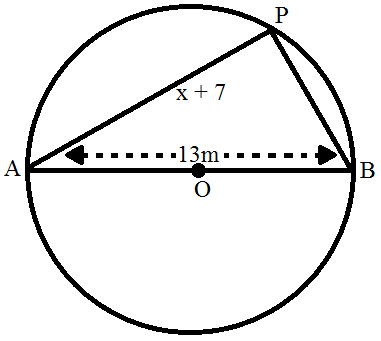
$ \Rightarrow(13)^2=x^2+(x+7)^2 $
$ \Rightarrow x^2+x^2+14 x+49=169 $
$ \Rightarrow 2 x^2+14 x+49-169=0 $
$ \Rightarrow 2 x^2+14 x-120=0 $
$ \left.\Rightarrow x^2+7 x-60=0 \text { (Dividing by } 2\right) $
$ \Rightarrow x^2+12 x-5 x-60=0 $
$ \Rightarrow x(x+12)-5(x+12)=0 $
$ \Rightarrow(x+12)(x-5)=0$
Either $x + 12 = 0,$ then $x = -12$ which is not possible being negative
Or $x - 5 = 0,$ then $x = 5$
P is at distance of $5\ m$ from $B$ and $5 + 7 = 12m$ from $A.$ View full question & answer→Question 174 Marks
A two-digit number is such that the product of digit is $12$. When $36$ is added to the number the digits interchange their places. Determine the number.
AnswerLet the tens digit be x then, the unit digits $=\frac{12}{\text{x}}$
Therefore, number $=\Big(10\text{x}+\frac{12}{\text{x}}\Big)$
And number obtained interchanging the digits $=\Big(10\times\frac{12}{\text{x}}+\text{x}\Big)$
Then according to question
$\Big(10\text{x}+\frac{12}{\text{x}}\Big)+36 =\Big(10\times\frac{12}{\text{x}}+\text{x}\Big)$
$\Big(10\text{x}+\frac{12}{\text{x}}\Big)+36=\Big(\frac{120}{\text{x}}+\text{x}\Big)$
$\Big(10\text{x}+\frac{12}{\text{x}}\Big)-\Big(\frac{120}{\text{x}}+\text{x}\Big)+36=0$
$\frac{(10\text{x}^2+12)-(120+\text{x}^2)+36\text{x}}{\text{x}}=0$
$10\text{x}^2+12-120-\text{x}^2+36\text{x}=0$
$9(\text{x}^2+4\text{x}-12)=0$
$\text{x}^2-2\text{x}+6\text{x}-12=0$
$\text{x}(\text{x}-2)+6(\text{x}-2)=0$
$(\text{x}-2)(\text{x}+6)=0$
$(\text{x}-2)=0$
$\text{x}=2$
Or $(\text{x}+6)=0$
$\text{x}=-6$
So, the digit can never be negative.
Therefore,
When $x = 2$ then unit digits
$=\frac{12}{\text{x}}$
$=\frac{12}{2}$
$=6$
And number
$=\Big(10\text{x}+\frac{12}{\text{x}}\Big)$
$=(10\times2+6)$
$=26$
Thus, the required number be $26$
View full question & answer→Question 184 Marks
Find the value of k for which root are real and equal in the following equations:
$x^2- 2(5 + 2k)x + 3(7 + 10k) = 0$
AnswerThe given quadric equation is $x^2- 2(5 + 2k)x + 3(7 + 10k) = 0,$ and roots are real and equal
Then find the value of k.
Here,$a = 1, b = -2(5 + 2k)$ and $c = 3(7 + 10k)$
As we know that $D = b^2- 4ac$
Putting the value of $a = 1, b = -2(5 + 2k)$ and, $c = 3(7 + 10k)$
$= (-2(5 + 2k))^2- 4 × 1 × 3(7 + 10k)$
$= 4(25 + 20k + 4k^2) - 12(7 + 10k)$
$= 100 + 80k + 16k^2- 84 - 120k$
$= 16 - 40k + 16k^2$
The given equation will have eqal and equal roots, if $D = 0$
Thus, $16 - 40k + 16k^2= 0$
$8(2k^2- 5k + 2) = 0$
$(2k^2- 5k + 2) = 0$
Now factorizing of the above equation
$(2k^2- 5k + 2) = 0$
$2k^2- 4k - k + 2 = 0$
$2k (k - 2) - 1(k - 2) = 0$
So, either $(k - 2) = 0$
$k = 2$
$(2k - 1) = 0$
$\text{k}=\frac{1}{2}$
therefore, the value of $\text{k}=2,\frac{1}{2}$
View full question & answer→Question 194 Marks
Solve the following quadratic equations by factorization:
$\frac{\text{x}+1}{\text{x}-1}+\frac{\text{x}-2}{\text{x}+2}=4-\frac{2\text{x}+3}{\text{x}-2},$ $\text{x}\neq1,-2,2$
Answer$\Rightarrow\frac{\text{x}+1}{\text{x}-1}+\frac{\text{x}-2}{\text{x}+2}=4-\frac{2\text{x}+3}{\text{x}-2}$
$\Rightarrow\frac{(\text{x}+1)(\text{x}+2)+(\text{x}-1)(\text{x}-2)}{(\text{x}-1)(\text{x}+2)}$
$=\frac{4(\text{x}+2)-(2\text{x}+3)}{\text{x}+2}$
$\Rightarrow\frac{(\text{x}^2+2\text{x}+\text{x}+2)+(\text{x}^2-2\text{x}-\text{x}+2)}{\text{x}^2+\text{x}-2}$
$=\frac{4\text{x}-8-2\text{x}-3}{\text{x}-2}$
$\Rightarrow\frac{\text{x}^2+3\text{x}+2+\text{x}^2-3\text{x}+2}{\text{x}^2+\text{x}-2}=\frac{2\text{x}-11}{\text{x}-2}$
$\Rightarrow\frac{2\text{x}^2+4}{\text{x}^2+\text{x}-2}=\frac{2\text{x}-11}{\text{x}-2}$
$ \Rightarrow 2 x^3-4 x^2+4 x-8=2 x^3+2 x^2-4 x-11 x^2-11 x+22 $
$ \Rightarrow 2 x^3-4 x^2+4 x-8=2 x^3-9 x^2-15 x+22 $
$ \Rightarrow 2 x^3-2 x^3-4 x^2+9 x^2+4 x+15 x-8-22=0 $
$ \Rightarrow 5 x^2+19 x-30=0 $
$ \Rightarrow 5 x^2+25 x-6 x-30=0 $
$ \Rightarrow 5 x(x+5)-6(x+5)=0 $
$ \Rightarrow(5 x-6)(x+5)=0 $
$ \Rightarrow 5 x-6=0, x+5=0$
$\Rightarrow\text{x}=\frac{6}{5},$ $x = -5$
View full question & answer→Question 204 Marks
Find the value of k for which the quadratic equation $(3k + 1)x^2+ 2(k + 1)x + 1 = 0$ has equal roots. Also, find the roots.
Answer$(3 k+1) x^2+2(k+1) x+1=0$
Here, $a=(3 k+1), b=2(k+1), c=1$
Now, $\mathrm{b}^2-4 \mathrm{ac}$
$ =[2(k+1)]^2-4 \times(3 k+1) \times 1 $
$ =4\left(k^2+2 k+1\right)-4(3 k+1) $
$ =4 k^2+8 k+4-12 k-4 \mid $
$ =4 k^2-4 k$
$\because$ Roots are real and equal,
$\therefore b^2- 4ac = 0$
$ \Rightarrow 4 \mathrm{k}^2-4 \mathrm{k}=0 $
$ \Rightarrow \mathrm{k}^2-\mathrm{k}=0 $
$ \Rightarrow \mathrm{k}^2-\mathrm{k}=0 $
$ \Rightarrow \mathrm{k}(\mathrm{k}-1)=0$
Either $k = 0$ or $k - 1 = 0$, then $k = 1$
$\therefore k = 0, 1$
When $k = 0,$
$ \text { Then, }(3 \times 0+1) x^2+2(0+1) x+1=0 $
$ \Rightarrow x^2+2 x+1=0 $
$ \Rightarrow(x+1)^2=0 $
$ \Rightarrow x+1=0$
$\therefore x = -1$
When $k = 1,$
$ \text { Then, }(3 \times 1+1) x^2+2(1+1) x+1=0 $
$ \Rightarrow 4 x^2+4 x+1=0 $
$ \Rightarrow(2 x+1)^2=0 $
$ \Rightarrow 2 x+1=0 $
$ \Rightarrow 2 x=-1$
$\Rightarrow\text{x}=\frac{-1}{2}$
$\therefore\text{x}=1,\frac{-1}{2}$
View full question & answer→Question 214 Marks
Solve the following quadratic equations by factorization:
$\frac{4}{\text{x}}-3=\frac{5}{2\text{x}+3},$ $\text{x}\neq-0,-\frac{3}{2}$
Answer$\frac{4}{\text{x}}-3=\frac{5}{2\text{x}+3}$
$\Rightarrow\frac{4-3\text{x}}{\text{x}}=\frac{5}{2\text{x}+3}$
$ \Rightarrow(4-3 x)(2 x+3)=5 x $
$ \Rightarrow 8 x+12-6 x^2-9 x=5 x $
$ \Rightarrow-6 x^2-6 x+12=0 $
$ \Rightarrow x^2+x-2=0 $
$ \Rightarrow x^2+2 x-x-2=0 $
$ \Rightarrow x(x+2)-1(x+2)=0 $
$ \Rightarrow(x-1)(x+2)=0 $
$ \Rightarrow x-1=0 \text { or } x+2=0 $
$ \Rightarrow x=1 \text { or } x=-2$
$\text { Hence, the factors are } 1 \text { and }-2$
View full question & answer→Question 224 Marks
Sum of the area of two squares is $400cm^2$. If the difference of their perimeters is $16\ cm$, find the sides of two squares.
AnswerLet the side of the smaller square be $x cm$
Perimeter of any square $= (4 \times $ side of the square)cm
It is given that the difference of the perimeters of two squares is $16\ cm$
Then side of the bigger square $=\frac{16+4\text{x}}{4}$
$= (4 + x)cm$
According to the question,
$ \Rightarrow x^2+(4+x)^2=400$
$ \Rightarrow x^2+16+x^2+8 x=400$
$ \Rightarrow 2 x^2+8 x-384=0$
$ \Rightarrow x^2+4 x-192=0$
$ \Rightarrow x^2+16 x-12 x-192=0$
$ \Rightarrow x(x+16)-12(x+16)=0$
$ \Rightarrow(x-12)(x+16)=0$
$ \Rightarrow x-12=0 \text { or } x+16=0$
$ \Rightarrow x=12 \text { or } x=-16$
Since, side of the square cannot be negative.
Thus, the side of the smaller square is $12\ cm$ and the side of the bigger square is $(4 + 12) = 16cm.$
View full question & answer→Question 234 Marks
Find two consecutive numbers whose squares have the sum $85.$
AnswerLet two consecutive numbers be X and $(x + 1)$
Then according to question $x^2+(x+1)^2=85$
$x^2+x^2+2 x+1=85$
$2 x^2+2 x-85+1=0$
$2 x^2+2 x-84=0$
$x^2+x-42=0$
$x^2+7 x-6 x-42=0$
$x(x+7)-6(x+7)=0$
$(x+7)(x-6)=0$
$(x+7)=0$
$x=-7$
$\text { or }(x-6)=0$
$x=6$
Since, x being a number,
Therefore,
When $x = -7$ then
$x + 1 = -7 + 1$
$x + 1 = -6$
And when $x = 6$ then
$x + 1 = 6 + 1$
$x + 1 = 7$
Thus, two consecutive number be either $6, 7$ or $-6, -7$
View full question & answer→Question 244 Marks
Solve the following quadratic equations by factorization:
$\frac{\text{x+3}}{\text{x}-2}-\frac{1-\text{x}}{\text{x}}=\frac{17}{4}$
AnswerWe have,
$\frac{\text{x+3}}{\text{x}-2}-\frac{1-\text{x}}{\text{x}}=\frac{17}{4}$
$\Rightarrow\frac{\text{x}(\text{x}+3)-(\text{x}-2)(1-\text{x})}{\text{x}(\text{x}-2)}=\frac{17}{4}$
$\Rightarrow\frac{\text{x}^2+3\text{x}-(\text{x}-\text{x}^2-2+2\text{x})}{\text{x}^2-2\text{x}}=\frac{17}{4}$
$\Rightarrow\frac{\text{x}^2+3\text{x}-\text{x}+\text{x}^2+2-2\text{x}}{\text{x}^2-2\text{x}}=\frac{17}{4}$
$\Rightarrow\frac{2\text{x}^2+2}{\text{x}^2-2\text{x}}=\frac{17}{4}$
$\Rightarrow 4\left(2 x^2+2\right)=17\left(x^2-2 x\right)$
$\Rightarrow 8 x^2+8=17 x^2-34 x$
$\Rightarrow 8 x^2+8=17 x^2-34 x$
$\Rightarrow(17-8) x^2-34 x-8=0$
$\Rightarrow 9 x^2-34 x-8=0$
${[9 x-8=-72 \Rightarrow-72=36 \times 2 \text { and }-34=-36+2]}$
$\Rightarrow 9 x^2-36 x+2 x-8=0$
$\Rightarrow 9 x(x-4)+2(x-4)=0$
$\Rightarrow(x-4)(9 x+2)=0$
$\Rightarrow(x-4)=0 \text { or } 9 x+2=0$
$\Rightarrow x=4 \text { or } x=\frac{-8}{2}$
$\therefore x = 4 $and $\text{x}=\frac{-8}{2}$ are the two roots of the given equation.
View full question & answer→Question 254 Marks
Solve the following quadratic equations by factorization:
$\frac{1}{\text{x}-3}+\frac{2}{\text{x}-2}=\frac{8}{\text{x}},$ $\text{x}\neq0, 2, 3$
Answer$\frac{1}{\text{x}-3}+\frac{2}{\text{x}-2}=\frac{8}{\text{x}}$
$\Rightarrow\frac{(\text{x}-2)+2(\text{x}-3)}{(\text{x}-3)(\text{x}-2)}=\frac{8}{\text{x}}$
$\Rightarrow\frac{\text{x}-2+2\text{x}-6}{\text{x}^2-2\text{x}-3\text{x}+6}=\frac{8}{\text{x}}$
$\Rightarrow\frac{3\text{x}-8}{\text{x}^2-5\text{x}+6}=\frac{8}{\text{x}}$
$ \Rightarrow x(3 x-8)=8\left(x^2-5 x+6\right)$
$ \Rightarrow 3 x^2-8 x=8 x^2-40 x+48$
$ \Rightarrow 5 x^2-32 x+48=0$
$ \Rightarrow 5 x^2-20 x-12 x+48=0$
$ \Rightarrow 5 x(x-4)-12(x-4)=0$
$ \Rightarrow(5 x-12)(x-4)=0$
$ \Rightarrow 5 x-12=0 \text { or } x-4=0$
$ \Rightarrow x=\frac{12}{5} \text { or } x=4$
Hence, the factors $4$ and $\frac{12}{5}$
View full question & answer→Question 264 Marks
Find the value of k for which the root are real and equal in the following equations:
$x^2- 2kx + 7k - 12 = 0$
Answer$\mathrm{x}^2-2 \mathrm{kx}+7 \mathrm{k}-12=0$
Here $\mathrm{a}=1, \mathrm{~b}=-2 \mathrm{k}, \mathrm{c}=(7 \mathrm{k}-12)$
$ \therefore \text { Discriminant }(D)=b^2-4 a c$
$ =(-2 k)^2-4 \times 1 \times(7 k-12)$
$ =4 k^2-4(7 k-12) $
$ =4 k^2-28 k+48$
$\because$ Roots are real and equal
$\therefore D=0$
$ \Rightarrow 4 k^2-28 k+48=0 $
$ \left.\Rightarrow k^2-7 k+12=0 \text { (Dividing by } 4\right) $
$ \Rightarrow k^2-3 k-4 k+12=0$
$\begin{Bmatrix}\because12=-3\times(-4)\\-7=-3-4\end{Bmatrix}$
$⇒ k(k - 3) - 4(k - 3) = 0$
$⇒ (k - 3)(k - 4) = 0$
Either $k - 3 = 0,$ then $k = 3$
or $k - 4 = 0,$ then $k = 4$
$\therefore k = 3, 4$
View full question & answer→Question 274 Marks
Divide $29$ into two parts so that the sum of the squares of the parts is $425.$
AnswerLet first numbers be x and other $(29 - x)$
Then according to question
$ x^2+(29-x)^2=425 $
$ x^2+x^2-58 x+841=425 $
$ 2 x^2-58 x+841=425 $
$ 2 x^2-58 x+841-425=0 $
$ 2 x^2-58 x+416=0 $
$ x^2-29 x+208=0 $
$ x^2-16 x-13 x+208=0 $
$ x(x-16)-13(x-16)=0 $
$ (x-16)(x+13)=0 $
$ (x-16)=0 $
$ x=16 $
$ \text { or }(x+13)=0 $
$ x=-13$
Since, $29$ beging a positive number, so x cannot be negative.
Therefore,
When $x = 16$ then
$29 - x = 29 - 16$
$29 - x = 13$
Thus, two consecutive number be $13, 16$
View full question & answer→Question 284 Marks
Find the roots of the following quadratic equation (if they exist) by the method of completing the square.
$4\text{x}^2+4\sqrt{3}\text{x}+3=0$
AnswerWe have been given that,
$4\text{x}^2+4\sqrt{3}\text{x}+3=0$
Now divide throughout by $4$ we get,
$\text{x}^2+\sqrt{3}\text{x}+\frac{3}{4}=0$
Now take the constant term to the $R.H.S$. and we get,
$\text{x}^2+\sqrt{3}\text{x}=-\frac{3}{4}$
Now add square of half of co-efficient of 'x' on both the sides. we have,
$\text{x}^2+2\Big(\frac{\sqrt{3}}{2}\Big)\text{x}+\Big(\frac{\sqrt{3}}{2}\Big)^2=\Big(\frac{\sqrt{3}}{2}\Big)^2-\frac{3}{4}$
$\text{x}^2+2\Big(\frac{\sqrt{3}}{2}\Big)\text{x}+\Big(\frac{\sqrt{3}}{2}\Big)^2=0$
$\Big(\text{x}+\frac{\sqrt{3}}{2}\Big)^2=0$
Since $R.H.S$. is a positive number, therefore the roots of the equation exist.
So, now take the square root on both the sides and we get,
$\text{x}+\frac{\sqrt{3}}{2}=0$
$\text{x}=-\frac{\sqrt{3}}{2}$
Now, we have the value of 'x' as
$\text{x}=-\frac{\sqrt{3}}{2}$
Also we have,
$\text{x}=-\frac{\sqrt{3}}{2}$
Therefore the roots of the equation are $\text{x}=-\frac{\sqrt{3}}{2}$ and $\text{x}=-\frac{\sqrt{3}}{2}$
View full question & answer→Question 294 Marks
The sum of ages of a man and his son is $45$ years. Five years ago, the product of their ages was four times the man's age at the time. Find their present ages.
AnswerLet the present age of the man be x years
Then present age of his son is $= (45 - x)$ years
Five years ago, man's age $= (x - 5)$ years
And his son's age $(45 - x - 5) = (40 - x)$ years
Then according to question,
$ (x-5)(40-x)=4(x-5) $
$ 40 x-x^2+5 x-200=4 x-20 $
$ -x^2+45 x-200=4 x-20 $
$ -x^2+45 x-200-4 x+20=0 $
$ -x^2+41 x-180=0 $
$ x^2-41 x+180=0 $
$ x^2-36 x-5 x+180=0 $
$ x(x-36)-5(x-36)=0 $
$ (x-36)(x-5)=0$
So, either
$(x - 5) = 0$
$x = 5$
But, the father's age never be $5$ years
Therefore, when $x = 36$ then
$45 - x = 45 - 36$
$45 - x = 9$
Hence, man's present age is $= 36$ years and his son's age is $= 9$ years.
View full question & answer→Question 304 Marks
The perimeter of a rectangular field is $82\ m$ and its area is $400m^2$. Find the breadth of the rectangle.
AnswerLet the breadth of the rectangle be $= x$ metres. Then
Perimeter $= 82$ metres
$2($length $+$ breadth$) = 82$
$($length $ + x) = 41$
length $= 41 - x$
And area of the rectangle
length $\times $ breadth $= 400$
$ (41-x) x=400$
$ 41 x-x^2=400$
$ x^2-41 x+400=0$
$ x^2-25 x-16 x+400=0$
$ x(x-25)-16(x-25)=0$
$ (x-25)(x-16)=0$
$ (x-25)=0$
$ x=25$
$ \text { Or }(x-16)=0$
$ x=16$
Since perimeter is $82$ meter. So breadth can't be $25$ meter.
Hence, breadth 16 metres.
View full question & answer→Question 314 Marks
Solve the following quadratic equations by factorization:
$(\text{x}-5)(\text{x}-6)=\frac{25}{(24)^2}$
AnswerWe have been given that,
$(\text{x}-5)(\text{x}-6)=\frac{25}{(24)^2}$
$\text{x}^2-11\text{x}+30-\frac{25}{576}=0$
$\text{x}^2-11\text{x}+\frac{17255}{576}=0$
$\text{x}^2-\frac{145}{24}\text{x}-\frac{119}{24}\text{x}+\frac{17255}{576}=0$
$\text{x}\Big(\text{x}-\frac{145}{24}\Big)-\frac{119}{24}\Big(\text{x}-\frac{145}{24}\Big)=0$
$\Big(\text{x}-\frac{119}{24}\Big)\Big(\text{x}-\frac{145}{24}\Big)=0$
Therefore,
$\text{x}-\frac{119}{24}=0$
$\text{x}=\frac{119}{24}$
or, $\text{x}-\frac{145}{24}=0$
$\text{x}=\frac{145}{24}$
Hence, $\text{x}=\frac{119}{24}=4\frac{23}{24}$ or $\text{x}=\frac{145}{24}=6\frac{1}{24}$
View full question & answer→Question 324 Marks
In the following, determine whether the given values are solution of the given equation or not:
$\text{x}^2-\sqrt{2}\text{x}-4=0,$ $\text{x}=-\sqrt{2},$ $\text{x}=-2\sqrt{2}$
Answer$\text{x}^2-\sqrt{2}\text{x}-4=0,$ $\text{x}=-\sqrt{2},$ $\text{x}=-2\sqrt{2}$
When, $\text{x}=-\sqrt{2}$
Substituting $\text{x}=-\sqrt{2}$
L.H.S.
$=\text{x}^2-\sqrt{2}\text{x}-4$
$=(-\sqrt{2})^2-\sqrt{2}(-\sqrt{2})-4$
$=2+2-4=0$
= R.H.S.
$\therefore\text{x}=-\sqrt{2}$ is its solution
When, $\text{x}=-2\sqrt{2}$
Substituting $\text{x}=-2\sqrt{2}$
L.H.S.
$=\text{x}^2-\sqrt{2}\text{x}-4$
$=(-2\sqrt{2})^2-\sqrt{2}(-2\sqrt{2})-4$
$=8+4-4$
$=8\neq\text{R.H.S}$
$\therefore\text{x}=-2\sqrt{2}$ is not its solution.
View full question & answer→Question 334 Marks
Rs.$ 9000$ were divided equally among a certain number of persons. Had there been $20$ more persons, each would have got Rs. $160$ less. Find the original number of persons.
AnswerTotal amount = Rs.$ 9000$
Let number of presons $= x$
Then each share $=\text{Rs.}\frac{9000}{\text{x}}$
Increased persons $= (x + 20)$
According to the condition,
$\frac{9000}{\text{x}}-\frac{9000}{\text{x}+20}=160$
$\Rightarrow\frac{9000\text{x}+180000-9000\text{x}}{\text{x}(\text{x}+20)}=160$
$\Rightarrow\frac{180000}{\text{x}^2+20\text{x}}=160$
$ \Rightarrow 160 x^2+3200 x=180000 $
$ \Rightarrow 160 x^2+3200 x-180000=0 $
$ \Rightarrow x 2+20 x-1125=0$
$\begin{Bmatrix}\because-1125=45\times(-25)\\20=45 - 25 \end{Bmatrix}$
$x^2+ 45x - 25x - 1125 = 0$
$x(x + 45) - 25(x + 45) = 0$
$(x + 45)(x - 25) = 0$
Either $x + 45 = 0$, then $x = -45$ which is not possible being negative or $x - 25 = 0$, then$ x = 25$
Number of persons $= 25$
View full question & answer→Question 344 Marks
Solve the following quadratic equations by factorization:
$\sqrt{3}\text{x}^2-2\sqrt{2}\text{x}-2\sqrt{3}=0$
Answer$\sqrt{3}\text{x}^2-2\sqrt{2}\text{x}-2\sqrt{3}=0$
Here, $\text{a}=\sqrt{3},\text{b}=-2\sqrt{2},\text{c}=-2\sqrt{3}$
$\text{D}=\text{b}^2-4\text{ac}$
$=\big(-2\sqrt{2}\big)^2-4\times\sqrt{3}\times\big(-2\sqrt{3}\big)$
$=8+24=32$
$\because\text{D}>0$
$\therefore$ The given equation has real roots,
$\text{x}=\frac{-\text{b}\pm\sqrt{\text{D}}}{2\text{a}}$
or $\frac{-\big(-2\sqrt{2}\big)\pm\sqrt{32}}{2\times\sqrt{3}}$
or $\text{x}=\frac{2\sqrt{2}\pm\sqrt{16\times2}}{2\sqrt{3}}$
$=\frac{2\sqrt{2}\pm4\sqrt{2}}{2\sqrt{3}}$
Either $\text{x}=\frac{2\sqrt{2}+4\sqrt{2}}{2\sqrt{3}}$ or $\text{x}=\frac{2\sqrt{2}-4\sqrt{2}}{2\sqrt{3}}$
$=\frac{6\sqrt{2}}{2\sqrt{3}}=\frac{3\sqrt{2}}{\sqrt{3}}$ or $=\frac{-2\sqrt{2}}{2\sqrt{3}}=\frac{-\sqrt{2}}{\sqrt{3}}$
$\Rightarrow\frac{3\sqrt{2}}{\sqrt{3}}\times\frac{\sqrt{3}}{\sqrt{3}}$ or $\frac{-\sqrt{2}}{\sqrt{3}}\times\frac{\sqrt{3}}{\sqrt{3}}$
$\Rightarrow\frac{3\sqrt{6}}{3}\text{ and }\frac{-\sqrt{6}}{3}$
$\Rightarrow\sqrt{6}\ \text{and}\ \frac{-\sqrt{6}}{3}$
$\therefore\text{x}=\sqrt{6}$ and $\frac{-\sqrt{6}}{3}$
View full question & answer→Question 354 Marks
Solve the following quadratic equations by factorization:
$\frac{3}{\text{x}+1}-\frac{1}{2}=\frac{2}{3\text{x}-1},$ $\text{x}\neq-1,\frac{1}{3}$
Answer$\frac{3}{\text{x}+1}-\frac{1}{2}=\frac{2}{3\text{x}-1}$
$\Rightarrow\frac{6-(\text{x}-1)}{2(\text{x}+1)}=\frac{2}{3\text{x}-1}$
$\Rightarrow\frac{6-\text{x}-1}{2\text{x}+2}=\frac{2}{3\text{x}-1}$
$ \Rightarrow(5-x)(3 x-1)=2(2 x+2)$
$ \Rightarrow 15 x-5-3 x^2+x=4 x+4$
$ \Rightarrow-3 x^2+16 x-5-4 x-4=0$
$ \Rightarrow-3 x^2+12 x+9=0$
$ \Rightarrow x^2-4 x+3=0$
$ \Rightarrow x^2-3 x-x+3=0$
$ \Rightarrow x(x-3)-1(x-3)=0$
$ \Rightarrow(x-1)(x-3)=0$
$ \Rightarrow x-1=0 \text { or } x-3=0$
$ \Rightarrow x=1 \text { or } x=3$
Hence, the factors are $3$ and $1$
View full question & answer→Question 364 Marks
An airplane left $50$ minutes later than its scheduled time, and in order to reach the destination, $1250\ km$ away, in time, it had to increase its speed by $250\ km/hr$ from its usual speed. Find its usual speed.
AnswerLet the usual speed of the plane be $x km/hr$
Distance coverred by the plane $= 1250\ km$
Time taken by the plane with usual speed $=\frac{1250}{\text{x}}=\text{ hrs.}$
To cover the delay of $50$ minutes, the speed of the plane is increased by $250\ km/hr$
Now,
Speed of plane after increasing $= (x + 250)$ km/hr and
Time taken by the plane with increased speed $=\frac{1250\text{ km}}{\text{(x}+250)\text{km/hr}}=\frac{1250}{\text{x}+250}\text{hr}$
From the data we have,
$\frac{1250}{\text{x}}\text{hr}-\frac{1250}{\text{x}+250}\text{hr}=50\text{ min}$
$\Rightarrow1250\text{ hr}\Big(\frac{1}{\text{x}}-\frac{1}{\text{x}+250}\Big)$ $=\frac{50}{60}\text{hr}[\because1\text{hr}=60\text{min}]$
$\Rightarrow250\Big(\frac{\text{x}+250-\text{x}}{\text{x}(\text{x}+250}\Big)=\frac{1}{6}$
$\Rightarrow 250 \times 250 \times 6=x(x+250) \times 1$
$ \Rightarrow 375000=x^2+250 x$
$ \Rightarrow x^2+250 x-375000=0$
$ \Rightarrow x^2+(750-500) x+(750 \times-500)=0$
$ \Rightarrow x^2+750 x-500 x+(750 \times-500)=0$
$ \Rightarrow(x+750)(x-500)=0$
$ \Rightarrow(x-500)=0 \text { or } x=500$
Since, speed cannol be a negative value. So, $x = 500$
$\therefore$ The usual speed of the plane $= 500 \ km/hr.$
View full question & answer→Question 374 Marks
A plane left $40$ minutes late due to bad weather and in order to reach its destination, $1600\ km$ away in time, it had to increase its speed by $400\ km/hr$ from its usual speed. Find the usual speed of the plane.
AnswerDistance $= 1600\ km$
Let usual speed of the plance $= x km/hr$
Increased speed $= (x + 400) km/hr$
According the condition,
$\Rightarrow\frac{1600}{\text{x}}-\frac{1600}{\text{x}+400}\\=\frac{40}{60}=\frac{2}{3}$
$\Rightarrow\frac{1600\text{x}+640000-1600\text{x}}{\text{x}(\text{x}+400)}=\frac{2}{3}$
$\Rightarrow\frac{640000}{\text{x}^2+400\text{x}}=\frac{2}{3}$
$ \Rightarrow 2 x^2+800 x=1920000 $
$ \left.\Rightarrow x^2+400 x-960000=0 \text { (Dividing by } 2\right)$
$ \Rightarrow x^2+1200 x-800 x-960000=0$
$\begin{cases}\because-960000\\=1200\times(-800)\\400=1200-800\end{cases}$
$⇒ x(x + 1200) - 800(x + 1200) = 0$
$⇒ (x + 1200)(x - 800) = 0$
Either $x + 1200 = 0,$ then $x = 0 - 1200$ which
is not possible being negative or $x - 800 = 0,$ then $x = 800$
Usual speed of the plane $= 800km/hr$
View full question & answer→Question 384 Marks
The sum of the squares of three consecutive natural number is $149$. Find the numbers.
AnswerLet three consecutive integer be $x, (x + 1)$ and $(x + 2)$
Then according to question,
$ x^2+(x+1)^2+(x+2)^2=149$
$ x^2+x^2+2 x+1+x^2+4 x+4=149$
$ 3 x^2+6 x+5-149=0$
$ 3 x^2+6 x-144=0$
$ 3 x^2+6 x-144=0$
$ 3 x^2+6 x-144=0$
$ 3\left(x^2+2 x-48\right)=0$
$ x^2+2 x-48=0$
$ x^2+8 x-6 x-48=0$
$ x(x+8)-6(x+8)=0$
$ (x+8)(x-6)=0$
$ (x+8)=0$
$ x=-8$
$ \text { Or }(x-6)=0$
$ x=6$
Since, x being a positive number, so x cannot be negative.
Therefore,
When x = 6 then other positive integer
$x + 1 = 6 + 1$
$x + 1 = 7$
And, $x + 2 = 6 + 2$
$x + 2 = 8$
Thus, three consecutive positive integer be $6, 7, 8$
View full question & answer→Question 394 Marks
Is it possible to design a rectangular mango grove whose length is twice its breadth and the area is $800m^2$? If so, find its length and breadth.
AnswerLet the breadth of the rectangular mango grove be x meter.
Given that length is twice that of breadth,
lengrh $= 2 \times xm$
Given that area of the grove is $800m^2$.
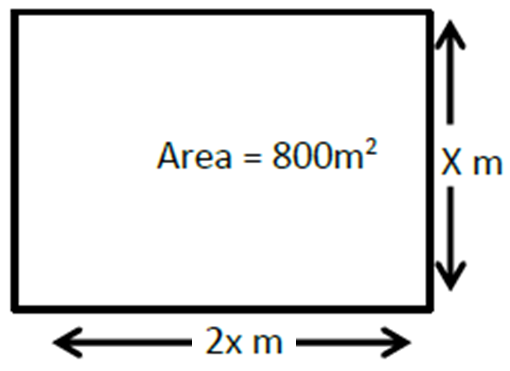
But we know that
Area of a rectangle = length $\times $ breadth
$ \Rightarrow 800 \mathrm{~m}^2=2 \mathrm{xm} \times \mathrm{xm} $
$ \Rightarrow 2 \mathrm{x}^2=800$
$\Rightarrow \mathrm{x}^2=400$
$\Rightarrow\text{x}=\sqrt{400}$
$\Rightarrow\text{x}=\sqrt{(20)^2}$
$\Rightarrow\text{x}\pm20$
Since, x cannot be a negative value
So,$ x = 20m$
Breadth of the manogo grove $= 20\ m$ and length of the mango grove
$= 2xm = 2 × 20m = 40m$
Yes. It is possible to dising a rectangular mango grove whose length is twice its breadth and the area is $800m^3$. View full question & answer→Question 404 Marks
A train, travelling at a uniform speed for $360\ km$, would have taken $48$ minutes less to travel the same distance if its speed were $5\ km/hr $ more. Find the original speed of the train.
AnswerLet the original speed of the train $= x km/h$
Then, the increased speed of the train $= (x + 5)$ km/h [by given condition]
and distance $= 360\ km$
According to the question,
$\frac{360}{\text{x}}-\frac{360}{\text{x}+5}=\frac{4}{5}$
$\begin{bmatrix}\because\text{Time}=\frac{\text{Distance}}{\text{Speed}}\\ \text{and }48 \text{ min}=\frac{48}{60}\text{h}=\frac{4}{5}\text{h}\end{bmatrix}$
$\Rightarrow\frac{360(\text{x}+5)-360\text{x}}{\text{x}(\text{x}+5)}=\frac{4}{5}$
$\begin{bmatrix}\because48\text{ min}=\frac{48}{60}\text{h}\\=\frac{4}{5}\text{h}\end{bmatrix}$
$\Rightarrow\frac{360\text{x}+1800-360\text{x}}{\text{x}^2+5\text{x}}=\frac{4}{5}$
$\Rightarrow\frac{1800}{\text{x}^2+5\text{x}}=\frac{4}{5}$
$\Rightarrow\text{x}^2+5\text{x}=\frac{1800\times5}{4}\\=2250$
$\Rightarrow\text{x}^2+5\text{x}-2250=0$
$\Rightarrow\text{x}^2+(50\text{x}-45\text{x})-2250=0$
$\Rightarrow\text{x}^2+50\text{x}-45\text{x}-2250=0$ [by factoris method]
$\Rightarrow\text{x}(\text{x}+50)-45(\text{x}+50)=0$
$\Rightarrow(\text{x}+50)(\text{x}-45)=0$
Now, $\text{x}+50=0$
$\Rightarrow\text{x}=-50$
Which is not possible because speed cannot be negative
and $\text{x}-45=0$
$\Rightarrow\text{x}=45$
Hence, the original speed of the train $= 45\ km/h$
View full question & answer→Question 414 Marks
Solve the following quadratic equations by factorization:
$ 9 x^2-6 b^2 x-\left(a^4-b^4\right)=0 $
Answer$ 9 x^2-6 b^2 x-\left(a^4-b^4\right)=0 $
$ \Rightarrow 9 x^2-6 b^2 x-\left(a^2-b^2\right)\left(a^2+b^2\right)=0 $
$ \Rightarrow 9 x^2+3\left(a^2-b^2\right) x-3\left(a^2+b^2\right) x-\left(a^2-b^2\right)\left(a^2+b^2\right)=0 $
$ \Rightarrow 3 x\left[3 x+\left(a^2-b^2\right)\right]-\left(a^2+b^2\right)\left[3 x+\left(a^2-b^2\right)\right]=0 $
$ \Rightarrow\left[3 x+\left(a^2-b^2\right)\right]\left[3 x-\left(a^2+b^2\right)\right]=0 $
$ \Rightarrow 3 x+\left(a^2-b^2\right)=0 \text { or } 3 x-\left(a^2-b^2\right)=0 $
$ 3 x=b^2-a^2 \text { or } 3 x=a^2+b^2$
$\Rightarrow\text{x}=\frac{\text{b}^2 -\text{a}^2}{3}$ or $\text{x}=\frac{\text{a}^2 +\text{b}^2}{3}$
$\Rightarrow\text{x}=\frac{\text{a}^2 -\text{b}^2}{3}$ or $\text{x}=\frac{\text{b}^2 -\text{a}^2}{3}$
Hence, the factors are $\frac{\text{a}^2 -\text{b}^2}{3}$ and $\frac{\text{b}^2 -\text{a}^2}{3}$
View full question & answer→Question 424 Marks
If the roots of the equation $(\mathrm{b}-\mathrm{c}) \mathrm{x}^2+(\mathrm{c}-\mathrm{a}) \mathrm{x}+(\mathrm{a}-\mathrm{b})=0$ are equal, then prove that $2b = a + c.$
AnswerThe given quadric equation is $(\mathrm{b}-\mathrm{c}) \mathrm{x}^2+(\mathrm{c}-\mathrm{a}) \mathrm{x}+(\mathrm{a}-\mathrm{b})=0$, and roots are real.
Then prove that $2 b=a+c$
Here, $\mathrm{a}=(\mathrm{b}-\mathrm{c}), \mathrm{b}=(\mathrm{c}-\mathrm{a})$ and $\mathrm{c}=(\mathrm{a}-\mathrm{b})$
As we know that $D=b^2-4 a c$
Putting the value of $a=(b-c), b=(c-a)$ and $c=(a-b)$
$D=b^2-4 a c $
$ =(c-a)^2-4 \times(b-c) \times(a-b) $
$ =c^2-2 c a+a^2-4\left(a b-b^2-c a+b c\right) $
$ =c^2-2 c a+a^2-4 a b+4 b^2+4 c a-4 b c $
$ =c^2+2 c a+a^2-4 a b+4 b^2-4 b c $
$ =a^2+4 b^2+c^2+2 c a-4 a b-4 b c$
As we know that $\left(a^2+4 b^2+c^2+2 c a-4 a b-4 b c\right)=(a+c-2 b)^2$
$D=(a+c-2 b)^2$
The given equation will have real roots, if $D=0$
$(a+c-2 b)^2$
Square root both side we get
$\sqrt{(\text{a}+\text{c}-2\text{b})^2}=0$
$a + c - 2b = 0$
$a + c = 2b$
Hence $2b = a + c$
View full question & answer→Question 434 Marks
Solve the following quadratic equations by factorization:
$3\Big(\frac{7\text{x}+1}{5\text{x}-3}\Big)-4\Big(\frac{5\text{x}-3}{7\text{x}+1}\Big)=11,$ $\text{x}\neq\frac{3}{5},-\frac{1}{7}$
Answer$\Rightarrow3\Big(\frac{7\text{x}+1}{5\text{x}-3}\Big)-4\Big(\frac{5\text{x}-3}{7\text{x}+1}\Big)=11$
$\Rightarrow\frac{3(7\text{x}+1)^2-4(5\text{x}-3)^2}{(5\text{x}-3)(7\text{x}+1)}=11$
$\Rightarrow\frac{3(49\text{x}^2+1+14\text{x})-4(25\text{x}^2+9-30\text{x})}{35\text{x}^2+5\text{x}-21\text{x}-3}=11$
$\Rightarrow\frac{147\text{x}^2+3+42\text{x}-100\text{x}^2-36+120\text{x}}{35\text{x}^2-16\text{x}-3}=11$
$\Rightarrow47\text{x}^2+162\text{x}-33\\=11(35\text{x}^2-16\text{x}-3)$
$\Rightarrow47\text{x}^2+162\text{x}-33\\=385\text{x}^2-176\text{x}-33$
$\Rightarrow385\text{x}^2-47\text{x}^2-176\text{x}\\-162\text{x}-33+33=0$
$\Rightarrow338\text{x}^2-338\text{x}=0$
$\Rightarrow\text{x}^2-\text{x}=0$
$\Rightarrow\text{x}(\text{x}-1)=0$
$\Rightarrow\text{x}=0$ or $\text{x}-1=0$
$\Rightarrow\text{x}=0$ or $\text{x}=1$
Hence, the factors are $0$ and $1.$
View full question & answer→Question 444 Marks
The sum of the reciprocals of Rehman's ages (in years) $3$ years ago and $5$ years from now is $\frac{1}{3}.$ Find his present age.
AnswerLet the present age of Rehman be x years.
Now, Rehman's age $3$ years ago $= (x - 3)$ years
And Rehman's $5$ years later $= (x + 5)$ years
Gievn that,
The sum of reciprocals of Rehman's ages $3$ years ago and $5$ years later is $\frac{1}{3}.$
$\Rightarrow\frac{1}{\text{x}-3}+\frac{1}{\text{x}+5}=\frac{1}{3}$
$\Rightarrow\frac{\text{x}+5+\text{x}-3}{(\text{x}-3)(\text{x}+5)}=\frac{1}{3}$
$ \Rightarrow(2 x+2) \times 3=1(x-3)(x+5) $
$ \Rightarrow 6 x+6=x^2+5 x-3 x-15 $
$ \Rightarrow x^2+2 x-6 x-15-6=0 $
$ \Rightarrow x^2-4 x-21=0 $
$ \Rightarrow x^2-7 x+3 x-21=0 $
$ \Rightarrow x(x-7)+3(x-7)=0 $
$ \Rightarrow(x-7)(x+3)=0 $
$ \Rightarrow x-7=0 \text { or } x+3=0 $
$ \Rightarrow x=7 \text { or } x=-3$
Since, age cannot be in negative value. So, $x = 7$ years
Hence, the present age of Rehman is $7$ years.
View full question & answer→Question 454 Marks
Solve the following quadratic equations by factorization:
$\frac{\text{x}-4}{\text{x}-5}+\frac{\text{x}-6}{\text{x}-7}=\frac{10}{3},$ $\text{x}\neq5,-7$
Answer$\frac{\text{x}-4}{\text{x}-5}+\frac{\text{x}-6}{\text{x}-7}=\frac{10}{3}$
$\Rightarrow\frac{(\text{x}-4)(\text{x}-7)+(\text{x}-6)(\text{x}-5)}{(\text{x}-5)(\text{x}-7)}=\frac{10}{3}$
$\Rightarrow\frac{\text{x}^2-11\text{x}+28+\text{x}^2-11\text{x}+30}{\text{x}^2-12\text{x}+35}=\frac{10}{3}$
$\Rightarrow\frac{2\text{x}^2-22\text{x}+58}{\text{x}^2-12\text{x}+35}=\frac{10}{3}$
$ \Rightarrow 3\left(2 x^2-22 x+58\right)=10\left(x^2-12 x+35\right) $
$ \Rightarrow 6 x^2-66 x+174=10 x^2-120 x+350 $
$ \Rightarrow 4 x^2-54 x+176=0 $
$ \Rightarrow 2 x^2-27 x+88=0 $
$ \Rightarrow 2 x^2-11 x-16 x+88=0 $
$ \Rightarrow x(2 x-11)-8(2 x-11)=0 $
$ \Rightarrow(x-8)(2 x-11)=0 $
$ \Rightarrow x-8=0 \text { or } 2 x-11=0$
$⇒ x = 8$ or $\text{x}=\frac{11}{2}$
Hence, the factors are 8 and $\frac{11}{2}$
View full question & answer→Question 464 Marks
Solve the following quadratic equations by factorization:
$4\sqrt{3}\text{x}^2+5\text{x}-2\sqrt{3}=0$
AnswerWe have been given
$4\sqrt{3}\text{x}^2+5\text{x}-2\sqrt{3}=0$
$4\sqrt{3}\text{x}^2+8\text{x}-3\text{x}-2\sqrt{3}=0$
$4\text{x}\big(\sqrt{3}\text{x}+2\big)-\sqrt{3}\big(\sqrt{3}\text{x}+2\big)=0$
$\big(\sqrt{3}\text{x}+2\big)\big(4\text{x}-\sqrt{3}\big)=0$
Therefore,
$\sqrt{3}\text{x}+2=0$
$\sqrt{3}\text{x}=-2$
$\text{x}=\frac{-2}{\sqrt{3}}$
or, $4\text{x}-\sqrt{3}=0$
$4\text{x}=\sqrt{3}$
$\text{x}=\frac{\sqrt{3}}{4}$
Hence, $\text{x}=\frac{-2}{\sqrt{3}}$ or $\text{x}=\frac{\sqrt{3}}{4}$
View full question & answer→Question 474 Marks
Find the roots of the following quadratic equation (if they exist) by the method of completing the square.
$2\text{x}^2-7\text{x}+3=0$
Answer$2\text{x}^2-7\text{x}+3=0$
$\text{x}^2-\frac{7}{2}\text{x}+\frac{3}{2}=0$ (Dividing by 2)
$(\text{x}^2)-2\times\frac{7}{4}\times\text{x}+\Big(\frac{7}{4}\Big)^2-\frac{25}{16}=0$
$\begin{cases}\frac{3}{2} = \frac{49}{16}-\frac{25}{16}=\frac{24}{16}\end{cases}$
$\Rightarrow\Big(\text{x}-\frac{7}{4}\Big)^2=\frac{25}{16}=\Big(\pm\frac{5}{4}\Big)^2$
$\Rightarrow\text{x}-\frac{7}{4}=\pm\frac{5}{4}$
$\therefore\text{x}=\frac{7}{4}+\frac{5}{4}$
$\text{x}=\frac{12}{4}=3$
and $\text{x}=\frac{7}{4}-\frac{5}{4}$
$\text{x}=\frac{2}{4}=\frac{1}{2}$
$\therefore$ Roots are $3,\frac{1}{2}$
View full question & answer→Question 484 Marks
If the roots of the equation $ \left(c^2-a b\right) x^2-2\left(a^2-b c\right) x+b^2-a c=0 $ are equal, prove that either $a = 0$ or $a^3+ b^3+ c^3= 3abc.$
Answer$ \left(c^2-a b\right) x^2-2\left(a^2-b c\right) x+b^2-a c=0 $
$ \text { Here } A=c^2-a b, B=-2\left(a^2-b c\right), C=b^2-a c $
$ \therefore \text { Discriminant }(D)=B^2-4 A C $
$ =\left[-2\left(a^2-b c\right)\right]^2-4\left(c^2-a b\right)\left(b^2-a c\right) $
$ =4\left[a^4+b^2 c^2-2 a^2 b c\right]-4\left[b^2 c^2-a c^3-a b^3+a^2 b c\right] $
$ =4 a^4+4 b^2 c^2-8 a^2 b c-4 b^2 c^2+4 a c^3+4 a b^3-4 a^2 b c $
$ =4 a^4+4 a b^3+4 a c^3-12 a^2 b c $
$ =4 a\left[a^3+b^3+c^3-3 a b c\right]$
The roots are equal
$ \therefore D=0 $
$ \therefore 4 a\left(a^3+b^3+c^3-3 a b c\right)=0 $
$ \Rightarrow a\left(a^3+b^3+c^3-3 a b c\right)=0$
Either $\mathrm{a}=0$
or $a^3+b^3+c^3-3 a b c=0$
$\Rightarrow a^3+b^3+c^3=3 a b c$ Hence proved.
View full question & answer→Question 494 Marks
Solve the following quadratic equations by factorization:
$\frac{3}{\text{x}+1}+\frac{4}{\text{x}-1}=\frac{29}{4\text{x}-1},$ $\text{x}\neq-1,-1,\frac{1}{4}$
Answer$\frac{3}{\text{x}+1}+\frac{4}{\text{x}-1}=\frac{29}{4\text{x}-1}$
$\frac{3\text{x}-3+4\text{x}+4}{(\text{x}^2-1)}=\frac{29}{4\text{x}-1}$
$\Rightarrow\frac{7\text{x}+1}{\text{x}^2-1}=\frac{29}{4\text{x}-1}$
$ \Rightarrow(7 x+1)(4 x-1)=29\left(x^2-1\right)$
$ \Rightarrow 28 x^2-7 x+4 x-1=29 x^2-29$
$ \Rightarrow 29 x^2-29-28 x^2+7 x-4 x+1=0 $
$ \Rightarrow x^2+3 x-28=0$
$\begin{Bmatrix}\because-28=7\times(-4) \\3=7-4\end{Bmatrix}$
$⇒ x^2+ 7x - 4x - 28 = 0$
$⇒ x(x + 7) - 4(x + 7) = 0$
$⇒ (x + 7)(x - 4) = 0$
Either $x + 7 = 0,$ then $x = -7$
or $x - 4 = 0,$ then $x = 4$
$\therefore x = 4, -7$
View full question & answer→Question 504 Marks
Solve the following quadratic equations by factorization:
$\frac{\text{x}-3}{\text{x}+3}-\frac{\text{x}+3}{\text{x}-3}=\frac{48}{7},$ $\text{x}\neq3,\text{x}\neq-3$
Answer$\frac{\text{x}-3}{\text{x}+3}-\frac{\text{x}+3}{\text{x}-3}=\frac{48}{7}$
$\Rightarrow\frac{\text{x}-3}{\text{x}+3}-\frac{\text{x}+3}{\text{x}-3}=\frac{48}{7}$
$\Rightarrow\frac{(\text{x}-3)^2-(\text{x}+3)^2}{(\text{x}+3)(\text{x}-3)}=\frac{48}{7}$
$\Rightarrow\frac{\text{x}^2-6\text{x}+9-\text{x}^2-6\text{x}-9}{\text{x}^2-9}=\frac{48}{7}$
$\Rightarrow\frac{-12\text{x}}{\text{x}^2-9}=\frac{48}{7}$
$\Rightarrow 48 x^2+84 x-432=0 $
$ \left.\Rightarrow 4 x^2+7 x-36=0 \text { (Dividing by } 12\right) $
$\Rightarrow 4 x^2+16 x-9 x-36=0$
$\begin{cases}\because36\times4=-144\\\therefore-144=16\times-9\\7=16-9\end{cases}$
$⇒ 4x(x + 4) - 9(x + 4) = 0$
$⇒ (x + 4)(4x - 9) = 0$
Either $x + 4 = 0,$ then $x = -4$
or $4x - 9 = 0,$ then $4x = 9$
$\Rightarrow\text{x}=\frac{9}{4}$
$\therefore$ Roots are -4, $\frac{9}{4}$
View full question & answer→